
This article is intended for anyone interested in learning about residential ceiling fans.
Quick Facts
- Ceiling fans are appliances wrapped decoratively with unique housings in a variety of finishes, and they often feature furniture-grade blades and accessories.
- During the summer, use of a ceiling fan allows for raising the home's thermostat setting by 4°F without feeling a difference in comfort.
- Even during the winter, most ceiling fans help when operated in the reverse direction by forcing warm air near the ceiling down into the living space of the residence.
- Ceiling fan/light combo kits that have earned the ENERGY STAR label are about 60% more efficient than conventional fan/light units.
Terms to Help You Get Started
- Downrod: Extension rod that allows you to set the fan at the proper height from your ceiling for optimum performance
- CFM: Cubic feet per minute
- CFM/watt: Cubic feet per minute/watt measures air flow efficiency for ceiling fans; the higher the number, the more efficient the unit.
- UL: Underwriters Laboratories
Can ceiling fans lower my utility bill?
One of the myths about ceiling fans is that they lower the temperature in a room. Actually, ceiling fans do not lower room temperature. However, they do create a breeze, making room occupants feel cooler and more comfortable. When a ceiling fan is operating, you can usually raise the thermostat setting by up to four degrees during the cooling season with no reduction in comfort. Increasing the room temperature by even two degrees can cut your cooling costs by at least 4%–6%, and in some cases by as much as 8%.
Should I leave ceiling fans running all the time?
No, because fans cool people, not rooms. Ceiling fans are less costly than air conditioning, but they still use electricity. Operating several fans 24 hours a day can add up quickly, especially if no one (or animal) is home to benefit from them. Operate the fan only when someone (or an animal) is in the room.
What features should I consider?
Correct Sizing
For maximum efficiency, choose a ceiling fan that is the right size for the room. See Table 1 for the guidelines suggested by the American Lighting Association:
Motors
To ensure long life and quiet operation, purchase fans with motor housings constructed with heavier materials, such as die-cast metal. These models tend to produce less vibration and provide better stability for downrods. Also look for models with heavy-duty windings, precision-engineered ball bearings, and shock-absorbent internal components.
Performance-grade fans are designed for continuous, quiet operation. They use larger, more powerful motors, and are generally the most expensive models. Medium-grade models are designed to operate 12 hours or fewer per day, and economy models are designed to operate 8 hours or fewer per day. You will have to do some research to determine fan grades. Check manufacturer's websites for information.
Motors come either with sealed and lubricated ball bearings, which require little or no maintenance, or with bearings that operate in an oil bath, which will occasionally require you to add oil.
Three-speed motors are recommended for maximum comfort. Most fans (and all ENERGY STAR–qualified models) can reverse direction via an external switch on the motor housing, so that they can move warm air (which rises up to the ceiling) down into the room's living space during cooler months.
Blades
Blades should be sealed or finished to prevent moisture-caused damage such as warping, peeling, or tarnishing, especially if the fan will be used in a high-humidity situation. More blades do not necessarily move more air. The pitch (angle of the fan's blades), balance of the blades, length of the blades, motor design, motor speed, number of blades, etc., are all important in determining how much air a fan can move.
Sound
Try the fan out in the store using all settings to determine how loud it is. If it is too noisy, try a different brand, or a model with blades made of a different material.
Types of Ceiling Fans
Ceiling Fan
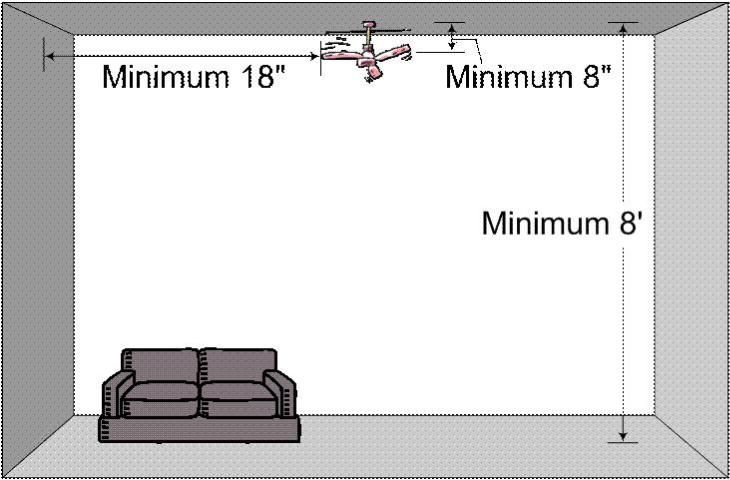
Ceiling fans are hung from the ceiling with rotating fan blades. The shortest point of the fan blade should be no fewer than 8 inches from the ceiling.
Hugger Ceiling Fan
Hugger ceiling fans have the shortest point of the fan blade equal to or less than 10 inches from the ceiling. Hugger ceiling fans application is installed on low ceilings.
Warranty
Warranty can differ from manufacture. Several manufacturers offer limited or lifetime warranties on their products and in-home services. However, qualifying products should offer 30 years for the motor and a minimum of one year for all other parts.
Ceiling Fans with Light Kits
Ceiling fans with light kits are available in three different formats: (1) incorporated into the fan, (2) can be included when purchased with the fan, (3) or can be sold separately. When light kits are sold separately, most of the time they are considered universal and adaptable to the ceiling fan model. However, most of the time they are compatible between the ceiling fan and the light kits within the same brand. Review product packaging for further information on compatibility.
Can I install a ceiling fan in any room?
The Energy Efficiency and Renewable Energy (EERE) program at the US Department of Energy indicates that for best performance, ceiling fans should only be installed in rooms where ceilings are 8 feet or higher. They also recommend installing ceiling fans so that the blades are no fewer than 8 inches from the ceiling and at least 18 inches from any given wall (Figure 1).
Credit: Image created by Hyun-Jeong Lee in Microsoft Office Visio. Converted to .GIF by IFAS Communication Services.
Do fan/light combination units save energy?
Fan/light units labeled with the ENERGY STAR logo (Figure 2) are about 60% more efficient than standard fan/light units. This can save on utility bills (in addition to the heating and cooling savings gained by operating the fan properly, as described previously). Lights can also be purchased separately as an add-on to a ceiling fan. Most fans accept add-on light kits, though a number of them are only compatible within brands. Check the package for compatibility information. Separately sold ceiling-fan light kits should be labeled ENERGY STAR when considering energy efficiency.
Credit: Courtesy of https://www.energystar.gov
Note that the Environmental Protection Agency (EPA) has a designation ENERGY STAR Most Efficient 2019 (Figure 3). This label recognizes products that deliver cutting-edge energy efficiency along with the latest in technological innovation. The year included on the label designates that the device or appliance meets the criteria for the year indicated. Ceiling fans are one of several appliances or devices that have units meeting these criteria. If interested, begin your search at https://www.energystar.gov/products/most_efficient.
Credit: Courtesy of https://www.energystar.gov
Can I use a fan in damp areas?
If you're installing a fan in a bathroom or other humid location, make sure it is UL-listed with a "damp" rating. If you are mounting a fan where it may come into direct contact with water (e.g., a porch or patio), be sure it has a UL "wet" rating. These fans have features such as sealed or moisture-resistant motors, rust-resistant housings, stainless steel hardware, and all-weather blades (ENERGY STAR, n.d-a).
What are the current ENERGY STAR ceiling fan specifications?
The following ENERGY STAR ceiling fan specifications became effective April 1, 2012 (https://www.energystar.gov/products/lighting_fans/ceiling_fans/ceiling_fans_key_product_criteria):
To help you evaluate different ceiling fans with lighting for purchase, click on the savings calculator link at https://www.energystar.gov/products/ceiling_fans.
The US Department of Energy (DOE) has federal design and test procedures for residential ceiling fans (see https://www1.eere.energy.gov/buildings/appliance_standards/standards.aspx?productid=5) and energy conservation standards for ceiling-fan light kits, which were corrected in March 2019 (see https://www.federalregister.gov/documents/2019/03/08/2019-04244/energy-conservation-program-energy-conservation-standards-for-ceiling-fan-light-kits-correction).
References and Resources
American Lighting Association. (n.d.). Selecting a ceiling fan. Retrieved December 2022, from https://alalighting.com/Lighting-Fundamentals/Ceiling-Fans/Detail
ENERGY STAR. (n.d.-a). Ceiling fan basics. Retrieved December 2022, from https://www.energystar.gov/products/lighting_fans/ceiling_fans/ceiling_fan_basics
ENERGY STAR. (n.d.-b). Fans, Ceiling (for Consumers). Retrieved December 2022, from https://www.energystar.gov/products/ceiling_fans
U.S. Department of Energy. (n.d.-a). Fans for cooling. Retrieved December 2022, from https://www.energy.gov/energysaver/fans-cooling
U.S. Department of Energy. (n.d.-b). Residential: Ceiling Fans. Retrieved December 2022, from https://ees.lbl.gov/residential