
The Featured Creatures collection provides in-depth profiles of insects, nematodes, arachnids and other organisms relevant to Florida. These profiles are intended for the use of interested laypersons with some knowledge of biology as well as academic audiences.
Introduction
The mango fruit fly, Ceratitis cosyra (Walker), is also commonly known as the marula fruit fly, based on its common occurrence in these host plants. Marula is a native African fruit related to mango and sometimes known locally as wild plum. This fly is a serious pest in smallholder and commercial mango across sub-Saharan Africa, where it is more destructive than either the Mediterranean fruit fly (Medfly; Ceratitis capitata (Wiedemann)) or the Natal fruit fly (Ceratitis rosa Karsch) (Malio 1979, Labuschagne et al. 1996, Javaid 1979, De Lima 1979, Rendell et al. 1995, Lux et al. 1998).
The fly's impact is growing along with the more widespread commercialization of mango. Late maturing varieties of mango suffer most in Zambia (Javaid 1986). In Ivory Coast, C. cosyra and Ceratitis anonae Graham are the main pests in guava (N'Guetta 1993). Ceratitis cosyra, as larvae in infested mangoes from Africa, is one of the most commonly intercepted fruit flies in Europe (I. M. White, The Natural History Museum, London, personal communication).
Distribution
This species is widespread in sub-Saharan Africa, occurring in at least 22 countries, including Ivory Coast, Kenya, Madagascar, South Africa, Tanzania, Uganda, Zambia, and Zimbabwe (CABI/EPPO 1999).
Fruit flies known as Ceratitis giffardi Bezzi and Ceratitis sarcocephali (Bezzi) may be the same as C. cosyra, but the taxonomy remains ambiguous (De Meyer 1998).
Description
Body and wing color yellowish. Sides and posterior of thorax prominently ringed with black spots, dorsum yellowish except for two tiny black spots centrally and two larger black spots near scutellum. Scutellum with three wide, black stripes separated by narrow yellow stripes. Wing length 4–6 mm, costal band and discal crossband joined. Adults are similar in size, coloration, and wing markings to Medfly. However, the thorax of Medfly has much more black, and the apex of its scutellum is solid black. The costal band and discal crossband of the Medfly wing are not joined.
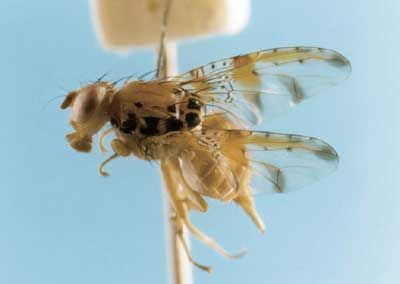
Credit: Jeffrey Lotz, Division of Plant Industry
Ceratitis cosyra differs also from the Natal fly, the latter being larger, lacking black spots laterally (postpronotal) on the thorax, and the costal band and discal crossband are not joined. Also, males of C. cosyra, as members of the subgenus Ceratalaspis, lack capitate setae such as are present in subgenus Ceratitis (e.g., Medfly), and they lack feathering of the tibia as in the subgenus Pterandrus (e.g., Natal fly).
Excellent keys to distinguish major fruit fly pests of the genus Ceratitis are available in White and Elson-Harris (1992). De Meyer (1998) provided a complete taxonomic treatment of the subgenus Ceratalaspis, including key characters to separate C. cosyra from other closely related and similar pest species, such as Ceratitis discussa Munro.
Life History
Life stage durations are approximately as follows:
- egg—two to three days
- larva—five or more days, nine to 15 days in laboratory colonies
- pupa—nine to 12 days
- adult—up to 41 days (60 days in laboratory colonies)
Females first oviposit at about age five days, and oviposition continues up to age two weeks, with up to eight weeks in laboratory colonies. Fruits are heavily infested, with an average of 50 larvae per fruit (Malio 1979; Lux, personal communication for laboratory colony data).
Hosts
Reported host by family: See Table 1.
Monitoring and Management
Ceratitis cosyra adults may be attracted to terpinyl acetate, but not to trimedlure or methyl eugenol. Adult populations can be reduced with insecticidal protein-bait sprays in the same manner as other fruit flies. Post-harvest quarantine treatments include hot water dips (C. cosyra larvae survive heat treatment better than Medfly or Natal fruit fly, but exact treatment parameters are not yet established) and prolonged exposure to temperatures below 7.5°C.
Selected References
CAB International / European and Mediterranean Plant Protection Organization (CABI/EPPO). 1999. Ceratitis cosyra. Distribution maps of plant pests. No. 592. 2 pp.
De Meyer M. 1998. Revision of the subgenus Ceratitis (Ceratalaspis) Hancock (Diptera: Tephritidae). Bulletin of Entomological Research 88: 257-290.
Javaid I, De Lima CPF. 1979. Attack of mangoes in Zambia by the fruit fly Pardalaspis cosyra. Bulletin of African Insect Science 3: 17.
Javaid I. 1986. Causes of damage to some wild mango fruit trees in Zambia. International Pest Control 28: 98-99.
Labuschagne T, Brink T, Steyn WP, De Beer MS. 1996. Fruit flies attacking mangoes—their importance and post harvest control. Yearbook South African Mango Growers' Association 16: 17-19.
Lux SA, Zenz N, Kimani S. 1998. The African fruit fly initiative: development, testing and dissemination of technologies for the control of fruit flies. ICIPE Annual Scientific Report 1998-1999 7: 78-80.
Malio E. 1979. Observations on the mango fruit fly Ceratitis cosyra in the Coast Province, Kenya. Kenya Entomologist's Newsletter 19: 7.
N'Guetta K. 1994. Inventory of insect fruit pests in northern Cote d'Ivoire. Symposium on tropical orchards, Montpellier, France, 30 August - 5 September, 1993. Fruits - Paris 49: 430- 431, 502-503.
Rendell CH, Mwashayenyi E, Banga DJ. 1995. The mango fruit fly: population and varietal susceptibility studies. Zimbabwe Science News 29: 12-14.
White I M, Elson-Harris M. 1992. Fruit Flies of Economic Significance: Their Identification and Bionomics. International Institute of Entomology, London. 601 pp.