


Tropical Fowl Mite, Ornithonyssus bursa (Berlese) (Arachnida: Acari: Macronyssidae)
The Featured Creatures collection provides in-depth profiles of insects, nematodes, arachnids and other organisms relevant to Florida. These profiles are intended for the use of interested laypersons with some knowledge of biology as well as academic audiences.
Introduction
The tropical fowl mite, commonly found on birds, has become a pest to people in areas of high bird populations or where birds are allowed to roost on roofs, around the eaves of homes, and office buildings. Nesting birds are the worst offenders. After the birds abandon their nests, the mites move into the building through windows, doors, and vents and bite the occupants.
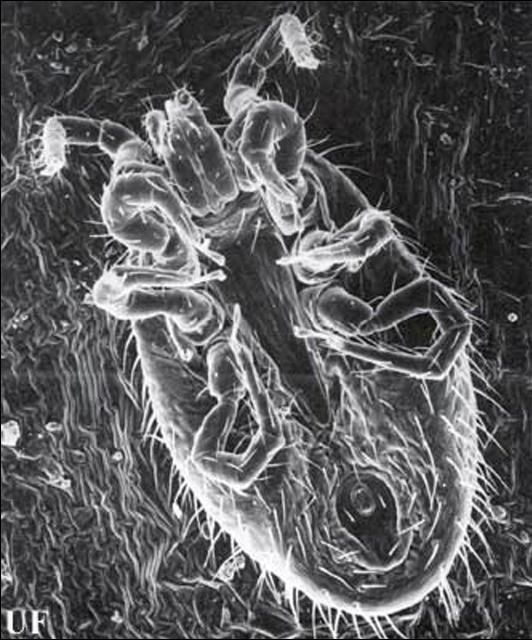
Credit: H. L. Cromroy, UF/IFAS
The bite is irritating, and some individuals react to the bite with prolonged itching and painful dermatitis. Several to many reports are received each year of mites invading homes. The mites are usually the tropical fowl mite found in the central and southern areas of the state. The northern fowl mite, Ornithonyssus sylviarum (Canestrini and Fanzago), a close relative, is also found in Florida.
Synonyms
Leiognathus bursa Berlese (1888)
Liponyssus bursa Hirst (1916)
Ornithonyssus bursa Sambon (1928)
Distribution
- Africa—Egypt, Nigeria, Malawi, Republic of South Africa
- Asia—China, India, Thailand. Indonesia - Java, Mauritius
- Australia—New South Wales, Queensland, South Australia
- Central America—Canal Zone
- Islands of the Indian Ocean—Comoro Islands, Zanzibar
- Islands of the Pacific—Hawaii, New Guinea
- North America—Canada, eastern and southern United States
- South America—Argentina, Colombia
- West Indies—The Bahamas
This mite is almost entirely restricted to warm and tropical regions. Canadian records could have been from birds returning from a warm region or a misidentification of the northern fowl mite.
Description
Although the tropical fowl mite is similar to the northern fowl mite, it can be distinguished by the dorsal plate. The posterior end tapers acutely in Ornithonyssus sylviarum but more evenly in Ornithonyssus bursa. There are three pairs of setae on the sternal plate in Ornithonyssus bursa and only two pairs in Ornithonyssus sylviarum.
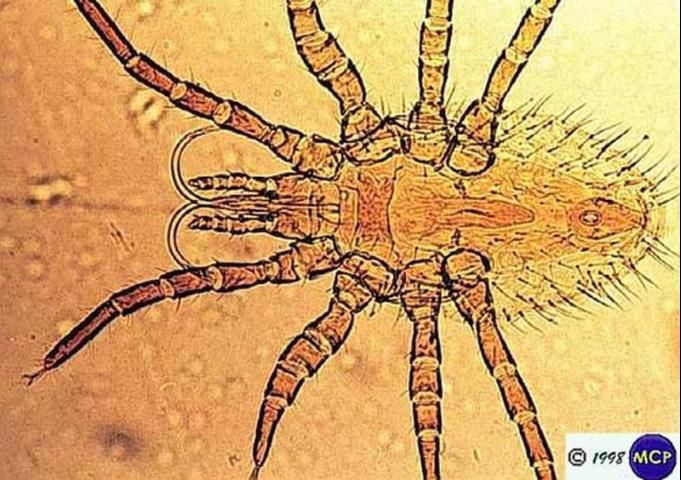
Credit: Marcelo de Campos Pereira, University of São Paulo
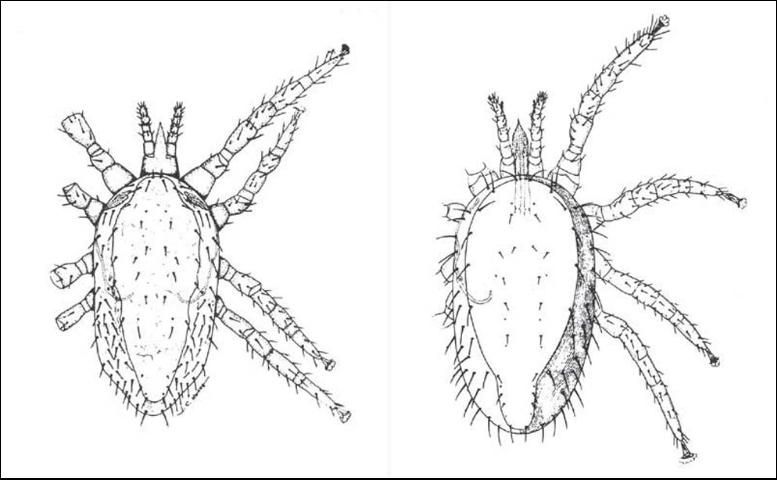
Credit: Division of Plant Industry (after Strandtmann and Whatton)
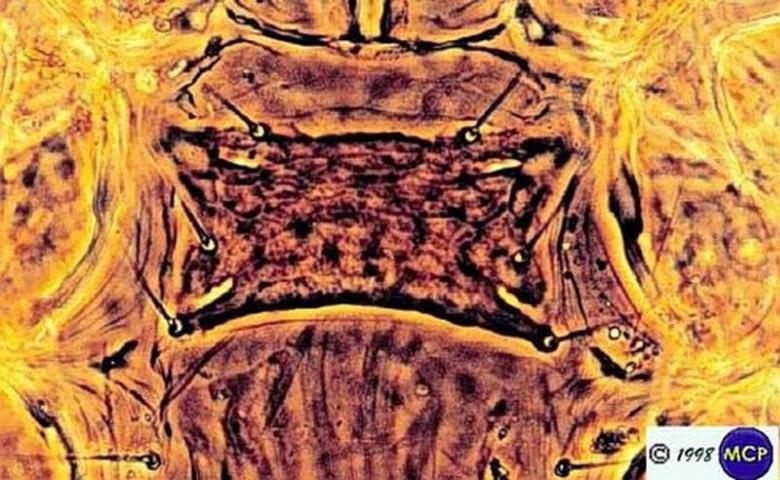
Credit: Marcelo de Campos Pereira, University of São Paulo
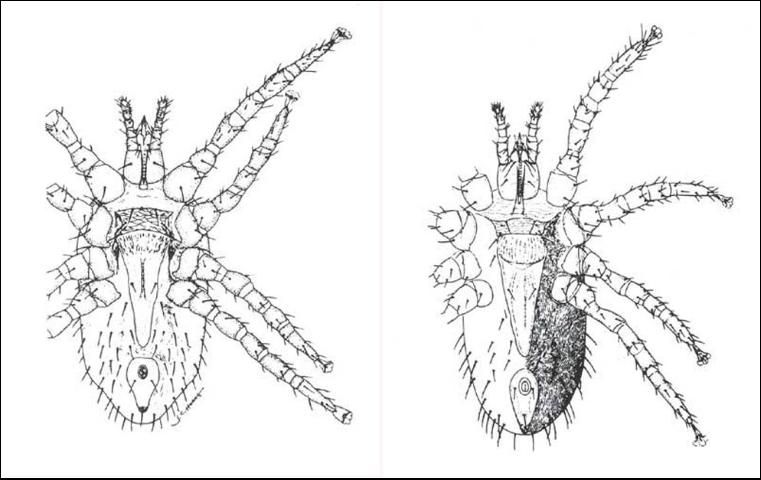
Credit: Division of Plant Industry (after Strandtmann and Whatton)
Life Cycle
This mite's life cycle is similar to the northern fowl mite. It has five stages: egg, larva, protonymph, deutonymph, and adult. In the laboratory, it lays most of its eggs in litter away from its hosts. In the field, it lays its eggs on the host or in the nest. Eggs hatch within three days. The non-feeding larvae molt in about 17 hours. The protonymph will molt in one or two days, but the length of the deutonymphal stage has not been determined. (It lasts about a day in the northern fowl mite.)
The nymphs and adults of the tropical fowl mite take blood meals, as opposed to only the protonymph and adult stages in the northern fowl mite. On birds, most of the breeding takes place in the nests. Only a few mites are found on birds flying about. On chickens, the mites prefer the fluffy, downy feathers and are numerous about the vent, accumulating on a few feathers. If a person handles the infested chicken he or she will become infested. This has occurred in the layer industry when there are heavy mite infestations.
Hosts
Mammals: bandicoot, gerbil, and humans.
Birds: canaries, caracara, chickens, common sparrow, ducks, English starling, kingbird, meadowlark, pigeons, red-eyed vireo, turkey, and wood thrush.
Economic Importance
The tropical fowl mite is a serious pest of domestic fowl and wild birds. It is almost never found on wild mammals, although there are many records of it biting humans. It has never been implicated in vectoring diseases. Chamberlain and Sikes (1955) concluded, after exhaustive tests, the mite is unimportant as a reservoir or transmitter of equine encephalitis.
Attacks cause people discomfort similar to that caused by Ornithonyssus sylviarum, northern fowl mite, which is also a pest of domestic fowl and wild birds. Other than bandicoots and gerbils, it apparently does not attack other mammals except humans and this occurs only when a bird or fowl host is not available. The northern fowl mite is common in the north temperate zone, but also is found in Florida.
Survey and Detection
Look for nesting birds around the eaves of buildings. Remove nests and discourage birds from nesting in or on buildings. Secure all openings to attics, windows, and doors.
Management
In homes or commercial buildings, remove all bird nests and wash the walls with a strong spray of water or steam clean. For both structural and poultry layer operations, see recommendations provided in the Management Guides listed below. This mite can only live for about 10 days away from the bird hosts so its effect on humans is temporary.
Florida Insect Management Guide for External Parasites of Poultry
Florida Insect Management Guide for Mites That Attack Humans
Selected References
Berlese A. 1882-1892. Acari, Myriapoda et Scorpiones hucusque in Italia reperta: Mesostigmata. Fusc. 52, No. 2, 143 pp.
Chamberlain RW, Sikes RK. 1955. "Laboratory investigations on the role of bird mites in the transmission of eastern and western equine encephalitis." American Journal of Tropical Medicine and Hygiene 4: 106–1118.
Hirst S. 1916. "On some new acarine parasites of rats." Bulletin of Entomological Research 6: 183–190.
Phillis WA, Cromory HL. 1972. "A preliminary survey of ectoparasitc mites (Acari) of the house sparrow and mocking bird in Florida." Florida Entomologist 55.
Phillis WA, Cromroy HL, Denmark HA. 1976. "New host and distribution records for the mite genera Dermanyssus, Ornithonyssus and Pellonyssus (Acari: Mesostigmata: Laelapoidea) in Florida." Florida Entomologist 59. http://www.jstor.org/stable/3493179.
Sambon LW. 1928. "The parasitic acarions of animals and the part they play in the causation of the eruptive fevers and other diseases of man. Preliminary considerations based upon an ecological study of typhus fever." Annals of Tropical Medical Parasitology 22: 67–132.