
Norman C. Leppla and Kenneth L. Johnson II2
This guide provides assistance in selecting, purchasing and using commercially available natural enemies and biopesticides for managing accurately diagnosed pest problems. It therefore applies only to situations in which the cause of a pest problem is known and a biological control solution is sought. To choose a commercial natural enemy product, first use Table 1 to select the habitat of your plant or animal pest problem and identify the insect or mite pest. Then select the types of natural enemies (parasitic nematodes, predatory mites, predatory insects, and parasitic wasps) and biopesticides available to manage these pests. The reference numbers correspond with the numbered scientific names of natural enemy and biopesticide products in Tables 2-6. Table 6 provides the scientific and product names and target pests for some of the most common microbial insecticides, nematicides and fungicides that often can be used alone or, if compatible, in combination with insect and mite natural enemies. Biopesticides included in Table 6, but not referenced in Table 1, are an insecticide for mosquito larvae (#62), another for grasshoppers (#64), a nematicide for nematodes that damage plants (#69), and eight microbial fungicides (#70-77). The biological control companies named in these tables are listed alphabetically in Table 7, along with their websites. Sources of information on obtaining and using commercial natural enemies follow in the next section.
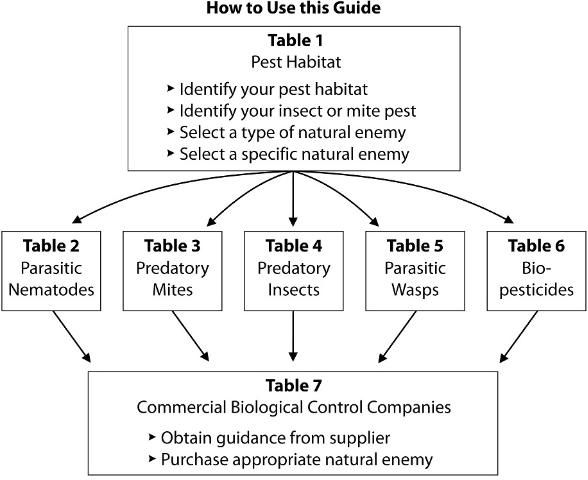
The guide is limited to 56 commercial natural enemy products (nematodes, mites, and insects) and 21 biopesticides that appear to be useful and available from 51 primary sources for use in Florida. These products often are also suitable for use in other states, particularly in the Southeast. Specialized products, such as those used for weed management, and natural enemies produced primarily for other states and Canada have been excluded. Companies not included were most garden centers, those with very limited geographic markets or product lines, suppliers without websites, governmental and other non-commercial producers, so-called big-box stores, and sources for which information was difficult to find or use. Almost half of the companies listed in Table 7 are members of the Association of Natural Biocontrol Producers (ANBP). Producers and suppliers belonging to ANBP are preferred because they adhere to a quality assurance policy and code of ethics for the industry, and promote research and education on the use of natural enemies. Additional biological control products and sources can be derived from the internet.
Biological control companies typically provide customer service to help assure that their products are effective. Information they supply includes the availability and cost of natural enemies and biopesticides, descriptions of target pests and their biology, and recommendations for applying and evaluating their products. Product instructions usually indicate the habitats and seasons in which the pests are encountered, developmental stages that are susceptible to parasitism or predation, and relevant behavior of the natural enemies, e.g. how far they move and how many pests they can parasitize or consume. Products often can be used in combination when there is more than one pest problem, and sometimes a product will manage a pest for which it was not intended. The companies only sell biological control products that have been tested thoroughly and receive federal and state approval to assure that they can be released into the environment safely. The products are marketed directly by producers or provided by suppliers after obtaining the necessary permits for natural enemies or EPA registrations for biopesticides.
Customers who use biological control products generally want to be directly involved in solving their pest problems. This involvement is essential because products must first be selected and deployed according to general instructions and subsequently evaluated for site-specific effectiveness. It may be necessary to try different products or application procedures, or to modify the environment in ways that enhance the impact of natural enemies. This may involve changing how plants are grown or adding food, companion plants and refuges for natural enemies. The effects of commercial natural enemies can be limited to the stage that is released or be long-term if they reproduce and become established. Typically, several pests are present and, if some must be managed with pesticides, it is necessary to know which pesticides are compatible with the natural enemies. Other considerations are how to release the natural enemies and in what developmental stage. They can be introduced, for example, on special plants with non-pest hosts, so called “banker plants,” added as eggs, or allowed to fly from release containers. These kinds of considerations may be addressed in instructions from the source companies or gleaned from the references in this guide.
Association of Natural Biocontrol Producers (ANBP) Website (http://www.anbp.org). [This is a global commercial biological control organization with members primarily in the U.S. and Canada. The website lists 17 producers, 14 distributors, 3 practitioners, 3 contributing members, and 43 associate members. Most of the producers and distributors list their products.]
Copping, L. G. (ed.). 2001. The BioPesticide Manual. British Crop Protection Council. Surrey, UK. 528 p. [This book contains a comprehensive listing and technical descriptions of biopesticides.]
Electronic Data Information Source (EDIS) Website (http://edis.ifas.ufl.edu/) . [The EDIS Web site is a comprehensive, single-source repository of all current UF/IFAS numbered peer-reviewed publications. The database is searchable by topic, e.g., agriculture or lawn and garden, and by key words.]
Featured Creatures Website (http://entnemdept.ifas.ufl.edu/creatures/) . [This is a set of in-depth profiles of insects, nematodes, arachnids, and other organisms. The database is searchable by common name, scientific name, crop or habitat, higher classification, and recent additions.]
Flint, M. L., S. H. Dreistadt, and J. K. Clark. 1998. Natural Enemies Handbook. University of California Integrated Pest Management Project. University of California Press, Los Angeles. 154 p. [This book can be used to identify and use many of the most common natural enemies. It contains a considerable amount of information about biological control, including the toxicity to natural enemies of selected insecticides and acaracides.]
Gerson, U., R. L. Smiley, and R. Ochoa. 2003. Mites (Acari) for Pest Control. Wiley-Blackwell. 560 p. [This book describes 34 acarine families that contain mites useful for the control of pest mites, insects, nematodes and weeds. It also contains information on using the mites.]
Hoffman, M. P., and A. C. Frodsham. 1993. Natural Enemies of Vegetable Insect Pests. Cornell Cooperative Extension, Cornell University, Ithaca, N.Y. 63 p. [This book facilitates identification of the major parasites and predators of insect pests of vegetables. It also contains information on entomopathogenic nematodes and microbial insecticides.]
Hunter, C. D. 1997. Suppliers of Beneficial Organisms in North America. California Environmental Protection Agency, Department of Pesticide Regulation. 32 p. (http://www.cdpr.ca.gov). [This book has been the most comprehensive catalogue of commercial biological control products in North America, but the list of producers and suppliers is out of date.]
International Biocontrol Manufacturers Association (IBMA) Website (http://www.ibma.ch) . [This is a global commercial biological control organization with members primarily in Europe. The website has an Invertebrate Biocontrol Agents (IBCA) Professional Group for producers of macroorganisms (insects, mites and entomopathogenic nematodes). This group has 54 members.]
The IPM Practitioner. 2001. 23:3-37. (http://www.birc.org/products.pdf). [This publication is a useful reference, but the list of producers and suppliers is out of date.]
IR-4. 2010. Searchable Database for Biopesticide and Organic Pest Management Solutions (http://www.ir4.rutgers.edu/Biopesticides/Labeldatabase/index.cfm). [Search categories include commercial crops, commercial turf and ornamentals, residential food crops, residential turf and ornamentals, pest problems (insects, diseases, weeds, nematodes, and animals), plant growth regulators, and states.]
Malais, M. H., and W. J. Ravensberg. 1992. Knowing and Recognizing (Revised Edition). Koppert Biological Systems. Reed Business Information. 288 p. [This book describes major plant pests and their natural enemies. A newer edition is available from Koppert, (http://www.koppert.com/) . This website also has information on the toxicity to natural enemies of selected pesticides.]
Martin, K. W., and D. D. Thomas. 2009. Florida's Major Agricultural Pests. University of Florida, IFAS Extension CD. [This compact disc contains photographs of almost 100 of Florida's major agricultural pests, including adults, larvae, or nymphs and the damage they cause. Information on the CD is available online from IPM Florida (http://ipm.ifas.ufl.edu).]
Natural Resources Canada, Insect Producer Database Website (http://www.insect.glfc.cfs.nrcan.gc.ca/) . [This database contains a listing of insects available from producers.]
Thomson, W. T. 1992. A Worldwide Guide to Beneficial Animals Used for Pest Control Purposes. W. T. Thomson Publishing. Fresno, CA. 92 p. [This book is a practical guide to use of the 72 most common species of commercial beneficial insects, mites, and nematodes for biological pest control. It includes an out-of-date list of companies that sell the natural enemies.]
The authors thank Howard Frank (University of Florida) for a very thorough scientific review of the manuscript and John Capinera (University of Florida) for guidance on its structure. Carol Glenister (IPM Laboratories) provided an expert review as a producer and supplier of natural enemies. An excellent review from a Cooperative Extension perspective was contributed by Kris Braman (University of Georgia). This information was assembled in response to many requests by Florida citizens for guidance in purchasing and using commercial natural enemies.
Habitats of plant or animal pests in Florida, typical pests, type of commercial natural enemies available to manage each pest, and species reference number.
Habitats of Plant or Animal Pests |
Identified Pest |
Commercial Natural Enemies |
|
Type |
No. ( see Tables 2-6) |
||
Citrus |
aphids |
predatory insects |
21, 26, 28, 30-32 |
microbial insecticides |
63, 66 |
||
beetles (grubs) |
parasitic nematodes |
3 |
|
microbial insecticides |
60, 63, 67 |
||
caterpillars |
predatory insects |
29-32 |
|
parasitic wasps |
54, 55 |
||
microbial insecticides |
57, 59, 65, 67 |
||
mealybugs |
predatory insects |
19, 22 |
|
parasitic wasps |
44 |
||
mites |
predatory mites |
11, 13 |
|
scales |
predatory insects |
22 |
|
parasitic wasps |
35, 45 |
||
thrips |
predatory mites |
14 |
|
predatory insects |
28 |
||
microbial insecticides |
67 |
||
whiteflies |
predatory insects |
20, 28, 30-32 |
|
Fruits and Vegetables |
aphids |
predatory insects |
21, 26, 28, 30-32 |
parasitic wasps |
34, 39-41 |
||
microbial insecticides |
63, 66 |
||
beetles (grubs) |
parasitic nematodes |
2 |
|
predatory insects |
29 |
||
parasitic wasps |
47 |
||
microbial insecticides |
60, 61, 63, 67 |
||
caterpillars |
predatory insects |
20, 30-32 |
|
parasitic wasps |
42, 54-56 |
||
microbial insecticides |
57, 59, 65, 67 |
||
fungus gnats |
predatory insects |
25 |
|
microbial insecticides |
58 |
||
leafminers |
parasitic wasps |
43, 46 |
|
microbial insecticides |
67 |
||
mealybugs |
predatory insects |
19, 22 |
|
mites |
predatory mites |
10-13, 15, 16, 18 |
|
predatory insects |
27, 33 |
||
scales |
predatory insects |
22, 23 |
|
thrips |
predatory mites |
11, 12 |
|
predatory insects |
25, 28, 30-32 |
||
microbial insecticides |
67 |
||
whiteflies |
predatory mites |
14 |
|
predatory insects |
20, 28, 30-32 |
||
Ornamental Plants and Landscapes |
aphids |
predatory insects |
21, 26, 28, 30-32 |
parasitic wasps |
34, 39-41 |
||
microbial insecticides |
63, 66, 67 |
||
beetles (grubs) |
parasitic nematodes |
1-3, 8 |
|
predatory insects |
29-32 |
||
microbial insecticides |
60, 61, 63, 67 |
||
caterpillars |
parasitic wasps |
54, 56 |
|
microbial insecticides |
57, 59, 65, 67 |
||
fungus gnats |
parasitic nematodes |
5, 8 |
|
predatory mites |
9 |
||
predatory insects |
25 |
||
microbial insecticides |
58 |
||
leafminers |
parasitic nematodes |
5 |
|
parasitic wasps |
43, 46 |
||
microbial insecticides |
67 |
||
mealybugs |
parasitic nematodes |
1 |
|
predatory insects |
19, 22 |
||
parasitic wasps |
45 |
||
mites |
predatory mites |
10-13, 16-18 |
|
predatory insects |
27 |
||
scales |
predatory insects |
22, 23 |
|
thrips |
parasitic nematodes |
5, 8, 9 |
|
predatory mites |
11, 12, 14 |
||
predatory insects |
25, 28, 30-32 |
||
microbial insecticides |
67 |
||
whiteflies |
predatory mites |
14 |
|
predatory insects |
20, 28, 30-32 |
||
Greenhouses and Interiorscapes |
aphids |
predatory insects |
21, 26 |
parasitic wasps |
34, 36, 39-41 |
||
microbial insecticides |
63, 66, 68 |
||
caterpillars |
parasitic wasps |
54 |
|
microbial insecticides |
57, 59, 65, 67 |
||
fungus gnats |
parasitic nematodes |
4 |
|
predatory mites |
9 |
||
predatory insects |
25 |
||
microbial insecticides |
58 |
||
leafminers |
parasitic wasps |
43, 46 |
|
microbial insecticides |
67 |
||
mealybugs |
predatory insects |
19 |
|
parasitic wasps |
44 |
||
mites |
predatory mites |
10, 11, 13, 16-18 |
|
predatory insects |
27 |
||
scales |
predatory insects |
23 |
|
parasitic wasps |
35, 45 |
||
thrips |
predatory mites |
9, 11 |
|
predatory insects |
25 |
||
microbial insecticides |
67 |
||
whiteflies |
predatory insects |
20 |
|
parasitic wasps |
36-38 |
||
Turf and Lawns |
caterpillars |
parasitic nematodes |
7 |
microbial insecticides |
57, 59, 65, 67 |
||
beetles (grubs) |
parasitic nematodes |
7, 8 |
|
microbial insecticides |
60, 63, 67 |
||
mole crickets |
parasitic nematodes |
6, 8 |
|
Animal Waste |
filth flies |
predatory insects |
24 |
parasitic wasps |
48-53 |
||
Parasitic nematodes. Numbered biological control products (family, genus, and species), some target pests and source companies.
PARASITIC NEMATODES |
|
Heterorhabditidae |
Source Company (see Table 7) |
1. Heterorhabditis bacteriophora (cucumber, scarab, Japanese, and flea beetles, thrips, white grubs, corn root worms, Colorado potato beetles, black vine weevils, and root mealybugs, on ornamentals, trees, and shrubs) |
ARBICO ∙ Andermatt ∙ Beneficial Insect Company ∙ Biobest ∙ Biocontrol Network ∙ BioLogic ∙ Bioworks ∙ Buglogical Control ∙ EcoSolutions ∙ The Green Spot ∙ Hydro-Gardens ∙ International Technology ∙ IPM Labs ∙ Koppert ∙ M & R Durango ∙ Natural Insect Control ∙ Peaceful Valley ∙ Rincon-Vitova ∙ Sound Horticulture |
2. Heterorhabditis megidis (vine weevil larvae on ornamentals, trees, shrubs, and strawberries) |
Andermatt ∙ BCP Certis ∙ Biobest ∙ International Technology ∙ Koppert ∙ Natural Insect Control ∙ Nature's Control ∙ Plant Products ∙ Syngenta Bioline |
3. Heterorhabditis spp. (vine weevil larvae and other soil borne beetle larvae on ornamentals, trees, and shrubs) |
Beneficial Insect Company ∙ Gardens Alive ∙ Hydro-Gardens ∙ International Technology ∙ Koppert ∙ M & R Durango ∙ Natural Insect Control ∙ Nature's Control |
Steinernematidae |
|
4. Steinernema carpocapsae (fungus gnats on potted plants) |
Andermatt ∙ ARBICO ∙ Becker Underwood ∙ Beneficial Insect Company ∙ Biobest ∙ Biocontrol Network ∙ Biofac ∙ BioLogic ∙ Buglogical Control ∙ EcoSolutions ∙ Gardens Alive ∙ The Green Spot ∙ Harmony Farm Supply ∙ Hydro-Gardens ∙ International Technology ∙ IPM Labs ∙ Koppert ∙ M & R Durango ∙ Natural Insect Control ∙ Peaceful Valley ∙ Sound Horticulture ∙ Three Trees Farm |
5. Steinernema feltiae (thrips, fungus gnats, and leafminers on ornamentals) |
Andermatt ∙ ARBICO ∙ BCP Certis ∙ Becker Underwood ∙ Biobest ∙ Biocontrol Network ∙ BioLogic ∙ Bioworks ∙ Buglogical Control ∙ EcoSolutions ∙ Gardens Alive ∙ The Green Spot ∙ Hydro-Gardens ∙ International Technology ∙ IPM Labs ∙ Koppert ∙ M & R Durango ∙ Natural Insect Control ∙ Peaceful Valley ∙ Planet Natural ∙ Plant Products ∙ Rincon-Vitova ∙ Sound Horticulture ∙ Syngenta Bioline |
6. Steinernema scapterisci (mole crickets in turf and lawns) |
Becker Underwood |
7. Steinernema spp. (grubs, caterpillars, and fungus gnats) |
Hydro-Gardens ∙ International Technology |
8. Steinernema feltiae and Heterorhabditis spp. mix (soil borne pests) |
Hydro-Gardens ∙ Natural Insect Control ∙ Nature's Control ∙ North Country |
Predatory mites. Numbered biological control products (family, genus, and species), some target pests and source companies.
PREDATORY MITES |
|
Laelapidae |
Source Company (see Table 7) |
9. Stratiolaelaps miles (also called Hypoaspis miles and Stratiolaelaps scimitus) (fungus gnats and thrips on potted plants, bedding plants, and seedlings) |
Applied Bio-nomics ∙ ARBICO ∙ BCP Certis ∙ Biobest ∙ Biocontrol Network ∙ Buglogical Control ∙ EcoSolutions ∙ Evergreen ∙ The Green Spot ∙ Hydro-Gardens ∙ International Technology ∙ IPM Labs ∙ Koppert ∙ M & R Durango ∙ Natural Insect Control ∙ Nature's Control ∙ Peaceful Valley ∙ Plant Products ∙ Rincon-Vitova ∙ Sound Horticulture ∙ Syngenta Bioline |
Phytoseiidae |
|
10. Amblyseius californicus (also called Neoseiulus californicus) (two-spotted spider, broad and cyclamen mites on ornamentals, vegetables, fruits, and potted plants) |
American Insectaries ∙ ARBICO ∙ Associates Insectary ∙ BCP Certis ∙ Biobest ∙ Biocontrol Network ∙ Biotactics ∙ Buglogical Control ∙ EcoSolutions ∙ The Green Spot ∙ Harmony Farm Supply ∙ Hydro-Gardens ∙ International Technology ∙ IPM Labs ∙ Koppert ∙ M & R Durango ∙ Natural Insect Control ∙ Natural Pest Controls ∙ Nature's Control ∙ Peaceful Valley ∙ Plant Products ∙ Rincon-Vitova ∙ Sterling Insectary ∙ Syngenta Bioline |
11. Amblyseius cucumeris (two-spotted spider mites, flower thrips, and tarsonemid mites on all crops) |
American Insectaries ∙ Applied Bio-nomics ∙ ARBICO ∙ BCP Certis ∙ Biobest ∙ Biocontrol Network ∙ Buglogical Control ∙ EcoSolutions ∙ Evergreen ∙ The Green Spot ∙ Harmony Farm Supply ∙ Hydro-Gardens ∙ International Technology ∙ IPM Labs ∙ Koppert ∙ M & R Durango ∙ Natural Insect Control ∙ Natural Pest Controls ∙ Nature's Control ∙ Peaceful Valley ∙ Planet Natural ∙ Plant Products ∙ Rincon-Vitova ∙ Sound Horticulture ∙ Syngenta Bioline |
12. Amblyseius degenerans (also called Iphiseius degenerans) (thrips, broad mites, and spider mites on peppers and ornamentals) |
Biobest ∙ International Technology ∙ IPM Labs ∙ Natural Insect Control ∙ Plant Products∙ Syngenta Bioline |
13. Amblyseius fallacis (also called Neoseiulus fallacies) (two-spotted spider mites, European red mites, bamboo mites, and citrus red mites on all crops) |
Applied Bio-nomics ∙ Biocontrol Network ∙ Biotactics ∙ Evergreen ∙ The Green Spot ∙ IPM Labs ∙ M & R Durango ∙ Natural Insect Control ∙ Plant Products ∙ Rincon-Vitova ∙ Sound Horticulture |
14. Amblyseius swirskii (whiteflies and thrips on ornamentals) |
Biobest ∙ EcoSolutions ∙ The Green Spot ∙ Hydro-Gardens ∙ International Technology ∙ IPM Labs ∙ Koppert ∙ Natural Insect Control ∙ Plant Products ∙ Syngenta Bioline |
15. Galendromus helveolus (persea mites on avocado) |
American Insectaries ∙ Rincon-Vitova (currently not produced) |
16. Galendromus occidentalis (spider, eriophyid, and russet mites on ornamentals and vegetables in greenhouses and interiorscapes) |
American Insectaries ∙ ARBICO ∙ Biocontrol Network ∙ Biotactics ∙ Buglogical Control ∙ The Green Spot ∙ Harmony Farm Supply ∙ Hydro-Gardens ∙ IPM Labs ∙ M & R Durango ∙ Natural Insect Control ∙ Natural Pest Controls ∙ Rincon-Vitova ∙ Sterling Insectary |
17. Mesoseiulus longipes (also called Phytoseiulus longipes) (two-spotted spider mites in greenhouses and interiorscapes) |
American Insectaries ∙ ARBICO ∙ Biocontrol Network ∙ Biotactics ∙ Buglogical Control ∙ The Green Spot ∙ Harmony Farm Supply ∙ Hydro-Gardens ∙ IPM Labs ∙ M & R Durango ∙ Natural Insect Control ∙ Nature's Control ∙ Peaceful Valley ∙ Rincon-Vitova |
18. Phytoseiulus persimilis (spider mites on all crops) |
American Insectaries ∙ Applied Bio-nomics ∙ ARBICO ∙ BCP Certis ∙ Biobest ∙ Biocontrol Network ∙ Biotactics ∙ Buglogical Control ∙ EcoSolutions ∙ Evergreen ∙ The Green Spot ∙ Harmony Farm Supply ∙ Hydro-Gardens ∙ International Technology ∙ IPM Labs ∙ Koppert ∙ M & R Durango ∙ Natural Insect Control ∙ Natural Pest Controls ∙ Nature's Control ∙ Peaceful Valley ∙ Planet Natural ∙ Rincon-Vitova ∙ Sound Horticulture ∙ Syngenta Bioline |
Predatory insects. Numbered biological control products (family, genus and species), some target pests and source companies.
PREDATORY INSECTS |
|
Coleoptera |
|
Coccinellidae |
Source Company (see Table 7) |
19. Cryptolaemus montrouzieri Mealybug destroyer (mealybugs on citrus, ornamentals, and vegetables, and in greenhouses and interiorscapes) |
American Insectaries ∙ ARBICO ∙ Associates Insectary ∙ BCP Certis ∙ Biobest ∙ Biocontrol Network ∙ Buglogical Control ∙ EcoSolutions ∙ Evergreen ∙ The Green Spot ∙ Hydro-Gardens ∙ International Technology ∙ IPM Labs ∙ Koppert ∙ M & R Durango ∙ Natural Insect Control ∙ Natural Pest Controls ∙ Nature's Control ∙ Peaceful Valley ∙ Planet Natural ∙ Plant Products ∙ Rincon-Vitova ∙ Sound Horticulture ∙ Sterling Insectary ∙ Syngenta Bioline |
20. Delphastus catalinae Whitefly predator (greenhouse, banded-winged, sweetpotato, woolly, azalea, hibiscus, cloudywinged, citrus and rhododendron whiteflies on ornamentals, vegetables, fruit, and citrus, and in greenhouses and interiorscapes) |
American Insectaries ∙ Applied Bio-nomics ∙ ARBICO ∙ Biocontrol Network ∙ Evergreen ∙ The Green Spot ∙ IPM Labs ∙ Natural Insect Control ∙ Rincon-Vitova ∙ Sound Horticulture |
21. Hippodamia convergens Ladybeetle (aphids, scales, and thrips in citrus, ornamentals, fruits and vegetables, and in greenhouses and interiorscapes) |
A-1 Unique ∙ American Insectaries ∙ ARBICO ∙ Biocontrol Network ∙ Biofac ∙ BioLogic ∙ Buglogical Control ∙ EcoSolutions ∙ Evergreen ∙ Gardens Alive ∙ The Green Spot ∙ Harmony Farm Supply ∙ Hydro-Gardens ∙ IPM Labs ∙ Kunafin ∙ M & R Durango ∙ Natural Insect Control ∙ Natural Pest Controls ∙ Nature's Control ∙ Peaceful Valley ∙ Planet Natural ∙ Rincon-Vitova ∙ Sound Horticulture ∙ Three Trees Farm |
22. Rhyzobius lophanthae (also called Lindorus lophanthae) (hard and soft scales and mealybugs on ornamentals, vegetables, citrus, and fruit) |
Biocontrol Network ∙ EcoSolutions ∙ The Green Spot ∙ Hydro-Gardens ∙ IPM Labs ∙ M & R Durango ∙ Natural Insect Control ∙ Rincon-Vitova |
Cybocephalidae |
|
23. Cybocephalus nipponicus Scale picnic beetle (euonymus and San Jose scale on ornamentals, vegetables, and fruits, and in greenhouses and interiorscapes) |
The Green Spot ∙ IPM Labs |
Histeridae |
|
24. Carcinops pumilio (flies in garbage, manure, and compost) |
IPM Labs |
Staphylinidae |
|
25. Dalotia coriaria (also called Atheta coriaria) (fungus gnats, shore flies, and thrips in vegetables and ornamentals, and in greenhouses and interiorscapes) |
Applied Bio-nomics ∙ Biobest ∙ Evergreen ∙ The Green Spot ∙ International Technology ∙ IPM Labs ∙ M & R Durango ∙ Natural Insect Control ∙ Plant Products ∙ Sound Horticulture ∙ Syngenta Bioline |
Diptera |
|
Cecidomyiidae |
|
26. Aphidoletes aphidimyza (aphids in citrus, ornamentals, fruits and vegetables, and in greenhouses and interiorscapes) |
American Insectaries ∙ Applied Bio-nomics ∙ ARBICO ∙ BCP Certis ∙ Biobest ∙ Biocontrol Network ∙ Buglogical Control ∙ EcoSolutions ∙ Evergreen ∙ The Green Spot ∙ Hydro-Gardens ∙ International Technology ∙ IPM Labs ∙ Koppert ∙ M & R Durango ∙ Natural Insect Control ∙ Nature's Control ∙ Planet Natural ∙ Plant Products ∙ Rincon-Vitova ∙ Sound Horticulture ∙ Syngenta Bioline |
27. Feltiella acarisuga (spider mites in ornamentals and vegetables, and in greenhouses and interiorscapes) |
ARBICO ∙ BCP Certis ∙ Biobest ∙ EcoSolutions ∙ The Green Spot ∙ Hydro-Gardens ∙ International Technology ∙ IPM Labs ∙ Koppert ∙ Natural Insect Control ∙ Rincon-Vitova ∙ Syngenta Bioline |
Hemiptera |
|
Anthocoridae |
|
28. Orius insidiosus Minute pirate bug (thrips, aphids, and whiteflies on ornamentals, vegetables, and citrus, and in greenhouses and interiorscapes) |
ARBICO ∙ Biobest ∙ EcoSolutions ∙ Evergreen ∙The Green Spot ∙ IPM Labs ∙ Koppert ∙ M & R Durango ∙ Natural Insect Control ∙ Plant Products ∙ Rincon-Vitova ∙ Sound Horticulture ∙ Syngenta Bioline |
Pentatomidae |
|
29. Podisus maculiventris Spined soldier bug (Colorado potato beetles and caterpillars on ornamentals, vegetables and citrus) |
ARBICO ∙ Biocontrol Network ∙ The Green Spot ∙ IPM Labs ∙ Natural Insect Control ∙ Planet Natural ∙ Rincon-Vitova |
Neuroptera |
|
Chrysopidae |
|
30. Chrysoperla carnea Lacewing (aphids and any other small soft-bodied insects on ornamentals, vegetables, and citrus) |
A-1 Unique ∙ American Insectaries ∙ BCP Certis ∙ Biobest ∙ Buglogical Control ∙ EcoSolutions ∙ Harmony Farm Supply ∙ Hydro-Gardens ∙ International Technology ∙ Koppert ∙ Natural Insect Control ∙ Plant Products ∙ Rincon-Vitova ∙ Sound Horticulture ∙ Syngenta Bioline |
31. Chrysoperla rufilabris Lacewing (aphids and any other small soft-bodied insects on ornamentals, vegetables, and citrus) |
A-1 Unique ∙ American Insectaries ∙ Beneficial Insectary ∙ EcoSolutions ∙ Gardens Alive ∙ The Green Spot ∙ Harmony Farm Supply ∙ IPM Labs ∙ M & R Durango ∙ Natural Insect Control ∙ Peaceful Valley ∙ Planet Natural ∙ Rincon-Vitova ∙ Sound Horticulture ∙ Three Trees Farm |
32. Chrysoperla spp. Lacewing (aphids and any other small soft-bodied insects on ornamentals, vegetables, and citrus) |
ARBICO ∙ Biocontrol Network ∙ Biofac ∙ EcoSolutions ∙ Kunafin ∙ M & R Durango ∙ Natural Pest Controls ∙ Nature's Control |
Thysanoptera |
|
Thripidae |
|
33. Scolothrips sexmaculatus (spider mites on fruit trees) |
Sterling Insectary |
Parasitic wasps. Numbered biological control products (family, genus and species), some target pests and source companies.
PARASITIC WASPS |
|
Hymenoptera |
|
Aphelinidae |
Source Company (see Table 7) |
34. Aphelinus abdominalis (potato aphids on ornamentals, fruits, and vegetables, and in greenhouses) |
BCP Certis ∙ Biobest ∙ EcoSolutions ∙ The Green Spot ∙ International Technology ∙ IPM Labs ∙ Koppert ∙ Natural Insect Control ∙ Rincon-Vitova ∙ Syngenta Bioline |
35. Aphytis melinus (oleander, California citrus, red, yellow, and dictyospermum scales on citrus and in greenhouses) |
American Insectaries ∙ ARBICO ∙ Associates Insectary ∙ Biocontrol Network ∙ EcoSolutions ∙ The Green Spot ∙ Hydro-Gardens ∙ International Technology ∙ IPM Labs ∙ M & R Durango ∙ Natural Insect Control ∙ Natural Pest Controls ∙ Rincon-Vitova ∙ Sespe Creek |
36. Encarsia formosa (whiteflies in greenhouses) |
American Insectaries ∙ Applied Bio-nomics ∙ ARBICO ∙ BCP Certis ∙ Biobest ∙ Biocontrol Network ∙ Buglogical Control ∙ EcoSolutions ∙ Evergreen ∙ The Green Spot ∙ Harmony Farm Supply ∙ Hydro-Gardens ∙ International Technology ∙ IPM Labs ∙ Koppert ∙ M & R Durango ∙ Natural Insect Control ∙ Natural Pest Controls ∙ Nature's Control ∙ Peaceful Valley ∙ Planet Natural ∙ Rincon-Vitova ∙ Sound Horticulture ∙ Syngenta Bioline |
37. Eretmocerus eremicus (sweetpotato whiteflies, and in greenhouses and interiorscapes) |
American Insectaries ∙ ARBICO ∙ BCP Certis ∙ Biobest ∙ EcoSolutions ∙ The Green Spot ∙ Hydro-Gardens ∙ International Technology ∙ IPM Labs ∙ Koppert ∙ M & R Durango ∙ Natural Insect Control ∙ Plant Products ∙ Rincon-Vitova ∙ Syngenta Bioline |
38. Eretmocerus mundus (sweetpotato and tobacco whiteflies in greenhouses) |
Biobest ∙ International Technology ∙ Koppert ∙ Natural Insect Control ∙ Plant Products ∙ Rincon-Vitova |
Braconidae |
|
39. Aphidius colemani (cotton, melon, green peach and other aphids on vegetables, fruits and ornamentals, and in greenhouses and interiorscapes) |
ARBICO ∙ BCP Certis ∙ Biobest ∙ Buglogical Control ∙ EcoSolutions ∙ The Green Spot ∙ Hydro-Gardens ∙ International Technology ∙ IPM Labs ∙ Koppert ∙ M & R Durango ∙ Natural Insect Control ∙ Planet Natural ∙ Plant Products ∙ Rincon-Vitova ∙ Sound Horticulture ∙ Syngenta Bioline |
40. Aphidius ervi (potato, pea, green peach, and greenhouse potato aphids on vegetables, fruits, and ornamentals, and in greenhouses and interiorscapes) |
BCP Certis ∙ Biobest ∙ EcoSolutions ∙ The Green Spot ∙ Hydro-Gardens ∙ International Technology ∙ IPM Labs ∙ Koppert ∙ M & R Durango ∙ Natural Insect Control ∙ Plant Products ∙ Rincon-Vitova ∙ Sound Horticulture ∙ Syngenta Bioline |
41. Aphidius matricariae (green peach aphids on vegetables, fruits, and ornamentals, and in greenhouses and interiorscapes) |
Applied Bio-nomics ∙ Biocontrol Network ∙ EcoSolutions ∙ Evergreen ∙ The Green Spot ∙ IPM Labs ∙ M & R Durango ∙ Natural Insect Control ∙ Nature's Control ∙ Plant Products ∙ Rincon-Vitova ∙ Sound Horticulture |
42. Cotesia plutellae (diamondback moths on vegetables) |
ARBICO ∙ Natural Insect Control ∙ Rincon-Vitova |
43. Dacnusa sibirica (leafminers in vegetables, fruit, and ornamentals, and in greenhouse and interiorscapes) |
American Insectaries ∙ ARBICO ∙ BCP Certis ∙ The Green Spot ∙ Hydro-Gardens ∙ International Technology ∙ IPM Labs ∙ Koppert ∙ Natural Insect Control ∙ Natural Pest Controls ∙ Plant Products ∙ Rincon-Vitova ∙ Syngenta Bioline |
Encyrtidae |
|
44. Leptomastix dactylopii (citrus mealybugs on citrus and ornamentals, and in greenhouses and interiorscapes) |
BCP Certis ∙ Biobest ∙ The Green Spot ∙ Hydro-Gardens ∙ International Technology ∙ IPM Labs ∙ Koppert ∙ Natural Insect Control ∙ Rincon-Vitova |
45. Metaphycus spp. (black, hemispherical, brown, and nigra scale in citrus, and in greenhouses and interiorscapes) |
BCP Certis ∙ EcoSolutions ∙ IPM Labs ∙ Natural Insect Control |
Eulophidae |
|
46. Diglyphus isaea (vegetable, tomato, serpentine, and chrysanthemum leafminers on vegetables, fruit, and ornamentals, and in greenhouses and interiorscapes) |
American Insectaries ∙ ARBICO ∙ BCP Certis ∙ Biobest ∙ Biocontrol Network ∙ EcoSolutions ∙ The Green Spot ∙ Hydro-Gardens ∙ International Technology ∙ IPM Labs ∙ Koppert ∙ Natural Insect Control ∙ Natural Pest Controls ∙ Planet Natural ∙ Plant Products ∙ Rincon-Vitova ∙ Syngenta Bioline |
47. Pediobius foveolatus (Mexican bean beetle on vegetables) |
ARBICO ∙ Biocontrol Network ∙ The Green Spot ∙ IPM Labs ∙ Rincon-Vitova |
Pteromalidae |
|
48. Muscidifurax raptor (flies in garbage, manure, and compost) |
A-1 Unique ∙ Beneficial Insectary ∙ Biofac ∙ IPM Labs ∙ Natural Insect Control |
49. Muscidifurax raptorellus (flies in garbage, manure, and compost) |
Beneficial Insectary ∙ The Green Spot ∙ IPM Labs ∙ M & R Durango ∙ Natural Insect Control ∙ Peaceful Valley ∙ Rincon-Vitova ∙ Sound Horticulture ∙ Spalding Laboratories |
50. Muscidifurax zaraptor (flies in garbage, manure, and compost) |
Beneficial Insectary ∙ Buglogical Control ∙ The Green Spot ∙ M & R Durango ∙ Natural Insect Control ∙ Natural Pest Controls ∙ Peaceful Valley ∙ Planet Natural ∙ Rincon-Vitova ∙ Sound Horticulture ∙ Spalding Laboratories |
51. Nasonia vitripennis (flies in garbage, manure, and compost) |
Buglogical Control ∙ Natural Pest Controls |
52. Spalangia cameroni (flies in garbage, manure, and compost) |
Beneficial Insectary ∙ IPM Labs ∙ Rincon-Vitova ∙ Spalding Laboratories |
53. Spalangia endius (flies in garbage, manure, and compost) |
A-1 Unique ∙ Beneficial Insectary ∙ Kunafin (Spalangia spp.) ∙ Natural Pest Controls ∙ Peaceful Valley ∙ Spalding Laboratories |
Trichogrammatidae |
|
54. Trichogramma brassicae (caterpillars in vegetables, fruit, ornamentals, and citrus, and in greenhouse and interiorscapes) |
BCP Certis ∙ Beneficial Insectary ∙ Buglogical Control ∙ EcoSolutions ∙ The Green Spot ∙ International Technology ∙ Koppert ∙ Kunafin (Trichogramma spp.) ∙ M & R Durango ∙ Natural Insect Control ∙ Rincon-Vitova ∙ Syngenta Bioline |
55. Trichogramma minutum (caterpillars in Eastern U.S. orchards) |
A-1 Unique ∙ American Insectaries ∙ ARBICO ∙ Beneficial Insectary ∙ Biocontrol Network ∙ Buglogical Control ∙ Gardens Alive ∙ The Green Spot ∙ Harmony Farm Supply ∙ International Technology ∙ IPM Labs ∙ M & R Durango ∙ Natural Insect Control ∙ Peaceful Valley ∙ Planet Natural ∙ Rincon-Vitova |
56. Trichogramma pretiosum (moth eggs in vegetables, field crops, and ornamentals) |
A-1 Unique ∙ American Insectaries ∙ Beneficial Insectary ∙ Biocontrol Network ∙ Biofac ∙ Buglogical Control ∙ Gardens Alive ∙ The Green Spot ∙ Harmony Farm Supply ∙ International Technology ∙ M & R Durango ∙ Natural Insect Control ∙ Planet Natural ∙ Rincon-Vitova |
Biopesticides. Microbial insecticides, nematicides and fungicides along with selected source companies (genus and species, product names, and some target pests).
BIOPESTICIDES |
|
Microbial Insecticides |
Source Company (see Table 7) |
57. Bacillus thuringiensis aizawai (BTA) Xentari, Florbac, Agree, Design, Ketch (caterpillars) |
BioBest ∙ Certis ∙ International Technology ∙ Valent BioSciences |
58. Bacillus thuringiensis israelensis (BTI) Skeetal, Mosquito Dunks, Bactimos, Gnatrol, Aquabac, Vetobac, Teknar (mosquitoes, blackfly larvae, and fungus gnats) |
ARBICO ∙ Beneficial Insect Company ∙ Biocontrol Network ∙ Bonide ∙ Buglogical Control ∙ Gardener's Supply ∙ Gardens Alive ∙ The Green Spot ∙ International Technology ∙ M & R Durango ∙ Natural Insect Control ∙ Natural Pest Controls ∙ North Country ∙ Peaceful Valley ∙ Planet Natural ∙ Rincon-Vitova ∙ Valent BioSciences |
59. Bacillus thuringiensis kurstaki (BTK) Thuricide, Dipel, Crymax, Foray, BioBit, Scutello, Crymax WDG, Deliver, Javelin, Baritone (caterpillars) |
AgraQuest ∙ BCP Certis ∙ BioBest ∙ Biocontrol Network ∙ Bonide ∙ Certis ∙ The Green Spot ∙ Harmony Farm Supply ∙ Hydro-Gardens ∙ International Technology ∙ Koppert ∙ Natural Insect Control ∙ North Country ∙ Peaceful Valley ∙ Planet Natural ∙ Rincon-Vitova ∙ Valent BioSciences |
60. Bacillus thuringiensis tenebrionis (BTT) Novodor, Raven, Potato Shield, Foil (beetle larvae) |
Valent BioSciences |
61. Bacillus popilliae Milky Spore (Japanese beetles) |
ARBICO ∙ Beneficial Insect Company ∙ Biocontrol Network ∙ Eartheasy ∙ Gardener's Supply ∙ The Green Spot ∙ North Country ∙ Peaceful Valley ∙ Planet Natural ∙ Rincon-Vitova ∙ St. Gabriel |
62. Bacillus sphaericus VectoLex, Spherimos (mosquito larvae) |
Valent BioSciences |
63. Beauveria bassiana Naturalis-O, L and T, Mycotrol, Botanigard (aphids, grubs, chinch bugs, grasshoppers, crickets, and sod webworms) |
ARBICO ∙ Bioworks ∙ Hydro-Gardens ∙ International Technology ∙ Peaceful Valley ∙ Rincon-Vitova ∙ Troy |
64. Nosema locustae Nolo Bait, Semispore Bait (grasshoppers) |
Biocontrol Network ∙ Buglogical Control ∙ Gardener's Supply ∙ The Green Spot ∙ Harmony Farm Supply ∙ Hydro-Gardens ∙ M & R Durango ∙ Natural Insect Control ∙ Natural Pest Controls ∙ North Country ∙ Peaceful Valley ∙ Planet Natural ∙ Rincon-Vitova |
65. Nucleopolyhedrosis virus (NPV) Gem-Star, NPV, Spod-X (caterpillars) |
Certis ∙ Rincon-Vitova |
66. Paecilomyces fumosoroseus PreFeRal, PFR-97 (aphids) |
Certis ∙ International Technology |
67. Saccharopolyspora spinosa Entrust (caterpillars, beetle larvae, thrips, and leafminers) |
ARBICO ∙ The Green Spot ∙ International Technology |
68. Verticillium lecanii Vertalec (aphids in greenhouses) |
Koppert |
Microbial Nematicides |
|
69. Myrothecium verrucaria DiTera (nematodes) |
Valent BioSciences |
Microbial Fungicides |
|
70. Agrobacterium radiobacter Galltrol-A, Gallex, NoGall K1026 (crown gall) |
AgBioChem |
71. Bacillus pumilis Activate, Ballad Plus, Sonata (fungal diseases) |
AgraQuest ∙ Rincon-Vitova |
72. Bacillus subtilis Serenade, Cease (fungal and bacterial diseases) |
AgraQuest ∙ Bioworks ∙ Harmony ∙ International Technology ∙ Rincon-Vitova |
73. Gliocladium virens SoilGard, Gliomix (Pythium, Rhizoctonia, Fusarium) |
Certis ∙ Harmony ∙ International Technology ∙ Rincon-Vitova |
74. Pseudomonas fluorescens Blight Ban (fire blight) |
Peaceful Valley |
75. Reynoutria sachalinensis Regalia (fungal and bacterial diseases including bacterial spot, citrus canker, powdery and downy mildews) |
Marrone Bio Innovations |
76. Streptomyces spp. Mycostop, RootGuard, Agrimycin, Actinovate (Fusarium, damping off, Pythium, Phytophthora and fire blight) |
The Green Spot ∙ Harmony ∙ Hydro-Gardens ∙ International Technology ∙ Peaceful Valley ∙ Planet Natural |
77. Trichoderma spp. Plant Shield, Plant Gard, Binab-T, Root Shield (Pythium, Rhizoctonia, Fusarium, Cylindrocladium and Thielaviopsis) |
ARBICO ∙ Binab ∙ Bioworks ∙ Gardens Alive ∙ The Green Spot ∙ Harmony ∙ International Technology ∙ Koppert ∙ Rincon-Vitova |
Commercial biological control companies that market nematodes, mites, insects, and biopesticides for pest management in Florida.
Company |
Website |
A-1 Unique Insect Control |
|
AgBioChem |
|
American Insectaries |
|
Andermatt Biocontrol |
|
Applied Bio-nomics* |
|
ARBICO Organics* |
|
Associates Insectary* |
|
BCP Certis |
|
Becker Underwood* |
|
Beneficial Insectary* |
|
Beneficial Insect Company |
|
Binab |
|
Biobest* |
|
Biocontrol Network |
|
Biofac Crop Care |
http://www.biofac.com $500 minimum order |
BioLogic Company |
|
Biotactics |
|
Bioworks |
|
Bonide |
|
Buglogical Control Systems |
|
Certis |
|
Eartheasy |
|
EcoSolutions* |
|
Evergreen Growers Supply* |
|
Gardener's Supply |
|
Gardens Alive |
|
The Green Spot* |
|
Harmony Farm Supply |
|
Hydro-Gardens* |
|
International Technology |
|
IPM Laboratories* |
|
Koppert Biological Systems* |
|
Kunafin* |
|
M & R Durango* |
|
Marrone Bio Innovations* |
|
Natural Insect Control* |
|
Natural Pest Controls |
|
Nature's Control |
|
North Country Organics |
|
Peaceful Valley |
|
Planet Natural |
|
Plant Products Company* |
|
Rincon-Vitova* |
|
Sespe Creek* |
|
Sound Horticulture* |
|
Spalding Laboratories* |
|
Sterling Insectary* |
|
Syngenta Bioline* |
|
Three Trees Farm |
|
Troy Biosciences |
|
Valent BioSciences |
|
*Members of the Association of Natural Biocontrol Producers (http://www.anbp.org) |
|
This document is IPM-146 (IN849), one of a series of the Entomology and Nematology, Florida Cooperative Extension Service, Institute of Food and Agricultural Sciences, University of Florida. Original publication date July 1, 2010. Revised June 2011. Visit the EDIS website at http://edis.ifas.ufl.edu.
Norman C. Leppla, professor, and Kenneth L. Johnson II, USDA, NIFA, National Needs Fellow, IPM Florida, Entomology and Nematology Department, Florida Cooperative Extension Service, Institute of Food and Agricultural Sciences, University of Florida, Gainesville, 32611.
The use of trade names in this publication is solely for the purpose of providing specific information. UF/IFAS does not guarantee or warranty the products named, and references to them in this publication do not signify our approval to the exclusion of other products of suitable composition.
The Institute of Food and Agricultural Sciences (IFAS) is an Equal
Opportunity Institution authorized to provide research, educational
information and other services only to individuals and institutions
that function with non-discrimination with respect to race, creed,
color, religion, age, disability, sex, sexual orientation, marital
status, national origin, political opinions or affiliations.
For more information on obtaining other extension publications,
contact your county Cooperative Extension service.
U.S. Department of Agriculture, Cooperative Extension Service,
University of Florida, IFAS, Florida A. & M. University Cooperative
Extension Program, and Boards of County Commissioners Cooperating. Nick T. Place,
Dean.