Anthracnose
Pathogen: Colletotrichum graminicola
Turfgrasses Affected: Primarily centipedegrass, but it is known to occur on all warm-season turfgrasses.
Occurrence: This disease primarily affects centipedegrass. It is normally observed in the spring months during periods of high moisture (rain or heavy fog) and warm temperatures. Disease severity is often greater on stressed turfgrass, especially during springs that follow cold winters.
Symptoms/Signs: Leaf infection appears as reddish-brown to brown spots that are often surrounded by a narrow yellow halo. Single spots may span the blade width, causing leaf yellowing and death. Tiller infection results in stem death and the development of small, yellow patches of turfgrass (Figure 1).
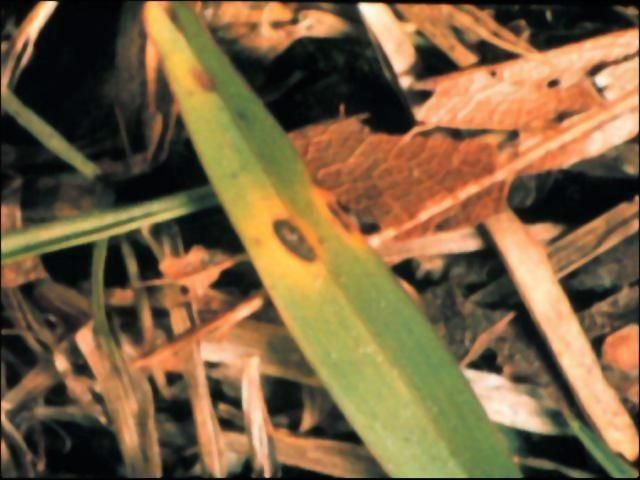
Credit: G. W. Simone
The fungus can be observed with a hand lens. It appears as small, black, cushion-like structures (acervuli) with black spines (setae) extending from the cushion. These structures are found at the base of leaves next to the stem.
Cultural Controls: Proper cultural practices can reduce the risk of Anthracnose. A balanced fertilizer containing equivalent amounts of potassium and nitrogen, preferably a slow-release potassium form, can be applied. This will ensure that potassium deficiency is avoided. Excessive nitrogen application during potential disease development periods should be avoided. Just prior to or during disease development periods, slow-release nitrogen sources should be used as opposed to readily available forms, such as soluble liquids or quick-release nitrogen sources. Irrigation should saturate the root zone so that drought stress is avoided. Irrigation should only occur in the early morning hours (between 2:00 and 8:00 a.m.) when dew is already present. If the diseased areas are associated with compacted soils, alleviating the compaction should be beneficial. Renovation or periodic removal of thatch by mechanical means can reduce the impact of excessive thatch accumulation.
Chemical Controls: There are multiple fungicide options including azoxystrobin, chlorothalonil, fenarimol, fludioxonil, metconazole, myclobutanil, propiconazole, thiophanate methyl, triadimefon, trifloxystrobin, and triticonazole.
The UF/IFAS Extension Electronic Data Information Source (EDIS) website can be referenced for a homeowner's guide to turfgrass fungicides (https://edis.ifas.ufl.edu/pp154). Fungicide labels indicate site application restrictions, as some fungicides cannot be used on residential lawns. Label directions and restrictions for all pesticides must be followed as required by law. The presence of a fungicide on this list does not constitute a recommendation.
The "Turfgrass Disease Management" section of the Florida Lawn Handbook (https://edis.ifas.ufl.edu/lh040) can be referenced for explanations of cultural and chemical controls.