
Because palms can give any landscape a more tropical look, it is understandable that people would attempt to grow them in climates that are decidedly less than tropical. While palms may survive, or even thrive, for years in climates cooler than those to which they are native, eventually they will experience temperatures cold enough to cause injury. This publication describes how cold temperatures affect palms and how to treat them following a cold weather event.
Types of Cold Damage
There are three types of cold weather events that can injure palms. Chilling injury occurs in tropical species at temperatures above freezing and occasionally as high as 50°F. However, the absolute temperature at which chilling injury occurs is less useful as a predictor of damage than the degree of cold acclimation a particular palm has experienced. For instance, a tropical palm acclimated to night temperatures of 70°F, but suddenly subjected to a single night of 45°F may experience some foliar necrosis (dead tissue) as a result. However, if that same palm had experienced gradually decreasing temperatures over a period of weeks, it may not show any cold injury symptoms until exposed to temperatures in the low to middle 30°sF.
Frost (radiational freeze) damage is like chilling injury in its symptoms, but occurs on clear, calm nights when radiational cooling (heat loss) of the leaf surface can cause leaf temperatures to drop to 32°F or less, while air temperatures may be several degrees warmer. The lack of air movement and protection of some parts of the crown from radiational heat loss means that frost damage is often spotty in distribution, both among trees within a landscape and among leaves within a single palm crown.
The third type of cold weather damage is caused by an advective freeze (hard freeze), during which air and plant surface temperatures drop below 32°F because of the presence of winds that cause uniform cooling of all plants and plant parts within the landscape. Although all parts of the palm canopy could theoretically reach the same temperature in an advective freeze, not all parts of the palm will be affected to the same degree. Larcher and Winter (1981) have shown that flowers and fruits are the most sensitive parts of a palm, while the petioles and apical meristem (bud) are the most hardy (Figure 1). The spear leaf tip and the youngest, partially expanded leaves are also hardier than more mature leaves, but the base of the spear leaf is one of the least cold-hardy tissues in a palm. Thus, one of the most common problems associated with advective freezes is that the freeze-killed lower portion of the spear leaf is degraded by secondary fungi and bacteria that were naturally present prior to the freeze. Several weeks after the freeze, the spear leaf can often be pulled out of the palm with little effort, and its base will be mushy and have an offensive odor (Figure 2). The purpose of bud drenches with copper fungicides (discussed below) is to prevent these secondary tissue-rotting microbes from reaching, and eventually killing, the meristem, which is located just below the spear leaf base. Whether meristem rotting is caused by these secondary microbes invading a healthy meristem is not known. Meristem death in severe freezes may be caused by the cold temperatures themselves.
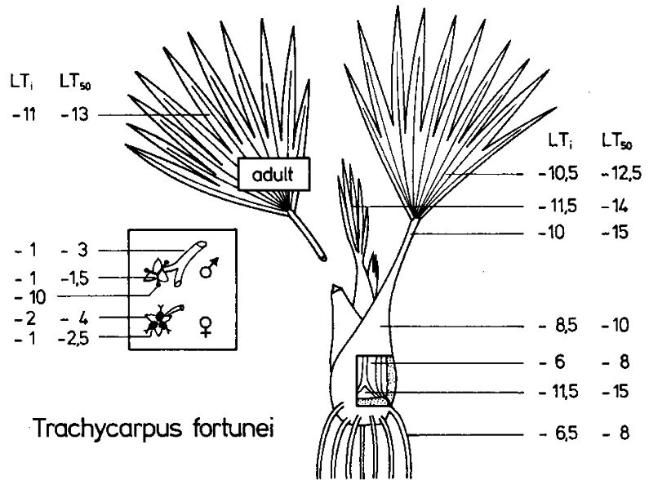
Credit: Larcher and Winter (1981)
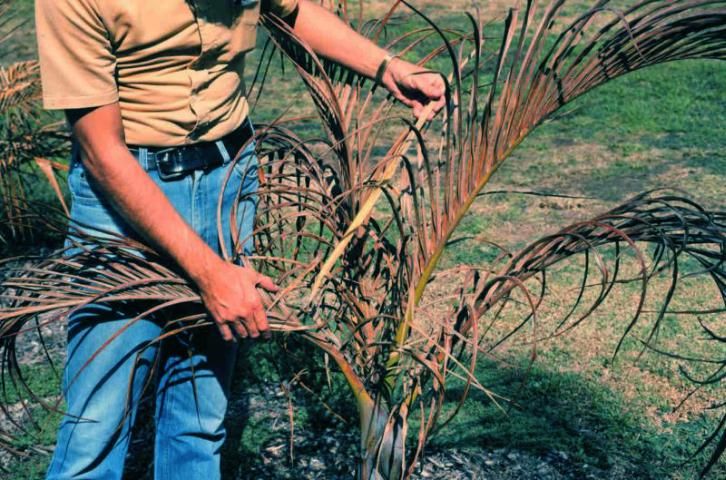
Credit: undefined
Symptoms of Cold Injury
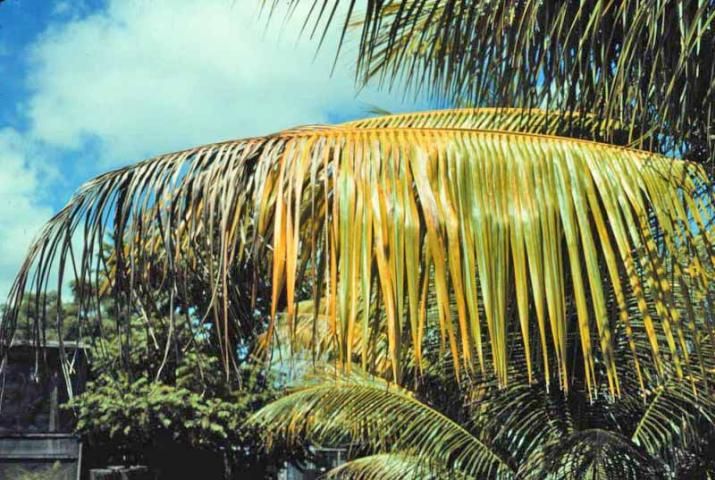
The types of symptoms caused by chilling or freezing temperatures can be similar but occur at different temperatures on different species. Cold injury symptoms include leaflet discoloration and/or necrosis (Figure 3), which occurs within days of the cool or cold weather. Since newly expanded leaves are usually more hardy than mature leaves (Larcher and Winter 1981), the youngest leaves may be unaffected or show only mild symptoms. In coconut palms, younger leaves may show reddish blotches on the upper surfaces of the leaflets (Figure 4), while mature leaves may show extensive necrosis from the base of each leaf to its tip (Figure 5). While potassium deficiency, which is almost ubiquitous in palms in Florida (see Potassium Deficiency in Palms, https://edis.ifas.ufl.edu/publication/ep269 also causes leaflet necrosis, this necrosis is most severe on the oldest leaves toward the leaf tips (Figure 6). Thus, the sudden appearance of extensive leaflet necrosis on mid- and lower-canopy leaves caused by cold temperatures can be easily distinguished from the leaf tip necrosis on the oldest leaves caused by potassium deficiency.
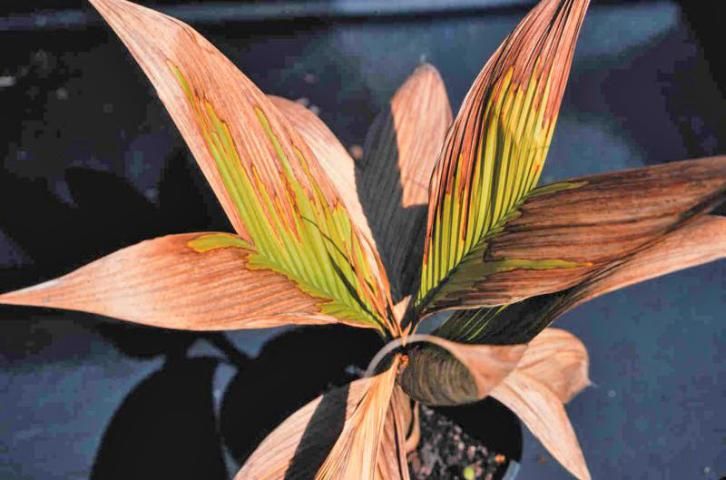
Credit: undefined
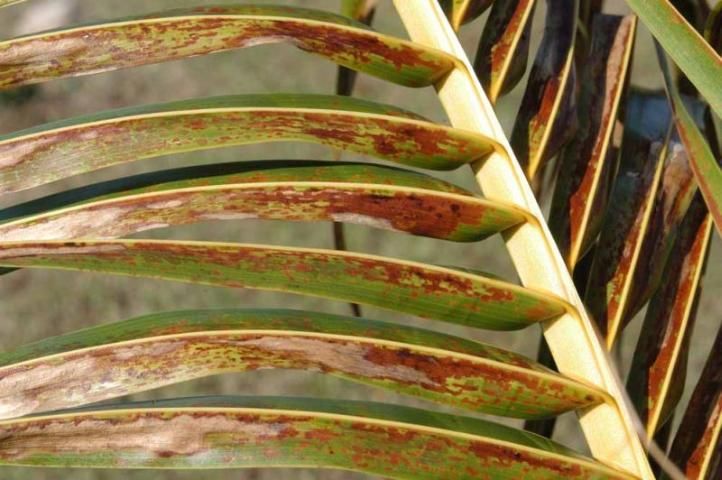
Credit: undefined
Credit: undefined
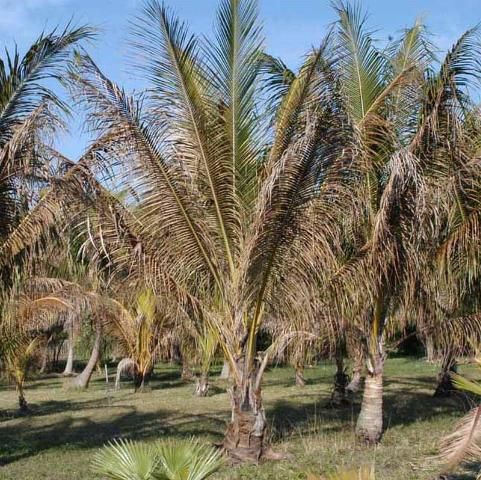
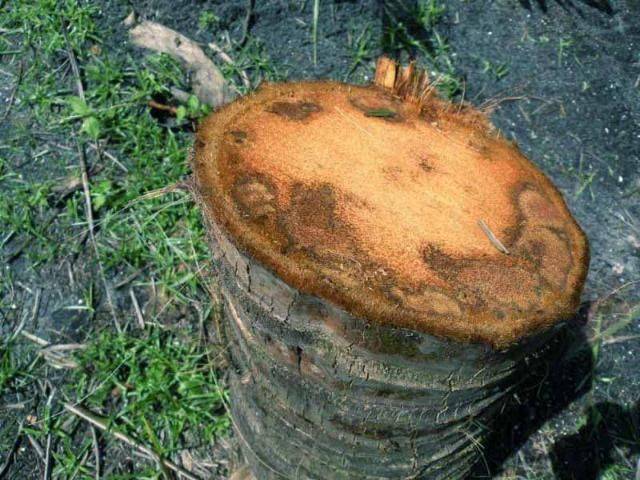
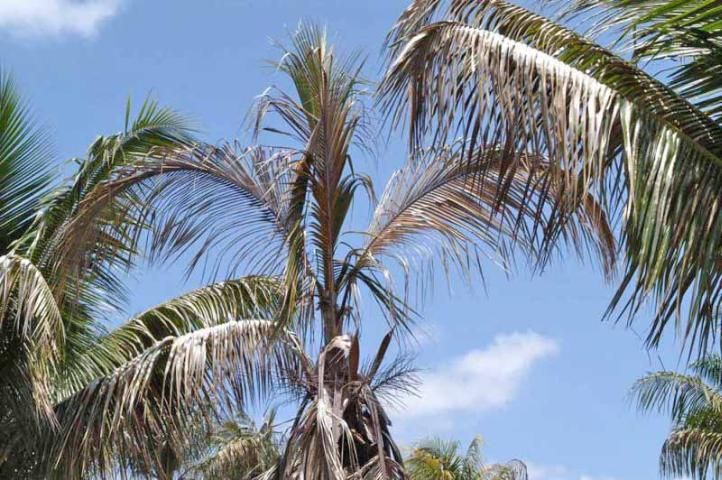
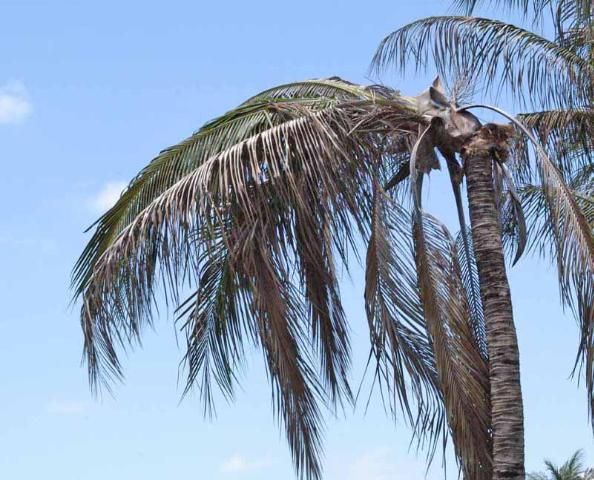
Palm trunks may also be damaged by cold weather, which results in the damaged tissue to be invaded by secondary fungi and/or bacteria that cause trunk decay. Three different types of trunk damage have been observed. While the damage described was observed on specific palm species, similar damage is quite possible on other palm species. Coconut palms subjected to prolonged temperatures in the low to middle 30°sF or below often have soft, sunken, reddish areas on the trunk (Figure 7). These cold-damaged trunk areas are often invaded by secondary fungi and/or bacteria that cause trunk rot. The rotting of the vascular system in the trunk results in leaf wilt (Figure 8) and, eventually, the collapse and toppling of the entire crown (Figure 9). These symptoms appear several months after the cold weather event.
Credit: undefined
Credit: undefined
Credit: undefined
Collapse of palm canopy in coconut palm (C. nucifera) due to secondary rotting of cold-damaged trunk tissue about three months after prolonged chilling temperatures.
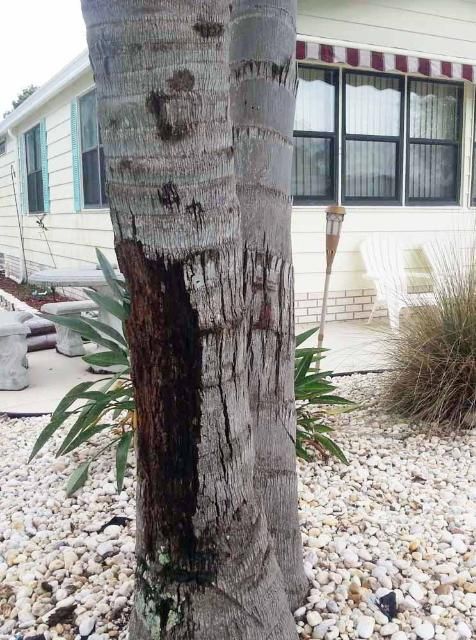
In Christmas palm (Adonidia merrillii) and queen palm (Syagrus romanzoffiana), a slow trunk decay occurs. Sometimes the trunk decay is apparent from the outside as a cracking of the pseudobark, but often it occurs beneath the pseudobark and does not become apparent until the thepseudobark and large portions of the trunk have decayed and fallen off (Figure 10). In other cases, the canopy wilts, and collapses (due to destruction of the vascular tissue) or the trunk collapses (lack of structural integrity). In either case, the palms usually live for at least two years, and often longer, before the problem becomes apparent, and no fungal growth is ever observed.
Credit: undefined
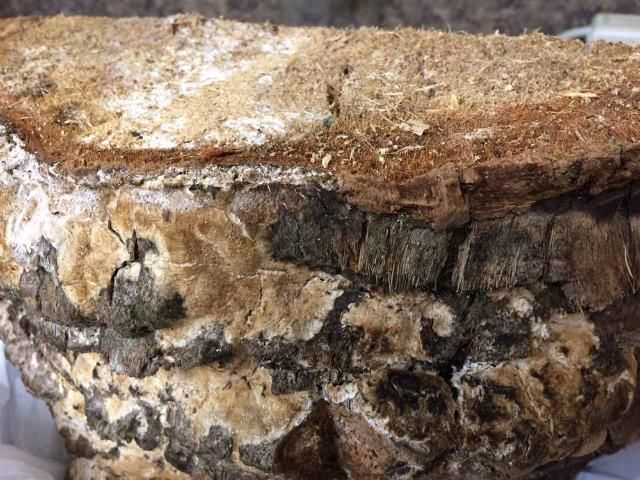
Trunk damage to date palms (Phoenix dactylifera) occurs in yet a different manner. Again, secondary fungi invade the damaged trunk tissue, but the fungus causing the decay is often observed on the outside of the trunk (Figure 11). These fungi are not pathogens (fungi infecting healthy trunk tissue), but saprophytes (fungi using damaged tissue as a food source). One of these fungi has been identified as a Ceriporia sp., a white rot crust fungus that destroys lignin within the trunk. Lignin is the compound which provides most of the structural strength in palm trunks. Thus, if the lignin is destroyed (even in a dead or dying palm), the palm trunk loses its structural integrity and collapses.
Credit: Sheila Dunning
Factors Affecting Palm Cold Hardiness
It is well known that palm species differ greatly in their cold hardiness. Meerow (2005) provides horticultural information about those palm species that are known to be relatively cold hardy. For any palm, planting them in areas protected by buildings or tree canopies can increase their chances of survival during cold weather. Recent studies have also demonstrated that proper fertilization can improve cold hardiness of palms. Broschat (2010) found that necrosis caused by chilling temperatures in coconut palms was significantly less in palms fertilized routinely with an 8N-2P2O5-12K2O-4Mg plus micronutrients palm fertilizer than in unfertilized palms (Table 1). See Fertilization of Field-grown and Landscape Palms in Florida (https://edis.ifas.ufl.edu/publication/ep261) for more information about palm fertilization. Although not documented experimentally, there is anecdotal evidence that over trimming can also reduce palm survival rates following cold weather events.
Treatment of Cold-Damaged Palms
Since foliar necrosis is one of the first and most conspicuous symptoms associated with cold damage, palm owners are often anxious to trim off these necrotic or mostly necrotic leaves following a cold weather event. Avoid the temptation to remove these leaves until the danger of additional cold weather has passed. Even dead leaves provide some insulative value to the palm meristem.
If the cold weather was sufficient to kill the spear leaf base and the spear leaf can easily be pulled out, it may be helpful to remove the spear leaf to allow for air movement and drying of the tissue. Drenching the bud area with a copper fungicide (not a copper nutrient spray or drench) to reduce the chances of secondary microbes killing the meristem may also be helpful. Whether or not such practices improve palm survival has never been scientifically tested. If the spear leaf does not pull out easily, it is likely that the spear leaf base has survived, and since the meristem is much hardier than the spear leaf base, it too should be alive. Fungicide treatment of such palms is probably unnecessary.
If applying a copper fungicide, follow the label. The label is the law. Avoid the use of water-soluble compounds such as copper sulfate unless they have been neutralized according to the label. Water-soluble copper compounds are phytotoxic when applied to palm foliage. Copper fungicides are recommended over other fungicides because they are active against both bacteria and fungi. The purpose of using these fungicides on cold-damaged palms is not to control a specific disease, but to inhibit fungal and bacterial degradation of damaged plant tissue.
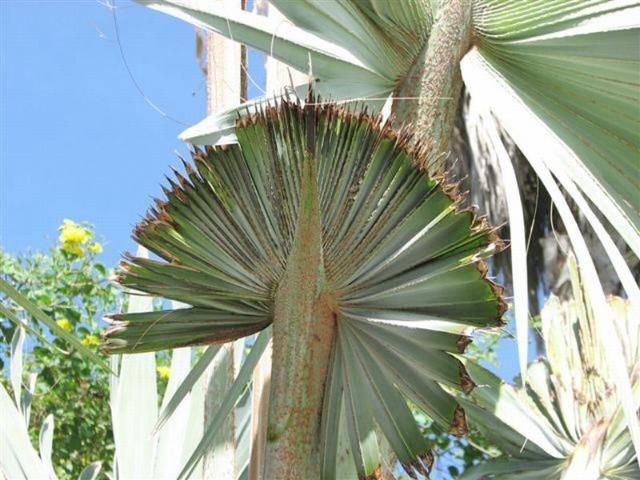
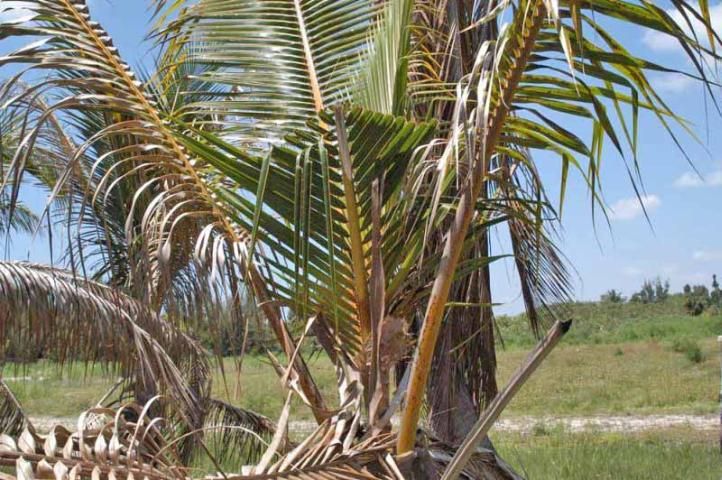
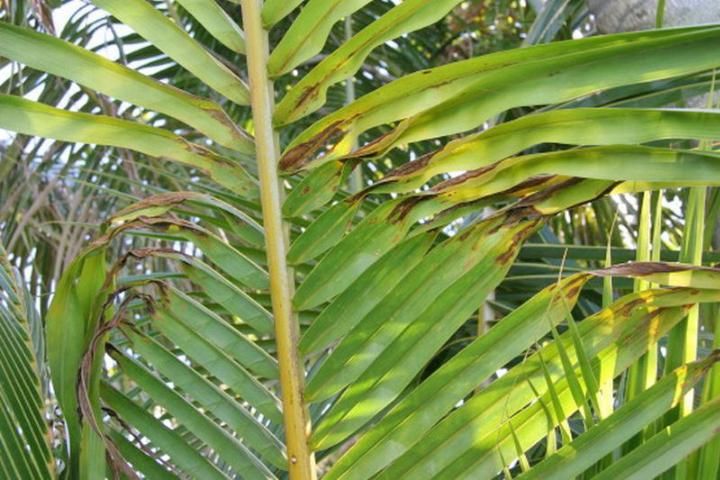
Once warm weather returns and growth resumes, newly emerging leaves often have truncated leaf tips (Figures 12 and 13) or even necrotic leaflets in the middle of a leaf (Figure 14). If the rachis itself has been severely damaged on this leaf, the otherwise healthy leaf tip may fall off. This type of damage occurred on the primordial leaves prior to their emergence and expansion. Subsequent leaves are usually normal in appearance.
Credit: undefined
Credit: undefined
Credit: undefined
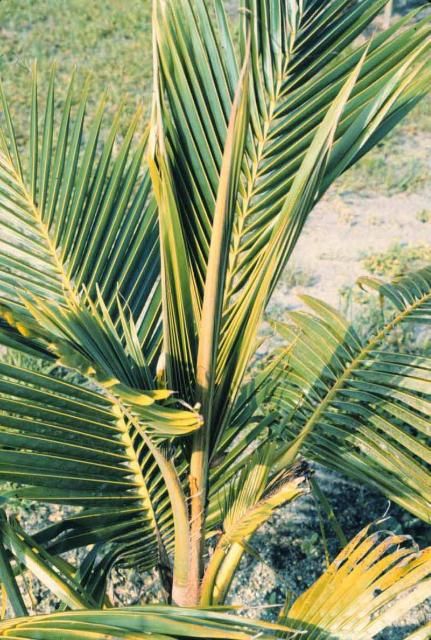
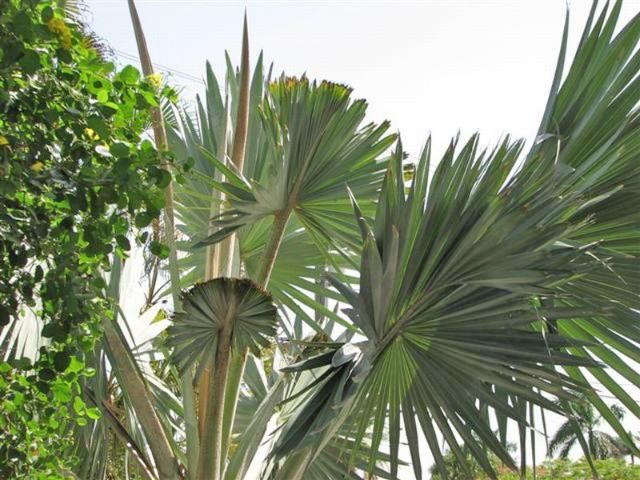
Sometimes new leaves show symptoms of micronutrient deficiencies, such as manganese deficiency (Figure 15) (see Manganese Deficiency in Palms, https://edis.ifas.ufl.edu/publication/ep267) or boron deficiency (Figure 16) (see Boron Deficiency in Palms, https://edis.ifas.ufl.edu/publication/ep264). These deficiencies are likely the result of cool soil temperatures that occurred about four months prior to the emergence of the affected leaves and slowed the rate of nutrient absorption by the roots. As soil temperatures warm up, these deficiencies typically are resolved without supplemental fertilization. Some people have advocated foliar sprays with micronutrient fertilizer blends following cold weather events to help correct these problems. However, since most of the foliage will be necrotic following a cold temperature event, the uptake of nutrients through the leaves is minimal at best. Routine applications of a complete landscape palm fertilizer (see Fertilization of Field-grown and Landscape Palms in Florida, https://edis.ifas.ufl.edu/publication/ep261, for specific recommendations) are more helpful in preventing these cold-induced deficiencies; the fertilizer also enhances palm cold hardiness.
Credit: undefined
Credit: undefined
References
Broschat, T. K. 2010. "Fertilization improves cold tolerance in coconut palm." HortTechnology 20:852–855.
Larcher, W. and A. Winter. 1981. Frost susceptibility of palms: Experimental data and their interpretation. Principes 25:143–52.
Meerow, A. W. 2005. Betrock's cold hardy palms. Davie, FL: Betrock Info. Systems.
Table 1. Effects of fertilization with an 8N-2P2O5-12K2O-4Mg fertilizer on potassium deficiency severity and chilling injury severity in coconut palms after chilling events during 2008–2010. Potassium deficiency severity was quantified by number of leaves and chilling injury severity by percent necrosis of canopy foliage, number of fruits retained, and green leaves remaining.