University of FloridaSolutions for Your Life

Download PDF
Publication #HS559

Bean, Wild Mung — Vigna vexillata (L.) A. Rich1

James M. Stephens2

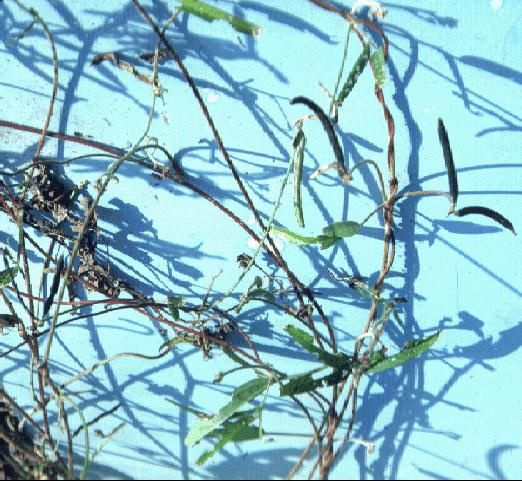
This plant has many scientific names. In trials at Gainesville in 1984 it resembled a plant somewhere between a Southern pea and a mung bean. The long trailing vines have narrow, pointed, bean-like leaves. Pods and seeds resemble mung beans, and the roots are nodulated.

USE

Because of its tuberous roots rather than its pods, the wild mung is held in fairly high esteem in some parts of the world. In Africa, the roots are eaten in times of severe hunger. It grows wild in the Himalayas and in the foothills of India. The tubers are soft, easy to peel, and possess a creamy, white, tasty interior. They are eaten boiled or raw. Protein content of the tubers is near the 15% level, which is high compared to the 1-7% for potatoes and yams.

Figure 1. 

CULTURE

In Florida trials only the production of the pods and seeds was observed. Very little has been reported on the edibility of the seeds. At Gainesville, it was seeded about September 1 and produced pods through November and December. Culture was similar to that used for most garden vegetables.
Footnotes

1.

This document is HS559, one of a series of the Horticultural Sciences Department, Florida Cooperative Extension Service, Institute of Food and Agricultural Sciences, University of Florida. Original publication date May 1994. Revised March 2009. Reviewed January 012. Visit the EDIS website at http://edis.ifas.ufl.edu.

2.

James M. Stephens, Professor, Horticultural Sciences Department, Cooperative Extension Service, Institute of Food and Agricultural Sciences, University of Florida, Gainesville FL 32611.


The Institute of Food and Agricultural Sciences (IFAS) is an Equal Opportunity Institution authorized to provide research, educational information and other services only to individuals and institutions that function with non-discrimination with respect to race, creed, color, religion, age, disability, sex, sexual orientation, marital status, national origin, political opinions or affiliations. For more information on obtaining other extension publications, contact your county Cooperative Extension service.

U.S. Department of Agriculture, Cooperative Extension Service, University of Florida, IFAS, Florida A. & M. University Cooperative Extension Program, and Boards of County Commissioners Cooperating. Nick T. Place, Dean.