
- Topics: Horticultural Sciences | Cardoon | MINOR VEGETABLES | Stephens, James M | Cardoon (HS)

James M. Stephens2
Cardoon is similar to the globe artichoke. With cardoon the young tender leaves and undeveloped tender flower stalks are eaten rather than the flower bud. The thistle-like cardoon plant grows to a height of 3-5 feet and spreads over an area 6 feet in diameter.
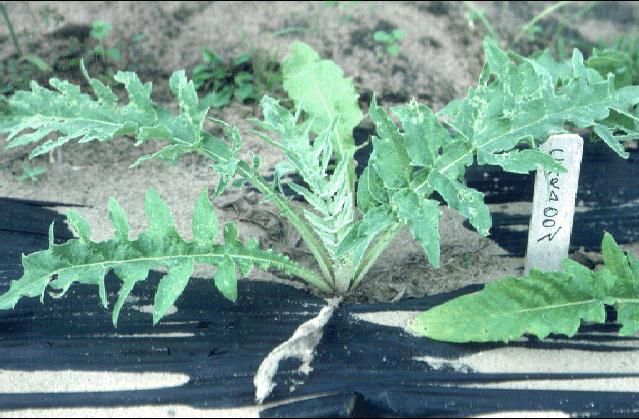
Florida summers are rather warm for cardoon to grow properly; therefore, it should be started in the fall or winter so that it develops in the cooler months. Freezing temperatures below 28°F may kill the aboveground parts of tender nonacclimatized cardoon. It has withstood 18°F at Gainesville.
Propagation is by seeds, suckers, or root division. In addition to a proper climate, cardoon requires a rich soil or abundant fertilizer and plenty of water. Blanching of the stalks before harvest is desired. This is accomplished by tying up the outer branches a foot or so from the top of the plant and piling soil up around the plant as it grows.
There are several uses for cardoon. The most popular way to prepare it is to cook the leaves and tender stalks together. Cardoon may also be eaten fresh and uncooked in salads. Some say it has gentle laxative properties.
This document is HS574, one of a series of the Horticultural Sciences Department, Florida Cooperative Extension Service, Institute of Food and Agricultural Sciences, University of Florida. Original publication date May 1994. Revised March 2009. Reviewed January 2012. Visit the EDIS website at http://edis.ifas.ufl.edu.
James M. Stephens, Professor, Horticultural Sciences Department, Cooperative Extension Service, Institute of Food and Agricultural Sciences, University of Florida, Gainesville FL 32611.
The Institute of Food and Agricultural Sciences (IFAS) is an Equal
Opportunity Institution authorized to provide research, educational
information and other services only to individuals and institutions
that function with non-discrimination with respect to race, creed,
color, religion, age, disability, sex, sexual orientation, marital
status, national origin, political opinions or affiliations.
For more information on obtaining other extension publications,
contact your county Cooperative Extension service.
U.S. Department of Agriculture, Cooperative Extension Service,
University of Florida, IFAS, Florida A. & M. University Cooperative
Extension Program, and Boards of County Commissioners Cooperating. Nick T. Place,
Dean.
