


Cushcush—Dioscorea trifida L.1
Cushcush is one of the lesser known cultivated species of tropical yam. Other common names are yampi (Jamaica), aja (Cuba), maona (Peru), mapuey (Puerto Rico), and cara doce (Brazil). Cushcush is native to the Caribbean where it is known as the best of the yams because of its flavor and cooking qualities.
In general, yams have never become as important a staple food in the Americas as they have in Africa, Asia, and the Pacific Islands because the same food purposes are served by sweet potatoes, cassava, and coco-yams. Cushcush is used throughout South America, Trinidad, and the West Indies, but not as a staple owing to the presence of cassava. It is highly probable that cushcush could be grown in Florida, but at present it is rarely grown or recognized by gardeners. Vines of other Dioscorea species are grown as ornamentals that do well in North and South Florida.
Credit: Mvh57, CC BY-SA 3.0
Description
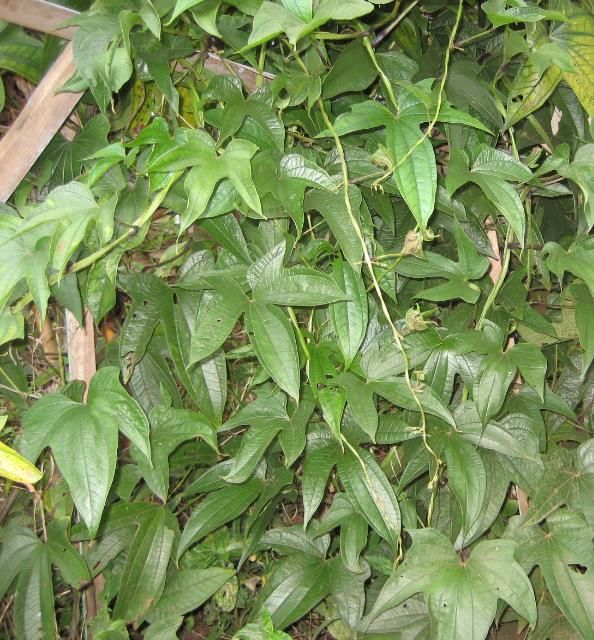
The cushcush plant is a perennial vining plant that produces an edible underground tuber. From 5 to 12 stems normally rise from a mature cushcush plant. The stems are distinguished from other yams by having from 2 to 8 membranous wings per stem. These wings may serve as external support for the stems or to help them climb.
The alternate leaves are large, up to 10 inches in length and width, and from light to dark green. Unlike the smooth heart-shaped leaves of many yams, cushcush leaves are deeply and sharply divided into three to seven pointed segments, with the middle one having three veins. Male and female flowers are produced on separate plants. Tiny flowers are borne on long slender branches called racemes. The nonedible fruits are three-winged capsules, with a seed in each wing.
The main edible parts of the plant are the tubers. These tubers are produced as enlargements at the ends of runners (stolons), which attach to the base of the crown. Although the tubers resemble roots and are often covered with adventitious fibrous roots, they do not have the internal structure of roots. Tubers vary in shape. The common forms are spherical or club-shaped, horse-hoof-shaped, and horse-hoof- shaped with a central cleft (clavate).
The outside skin of the starchy tubers is thin and smooth, with a few elongated cracks. The white internal color is sometimes tinged with yellow and purple pigments. Purple-fleshed varieties are also known.
Culture
Varieties of cushcush have been named, but the majority have not been described. Varietal names include 'Patte a Cheval,' 'IRAT-50,' 'Mapuey Largo,' 'Genuina,' 'Cousse-Couche Violette,' 'Cousse-Couche Rouge,' and 'IRAT-24.' Cushcush, like other tropical yams, is perennial, surviving adverse seasons via the tubers. It is best produced as an annual planted early in the spring and harvested 10 to 11 months later. It is a warm season crop and does not tolerate below freezing temperatures.
Growing cushcush is similar to growing potatoes, except for trellising. Plant small, whole tubers or large tubers cut into 2-ounce pieces. Pieces taken from the upper portion of the tuber have more eyes and produce more stems and tubers than do seedpieces taken lower on the tuber. Because of the vining habit of the plants, stakes 6 to 9 feet in length are used. Weak stakes and poorly supported trellises will be pulled down by the vigorous vines.
Harvesting and Use
Harvest of tubers follows planting by about 10 to 11 months in climatic areas similar to South Florida. The foliage dies back when tubers are about ready to be dug. Spade or fork them out of the soil much as you would potatoes. Yields of cushcush tend to be much lower than for other forms of yam, such as D. alata. The tubers, which contain 7% protein and 38% starch, may be baked whole or peeled and cut for boiling.