
Gherkin, West Indian—Cucumis anguria L.1
The West Indian gherkin is also known as burr cucumber, Jerusalem cucumber, and (erroneously) gooseberry gourd. It is related to the cucumber, which it resembles in many aspects such as fruit and vine characteristics.
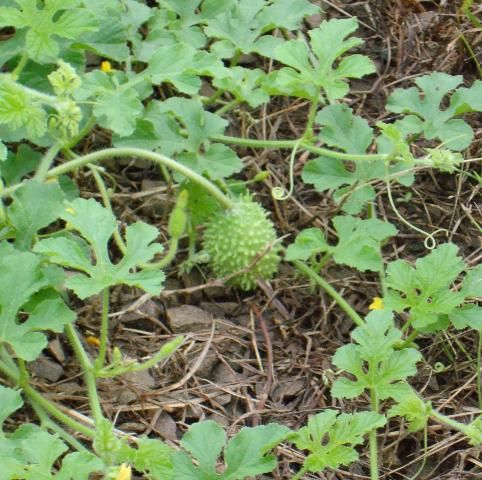
Description
The gherkin plant is a trailing vine, 5–10 feet long. The stem is angular, ridged, and hairy; internodes are 2–3 inches long. At each node, a 1–2 inch long curling tendril forms, along with two to four pale yellow male flowers, a leaf petiole, and occasionally a fruiting branch. At some nodes, adventitious rooting occurs. Female flowers are borne only on these secondary fruiting branches rather than from a pedicel directly from the node. The small, deeply cut, five-lobed leaves are similar to those of the watermelon.
Culture
Gherkin is grown occasionally in home gardens throughout Florida in a manner similar to that for cucumber. Since the plant is sensitive to frosts and cold temperatures, it may be grown only during the warm seasons. The time from seeding to harvest is 60–75 days. Seeding in early September gives particularly good results in Florida gardens.
Use
The fruits are used mainly for pickling. They are oblong-oval (like a blunt-ended football) in shape, and range from 1 to 3 inches long. Each of the fruits is light green and very spiny. Each fruit is filled with tiny seeds shaped like those from cucumber.
Other Similar Gourds
Owing to similarity of fruits, West Indian gherkins are sometimes confused with other members of the gourd family, such as teasel or hedgehog gourd (C. dipaceus), gooseberry gourd (C. myriocarpus), and horned cucumber (C. metuliferus).
Hedgehog gourd fruits are densely spined and are about 3-inches long. The light green fruits turn yellow when mature. Gooseberry gourds are also densely spined, but are only 1-inch long and have light ivory-colored stripes on a dark green background. The fruits turn yellow when mature. Horned cucumbers are larger than the other two, measuring 5-inches long by 3-inches in diameter. Spines are less numerous, but are longer and sharper and, in fact, quite formidable in appearance. The greenish gray fruits, which turn reddish orange on maturity, are reported to be eaten in Africa.