


Pea, Pigeon—Cajanus cajan (L.) Millsp.1
Pigeon pea is also called Congo pea, no-eye pea, red gram, arhur, urhur, grandul, dhal, toor, Gunds pea, and alverja.
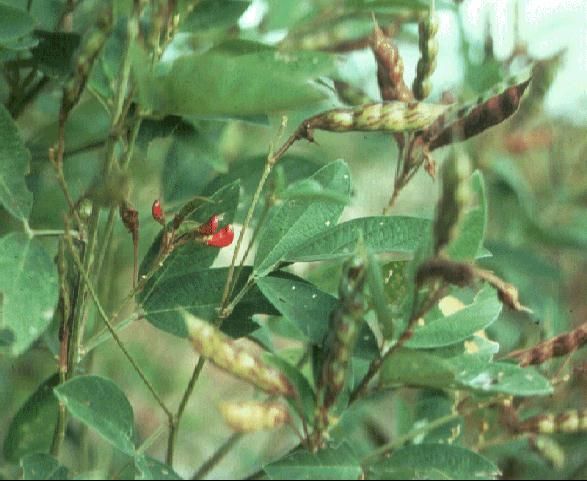
Credit: James M. Stephens, UF/IFAS
This pea-like legume is widely propagated in the tropics for the edible seeds and pods. Although an important food plant in the West Indies, they are not grown in gardens or commercially to any great extent in the United States. However, in 1950 there was a report of 10,000 acres of pigeon peas in Hawaii.
Description
The pigeon pea plant is an erect annual or short-lived perennial reaching a height of 3–10 feet. Because the coarse bush is deeply rooted, it has wide adaptability and grows well on semiarid land. It has slender, pointed trifoliate leaves and yellow or yellow and red flowers. Pods are similar to English peas, green and pointed with a bit of reddish mottling. Several pods are produced in clusters on an upright stem.
Culture
Seeds of pigeon pea are sown at the rate of 8–10 pounds per acre in rows 3–4 feet apart and thinned to 12–18 inches between plants. Some types are killed by frost, while certain selections appear to be hardy. Yields as high as 35 tons of green matter per acre and 30 bushels of seed per acre have been obtained in other areas of the world. In Florida, plant in late spring (May) and harvest in the late fall (October–November).
Use
Some of the most common uses for pigeon pea are as human food, fodder, browse plants, green manure, and a grain cash crop. The flavorful seeds are eaten both as fresh shell beans and as dry beans.