


Soybeans, Edible—Glycine max (L.) Merr.1
The soybean primarily is known and grown in the United States as a field crop for forage, feed, and oil. Few Americans think of it as a vegetable, but this has been its use in Asia for over 1000 years. It is becoming more popular as a garden vegetable throughout Florida and the rest of the country.
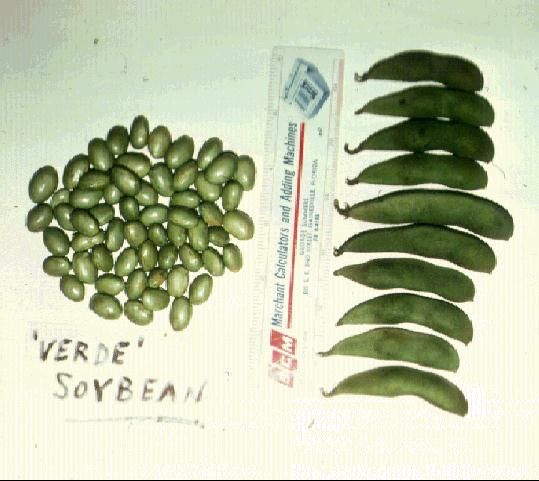
Credit: James M. Stephens, UF/IFAS
Description
The varieties suitable for vegetable use are different from those for field crops. Seedsmen in the United States now list vegetable varieties such as 'Bansei,' 'Fuji,' 'Verde,' and 'Seminole.' Varieties tested in Florida include 'Verde,' 'Disoy,' 'Bansei,' and 'Giant Green.' All of these make good green crops and produce many pods suitable for fresh table usage. The pods must be harvested when the beans are in a mature green stage. As they mature, fungus diseases become quite destructive. Anyone wanting to save seed in Florida would have problems.
Culture
The culture in Florida of edible soybeans should follow very closely that for lima beans. Soybeans should be planted in early spring in rows 2½ feet apart with 2 to 3 inches between plants. Fall production is also feasible.
Use
Edible soybeans are particularly suited as a fresh vegetable because of their good taste and high nutritional value. Tests on 'Bansei' and 'Disoy' showed fat at 18 to 20% and protein at 38%. One use as a vegetable is to boil the pods whole, then shell, and enjoy the seeds. Edible soybeans also make excellent bean sprouts. In many restaurants, the bean pods are extremely popular as an appetizer and are known as edameme.