
University of FloridaSolutions for Your Life

Download PDF
Publication #PI-83

IRAC's Insecticide Mode of Action Classification1

Frederick M. Fishel2

This guide explains the rationale behind the Insecticide Resistance Action Committee's (IRAC) insecticide and acaricide mode of action classification and provides a listing of those insecticide common names with their groupings and primary modes of action for insecticides currently registered in Florida.

What is IRAC?

IRAC has groups formed in several countries, including the United States, Brazil, South Africa, Spain, India, and Australia. The group's purpose is to communicate and educate agricultural producers and crop protection professionals by providing resistance management information. Members of an IRAC group are generally professionals who are actively engaged in the insecticide and acaricide manufacturing industry. Some university researchers also participate.

Resistance to Pesticides

Resistance refers to an inheritable change in the sensitivity of a pest population that is reflected in the repeated failure of a product to achieve the expected level of control when used according to the label recommendation for that pest species. Resistance does not always occur, but has been documented with insecticides as early as 1914. There are many known instances today where resistance is a problem. Not only has resistance occurred with insecticides but also with other pesticides, such as fungicides, herbicides, and rodenticides. Complicating the understanding and management of resistance is the problem of knowing which type of resistance is present in a given pest population. For example, some pest populations are known to have cross-resistance. That is, they are not effectively controlled with pesticides having the same mode of action that generally targets the same site within the pest. For example, both the carbamate and organophosphate insecticides target acetylcholine esterase, although each group of insecticides is chemically different from one another. The greatest resistance concern arises when multiple-resistance is confirmed. Multiple-resistance is the situation of a pest population that is resistant to pesticides having different modes of action. It is the most difficult type of resistance to manage because the number of management options is reduced. For more information on resistance, see UF/IFAS EDIS Document ENY-624, 2011 Florida Citrus Pest Management Guide: Pesticide Resistance and Resistance Management, http://edis.ifas.ufl.edu/cg026.

IRAC's Classification Scheme

IRAC's insecticide classification scheme is based on mode of action. The goal of the scheme is to provide information to applicators of acaricides and insecticides so that they can make sound decisions on selecting insecticides to prevent or manage resistance. Besides selecting products that have different modes of action, growers are also encouraged to integrate other methods into insect and mite control programs. Table 1 contains those acaricides and insecticides registered for use in Florida, though it changes constantly. They are listed according to IRAC's classification scheme by their group and subgroup codes, primary target site of action, chemical sub-group or exemplifying active ingredient, and active ingredient, based on that appearing in The Pesticide Manual, 15th edition, 2009, edited by C.D.S. Tomlin, published by The British Crop Protection Council.

Using the IRAC Classification Scheme with Product Labels

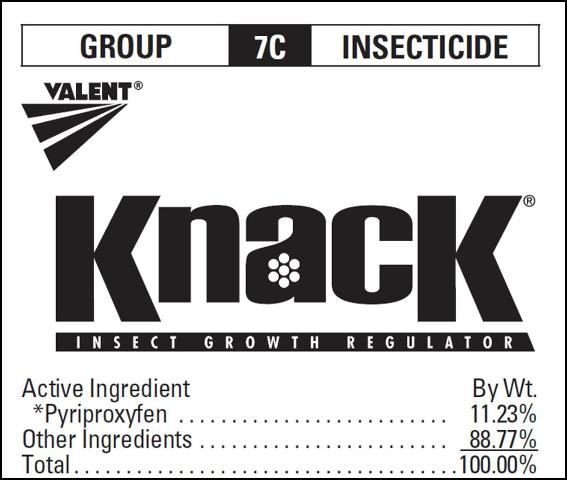
IRAC is currently encouraging manufacturers of pesticides to indicate the IRAC mode of action group number and description on their product labels; some registrants are now doing so, especially with newer products. Such information would be helpful in assisting pesticide applicators in the selection of acaricides and insecticides for use in resistance management strategies. An example of the manner that IRAC is encouraging registrants to list this information is as follows:

Figure 1. 

Additional Information

IRAC: http://www.irac-online.org/groups/guide/

Rogers, M.E., and M. M. Dewdney. 2010. 2011 Florida citrus pest management guide: pesticide resistance and resistance management. UF/IFAS EDIS Document ENY-624. http://edis.ifas.ufl.edu/cg026.

Tomlin, C.D.S. Ed. 2009. The pesticide manual. 15th edition, The British Crop Protection Council. 1250 pp., ISBN 1 901396 13 4.

Tables

Table 1. 

IRAC's classification scheme for acaricides and insecticides registered for use in Florida.

Group

Subgroup

Primary target site of action

Chemical subgroup or exemplifying active ingredient

Active ingredients

1*

1A

Acetylcholine esterase inhibitors

Carbamates

Aldicarb

Bendiocarb

Carbaryl

Carbofuran

Methiocarb

Methomyl

Oxamyl

Propoxur

Thiodicarb


1B


Organophosphates

Acephate

Azinphos-methyl

Chlorpyrifos

Chlorpyrifos-methyl

Coumaphos

Diazinon

Dichlorvos

Dicrotophos

Dimethoate

Disulfoton

Ethion

Ethoprop

Fenamiphos

Fenthion

Fosthiazate

Isofenphos

Malathion

Methamidophos

Methidathion

Methyl parathion

Naled

Oxydemeton-methyl

Phorate

Profenofos

Propetamphos

Temephos

Terbufos

Tetrachlorvinphos

Trichlorfon


2

2A

GABA-gated chloride channel antagonists

Cyclodiene organochlorines

Endosulfan


2B


Phenylpyrazoles (Fiproles)

Fipronil

3*

3A

Sodium channel modulators

Pyrethroids

Pyrethrins

Allethrin and isomers

Bifenthrin and isomers

Cyfluthrin and isomers

Cyhalothrin and isomers

Cypermethrin and isomers

Cyphenothrin

Deltamethrin

Esfenvalerate

Fenpropathrin

Fenvalerate

Imiprothrin

Permethrin

Phenothrin

Prallethrin

Pyrethrins (pyrethrum)

Resmethrin

Tefluthrin

Tetramethrin

Tralomethrin


3B


Methoxychlor

Methoxychlor

4

4A

Nicotinic acetylcholine receptor agonists

Neonicotinoids

Acetamiprid

Clothianidin

Dinotefuran

Imidacloprid

Thiamethoxam


4B


Nicotine

Nicotine

5

Nicotinic acetylcholine receptor allosteric activators

Spinosyns

Spinetoram

Spinosad

6

Chloride channel activators

Avermectins,

Milbemycins

Abamectin

Emamectin benzoate

Milbemectin

7

7A

Juvenile hormone mimics

Juvenile hormone analogues

Hydroprene


Kinoprene

7B

Fenoxycarb

Fenoxycarb

7C

Pyriproxyfen

Pyriproxyfen

8

8A

Miscellaneous non-specific (multi-site) inhibitors

Alkyl halides

Methyl bromide and other alkyl halides


8B


Chloropicrin

Chloropicrin


8C


Sulfuryl fluoride

Sulfuryl fluoride

8D

Borax

Borax

10

10A

Mite growth inhibitors

Clofentezine

Hexythiazox

Clofentezine

Hexythiazox


10B


Etoxazole

Etoxazole

11

Microbial disruptors of insect midgut membranes (includes transgenic crops expressing B.t. toxins)

Bacillus thuringiensis or Bacillus sphaericus and the insecticidal proteins they produce

Bacillus thuringiensis subsp. israelensis

Bacillus sphaericus

Bacillus thuringiensis subsp. Kurstaki

Bt crop proteins

12

12B

Inhibitors of mitochondrial ATP synthase

Organotin miticides

Fentutatin oxide


12C


Propargite

Propargite

13

Uncouplers of oxidative phosphorylation via disruption of the proton gradient

Chlorfenapyr

Chlorfenapyr

15

Inhibitors of chitin biosynthesis, type 0, Leptdopteran

Benzoylureas

Diflubenzuron

Hexaflumuron

Lufenuron

Novaluron

Noviflumuron

16

Inhibitors of chitin biosynthesis, type 1

Buprofezin

Buprofezin

17

Moulting disruptor, Dipteran

Cyromazine

Cyromazine

18

Ecdysone receptor agonists

Diacylhydrazines

Halofenozide

Methoxyfenozide

Tebufenozide


19

Octopamine receptor agonists

Amitraz

Amitraz

20*

20A

Mitochondrial complex III electron transport inhibitors

Hydramethylnon

Hydramethylnon

20B

Acequinocyl

Acequinocyl

21*

21A

METI acaricides and insecticides

Fenazaquin

Fenazaquin

Fenpyroximate

Pyridaben

Tolfenpyrad

21B

Mitochondrial complex I electron transport inhibitors

Rotenone

Rotenone

22*

22A

Voltage-dependent sodium channel blockers

Indoxacarb

Indoxacarb

22B

Metaflumizone

Metaflumizone

23


Inhibitors of acetyl CoA carboxylase

Tetronic and tetramic acid derivatives

Spirodiclofen

Spiromesifen

Spirotetramat

24

24A

Mitochondrial complex IV electron transport inhibitors

Phosphine

Aluminum phosphide

Phosphine

Zinc phosphide

28

Ryanodine receptor modulators

Diamides

Chlorantraniliprole

Flubendiamide

UN

Compounds of unknown or uncertain mode of action@

Azadirachtin

Azadirachtin

Bifenazate

Bifenazate

Cryolite

Cryolite

Dicofol

Dicofol

Pyridalyl

Pyridalyl

*Groups and Sub-groups: Although sharing the same primary target site, it is possible that not all members of a single mode of action class have been shown to be cross-resistant. Different resistance mechanisms that are not linked to the target site, such as enhanced metabolism, may be common for such a group of chemicals. In such cases, the mode of action grouping is further divided into sub-groups.

@A compound with an unknown or controversial mode of action or an unknown mode of toxicity will be held in category UN until evidence becomes available to enable that compound to be assigned to a more appropriate mode of action class.

Footnotes

1.

This document is PI-83, one of a series of the Pesticide Information Office, Florida Cooperative Extension Service, Institute of Food and Agricultural Sciences, University of Florida. Original publication date October 2005. Revised April 2011. Visit the EDIS website at http://edis.ifas.ufl.edu.

2.

Frederick M. Fishel, associate professor, Agronomy Department, and director, Pesticide Information Office; Florida Cooperative Extension Service, Institute of Food and Agricultural Sciences, University of Florida, Gainesville, FL 32611.

The use of trade names in this publication is solely for the purpose of providing specific information. UF/IFAS does not guarantee or warranty the products named, and references to them in this publication do not signify our approval to the exclusion of other products of suitable composition. Use pesticides safely. Read and follow directions on the manufacturer's label.


The Institute of Food and Agricultural Sciences (IFAS) is an Equal Opportunity Institution authorized to provide research, educational information and other services only to individuals and institutions that function with non-discrimination with respect to race, creed, color, religion, age, disability, sex, sexual orientation, marital status, national origin, political opinions or affiliations. For more information on obtaining other extension publications, contact your county Cooperative Extension service.

U.S. Department of Agriculture, Cooperative Extension Service, University of Florida, IFAS, Florida A. & M. University Cooperative Extension Program, and Boards of County Commissioners Cooperating. Nick T. Place, Dean.