
Sucrose Accumulation Maturity Curves for CP 88-1762
Introduction
Sugarcane (a complex hybrid of Saccharum spp.) is harvested during a five-month period (October to March) in south Florida. "Early maturing" cultivars milled in October or November may not have reached their peak sucrose content but may have higher sugar per ton (SPT, lb sucrose per ton of sugarcane biomass) than other cultivars at the onset of milling operations (Miller and James 1977). Under current industry milling capacities, harvesting the 397,000 acres of Florida sugarcane takes roughly five to six months. Unavoidably, sugarcane plants harvested during the early harvest period have not yet achieved maximum sugar content. Consequently, sugar content for any given cultivar will change over the course of the harvest season, which can impact the profitability of the harvest. Maturity curves of SPT vs. time have been developed for sugarcane cultivars in South Africa (Bond 1982), Louisiana (Legendre and Fanguy 1975; Legendre 1985; Richard et al. 1981), and Mauritius (Mamet and Galwey 1999). Although it is known that sucrose accumulation rates vary between varieties, maturity curves for "CP" sugarcane cultivars (those developed at the USDA-ARS Sugarcane Field Station in Canal Point, Florida) have not been reported since 1977 (Rice 1974; Miller and James 1977). CP cultivars occupy more than 85 percent of Florida sugarcane acreage (VanWeelden et al. 2020), and are also economically important (Tew 2003) in many countries, including Argentina (25% of total acreage), Belize (16%), El Salvador (50%), Guatemala (65%), Honduras (47%), Mexico (15%), Morocco (54%), Nicaragua (75%), Senegal (9%), and Venezuela (9%). Since most sugarcane growers in Florida plant a diverse selection of cultivars, these maturity curves are needed as tools to help growers make informed choices regarding harvest scheduling decisions.
This publication presents the sucrose accumulation maturity curves for different crop ages (plant cane, first ratoon, and second ratoon) of CP 88-1762. CP 88-1762 harvest samples were collected at two-week intervals at five locations over four harvest seasons in the Everglades Agricultural Area (EAA). Biomass and sugar yields were determined on all samples in order to generate SPT trends over time. A full comparison of CP 88-1762 SPT trends with 12 other CP cultivars may be found in EDIS publication SC069, Maturity Curves and Harvest Schedule Recommendations for CP Sugarcane Varieties (https://edis.ifas.ufl.edu/sc069).
Cultivar Description
CP 88-1762 acreage decrease in last three years and currently grown on approximately 500 acres in Florida. This cultivar has a large stalk and high sugar content with good tillering ability.
Maturity Curves
Figure 1 presents the sugar per ton (SPT, lb sugar/ton sugarcane biomass) for CP 88-1762 from mid-October to mid-March. Separate curves are presented for plant cane, first ratoon, second ratoon, and the entire data set.
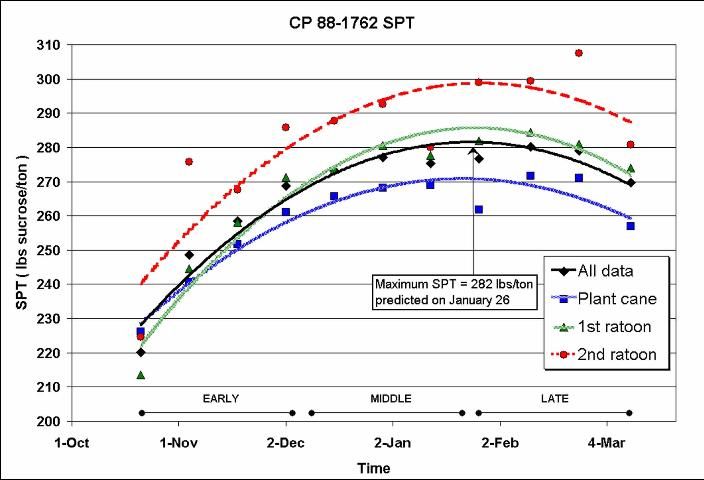
Research has shown that older ratoon crops generally have higher SPT values but lower tonnage (Glaz et al. 1989; MacColl 1976). Thus, growers should generally expect the SPT of their sugarcane crop to increase with crop age (see Figure 1). The mean SPT of CP 88-1762 increased from 258 lb/ton in plant cane to 266 lb/ton in first ratoon, and 275 lb/ton in second ratoon. The overall mean across crop ages ranked fourth out of 13 CP cultivars.
Grower recommendations are based on the entire data set across all crop ages. Early-season predicted SPT for CP 88-1762 at the onset of harvest on October 14 was 215 lb/ton (ranked third out of 13 cultivars), and maximum predicted SPT was 282 lb/ton on January 26 (ranked fifth out of 13 cultivars). In comparison to other CP cultivars, CP 88-1762 matures quickly and also deteriorates quickly following freeze events, and thus should be harvested during the first 50 days of the harvest season (see https://edis.ifas.ufl.edu/sc069).
References
Bond, R. S. 1982. "Maturity differences between varieties in the selection programme." Proc. Ann. Cong. S. African Sugar Technol. Assoc. 56: 136–139.
Gilbert, R. A., J. M. Shine, Jr., J. D. Miller, and R. W. Rice. 2004. Sucrose Accumulation and Harvest Schedule Recommendations for CP Sugarcane Varieties. SSAGR221. Gainesville: University of Florida Institute of Food and Agricultural Sciences. https://edis.ifas.ufl.edu/sc069.
Glaz, B., M. F. Ulloa, and R. Parrado. 1989. "Cultivation, cultivar and crop age effects on sugarcane." Agron. J. 81: 163–167.
Legendre, B. L. 1985. "Changes in juice quality of nine commercial sugarcane varieties grown in Louisiana". J. Am. Soc. Sugarcane Technol. 4: 54–57.
Legendre, B. L., and H. Fanguy. 1975. "Relative maturity of six commercial sugarcane varieties grown in Louisiana during 1973." Sugar Bull. 53 (2): 6–8.
MacColl, D. 1976. "Growth and sugar accumulation of sugarcane: II. Percentage of sugar in relation to pattern of growth." Expl. Agric. 12: 369–377.
Mamet, L. D., and N. W. Galwey. 1999. "A relationship between stalk elongation and earliness of ripening in sugarcane." Expl. Agric. 35: 283–291.
Miller, J. D., and N. I. James. 1977. "Maturity of six sugarcane varieties in Florida." Proc. Am. Soc. Sugar Cane Tech. 7: 107–111.
Richard, C. A., F. A. Martin, and G. M. Dill. 1981. "Maturity patterns of several Louisiana sugarcane varieties." J. Am. Soc. Sugarcane Technol. 8: 62–65.
Rice, E. 1974. "Maturity studies of sugarcane varieties in Florida." Proc. Am. Soc. Sugarcane Technol. 4: 33–35.
Tew, T. L. 2003. "World sugarcane variety census—year 2000." Sugar Cane International March/April 2003: 12–18.
VanWeelden, M., S. Swanson, W. Davidson, M. Baltazar, and R. Rice. 2020. "Sugarcane variety census-Florida 2019." Sugar J. 83: 8–20.