
Flooding is a major risk for commercial vegetable production in south Florida, especially in the south Dade County area. Although most soils usually are well drained, low-lying areas are often prone to flooding during rainy seasons. In December 2000, in Miami-Dade County, agricultural losses from flooding were estimated at 13 million dollars because of rain (13.9"). In October 1999, Hurricane Irene destroyed almost 19,000 acres of vegetable crops valued at approximately 77 million dollars.
Flooding causes oxygen deficiency, also called hypoxic stress. When experiencing hypoxia, plants only produce about 5% of the energy (in the form of ATP) that they produce during normal oxygen conditions. This ATP shortage disrupts the physiological and biochemical activities of the plant, preventing the absorption of nutrients such as nitrogen (N), phosphorus (P), and potassium (K). In addition, hypoxic plants accumulate toxic metabolic products, such as ethanol, from anaerobic respiration. Therefore, plants typically die within two or three days of severe floods.
Several management practices have been attempted to help crops partially or entirely overcome flood damage. The application of nitrate-nitrogen fertilizers, particularly potassium nitrate, overcomes N deficiency and mitigates oxygen deficiency. Natural plant hormones or synthetic growth regulators are sometimes provided to correct plant hormone imbalances. The addition of fungicides can help control soil-borne pathogens. Oxygen fertilizers can also help reduce the effects of hypoxia by increasing the bioavailability of oxygen in flooded soils.
We conducted an experiment wherein bush bean, cowpea, and sweet corn were flooded with fertilizers (Table 1) such as potassium nitrate, growth regulators, e.g., cytokinin, and fungicide including Ridomil (Table 2). Another trial was completed with flooded basil plants provided with solid oxygen fertilizers. The research data from the trials provided us with some practical recommendations. This article recommends some practices to alleviate the damage to vegetables from flooding.
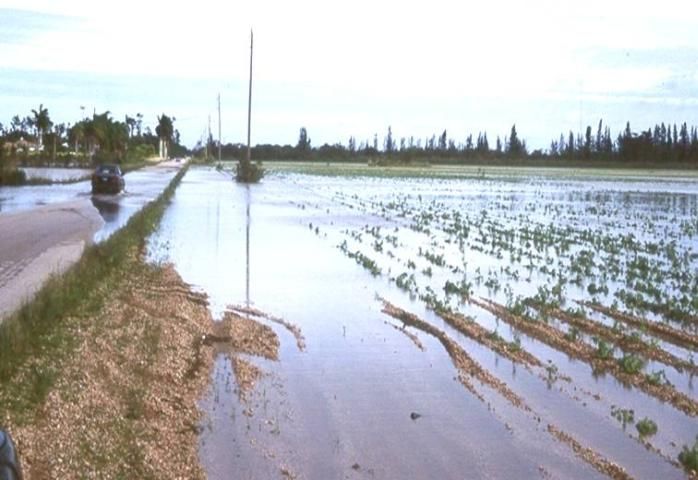
Credit: Yoncong Li
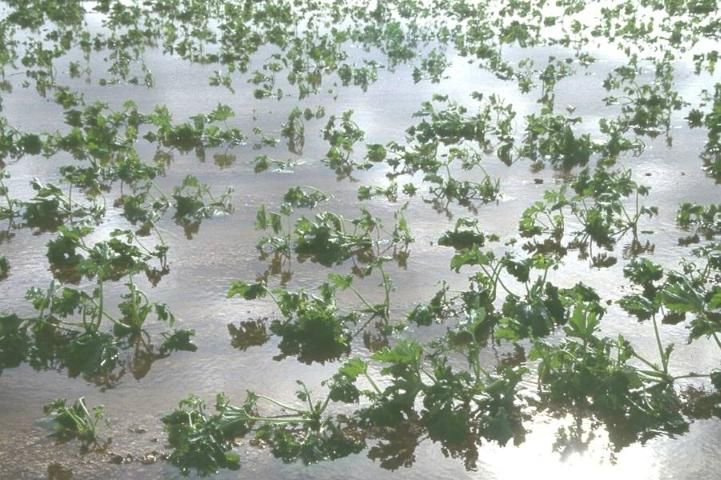
Credit: Yoncong Li
Nitrogen and Potassium Fertilization
A few kinds of N fertilizers can be used on crops after flooding. Recently, we tested several fertilizers for their effectiveness in promoting the recovery of flood-damaged vegetable crops and found that potassium nitrate performed the best. Every nitrate molecule can provide three oxygen atoms and, hence, alleviate the low-oxygen stress of the flooded plants. Flooded plants take up nitrate preferentially (Scott and Renaud 2007). Because of reduced root activity, flooding causes a significant decrease in the uptake rate of N and, hence, the N content in plants. Plant-available N is usually low in flooded soils because of leaching or runoff. Yellowing of leaves within two to three days of waterlogging occurs due to N deficiency and abnormal N metabolism. Thus, a strategic use of N fertilizer after flooding may alleviate N deficiency and enhance crop recovery from flooding. Growers should apply nitrate N fertilizers as soon as soils become dry enough for tractor operation. Foliar application of liquid fertilizers with potassium nitrate is more effective than broadcasting dry fertilizer because of the oxygen deficiency and root damage caused by flooding.
However, ammonium nitrogen fertilizers, such as ammonium nitrate, ammonium sulfate, and ammonium chloride, should NOT be applied to flooded plants. Excessive ammonium is toxic to plants (Viciedo et al. 2020) because ammonium ions can damage the respiration system. In normal growing conditions, ammoniacal nitrogen is readily converted into nitrate nitrogen by naturally occurring soil bacteria called nitrifiers. In low-oxygen conditions, however, the nitrifiers must compete with vegetable roots for the limited bioavailable oxygen when excessive ammonium nitrogen fertilizers are applied. Therefore, applying ammoniacal fertilizers to flooded vegetable crops can significantly exacerbate waterlogging or flooding damage.
Hypoxia also decreases the plant's capacity to absorb nutrients like potassium (K). Potassium plays an important role in mitigating both abiotic and biotic stresses (Wang et al. 2013). In fact, K+ ions can be used to detoxify ammonium and ammonia (Martinelle and Häggström 1993). Supplementing with K promotes increased photosynthesis, which speeds plant recovery and improves the nutrient uptake of most soil-supplied elements. Both soil and foliar applications alleviate the adverse effects of low-oxygen stress (Ashraf et al. 2011). See Table 1 for application information. A regular granular dry fertilizer, such as 10-10-10, can also be used for flooded crops, but it is not as effective as foliar fertilization.
Oxygen Fertilization
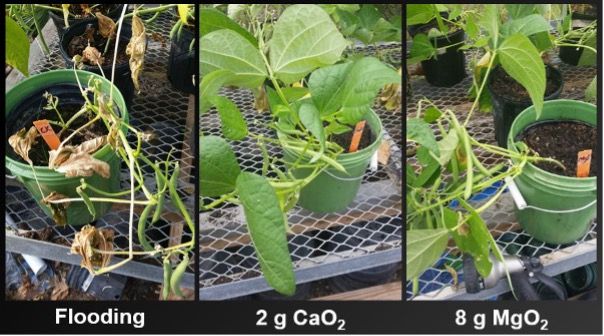
Adding oxygen-containing fertilizers to soil can reduce or even eliminate hypoxic problems. For example, oxygen fertilization significantly retained the chlorophyll content and biomass (Figure 3) of flooded Italian basil (Liu and Li et al. 2013). The positive effects of oxygen fertilization can be attributed to enhanced oxygen bioavailability and improved soil redox potential in vegetable root zones (Figure 4). Solid oxygen fertilizer can significantly increase yield of flooded snap bean (Figure 5, Liu et al. 2022, Rusnak 2022).
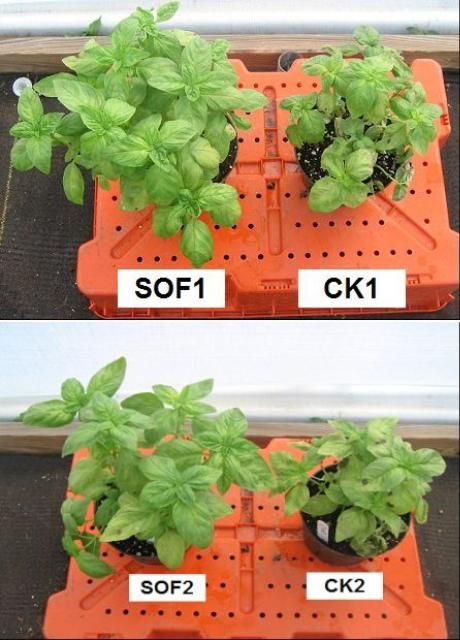
Credit: Guodong Liu
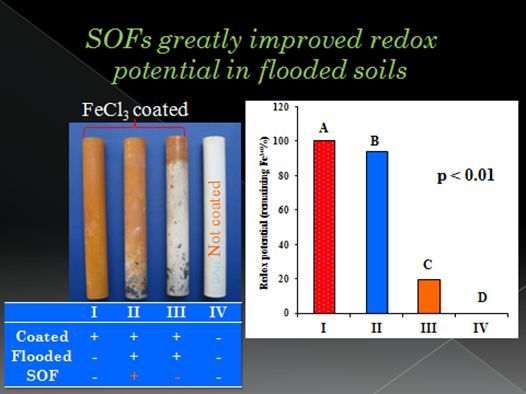
Credit: Guodong Liu
Credit: Danyang Liu
Growth Regulators
Various plant growth regulators have claimed to alleviate waterlogging damages, but limited information is available concerning their effects on waterlogged crops in the field. Spraying shoots with a synthetic cytokinin [6-benzylaminopurine (BAP)] has been reported to reduce flooding damage by enhancing leaf extension and delaying the premature loss of chlorophyll in older leaves. This effect was attributed to the application of BAP, which compensated for the restricted transport of natural cytokinins from the root system, affected the metabolism of gibberellins, and adversely affected the inhibitory action of abscisic acid on growth. However, our data showed no effects on the recovery of flood-damaged sweet corn and cowpea plants. See Table 2 for application rates used in this study. Some growth regulators even inhibited crop recovery by affecting photosynthesis and leaf transpiration.
Fungicides
Flooding increases the severity of diseases. The symptoms of diseased roots are discoloration, rotting of the root, and the premature death of the plant. The damage reduces the ability of the root systems to obtain mineral nutrients or perform other functions essential to the shoot. Two common pathogens, Phytophthora and Pythium, cause the greatest damage to roots of vegetable plants grown on poorly drained soils. In theory, the application of fungicides likely reduces the incidence of disease in waterlogged plants and thereby increases plant tolerance to flooding. However, the two fungicides (Ridomil and Bravo 720) tested in our flooding experiment did not significantly affect plant growth. See Table 2 for application rates used in this experiment.
Further Reading
Ashraf, M.A., M.S.A Ahmad, M. Ashraf, F. Al-Qurainy, M.Y. Ashraf. 2011. "Alleviation of waterlogging stress in upland cotton (Gossypium hirsutum L.) by exogenous application of potassium in soil and as a foliar spray." Crop Pasture Sci. 62, 25–38. Accessed on June 10, 2022. https://www.publish.csiro.au/cp/cp09225
UF/IFAS. 20220. UF/IFAS Study Looks to Oxygen as Solution for Flooded Fields. Accessed on Jine 10, 2022. https://specialtycropindustry.com/uf-ifas-study-looks-to-oxygen-as-solution-for-flooded-fields/
Liu, D., A.L. Paul, K.T. Morgan. G.D. Liu. 2022. Effects of oxygen fertilization on damage reduction in flooded snap bean (Phaseolus vulgaris L.). Sci Rep 12, 4282 (2022). https://doi.org/10.1038/s41598-022-08165-5
Liu, G.D., Y.C. Li, K. Migliaccio, T. Olczyk, and A. Alva. 2013. "Oxygen Amendment on Growth and Nitrogen Use Efficiency of Flooded Italian Basil." International Journal of Vegetable Science 19: 217-227. Accessed on June 10, 2022. https://www.tandfonline.com/doi/abs/10.1080/19315260.2012.713451
Martinelle, K and L. Häggström . 1993. "Mechanisms of ammonia and ammonium ion toxicity in animal cells: transport across cell membranes." Journal of Biotechnology. 30(3):339-50. Accessed on June 10, 2022. https://www.sciencedirect.com/science/article/pii/016816569390148G
Rusnak, P. 2022. Got Flooding in Your Farm Fields? There Might Be a Solution for Swamped Crops. Growing Produce. Accessed on June 10, 2022. https://www.growingproduce.com/vegetables/more-vegetables/got-flooding-in-your-farm-fields-there-might-be-a-solution-for-swamped-crops/
Scott, H.D. and F.G. Renaud. 2007. Aeration and Drainage. In: Irrigation of agricultural crops (2nd ed) (eds) R.J. Lascano and R.E. Sojka. 195-235. ASA-CSA-SSSA, Inc. Madison, WI.
Viciedo, D.O., R. de Mello Prado, R. L. Toledo, D. S. Aguilar, L. C. Nascimento dos Santos, A. C. Hurtado, K. P. Calzada, C. B. Aguilar. 2020. Physiological role of silicon in radish seedlings under ammonium toxicity. J Sci, of Food Agri. 100(15): 5637-5644. Accessed on June 10, 2022. https://onlinelibrary.wiley.com/doi/full/10.1002/jsfa.10587