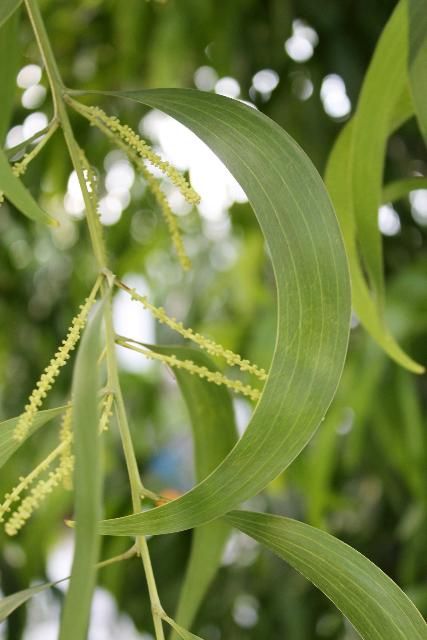
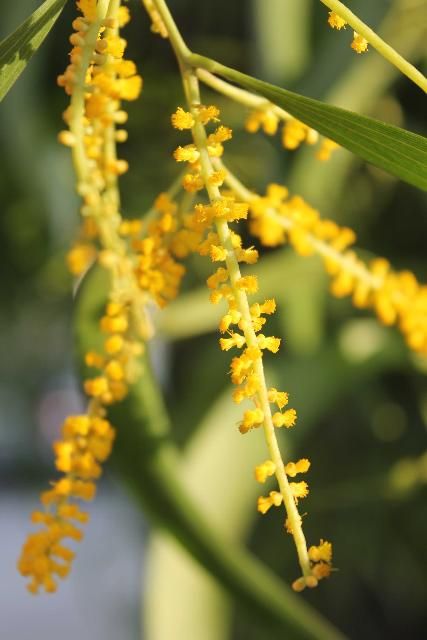
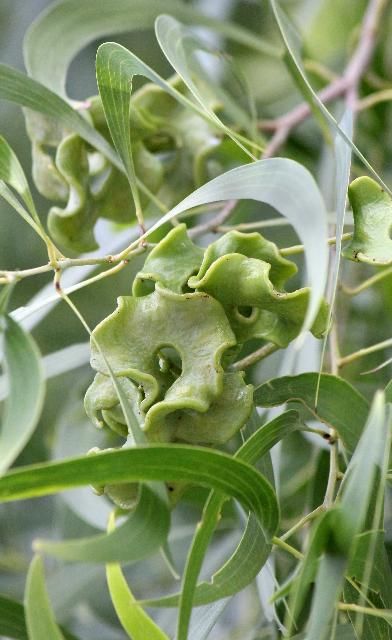
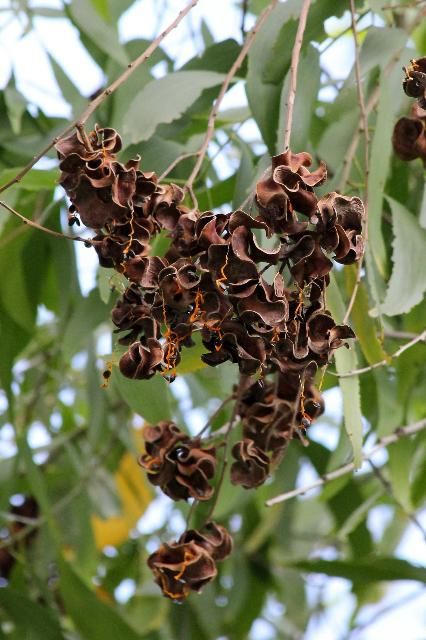
Quickly reaching a height of 40 feet and a spread of 25 feet, earleaf acacia becomes a loose, rounded, evergreen, open shade tree. It is often planted for its abundance of small, beautiful, bright yellow flowers and fast growth. The flattened, curved branchlets, which look like leaves, are joined by twisted, brown, ear-shaped seed pods. Growing 6 to 8 feet per year, earleaf acacia quickly grows into a medium-sized shade tree. This makes it a popular tree. However, it has brittle wood and weak branch crotches, and the tree can be badly damaged during wind storms. Prune branches so there is a wide angle of attachment to help them from splitting from the tree. Also, be sure to keep the major branches pruned back so they stay less than half the diameter of the trunk. These techniques might increase the longevity of existing trees.
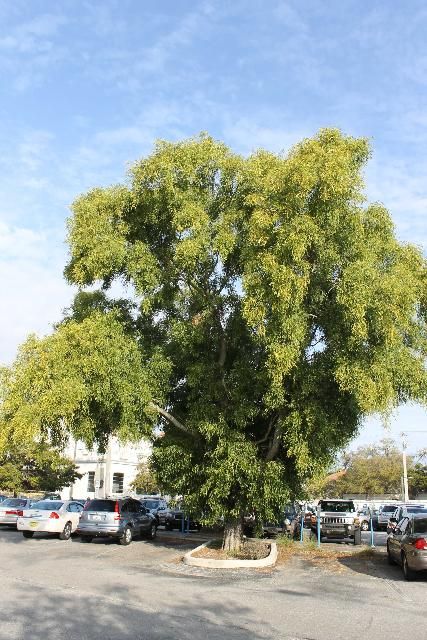
Figure 1. Full Form - Acacia auriculiformis: earleaf acacia Credit: Gitta Hasing UF/IFAS
Origin: native to northern Australia, Papua New Guinea, and Indonesia
UF/IFAS Invasive Assessment Status: caution, may be recommended but manage to prevent escape (Central, South); not considered a problem species at this time, may be recommended (North)
Uses: not recommended for planting
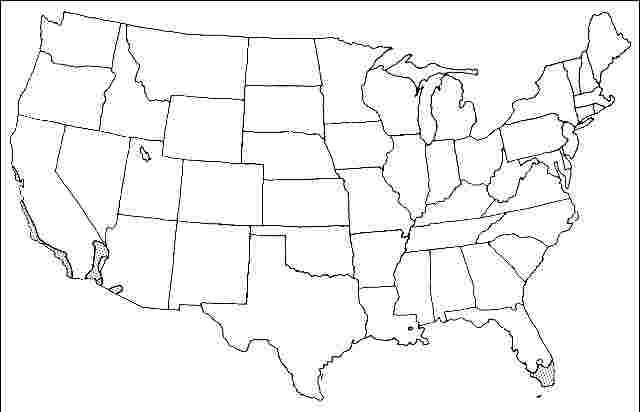
Figure 2. Range
Description
Height: 35 to 40 feet
Spread: 25 to 35 feet
Crown uniformity: irregular
Crown shape: round
Crown density: moderate
Growth rate: fast
Texture: medium
Foliage
Leaf arrangement: alternate
Leaf type: simple
Leaf margin: entire
Leaf shape: linear and sickle-shaped
Leaf venation: 3-7parallel veins
Leaf type and persistence: evergreen, broadleaf evergreen
Pest resistance: free of serious pests and diseases
Use and Management
Seeds also germinate in the landscape and it has escaped cultivation in south Florida where it is becoming a mildly invasive weed in some areas. However, it is not as invasive as Australian pine or Brazilian pepper and probably will not become so. Despite this, many people consider this to be an undesirable tree.
Earleaf acacia grows in full sun on almost any soil including alkaline and is moderately salt-tolerant. It will withstand periods of water inundation but is also very tolerant of drought.
Pests and Diseases
No pests or diseases are of major concern. Occasionally anthracnose infects leaves.
Reference
Koeser, A.K., Friedman, M.H., Hasing, G., Finley, H., Schelb, J. 2017. Trees: South Florida and the Keys. University of Florida Institute of Food and Agricultural Sciences.