


Calocedrus decurrens: California Incense-Cedar1
Introduction
This stately native evergreen tree slowly grows straight up in a very narrow cone or columnar shape to a height of 70- to 100-feet or more in the wild, 40- to 60-feet in landscapes, yet is only 8- to 12-feet wide at maturity. The branches—which are densely clothed with flat, shiny, dark green, aromatic needles—extend to the ground and remain on the tree unless shaded-out by other trees, making California incense-cedar ideal for use as a screen, hedge, or windbreak. Small, 1-inch long cones are produced at branch tips and are quite persistent, the seeds providing a welcome treat for many varieties of birds and wildlife. Although growth is slow, California Incense-Cedar trees are extremely long-lived, surviving 500 to 1000 years in the wild. Mature specimens have attractive, brick-red, flaky, furrowed bark.
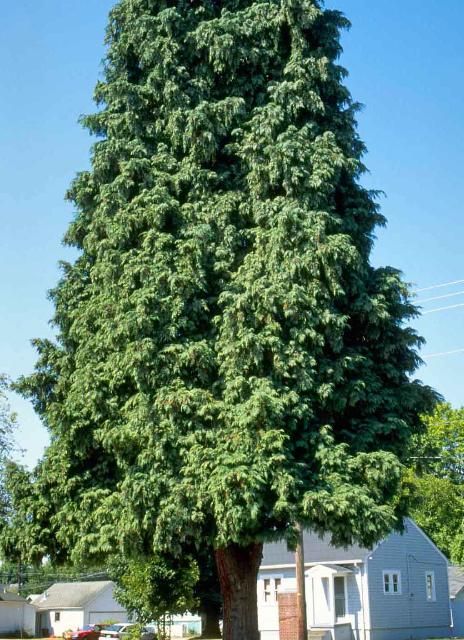
Credit: Ed Gilman
General Information
Scientific name: Calocedrus decurrens
Pronunciation: kal-oh-SEE-drus deck-ER-renz
Common name(s): California incense-cedar
Family: Cupressaceae
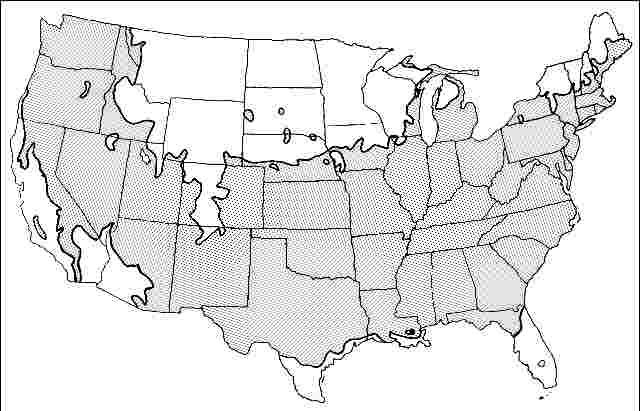
USDA hardiness zones: 5A through 8B (Fig. 2)
Origin: native to North America
Invasive potential: little invasive potential
Uses: screen; hedge; specimen
Availability: somewhat available, may have to go out of the region to find the tree
Description
Height: 40 to 60 feet
Spread: 8 to 12 feet
Crown uniformity: symmetrical
Crown shape: pyramidal, columnar
Crown density: dense
Growth rate: slow
Texture: fine
Foliage
Leaf arrangement: opposite/subopposite
Leaf type: simple
Leaf margin: entire
Leaf shape: scale-like
Leaf venation: none, or difficult to see
Leaf type and persistence: evergreen, fragrant
Leaf blade length: less than 2 inches
Leaf color: green
Fall color: no color change
Fall characteristic: not showy
Flower
Flower color: unknown
Flower characteristics: not showy
Fruit
Fruit shape: elongated, oval
Fruit length: .5 to 1 inch
Fruit covering: dry or hard
Fruit color: brown
Fruit characteristics: attracts birds; not showy; fruit/leaves not a litter problem
Trunk and Branches
Trunk/bark/branches: branches don't droop; very showy; typically one trunk; thorns
Pruning requirement: little required
Breakage: resistant
Current year twig color: green, brown
Current year twig thickness: thin
Wood specific gravity: 0.37
Culture
Light requirement: full sun, partial sun or partial shade
Soil tolerances: clay; sand; loam; acidic; slightly alkaline; well-drained
Drought tolerance: high
Aerosol salt tolerance: high
Other
Roots: not a problem
Winter interest: no
Outstanding tree: yes
Ozone sensitivity: unknown
Verticillium wilt susceptibility: resistant
Pest resistance: resistant to pests/diseases
Use and Management
California incense-cedar is a bit particular as to its growing requirements, being very sensitive to continually wet conditions. But with the right combination of proper humidity and moist soil, California incense-cedar will be quite happy growing in full sun or partial shade with some protection from harsh winds. It is surprisingly tolerant of heat and drought. Pruning is rarely necessary, but trees may be sheared, if desired, to maintain a shorter, denser screen. Beautiful specimens of this tree can be seen growing in USDA hardiness zones six and 7.
Many plants grown seem to be the cultivar 'Columnaris', having a very formal landscape effect. The cultivar 'Compacta' has a dwarf, compact growth habit; 'Aureovariegata' has interspersed sprays of bright yellow foliage.
Propagation is by seed or cuttings (with great difficulty) or grafted onto Thuja occidentalis.
Pests
No pests are of major concern.
Diseases
A serious problem is heart rot; less serious problems are rust and leafy mistletoe.

