


Chamaecyparis lawsoniana: Lawson Falsecypress1
Introduction
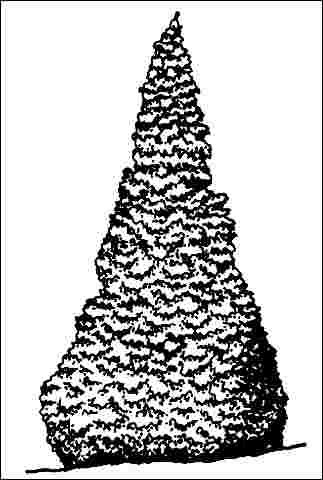
Often seen at 40 to 60 feet tall by 15 feet wide in its cultivated form, this North American native can soar to heights of 100 to 150 feet in the wild. The massive, thick trunk and formal, upright, conical silhouette is softened by the gently weeping tips of the short, upright branches. The flattened, dark blue-green branchlets have a delicate, almost fern-like appearance, and are nicely complemented by the rough, deeply furrowed, reddish-brown bark. Available in a wide variety of forms and bluish foliage colors, Lawson falsecypress still remains today an important timber trees from the Pacific Northwest. But it is rare in the nursery trade and probably not well adapted to most landscapes.
General Information
Scientific name: Chamaecyparis lawsoniana
Pronunciation: kam-eh-SIP-uh-riss law-so-nee-AY-nuh
Common name(s): Lawson falsecypress, Port Orford cedar
Family: Cupressaceae
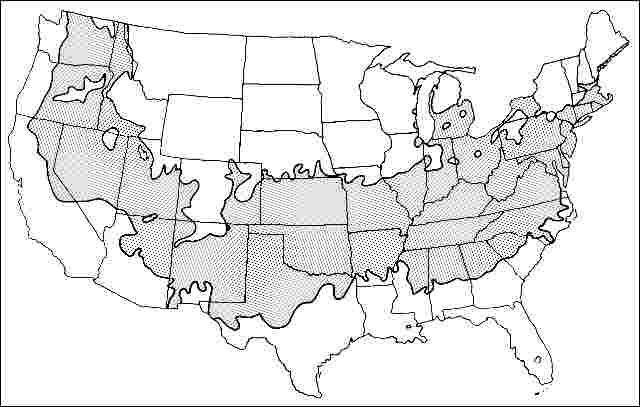
USDA hardiness zones: 5B through 7B (Fig. 2)
Origin: native to North America
Invasive potential: little invasive potential
Uses: specimen; screen; bonsai
Availability: not native to North America
Description
Height: 40 to 60 feet
Spread: 15 to 25 feet
Crown uniformity: symmetrical
Crown shape: upright/erect, columnar, pyramidal
Crown density: dense
Growth rate: moderate
Texture: fine
Foliage
Leaf arrangement: opposite/subopposite
Leaf type: simple
Leaf margin: entire
Leaf shape: scale-like
Leaf venation: none, or difficult to see
Leaf type and persistence: evergreen
Leaf blade length: less than 2 inches
Leaf color: blue or blue-green, green
Fall color: no color change
Fall characteristic: not showy
Flower
Flower color: red, blue
Flower characteristics: not showy
Fruit
Fruit shape: round, cone
Fruit length: less than .5 inch
Fruit covering: dry or hard
Fruit color: brown
Fruit characteristics: does not attract wildlife; not showy; fruit/leaves not a litter problem
Trunk and Branches
Trunk/bark/branches: branches don't droop; showy; typically one trunk; thorns
Pruning requirement: little required
Breakage: resistant
Current year twig color: green, brown
Current year twig thickness: thin
Wood specific gravity: 0.43
Culture
Light requirement: full sun
Soil tolerances: clay; sand; loam; acidic; slightly alkaline; well-drained
Drought tolerance: moderate
Aerosol salt tolerance: moderate
Other
Roots: not a problem
Winter interest: no
Outstanding tree: yes
Ozone sensitivity: unknown
Verticillium wilt susceptibility: resistant
Pest resistance: resistant to pests/diseases
Use and Management
Lawson falsecypress is only suited for the largest landscapes such as in parks, golf courses, and large industrial or commercial landscapes or estates. The unusually blue foliage and dense, symmetrical growth habit make it ideally suited as a screen in a sunny spot protected from constant wind. It has somewhat picky cultural requirements and should be grown in full sun in moist, well-drained soil (not clay), in areas of moderate to high humidity, and preferably where the trees can be protected from harsh winds. These sites may be hard to find in the East.
Various cultivars are available with different foliage colors (golden, blue, or silver-variegated) and different growth forms (dwarf, columnar, and low-spreading).
Propagation is done easily by cuttings taken in fall, or by seeds, with difficulty.
Pests
No pests are of major concern.
Diseases
A fungus damages this species by causing root rot, which eventually kills the tree. Plant only in the most well-drained soil.
There is also a branch canker which can cause branch dieback.

