
Introduction
This broad, sweeping, conical-shaped evergreen has graceful, flattened, fern-like branchlets that gently droop at branch tips. Hinoki falsecypress reaches 50 to 75 feet in height with a spread of 10 to 20 feet, has dark green foliage, and attractive, shredding, reddish-brown bark that peels off in long narrow strips.
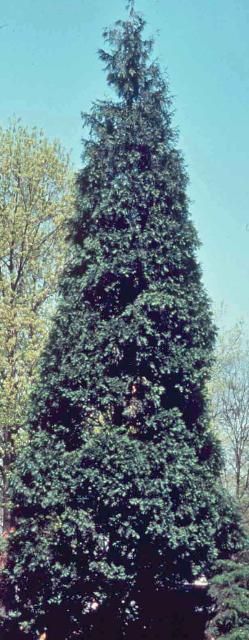
Credit: Ed Gilman, UF/IFAS
General Information
Scientific name: Chamaecyparis obtusa
Pronunciation: kam-eh-SIP-uh-riss ob-TOO-suh
Common name(s): Hinoki falsecypress
Family: Cupressaceae
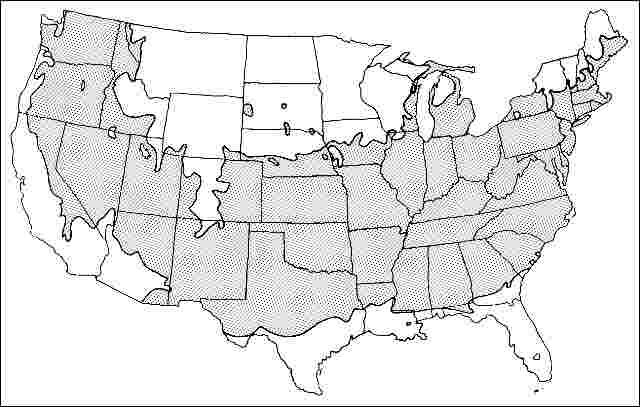
USDA hardiness zones: 5A through 8A (Fig. 2)
Origin: not native to North America
Invasive potential: little invasive potential
Uses: screen; bonsai
Availability: somewhat available, may have to go out of the region to find the tree
Description
Height: 40 to 75 feet
Spread: 10 to 20 feet
Crown uniformity: symmetrical
Crown shape: pyramidal
Crown density: dense
Growth rate: moderate
Texture: fine
Foliage
Leaf arrangement: opposite/subopposite
Leaf type: simple
Leaf margin: entire
Leaf shape: scale-like
Leaf venation: none, or difficult to see
Leaf type and persistence: evergreen
Leaf blade length: less than 2 inches
Leaf color: green
Fall color: no color change
Fall characteristic: not showy
Flower
Flower color: yellow
Flower characteristics: not showy
Fruit
Fruit shape: round, cone
Fruit length: less than .5 inch
Fruit covering: dry or hard
Fruit color: brown
Fruit characteristics: does not attract wildlife; not showy; fruit/leaves not a litter problem
Trunk and Branches
Trunk/bark/branches: branches droop; showy; typically one trunk; thorns
Pruning requirement: little required
Breakage: resistant
Current year twig color: green, brown
Current year twig thickness: thin
Wood specific gravity: unknown
Culture
Light requirement: full sun
Soil tolerances: clay; sand; loam; acidic; well-drained
Drought tolerance: moderate
Aerosol salt tolerance: unknown
Other
Roots: not a problem
Winter interest: no
Outstanding tree: no
Ozone sensitivity: unknown
Verticillium wilt susceptibility: resistant
Pest resistance: resistant to pests/diseases
Use and Management
Hinoki falsecypress should be grown in full sun on moist, well-drained soil, in areas of moderate to high humidity, and preferably where the trees can be protected from harsh winds. It is fairly free of pests and diseases.
Propagation is by cuttings.
There are many cultivars, some quite dwarf. Other cultivars have excellent foliage coloration or unusual growth habit. Cultivars include 'Aurea'—golden foliage: 'Caespitosa'—rare, miniature, about six inches tall; 'Compacta'—dwarf, about three feet tall, dense, conical; 'Coralliformis'—branchlets, reddish and contorted; 'Crippsii'—broad pyramid with spreading branches and golden foliage; 'Erecta'—columnar habit; 'Ericoides'—low, blue-gray foliage; 'Filicoides'—fern-like; 'Gracilis'—compact growth habit, tips of branchlets pendulous; 'Kosteri'—dwarf, three to four feet tall, branch tips curved; 'Mariesii'—dwarf, foliage variegated with yellowish white; 'Nana'—very dwarf, height and spread of two feet; 'Pygmaea'—dwarf, two feet tall, wider than tall; 'Stoneham'—slow, dwarf, tiered branching; and 'Tetragona'—slow, dwarf, erect.
Pests
Juniper scale can be controlled by applying pesticides when the crawlers are active.
The bagworm webs dead foliage and other debris together to make a nest. The covering makes the insect difficult to control. The nests can be picked off by hand.
Diseases
Blight can be a problem on young plants in nurseries or old plants in landscape situations. In young plants, branch tips turn brown and die back until the whole branch or young tree is killed. Trees over five years old are less susceptible. When older trees in landscapes are affected by tip blight, entire trees are seldom killed.
Tip blight can infect trees during wet weather. The disease causes sooty pustules on the leaves, bark, and cones.
Scorch may look like a disease but is caused by excessive direct sun, freezing stress, drought, or mites. Freezing stress can be prevented by shading small plants in winter.