

Ficus elastica 'Variegata': 'Variegata' Rubber Tree
Introduction
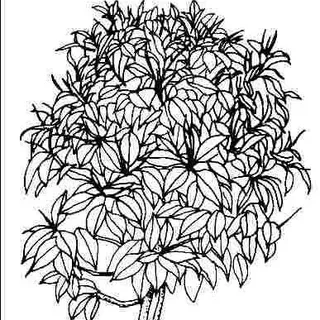
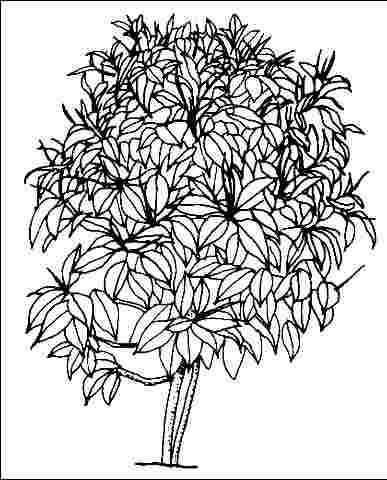
Often seen as an interior container plant, variegated rubber tree has large, 5 to 12-inch-long, thick, light green leaves with white or yellow margins, multiple trunks, and a spreading, irregular canopy. Able to reach 100 feet in height in its native habitat in the jungle but most often seen at about 25 to 40 feet in the landscape, rubber tree is useful as a screen, shade, patio, or specimen tree. Its coarse texture makes a strong statement in the landscape. Use as a street tree is limited by the tree's tendency to break apart in high winds. Perhaps the tree could be made stronger by removing branches with weak tight-angle crotches and spacing major lateral branches along one central trunk. Eliminate multiple trunks early in the life of the tree and prune lateral branches so they remain smaller than half the diameter of the trunk to increase longevity in the landscape.
Credit: UF/IFAS
General Information
Scientific name: Ficus elastica
Pronunciation: FYE-kuss ee-LASS-tick-uh
Common name(s): 'Variegata' rubber tree, ‘Variegata' India-rubber fig
Family: Moraceae
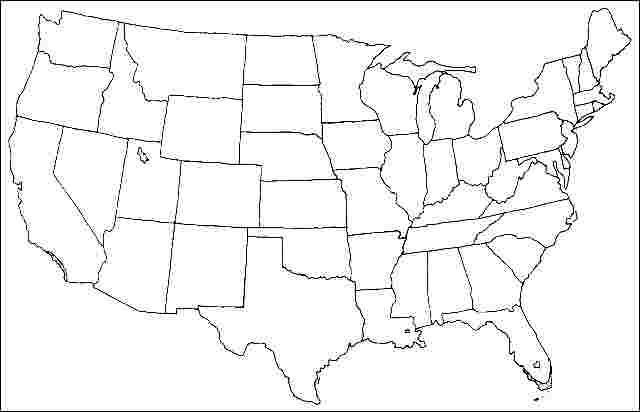
USDA hardiness zones: 10B through 11 (Figure 2)
Origin: not native to North America
Outstanding tree: no
Invasive potential: not considered a problem species at this time, may be recommended (North, Central, South)
Uses: shade; trained as a standard; indoors; screen; specimen; deck or patio; container or planter; espalier; highway median
Credit: UF/IFAS
Description
Height: 30 to 45 feet
Spread: 25 to 30 feet
Crown uniformity: symmetrical
Crown shape: oval
Crown density: dense
Growth rate: fast
Texture: coarse
Foliage
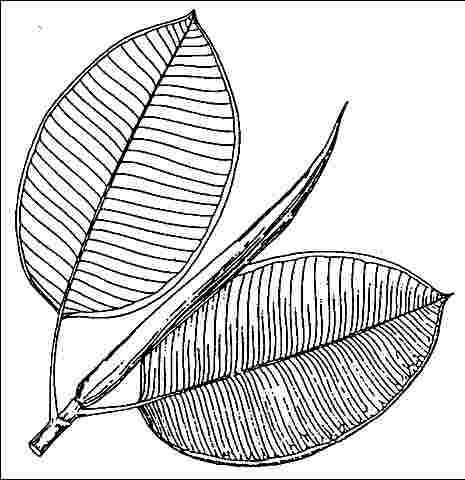
Leaf arrangement: alternate (Figure 3)
Leaf type: simple
Leaf margin: entire
Leaf shape: elliptic (oval)
Leaf venation: pinnate, brachidodrome
Leaf type and persistence: evergreen, broadleaf evergreen
Leaf blade length: 8 to 12 inches
Leaf color: variegated
Fall color: no color change
Fall characteristic: not showy
Credit: UF/IFAS
Flower
Flower color: unknown
Flower characteristics: not showy
Fruit
Fruit shape: round
Fruit length: less than 0.5 inch
Fruit covering: fleshy
Fruit color: green
Fruit characteristics: does not attract wildlife; not showy; fruit/leaves a litter problem
Trunk and Branches
Trunk/bark/branches: branches droop; not showy; typically one trunk; thorns
Pruning requirement: needed for strong structure
Breakage: susceptible to breakage
Current year twig color: green
Current year twig thickness: thick
Wood specific gravity: unknown
Culture
Light requirement: full sun, partial sun, or partial shade
Soil tolerances: sand; loam; clay; acidic; alkaline; well-drained; occasionally wet
Drought tolerance: high
Aerosol salt tolerance: moderate
Other
Roots: can form large surface roots
Winter interest: no
Ozone sensitivity: unknown
Verticillium wilt susceptibility: unknown
Pest resistance: resistant to pests/diseases
Use and Management
Rubber Tree will grow quickly in sun or partial shade on almost any well-drained soil. The soil should be allowed to become fairly dry between waterings, especially in containers. Rubber Tree makes a nice house plant if it is not over-watered.
Other available cultivars include: ‘Doescheri' has yellow-variegated leaves; ‘Decora' produces broad, reddish-green leaves with ivory-colored veins running down the center of the leaf.
Propagation is by layering or cuttings.
Pests and Diseases
No pests or diseases are of major concern but occasionally scales are a problem.