


Fraxinus texensis: Texas Ash1
Introduction
Texas Ash creates a wonderful shade tree, its short trunk supporting a broad, rounded crown of seven-inch-long leaves divided into leaflets. Unfortunately, it is rare in the trade. Trees slowly grow to about 50 feet tall but most are seen 25 to 30 feet tall. The leaves are dark green to olive green above and paler green below and cast a medium shade beneath the tree. Petioles are an attractive pale red to pink, and fall color is showy ranging from orange/red to purple. The inconspicuous flowers appear before the leaves emerge in spring, and are followed by the production of 1.5-inch-long, light red to pink, winged fruit, or samara. It often grows as a multi-stemmed tree in the wild on limestones soils in central Texas.
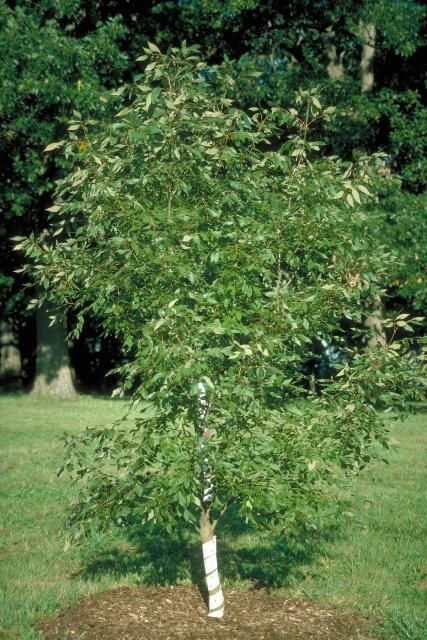
Credit: Ed Gilman
General Information
Scientific name: Fraxinus texensis
Pronunciation: FRACK-sih-nus teck-SEN-sis
Common name(s): Texas Ash
Family: Oleaceae
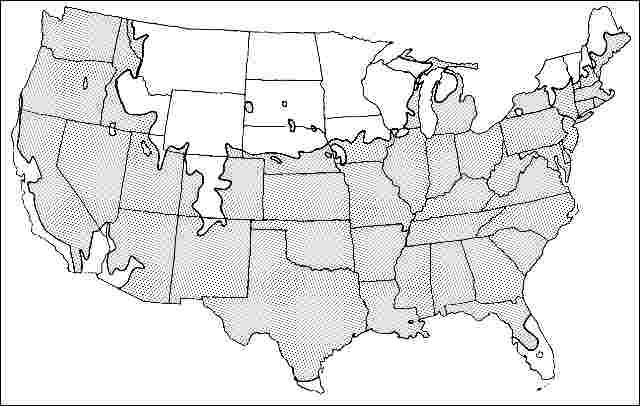
USDA hardiness zones: 5A through 9A (Fig. 2)
Origin: native to North America
Invasive potential: little invasive potential
Uses: reclamation; shade; street without sidewalk; deck or patio; specimen; parking lot island < 100 sq ft; parking lot island 100-200 sq ft; parking lot island > 200 sq ft; tree lawn 3-4 feet wide; tree lawn 4-6 feet wide; tree lawn > 6 ft wide; highway median
Availability: not native to North America
Description
Height: 30 to 40 feet
Spread: 25 to 35 feet
Crown uniformity: symmetrical
Crown shape: oval, upright/erect
Crown density: moderate
Growth rate: slow
Texture: medium
Foliage
Leaf arrangement: opposite/subopposite (Fig. 3)
Leaf type: odd-pinnately compound
Leaf margin: serrate, entire
Leaf shape: ovate, obovate
Leaf venation: pinnate, reticulate
Leaf type and persistence: deciduous
Leaf blade length: less than 2 inches, 2 to 4 inches
Leaf color: green
Fall color: orange, red, purple
Fall characteristic: showy
Flower
Flower color: green
Flower characteristics: not showy
Fruit
Fruit shape: round
Fruit length: .5 to 1 inch
Fruit covering: dry or hard
Fruit color: pink
Fruit characteristics: does not attract wildlife; showy; fruit/leaves not a litter problem
Trunk and Branches
Trunk/bark/branches: branches don't droop; not showy; typically multi-trunked; thorns
Pruning requirement: needed for strong structure
Breakage: resistant
Current year twig color: gray, brown
Current year twig thickness: thick
Wood specific gravity: unknown
Culture
Light requirement: full sun
Soil tolerances: clay; sand; loam; alkaline; acidic; occasionally wet; well-drained
Drought tolerance: high
Aerosol salt tolerance: unknown
Other
Roots: not a problem
Winter interest: no
Outstanding tree: yes
Ozone sensitivity: tolerant
Verticillium wilt susceptibility: susceptible
Pest resistance: resistant to pests/diseases
Use and Management
Texas Ash grows in full sun on well-drained soil, either dry or wet, and prefers alkaline soil. It is very popular in Texas and Oklahoma, but could be cultivated and planted more in other areas. Trained to a central leader and a straight trunk it could be used for city street and parking lot tree planting. It could be grown in the east in areas with good drainage especially on sites which are not irrigated due to its low water requirement or drought tolerance. Texas Ash will tolerate both soil compaction and air pollution, making it well-suited for use as a street, parking lot or median tree. Not as susceptible to borers as other Ashes.
Propagation is by seed.
Pests and Diseases
No pests or diseases are of major concern. Probably borers on recently transplanted or stressed trees.

