


Juniperus deppeana 'Mcfetter': McFetter Alligator Juniper1
Introduction
This native North American evergreen tree found in the southwestern United States reaches 50 to 60 feet in height and forms a broad, pyramidal or rounded canopy. The crown probably spreads to about 20 or 25 feet. The trunk is normally rather short and covered with brown, scaly bark. The foliage has a rich blue coloration which stands out in the landscape against any background.
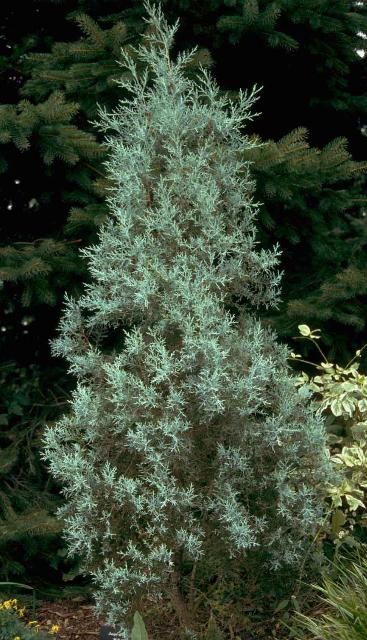
Credit: Ed Gilman, UF/IFAS
General Information
Scientific name: Juniperus deppeana
Pronunciation: joo-NIP-er-us depp-ee-AY-nuh
Common name(s): McFetter alligator juniper
Family: Cupressaceae
USDA hardiness zones: 7A through 9B (Fig. 2)
Origin: native to North America
Invasive potential: little invasive potential
Uses: hedge; screen; reclamation; specimen; highway median; Bonsai
Availability: not native to North America
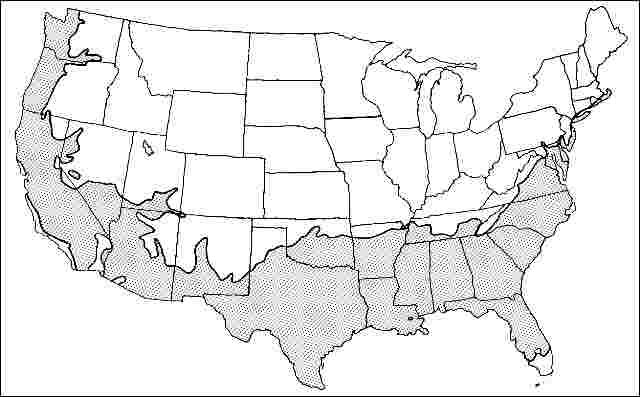
Description
Height: 50 to 60 feet
Spread: 20 to 25 feet
Crown uniformity: symmetrical
Crown shape: oval, columnar
Crown density: dense
Growth rate: fast
Texture: fine
Foliage
Leaf arrangement: opposite/subopposite
Leaf type: simple
Leaf margin: entire
Leaf shape: scale-like
Leaf venation: none, or difficult to see
Leaf type and persistence: evergreen, fragrant
Leaf blade length: less than 2 inches
Leaf color: blue or blue-green
Fall color: no color change
Fall characteristic: not showy
Flower
Flower color: unknown
Flower characteristics: not showy
Fruit
Fruit shape: cone, round
Fruit length: less than .5 inch
Fruit covering: fleshy
Fruit color: unknown
Fruit characteristics: does not attract wildlife; not showy; fruit/leaves not a litter problem
Trunk and Branches
Trunk/bark/branches: branches don't droop; showy; typically one trunk; thorns
Pruning requirement: little required
Breakage: resistant
Current year twig color: green, brown
Current year twig thickness: thin
Wood specific gravity: unknown
Culture
Light requirement: full sun
Soil tolerances: clay; sand; loam; acidic; alkaline; well-drained
Drought tolerance: high
Aerosol salt tolerance: unknown
Other
Roots: not a problem
Winter interest: no
Outstanding tree: yes
Ozone sensitivity: unknown
Verticillium wilt susceptibility: resistant
Pest resistance: resistant to pests/diseases
Use and Management
Mcfetter alligator juniper can be used as leyland cypress has been. Plant it on 15 to 20 foot centers to form a solid blue screen. Growth rate is rapid in full sun.
Mcfetter alligator juniper is grown in full sun on well-drained, slightly acid soil. It appears to perform well on clay soils and should be suited for many areas of the southern United States.
Pests
No pests are of major concern at this time. However, the plant has not been grown in the east for very long.
Diseases
No diseases are of major concern at this time.

