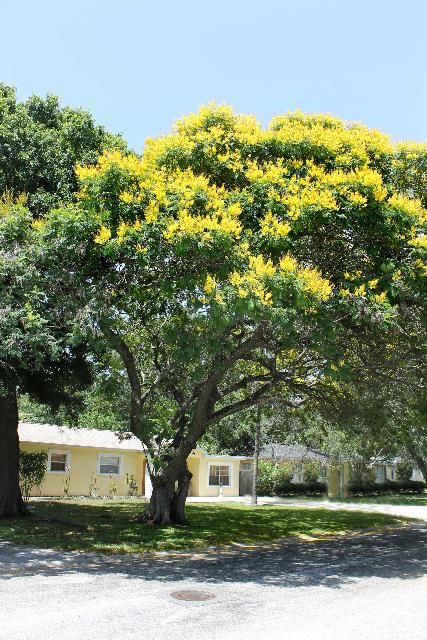
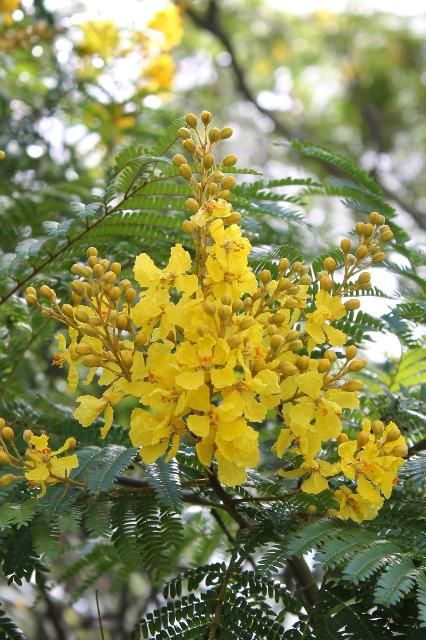
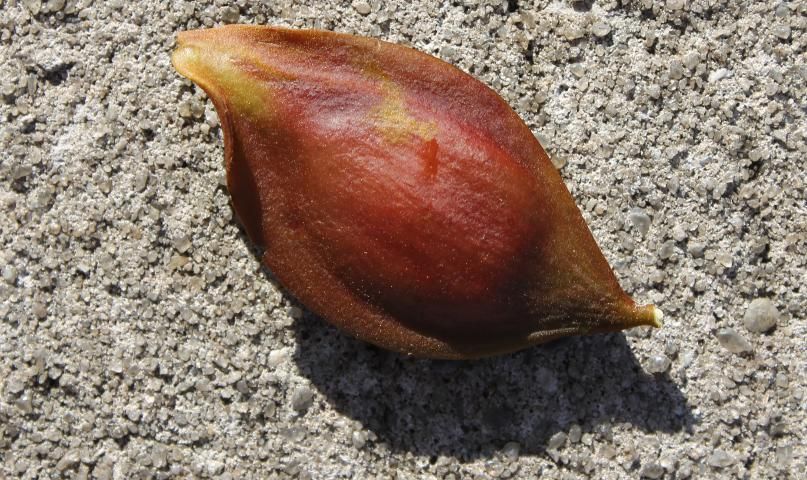
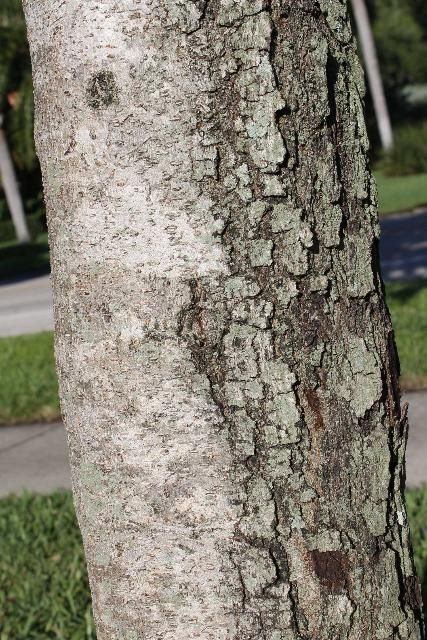
This upright, handsome, spreading, semi-evergreen tree has a rounded canopy and is capable of reaching 50 feet in height with a 30 to 50-foot spread. Form can be quite variable from tree to tree, unfortunately, eliminating this plant from the palette of many architects. With proper training and pruning in the nursery and in the landscape, a more uniform crown will develop. The dark green, delicate, feathery leaflets provide a softening effect for the tree's large size and create a welcoming, dappled shade. From May through September, the entire tree's canopy is smothered with a yellow blanket of flowers, appearing in showy, terminal panicles and exuding a delicious, grape-like perfume. These flower clusters are followed by four-inch-long seed pods which ripen to a brilliant, coppery red.
Figure 1. Full Form - Peltophorum pterocarpum: yellow poinciana Credit: UF/IFAS
General Information
Scientific name: Peltophorum pterocarpum
Pronunciation: pell-TOFF-oh-rum teer-oh-KAR-pum
Common name(s): yellow poinciana
Family: Fabaceae orLeguminosae
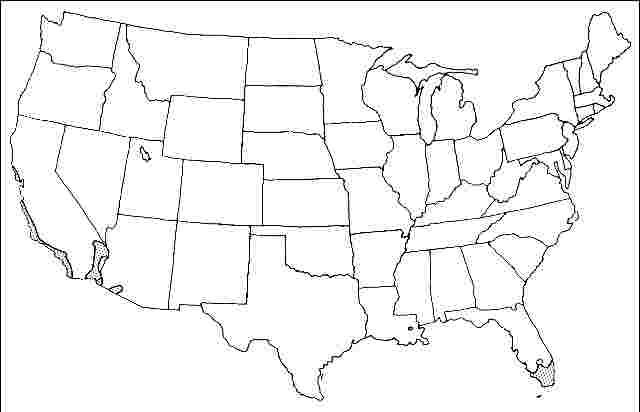
USDA hardiness zones: 10A through 11 (Figure 2)
Origin: native to Sri Lanka, Malay Archipelago, Indonesia, and northern Australia
UF/IFAS Invasive Assessment Status: not considered a problem species at this time, may be recommended (North, Central, South)
Uses: shade; specimen; reclamation; highway median
Figure 2. Range
Description
Height: 40 to 50 feet
Spread: 30 to 50 feet
Crown uniformity: irregular
Crown shape: vase, round, spreading
Crown density: open
Growth rate: fast
Texture: fine
Foliage
Leaf arrangement: alternate
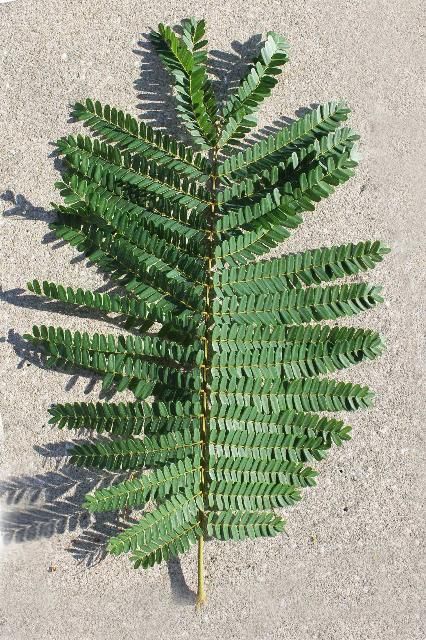
Leaf type: bipinnately compound; primary leaflets are in pairs of 7 to 15 and are made up of 8 to 20 pairs of secondary leaflets
Leaf margin: entire
Leaf shape: oblong
Leaf venation: pinnate
Leaf type and persistence: semi-evergreen
Leaf blade length: 1 to 2 feet; secondary leaflets are ½ to ¾ inch
Leaf color: dark green on top, paler green underneath
Pest resistance: free of serious pests and diseases
Use and Management
Yellow poinciana is a wonderful shade or specimen tree for a large landscape, especially when in full bloom, and it can make a street tree as long as it receives regular pruning to control its weedy, somewhat unkempt habit. Its large size makes it a natural for the wide-open spaces of large lawns or city parks.
Trees can be grown with a single or multiple trunk. Trunks or branches of multi-trunked trees should be well-spaced along a central stem and not allowed to grow larger than half the diameter of the main stem. This will increase wind hardiness. Plant only single-trunked trees along streets and other public areas to ensure a durable plant.
A fast-growing tree, yellow poinciana grows best in full sun on any well-drained soil. Temperatures in the high 20's cause the leaves to drop but these are quickly replaced. Even though yellow poinciana will develop a very large trunk, its shallow, surface roots make it susceptible to being blown over during a hurricane's severe windstorms. Locate the tree about ten feet from sidewalks or pavement so the large surface roots don't cause damage.
Peltophorum inerme is grown in the southern part of Florida (USDA hardiness zone 10b) and in the tropical areas, and is not as hardy. Peltophorum dubium is cold hardy to Orlando (USDA hardiness zone 9b).
Propagation is by cuttings or seed. Seeds must be scarified, and seedlings will bloom in four to five years.
Pests and Diseases
No pests or diseases are of major concern.
References
Koeser, A.K., Friedman, M.H., Hasing, G., Finley, H., Schelb, J. 2017. Trees: South Florida and the Keys. University of Florida Institute of Food and Agricultural Sciences.