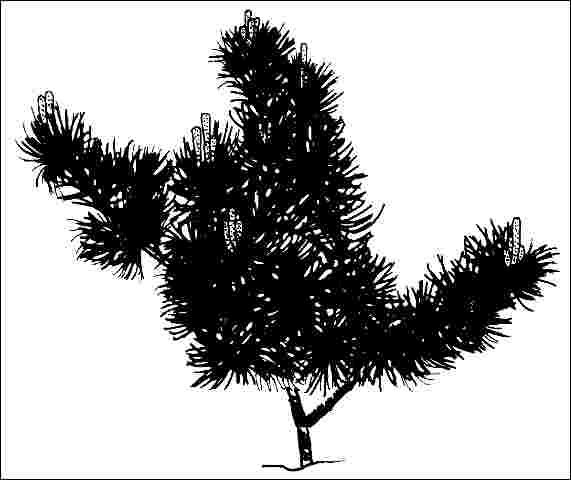
This cultivar of Japanese white pine creates a striking landscape element wherever it is used. Often seen as a dense, conical form when young, 'Glauca' Japanese white pine develops into a 35- to 50-foot-tall, wide-spreading graceful, irregularly-shaped tree, with an equal or greater spread, and a broad, flattened canopy. The 1- to 2.5-inch-long needles are stiff and twisted, forming glaucous blue/green tufts of foliage at branch tips, and creating an overall fine texture to the tree's silhouette. The brownish-red cones are one to 4-inches-long and persist on the tree for 6- to 7-years.
Figure 1. Young Pinus parviflora 'Glauca': 'Glauca' Japanese White Pine
General Information
Scientific name: Pinus parviflora
Pronunciation: PIE-nus par-vih-FLOR-uh
Common name(s): 'Glauca' Japanese white pine
Family: Pinaceae
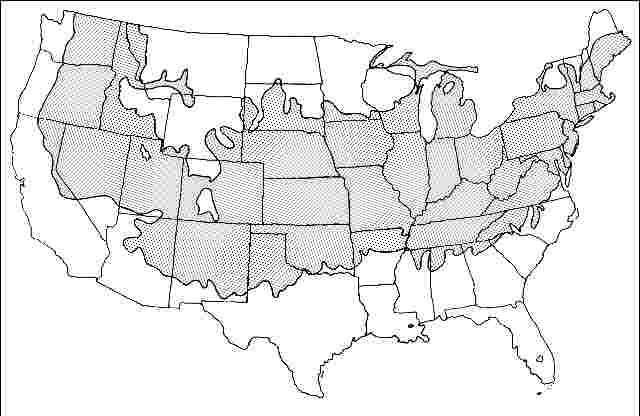
USDA hardiness zones: 4B through 7A (Fig. 2)
Origin: not native to North America
Invasive potential: little invasive potential
Uses: Bonsai; specimen; screen
Availability: somewhat available, may have to go out of the region to find the tree
Figure 2. Range
Description
Height: 35 to 50 feet
Spread: 35 to 50 feet
Crown uniformity: irregular
Crown shape: pyramidal, spreading
Crown density: dense
Growth rate: slow
Texture: fine
Foliage
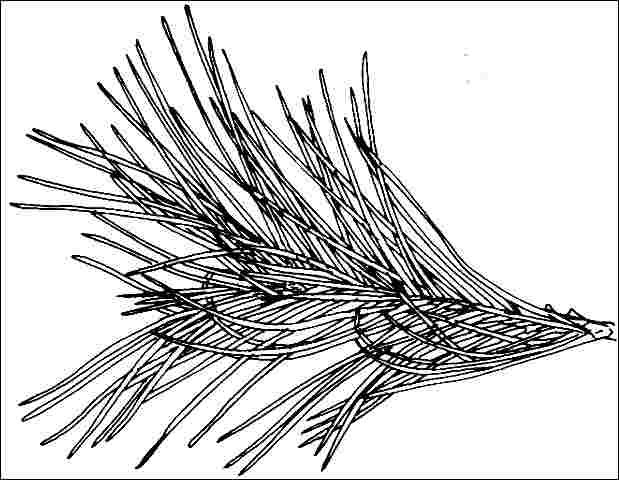
Leaf arrangement: alternate (Fig. 3)
Leaf type: simple
Leaf margin: entire
Leaf shape: needle-like (filiform)
Leaf venation: parallel
Leaf type and persistence: needled evergreen, evergreen, fragrant
Leaf blade length: less than 2 inches, 2 to 4 inches
Leaf color: green, silver
Fall color: no color change
Fall characteristic: not showy
Figure 3. Foliage
Flower
Flower color: yellow
Flower characteristics: not showy
Fruit
Fruit shape: oval, cone
Fruit length: 1 to 3 inches, 3 to 6 inches
Fruit covering: dry or hard
Fruit color: red, brown
Fruit characteristics: does not attract wildlife; showy; fruit/leaves a litter problem
Trunk and Branches
Trunk/bark/branches: branches droop; not showy; typically one trunk; thorns
When looking for a small, picturesque specimen pine for a coastal landscape, search no more. One of the best specimens in any landscape, Japanese white pine is a pleasure to behold with attractive foliage in all seasons. Set it off in the landscape with a low ground cover beneath or locate it in the lawn, but keep the grass cleared away from the thin-barked trunk.
Japanese white pine should be grown in full sun on well-drained soil with adequate moisture. The trees are salt-tolerant, and tolerate moderate drought and moist, clay soil.
Other cultivars include: 'Brevifolia', upright, narrow tree, sparsely branched, blue/green foliage in tight bundles.
Propagation is by seed.
Pests and Diseases
There are a large number of pests and diseases on pine.