


Pinus virginiana: Virginia Pine1
Introduction
This scrubby North American native tree is most often found growing in the poorest sites and will easily adapt to most soil conditions, except alkaline soils. Capable of reaching up to 70 feet in height, Virginia Pine is more often seen from 20 to 40 feet in height with a 20 to 35-foot spread. The yellowish-green, 1.5 to 3-inch-long, flexible, evergreen needles are joined by the numerous, mature, prickly cones. The thin, orange/brown bark becomes ridged and furrowed on older trees, and is often seen due to the open branching habit.
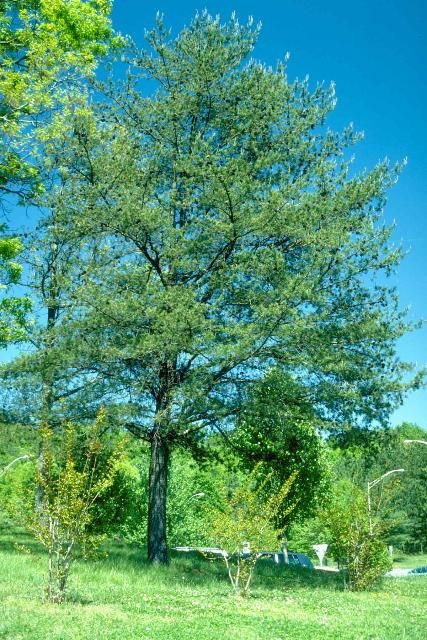
Credit: Ed Gilman
General Information
Scientific name: Pinus virginiana
Pronunciation: PIE-nus ver-jin-ee-AY-nuh
Common name(s): Virginia Pine, Scrub Pine
Family: Pinaceae
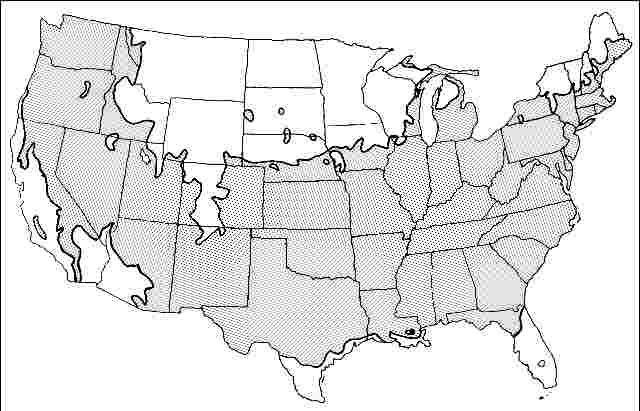
USDA hardiness zones: 5A through 8B (Fig. 2)
Origin: native to North America
Invasive potential: weedy native
Uses: specimen; reclamation; Bonsai; highway median; Christmas tree
Availability: not native to North America
Description
Height: 20 to 40 feet
Spread: 20 to 35 feet
Crown uniformity: irregular
Crown shape: round
Crown density: open
Growth rate: moderate
Texture: fine
Foliage
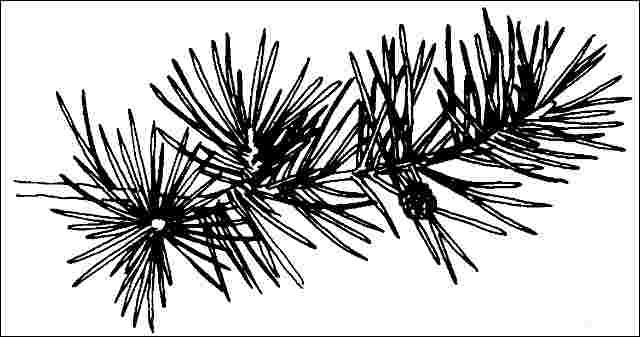
Leaf arrangement: spiral (Fig. 3)
Leaf type: simple
Leaf margin: entire
Leaf shape: needle-like (filiform)
Leaf venation: parallel
Leaf type and persistence: fragrant, evergreen, needled evergreen
Leaf blade length: less than 2 inches, 2 to 4 inches
Leaf color: green
Fall color: no color change
Fall characteristic: not showy
Flower
Flower color: yellow
Flower characteristics: not showy
Fruit
Fruit shape: oval, cone
Fruit length: 1 to 3 inches
Fruit covering: dry or hard
Fruit color: brown
Fruit characteristics: attracts squirrels/mammals; showy; fruit/leaves a litter problem
Trunk and Branches
Trunk/bark/branches: branches droop; not showy; typically one trunk; thorns
Pruning requirement: little required
Breakage: susceptible to breakage
Current year twig color: reddish
Current year twig thickness: thin
Wood specific gravity: 0.48
Culture
Light requirement: full sun
Soil tolerances: clay; sand; loam; acidic; well-drained
Drought tolerance: high
Aerosol salt tolerance: low
Other
Roots: not a problem
Winter interest: no
Outstanding tree: no
Ozone sensitivity: sensitive
Verticillium wilt susceptibility: resistant
Pest resistance: resistant to pests/diseases
Use and Management
Although considered to have an untidy appearance because of an irregular habit, the very low branches which stay on the tree help make Virginia Pine a popular choice in the South for culture as a Christmas tree. The trees grow moderately fast in cultivation and have a branching structure which tolerates pruning quite well. Pruning or shearing increases branchiness to create a nice Christmas tree. Can also be used for an open-branched specimen in a large-scale landscape.
Tolerant of a wide variety of soil types, Virginia Pine prefers to be grown in full sun on well-drained, loamy soil. It grows on soil too dry, rocky or clayey for most other plants, particularly Pines, but prefers acidic pH. It is useful as a reclamation tree due to the ability to seed itself in and tolerance to poor, dry soil.
Propagation is by seed.
Pests
No pests are normally serious to this pine in the landscape, although the list of possible problems is long.
Diseases
No diseases are normally serious to this pine in the landscape, although the list of possible problems is long.

