
Introduction
Double-flowered (`Autumnalis') Higan Cherry is 25 to 35-foot-tall and wide tree, usually with a multiple trunk, slender, upright branches, and a rounded canopy. The canopy on older trees often grows wider than the tree grows tall. Before the leaves appear in spring, the trees are covered with many semi-double pink flowers; some flowers may also appear in autumn if the weather is sufficiently warm. The one to four-inch-long dark green leaves are later joined by the appearance of small, black berries. The leaves cast light shade below the spreading canopy, and turn attractive fall colors of yellow and bronze before dropping.
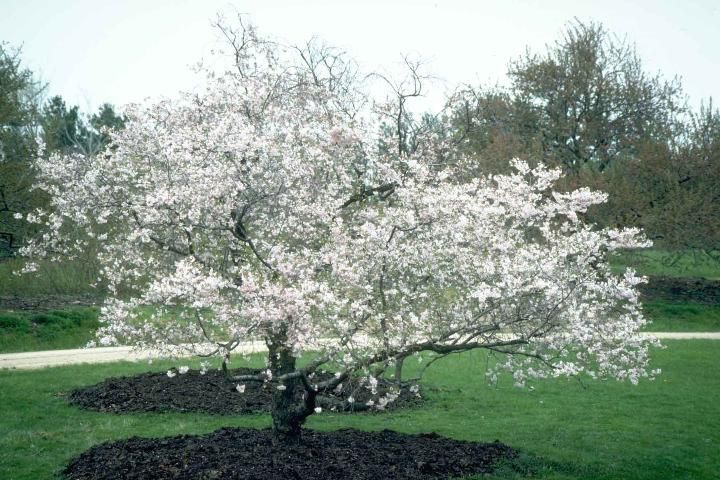
Credit: Ed Gilman
General Information
Scientific name: Prunus subhirtella
Pronunciation: PROO-nus sub-her-TELL-uh
Common name(s): 'Autumnalis' Higan Cherry
Family: Rosaceae
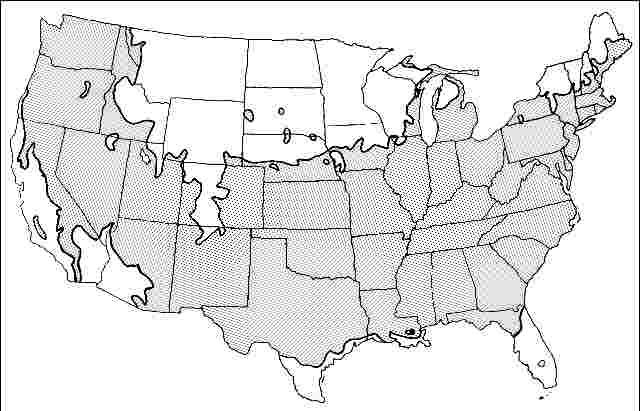
USDA hardiness zones: 5A through 8B (Fig. 2)
Origin: not native to North America
Invasive potential: little invasive potential
Uses: specimen; deck or patio; highway median; shade
Availability: somewhat available, may have to go out of the region to find the tree
Description
Height: 25 to 35 feet
Spread: 25 to 35 feet
Crown uniformity: symmetrical
Crown shape: vase
Crown density: dense
Growth rate: fast
Texture: medium
Foliage
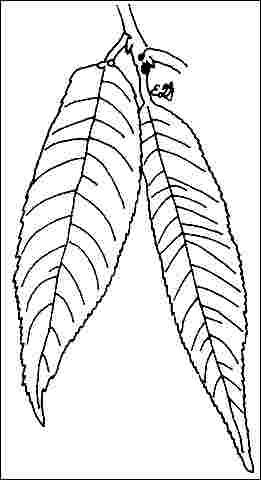
Leaf arrangement: alternate (Fig. 3)
Leaf type: simple
Leaf margin: serrate
Leaf shape: oblong, ovate
Leaf venation: pinnate, brachidodrome
Leaf type and persistence: deciduous
Leaf blade length: less than 2 inches, 2 to 4 inches
Leaf color: green
Fall color: yellow
Fall characteristic: showy
Flower
Flower color: pink
Flower characteristics: showy
Fruit
Fruit shape: oval
Fruit length: less than .5 inch
Fruit covering: fleshy
Fruit color: black
Fruit characteristics: attracts birds; not showy; fruit/leaves not a litter problem
Trunk and Branches
Trunk/bark/branches: branches don't droop; showy; typically one trunk; thorns
Pruning requirement: little required
Breakage: resistant
Current year twig color: brown
Current year twig thickness: thin
Wood specific gravity: unknown
Culture
Light requirement: full sun
Soil tolerances: clay; sand; loam; acidic; well-drained
Drought tolerance: moderate
Aerosol salt tolerance: unknown
Other
Roots: not a problem
Winter interest: yes
Outstanding tree: yes
Ozone sensitivity: unknown
Verticillium wilt susceptibility: susceptible
Pest resistance: sensitive to pests/diseases
Use and Management
Use the tree along an entrance road to a commercial development planted on 20-foot centers or along side the patio or deck in the back yard. It also makes a nice small-scale court yard tree or specimen planted in the lawn or in bed of ground cover. It could be planted along a residential street where there is plenty of soil for root expansion. It is becoming available in the industry.
Double-flowered Higan Cherry should be grown in full sun or partial shade on well-drained, acid soil with sufficient moisture. It is moderately drought-tolerant and grows well in clay soil, as long as it drains well. Trees grow quickly when young but slow down with age.
Propagation is by cuttings or grafts.
Pests
Aphids cause distortion of new growth, deposits of honeydew, and sooty mold.
Borers attack trees under stress. Keep trees healthy with regular fertilizer applications.
Scales of several types infest prunus. Horticultural oil is used to provide some control of overwintering stages.
Spider mites cause yellowing or stippling but are very difficult to see. They are usually recognized only after plant symptoms are quite advanced.
Tent caterpillars make large webbed nests in trees then eat the foliage. One defoliation may not be serious and small nests can be pruned out and destroyed. Use Bacillus thuringiensis when the insects are first seen and are still small.
Diseases
No diseases are of major concern. A bacterium causes leaf spot and twig cankers on cherry. Small, reddish spots dry, and drop out, giving a shot-holed appearance. Defoliation can be severe when conditions favor disease development. Fertilize infected trees and prune out infected branches.
A fungus causes reddish spots which drop out leaving shot holes. Once the holes appear the leaves may drop. The disease is worse in wet weather.
Black knot causes black swellings or galls on the branches. Branches with galls are pruned out.