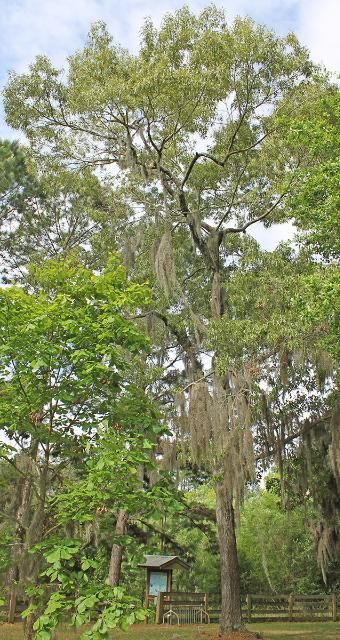
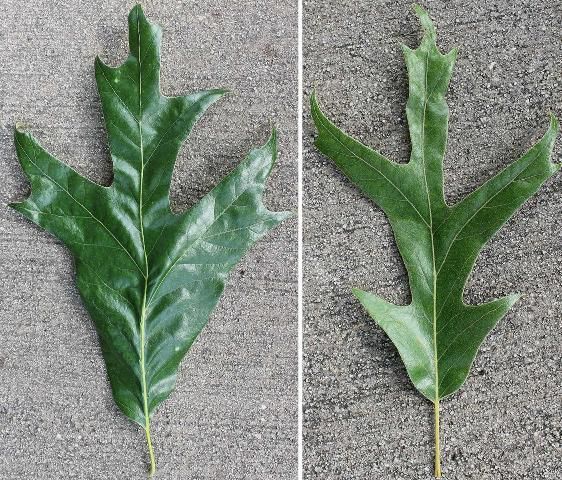
Southern red oak is an excellent large, durable shade tree which reaches 60 to 80 feet in height with a large, rounded canopy when it is open-grown. The deciduous, shiny green leaves are 5- to 9-inches-long by 4- to 5-inches-wide, with the terminal lobe much longer and narrower than the others. Leaves fall brown over an extended period of time in fall and winter. Some defoliation is noted during the summer in droughty years, but this is probably a drought-avoidance mechanism. No permanent damage appears to come from this. The dark gray to black bark is ridged and furrowed and resembles cherry bark, to some extent. The half-inch-diameter acorns are popular with wildlife. The trunk normally grows straight with major branches well-spaced and strongly attached to the tree.
Figure 1. Full Form—Quercus falcata: southern red oak
General Information
Scientific name: Quercus falcata
Pronunciation: KWERK-us fal-KAY-tuh
Common name(s): Southern red oak, spanish oak
Family: Fagaceae
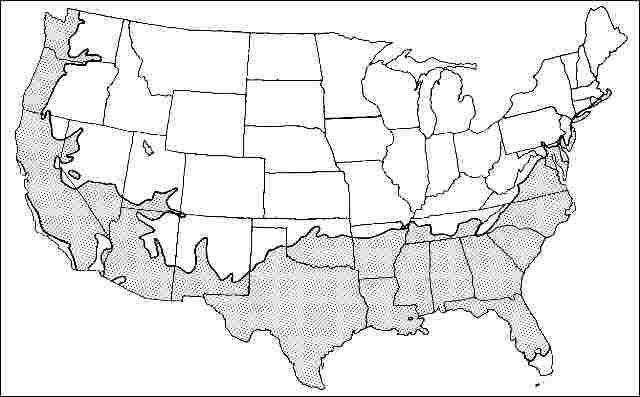
USDA hardiness zones: 7A through 9B (Figure 2)
Origin: native to the southeastern United States, in addition to eastern Texas and Oklahoma, and as far north as New York
UF/IFAS Invasive Assessment Status: native
Uses: specimen; shade; reclamation; street without sidewalk
Figure 2. Range
Description
Height: 60 to 80 feet
Spread: 60 to 70 feet
Crown uniformity: irregular
Crown shape: round, oval
Crown density: moderate
Growth rate: moderate
Texture: coarse
Foliage
Leaf arrangement: alternate
Leaf type: simple
Leaf margin: parted, lobed
Leaf shape: elliptic (oval), obovate, ovate
Leaf venation: pinnate
Leaf type and persistence: deciduous
Leaf blade length: 5 to 9 inches
Leaf color: dark green and shiny on top, paler green with a rusty pubescence underneath
Fall color: copper
Fall characteristic: not showy
Figure 3. Leaf variation—Quercus falcata: southern red oak
Flower
Flower color: male—yellow-green; female—reddish
Flower characteristics: not showy; male—3"–5" long catkin; female— tiny spike that emerges from leaf axils
Flowering: spring, with the leaves
Fruit
Fruit shape: ovoid to oblong
Fruit length: 1 inch
Fruit covering: dry or hard acorn; cap is bowl-shaped, warty, and covers the top 1/3 of the nut
Fruit color: brown
Fruit characteristics: attracts squirrels/mammals; not showy; fruit/leaves a litter problem
Fruiting: fall
Trunk and Branches
Trunk/branches: branches don't droop; not showy; typically one trunk; no thorns
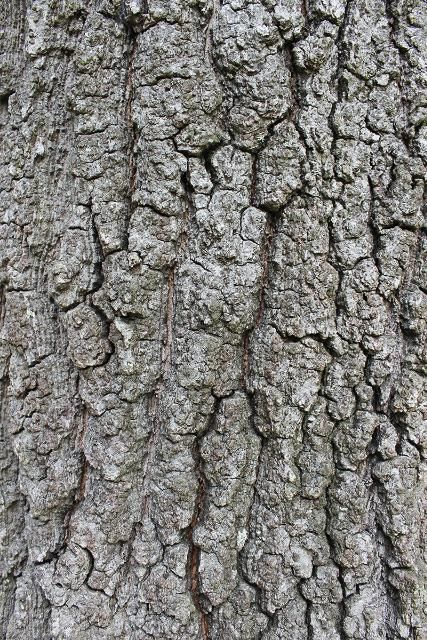
Bark: dark gray to back and smooth, becoming deeply furrowed with blocky ridges with age
Pruning requirement: needed for strong structure
Breakage: resistant
Current year twig color: brown, reddish
Current year twig thickness: medium
Wood specific gravity: 0.59
Figure 4. Bark—Quercus falcata: southern red oak Credit: Gitta Hasing
Culture
Light requirement: full sun
Soil tolerances: clay; sand; loam; acidic; well-drained to occasionally wet
Drought tolerance: high
Aerosol salt tolerance: moderate
Other
Roots: not a problem
Winter interest: no
Outstanding tree: yes
Ozone sensitivity: unknown
Verticillium wilt susceptibility: resistant
Pest resistance: resistant to pests/diseases
Use and Management
Naturally found on poor upland soils, southern red oak should be grown in full sun on well-drained soil, acid, sandy, or loam (not clay). It is common on poor-quality, sandy ridges. It is well suited for planting in areas such as along roadsides where there is little maintenance after planting. The wood is used for furniture but does not have the quality of Quercus rubra.
Variety pagodifolia, cherrybark oak, is adaptable, growing along stream banks and ridge tops throughout its range. It may be more commonly available than the species and may be referred to as Quercus pagodifolia in some nurseries. This plant may also be referred to as Quercus pagoda.
Propagation is by seed.
Pests and Diseases
There is a large number of potential problems. Except for oak wilt though, usually no pests or diseases of major concern. Caterpillars can defoliate trees. Fall cankerworm has been a problem in some years.
Reference
Koeser, A. K., Hasing, G., Friedman, M. H., and Irving, R. B. 2015. Trees: North & Central Florida. Gainesville: University of Florida Institute of Food and Agricultural Sciences.