Edward F. Gilman and Dennis G. Watson2
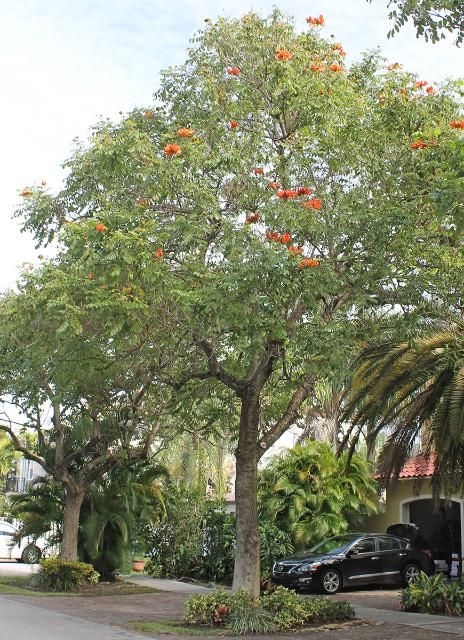
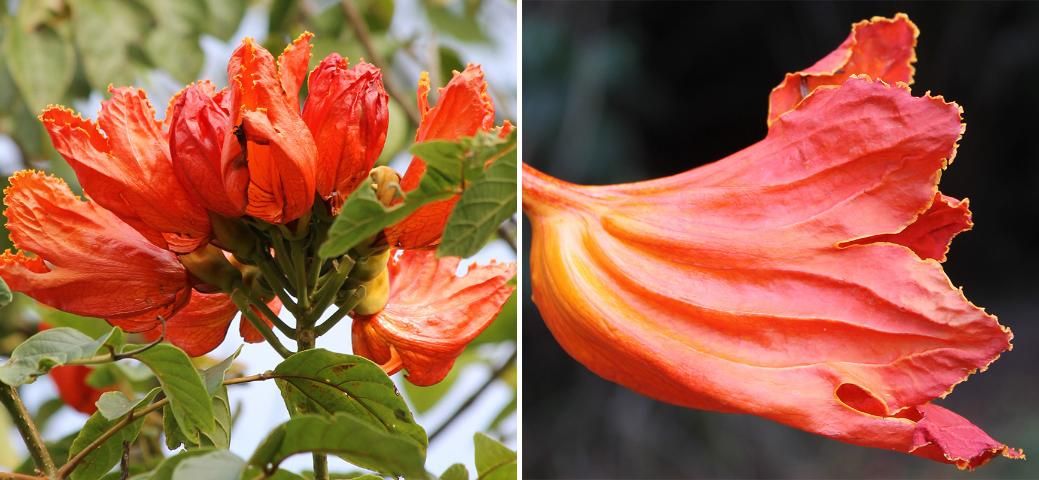
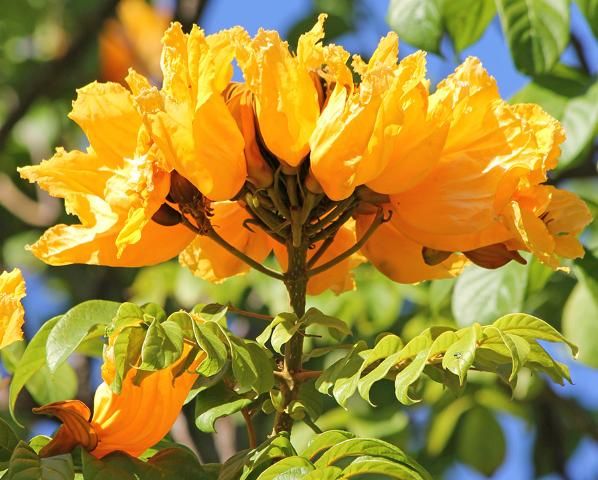
A native of tropical Africa, this large, upright, 50 to 60-foot tree has a dense, 40-foot-wide crown and one-and-one-half-foot-long, pinnately-compound, evergreen leaves composed of four-inch leaflets. Due to its size it is best located in large, open landscapes and is generally not suited for small residences unless your objective is deep shade. During winter and until late spring, African Tulip-Tree produces terminal clusters of beautiful blooms held above the foliage, a profusion of upwardly-facing, orange and yellow flowers which open several at a time from curved, two-inch-long, fuzzy brown flower buds filled with water. African Tulip-Tree is quite spectacular when in bloom. It is often used as a framing, shade, or specimen tree but must be used only in frost-free areas. Also, its soft, brittle wood is easily broken by high winds, and trees should be located either in sheltered locations or where falling branches will do no damage.
Young Spathodea campanulata: African Tulip-Tree
R.A. Howard. ©Smithsonian Institution. Courtesy of Smithsonian Institution, Richard A. Howard Photograph Collection. Jamaica.
Scientific name: Spathodea campanulata
Pronunciation: spath-OH-dee-uh kam-pan-yoo-LAY-tuh
Common name(s): African Tulip-Tree
Family: Bignoniaceae
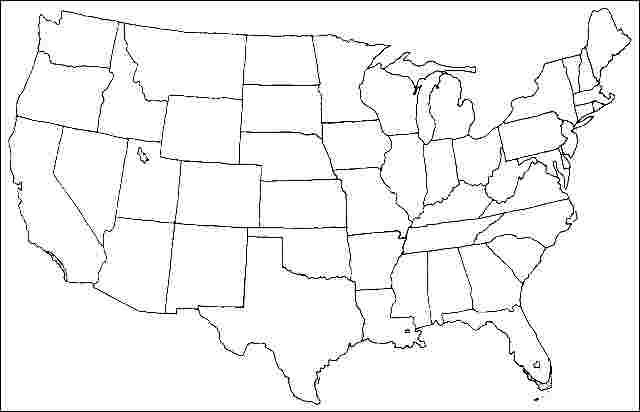
USDA hardiness zones: 10B through 11 (Fig. 2)
Origin: not native to North America
Invasive potential: According to the IFAS Assessment of Non-Native Plants in Florida’s Natural Areas (IFAS Invasive Plant Working Group 2008), Spathodea campanulata should be treated with caution in the south zone in Florida, may be recommended but managed to prevent escape. It is not considered a problem species and may be recommended in the north and central zone in Florida (counties listed by zone at: http://plants.ifas.ufl.edu/assessment/pdfs/assess_counties.pdf)
Uses: specimen; shade
Availability: somewhat available, may have to go out of the region to find the tree
Height: 50 to 60 feet
Spread: 35 to 50 feet
Crown uniformity: irregular
Crown shape: upright/erect, round, spreading
Crown density: moderate
Growth rate: fast
Texture: coarse
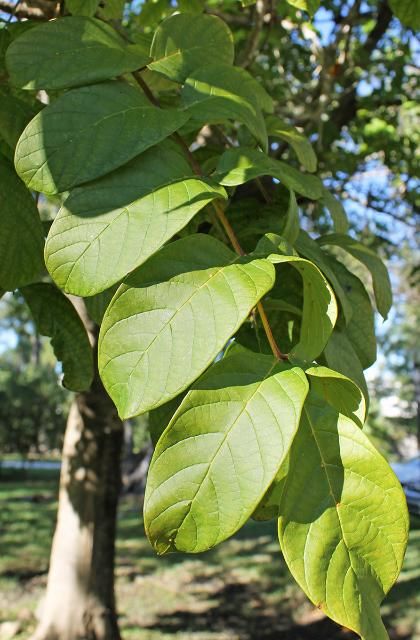
Leaf arrangement: opposite/subopposite (Fig. 3)
Leaf type: odd-pinnately compound
Leaf margin: entire
Leaf shape: elliptic (oval), oblong
Leaf venation: pinnate
Leaf type and persistence: evergreen, broadleaf evergreen
Leaf blade length: 2 to 4 inches
Leaf color: green
Fall color: no color change
Fall characteristic: not showy
Flower color: orange, yellow
Flower characteristics: very showy
Fruit shape: pod or pod-like, elongated
Fruit length: 6 to 12 inches
Fruit covering: dry or hard
Fruit color: brown
Fruit characteristics: does not attract wildlife; not showy; fruit/leaves a litter problem
Fruit.
R.A. Howard. ©Smithsonian Institution. Courtesy of Smithsonian Institution, Richard A. Howard Photograph Collection. United States, HI, Kauai.
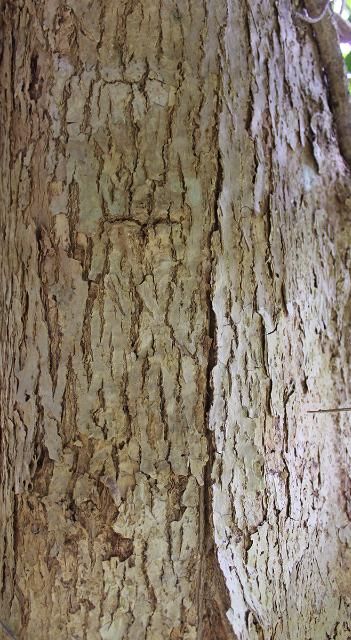
Trunk/bark/branches: branches droop; not showy; typically one trunk; thorns
Pruning requirement: needed for strong structure
Breakage: susceptible to breakage
Current year twig color: brown
Current year twig thickness: medium
Wood specific gravity: unknown
Light requirement: full sun
Soil tolerances: clay; sand; loam; acidic; well-drained
Drought tolerance: moderate
Aerosol salt tolerance: low
Roots: can form large surface roots
Winter interest: yes
Outstanding tree: no
Ozone sensitivity: unknown
Verticillium wilt susceptibility: unknown
Pest resistance: free of serious pests and diseases
Eliminate major branches that will form embedded bark as early as possible. Save those that are oriented more horizontally, with stonger attachments to the trunk. Keep them from growing larger than about half the trunk diameter by periodic thinning.
African Tulip-Trees will grow rapidly in full sun on any soil of reasonable drainage and fertility. Plants should be regularly watered until well-established and will then require little care.
Propagation is by seed, softwood cuttings, or root suckers.
No pests or diseases of major concern.
Fox, A.M., D.R. Gordon, J.A. Dusky, L. Tyson, and R.K. Stocker (2008) IFAS Assessment of Non-Native Plants in Florida’s Natural Areas: Status Assessment. Cited from the Internet (November 16, 2012), http://plants.ifas.ufl.edu/assessment/pdfs/status_assessment.pdf
This document is ENH-758, one of a series of the Environmental Horticulture, Florida Cooperative Extension Service, Institute of Food and Agricultural Sciences, University of Florida. Original publication date November 1993. Revised February 2013. Visit the EDIS website at http://edis.ifas.ufl.edu.
Edward F. Gilman, professor, Environmental Horticulture Department; Dennis G. Watson, former associate professor, Agricultural Engineering Department, Cooperative Extension Service, Institute of Food and Agricultural Sciences, University of Florida, Gainesville, FL 32611.
The Institute of Food and Agricultural Sciences (IFAS) is an Equal
Opportunity Institution authorized to provide research, educational
information and other services only to individuals and institutions
that function with non-discrimination with respect to race, creed,
color, religion, age, disability, sex, sexual orientation, marital
status, national origin, political opinions or affiliations.
For more information on obtaining other extension publications,
contact your county Cooperative Extension service.
U.S. Department of Agriculture, Cooperative Extension Service,
University of Florida, IFAS, Florida A. & M. University Cooperative
Extension Program, and Boards of County Commissioners Cooperating. Nick T. Place,
Dean.