


Trachycarpus fortunei: Windmill Palm1
Introduction
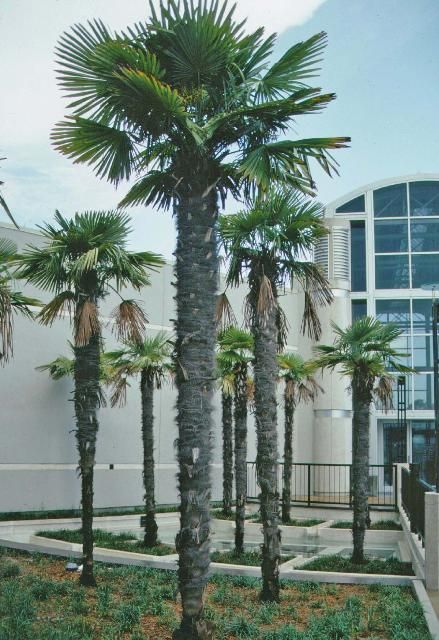
The erect, single trunk of windmill palm is covered with dense, brown, hairlike fibers, and the three-foot-wide, fan-shaped fronds extend from 1.5-foot-long, rough-edged petioles. The trunk appears to be wrapped in burlap. A very slow-growing palm, windmill palm can reach 40 feet in height but is often seen much smaller, 10 to 20 feet tall. Windmill palm works well as a framing tree, accent, specimen, patio or urn subject. It is ideal for use as an accent in a shady shrub border or by a front entryway. It does well in confined areas and is hardy to 10°F or lower.
Credit: Ed Gilman, UF/IFAS
General Information
Scientific name: Trachycarpus fortunei
Pronunciation: tray-kee-KAR-pus FOR-too-nee-eye
Common name(s): Windmill palm
Family: Arecaceae
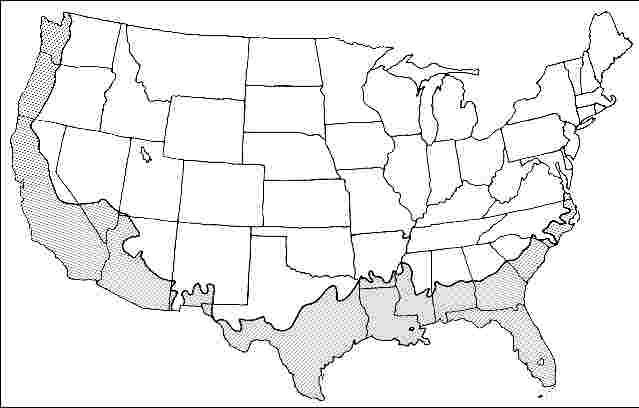
USDA hardiness zones: 8A through 11 (Fig. 2)
Origin: not native to North America
Invasive potential: little invasive potential
Uses: indoors; deck or patio; specimen; container or planter
Availability: not native to North America
Description
Height: 10 to 20 feet
Spread: 6 to 10 feet
Crown uniformity: symmetrical
Crown shape: palm, upright/erect
Crown density: open
Growth rate: slow
Texture: medium
Foliage
Leaf arrangement: alternate
Leaf type: simple
Leaf margin: entire
Leaf shape: star-shaped
Leaf venation: palmate
Leaf type and persistence: broadleaf evergreen, evergreen
Leaf blade length: 18 to 36 inches
Leaf color: green
Fall color: no color change
Fall characteristic: not showy
Flower
Flower color: yellow, white/cream/gray
Flower characteristics: not showy
Fruit
Fruit shape: round
Fruit length: less than .5 inch, .5 to 1 inch
Fruit covering: fleshy
Fruit color: blue
Fruit characteristics: does not attract wildlife; not showy; fruit/leaves not a litter problem
Trunk and Branches
Trunk/bark/branches: branches don't droop; showy; typically one trunk; thorns
Pruning requirement: little required
Breakage: resistant
Current year twig color: not applicable
Current year twig thickness:
Wood specific gravity: unknown
Culture
Light requirement: partial sun or partial shade, shade tolerant
Soil tolerances: clay; sand; loam; alkaline; acidic; well-drained
Drought tolerance: moderate
Aerosol salt tolerance: moderate
Other
Roots: not a problem
Winter interest: no
Outstanding tree: no
Ozone sensitivity: unknown
Verticillium wilt susceptibility: resistant
Pest resistance: resistant to pests/diseases
Use and Management
Windmill palm should be grown in shade or partial shade on fertile soil to look its best, but it is also tolerant of full sun on well-drained soils when given ample moisture in the northern part of its range. Plants should be watered faithfully. Protection from harsh winds will minimize leaf tearing, but plants can be used successfully close to the shore, being quite tolerant of salt and wind. There are fine examples of mass plantings where palms are spaced six to 10 feet apart around a patio or sitting area. They have also been used very successfully lining an entry walk to a large building. This adds a formal elegance to any structure, especially one with a glass facade.
Propagation is by seed.
Pests
Scales and palm aphids are pests of windmill palm.
Diseases
Windmill palm may be infected by root rot, moderately susceptible to lethal yellowing disease, and leaf spots.

