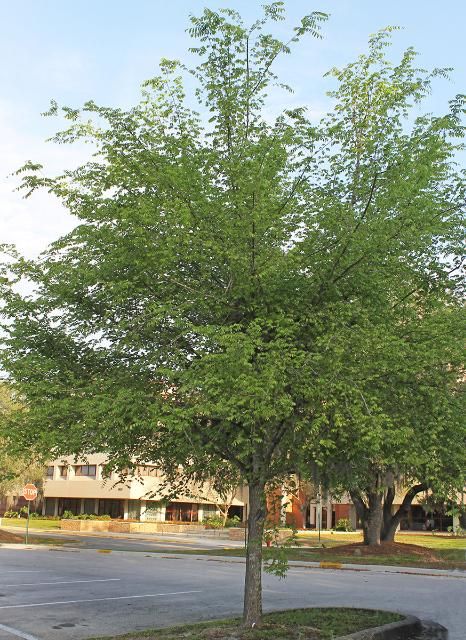
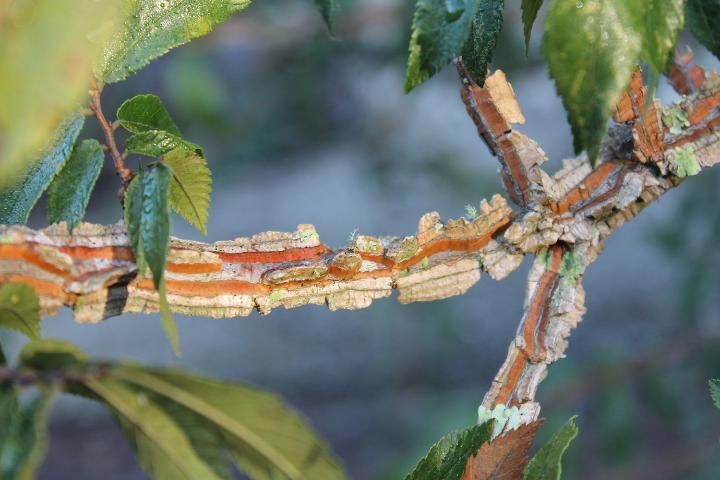
Usually seen at 45 to 70 feet high, winged elm can reach 90 feet in height in the woods with a 30 to 40-foot spread. Canopy form is variable from pyramidal to vase or rounded. A North American native, this fast-growing deciduous tree is quickly identified by the corky, wing-like projections which appear on opposite sides of twigs and branches. Branches rise through the crown, then bend in a sweeping manner toward the ground. The size of the wings varies greatly from one tree to another. Because it is found growing in wet sites as well as dry, rocky ridges it is a very adaptable tree for urban planting.
Figure 1. Full Form—Ulmus alata: winged elm
General Information
Scientific name: Ulmus alata
Pronunciation: UL-mus uh-LAY-tuh
Common name(s): winged elm
Family: Ulmaceae
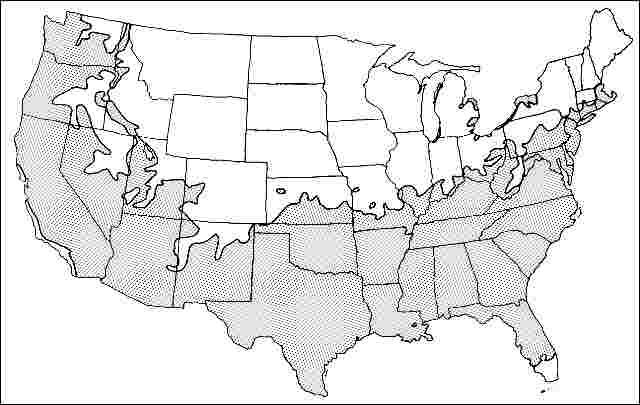
USDA hardiness zones: 6A through 9B (Figure 2)
Origin: native to the southern two-thirds of the eastern half of the United States
UF/IFAS Invasive Assessment Status: Native
Uses: street without sidewalk; shade; specimen; parking lot island < 100 sq ft; parking lot island 100-200 sq ft; parking lot island > 200 sq ft; sidewalk cutout (tree pit); tree lawn 3–4 feet wide; tree lawn 4–6 feet wide; tree lawn > 6 ft wide; urban tolerant; highway median; reclamation
Figure 2. Range
Description
Height: 45 to 70 feet
Spread: 30 to 40 feet
Crown uniformity: irregular
Crown shape: pyramidal, vase, oval, upright/erect
Crown density: moderate
Growth rate: fast
Texture: fine
Foliage
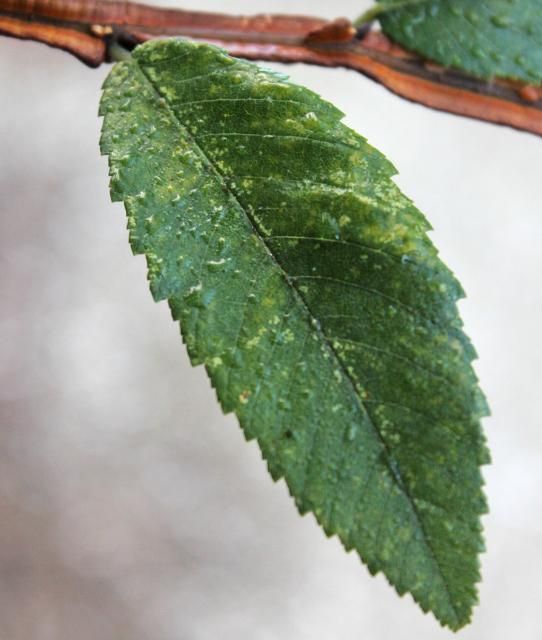
Leaf arrangement: alternate
Leaf type: simple
Leaf margin: double serrate, serrate
Leaf shape: elliptic (oval), ovate
Leaf venation: pinnate
Leaf type and persistence: deciduous
Leaf blade length: 2 to 4 inches
Leaf color: dark green on top, paler green underneath with pubescence in the leaf axils
Fall color: yellow
Fall characteristic: showy
Figure 3. Leaf—Ulmus alata: winged elm
Flower
Flower color: reddish
Flower characteristics: not showy; bell-shaped; emerges in clusters at leaf axils
Flowering: early spring
Fruit
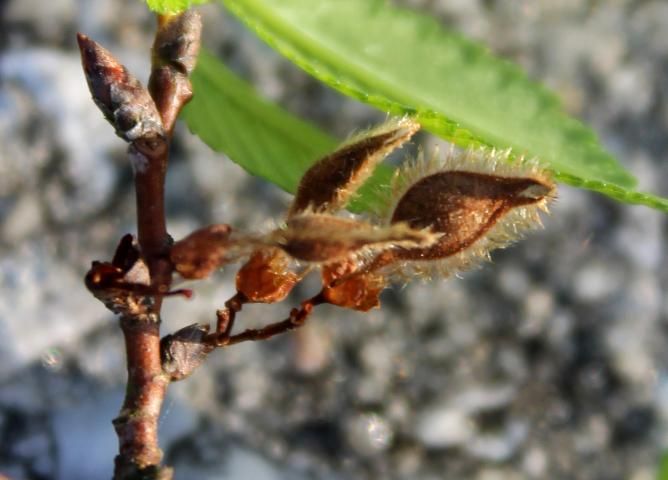
Fruit shape: flat, elliptic samara
Fruit length: 3/8 to 1/2 inch
Fruit covering: dry or hard; pubescence around the margins
Fruit color: brown
Fruit characteristics: does not attract wildlife; not showy; fruit/leaves not a litter problem
Fruiting: shortly after flowering
Figure 4. Fruit—Ulmus alata: winged elm
Trunk and Branches
Trunk/branches: branches don't droop; not showy; typically one trunk; no thorns
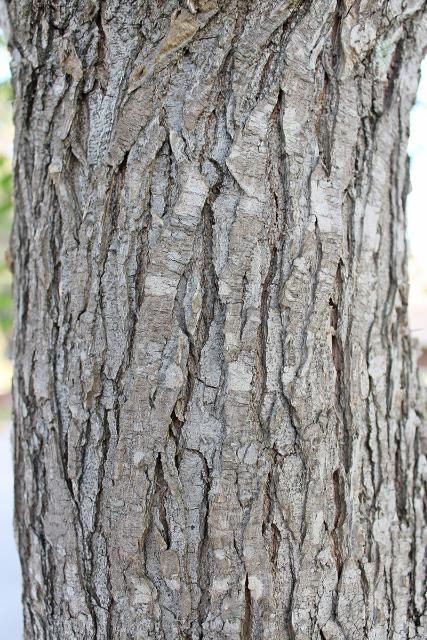
Bark: red brown to ashy gray, shallowly fissured, with flat-topped ridges, and corky, wing-like appendages on opposite sides of twigs and branches, although the latter feature may be lacking on older species
Pruning requirement: needed for strong structure
Breakage: resistant
Current year twig color: gray, brown
Current year twig thickness: thin
Wood specific gravity: unknown
Figure 5. Branch—Ulmus alata: winged elm
Figure 6. Bark—Ulmus alata: winged elm Credit: Gitta Hasing
Culture
Light requirement: full sun to partial shade
Soil tolerances: clay; sand; loam; alkaline; acidic; wet to well-drained
Drought tolerance: high
Aerosol salt tolerance: moderate
Other
Roots: not a problem
Winter interest: yes
Outstanding tree: no
Ozone sensitivity: tolerant
Verticillium wilt susceptibility: susceptible
Pest resistance: resistant to pests/diseases
Use and Management
Winged elm will easily adapt to full sun or partial shade, growing relatively quickly on any soil. It is an extremely sturdy and adaptable tree and is well-suited as a shade or street tree. It grows very well in urban areas and is suited to parking lot islands and other confined soil spaces. It must be pruned regularly at an early age to eliminate double and multiple trunks. Select branches which form a wide angle with the trunk, eliminating those with narrow crotches. Strive to produce a central trunk with major lateral limbs spaced along the trunk. This trunk will not be straight (unless it is staked) but this is fine. Purchase trees with good form in the nursery and be selective since form varies greatly from one tree to the next.
It is not an easy tree to train and prune, requiring perhaps three or four pruning's in the first several years after seed germination. Trees look very open and lanky following proper pruning and this may be one reason the tree has not been very popular with nursery operators, architects, and urban foresters. But after this initial training period, trees fill in nicely to make a well-adapted, beautiful shade tree.
Propagation is by seed which, when sown immediately after harvest, germinate quickly and easily.
Pests and Diseases
The biggest problem is Dutch elm disease which can kill trees. To protect the community from widespread tree loss, do not plant a large number of these trees. Some trees are susceptible to powdery mildew, causing varying degrees of leaf color changes in fall, right before leaves drop. Mites can yellow the foliage but usually cause no permanent damage. Scale insects can infest winged elm along branches. Scale infestations are often missed due to the thick, corky bark along the twigs.
Reference
Koeser, A. K., Hasing, G., Friedman, M. H., and Irving, R. B. 2015. Trees: North & Central Florida. Gainesville: University of Florida Institute of Food and Agricultural Sciences.