
Turfgrass Herbicides: Mode of Action and Resistance Management

Pawel Petelewicz andJ. Bryan Unruh


Target Audience

This document is a tool for turfgrass professionals, sod producers, golf course superintendents, athletic and sports fields managers, landscape managers, and extension specialists to help develop herbicide programs that reduce the risk of herbicide resistant weeds in turfgrass systems.

Introduction

Herbicides are the most efficacious tool for weed control in turfgrass. Many common and/or troublesome weeds are not adequately controlled for various reasons such as lack of access to efficacious active ingredients (AIs) and use restrictions to selected turf species. Weed species are also capable of adapting where these poorly controlled become more common. If not successfully controlled, these weeds can spread creating a cascade of environmental, management, and economic issues. In addition, certain weeds have a high potential for developing resistant populations. One such weed is goosegrass [Eleusine inidica (L.) Gaertn.], which is a difficult to control annual grassy weed in most Florida turfgrass systems. Populations resistant to current industry standard herbicides such as prodiamine, oxadiazon, and metribuzin have been confirmed in various turfgrass settings.

For turfgrass managers, resistant populations lead to a further limitation of reliable control options. This may force managers to employ less efficacious chemistries, or overuse options still capable of providing satisfactory control, directly resulting in increased management costs. Alternative products can be significantly more expensive while less efficacious products often require more applications to achieve desired weed control. These strategies can also pose an elevated risk of turfgrass damage. While herbicide safeners and/or safening strategies could reduce the potential for turfgrass injury, they generate additional logistic issues and/or expenses and effects may be inconsistent.

Successfully preventing resistance problems requires a complete understanding of what herbicide resistance is, how it develops, and effective strategies for mitigation. To achieve this, it is also crucial to understand the general nature of herbicidal activity within a plant.

Herbicide Mode of Action and Herbicide Resistance Explained

The term mode of action (MOA) refers to the entire sequence of events occurring within the plant treated with an herbicide (including its uptake, translocation, and metabolism), from first contact until the death of the susceptible plant. The term mechanism of action (MoA) is more specific and applies to a particular chain of biophysical (e.g., electron flow inhibition, cell division disruption, protein binding) or biochemical (e.g., enzyme inhibition) processes which herbicide disrupts (e.g., by inhibition or overstimulation). Although some herbicides may function via several MOAs, only one is considered principal, and is used to describe the herbicide’s effect on plant. There is also a term site of action, which refers to a particular location within a cell where these processes occur (e.g., chloroplasts or particular photosystems in the case of photosynthesis, mitochondria in the case of respiration, nuclei in the case of mitosis, specific binding sites on a protein in the case of enzymes). Some confusion may arise as sometimes those three terms are incorrectly considered as interchangeable by individuals referring to the MOA, which is also used as one of the characteristics for herbicide classification. Being fundamental to proper herbicide resistance management, it is the MOA which is further discussed in this publication.

Herbicide resistance is commonly defined as “the inherited ability of a plant to survive and reproduce following exposure to a dose of herbicide normally lethal to the wild type.” A more current weed-specific definition describes herbicide resistance as “the evolved capacity of a previously herbicide-susceptible weed population to withstand an herbicide and complete its life cycle when the herbicide is used at its normal rate in an agricultural situation.” In both cases herbicide resistance is distinct from herbicide tolerance, which is described as the “ability of a plant to remain uninjured by a dose of an herbicide normally lethal to other plant species.”

Overall, while HR results from over-reliance on herbicides as a sole mean for weed control, herbicides do not induce any gene mutations resulting in herbicide resistance. Those occur naturally and spontaneously. Subsequently, herbicide resistance can be transferred between generations via sexual reproduction in plants producing seeds. Such risk is higher in weeds with an annual life cycle compared to perennial plants that do not rely completely on seed production (i.e., sexual reproduction) for persistence across multiple seasons.

Herbicide resistance usually develops where an individual herbicide or herbicides with the same MOA are used excessively (Figure 1). This occurs during continuous and repeated applications over extended periods of time (e.g., multiple seasons) as the primary control of particular weed species. Such an approach creates a high selection pressure on the targeted weed populations. In most cases, herbicide resistance is already present at very low levels (often <0.0001%). While susceptible plants are removed by the herbicide, the herbicide resistant individuals grow and reproduce and eventually become dominant. Also, weeds may evolve herbicide resistance to other herbicides within the same MOA. However, this is not the case with all MOAs.
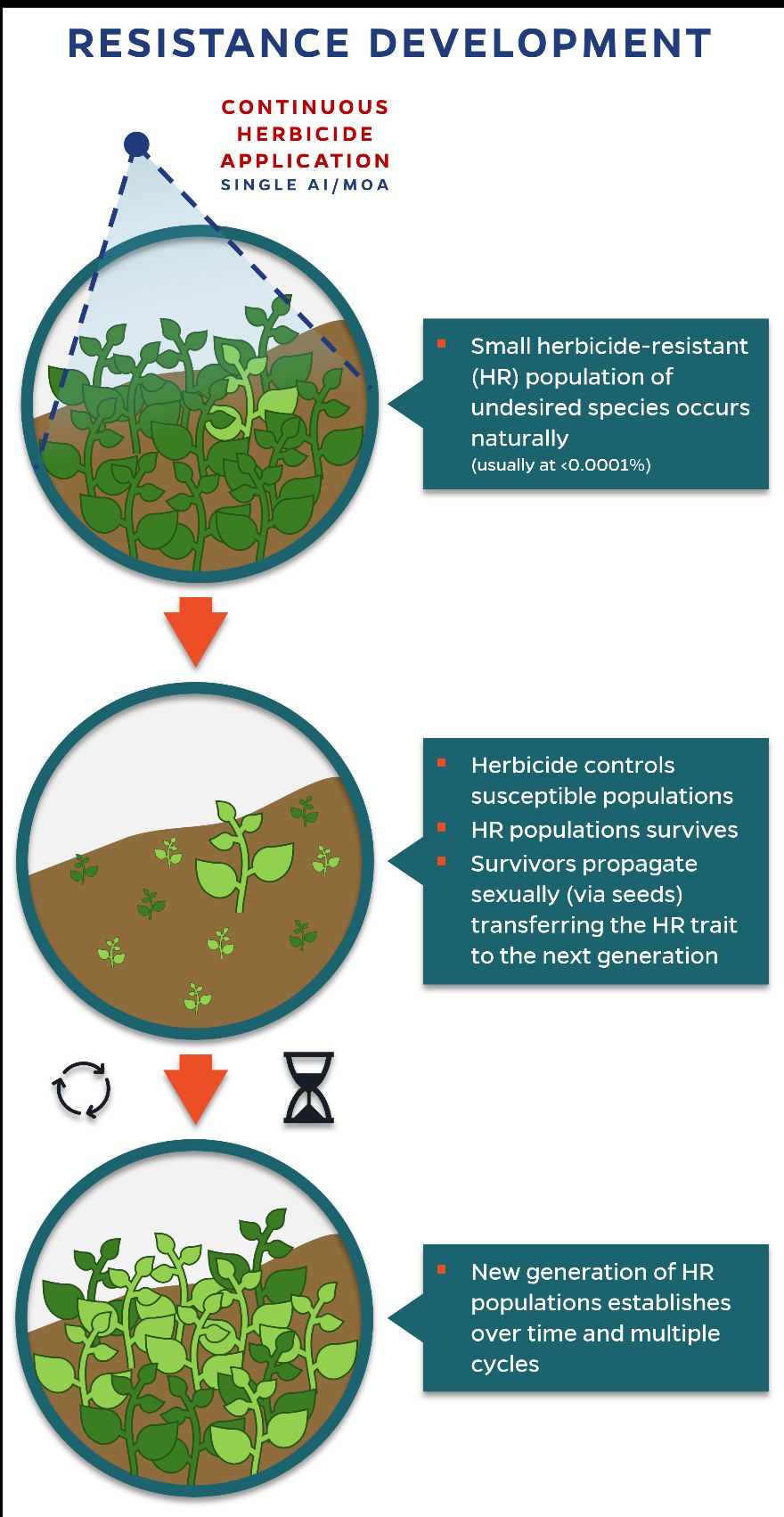
Development of herbicide resistance in weeds due to the continuous use of a single mode of action (MOA) or active ingredient (AI).
Figure 1. Development of herbicide resistance in weeds due to the continuous use of a single mode of action (MOA) or active ingredient (AI).

Monoculture settings of perennial crops, such as turfgrass, additionally favor the development of herbicide resistant populations. In these situations, crop rotation does not occur, eliminating herbicide options with differing MOAs that would be used in rotational crops. Moreover, proven agronomic management practices that alleviate the risk for herbicide resistance development such as tillage and cultivation, cover cropping, and fallow periods cannot be employed in established turfgrass settings. Therefore, the use of herbicides to control weeds in turfgrass settings becomes a necessity.

Strategies for Reduction of HR Development Risk

Entities such as Weed Science Society of America (WSSA) and the Herbicide Resistance Action Committee (HRAC) have developed MOA-based herbicide classification systems to help end users better address arising herbicide resistance issues. In the past, there were differences between these individual systems (e.g., numerical coding in WSSA’s system, alphabetical coding in HRAC’s system). In 2020, the HRAC updated their classification system to capture new active ingredients and to reflect the current state of knowledge. Also, the classification was harmonized, and a transition was made from alphabetical (now referred to as "HRAC Legacy") to numerical codes to ensure global sustainability of the system. A summary of MOAs and their classifications according to the WSSA and HRAC, along with a comprehensive list of herbicide active ingredients registered for use in turfgrass (including their chemical families) and their respective WSSA/HRAC MOA groups, is provided in Table 1. Additionally, Table 2 summarizes turfgrass tolerance (based on label information) for the most prevalent turfgrasses managed in Florida. Alphabetical codes are no longer used in the U.S., thus are not included in this publication. Moreover, in an effort to adopt responsible resistance management practices, CropLife International members have voluntarily committed to include MOA icons and WSSA/HRAC groups on all herbicide product labels (Figure 2).
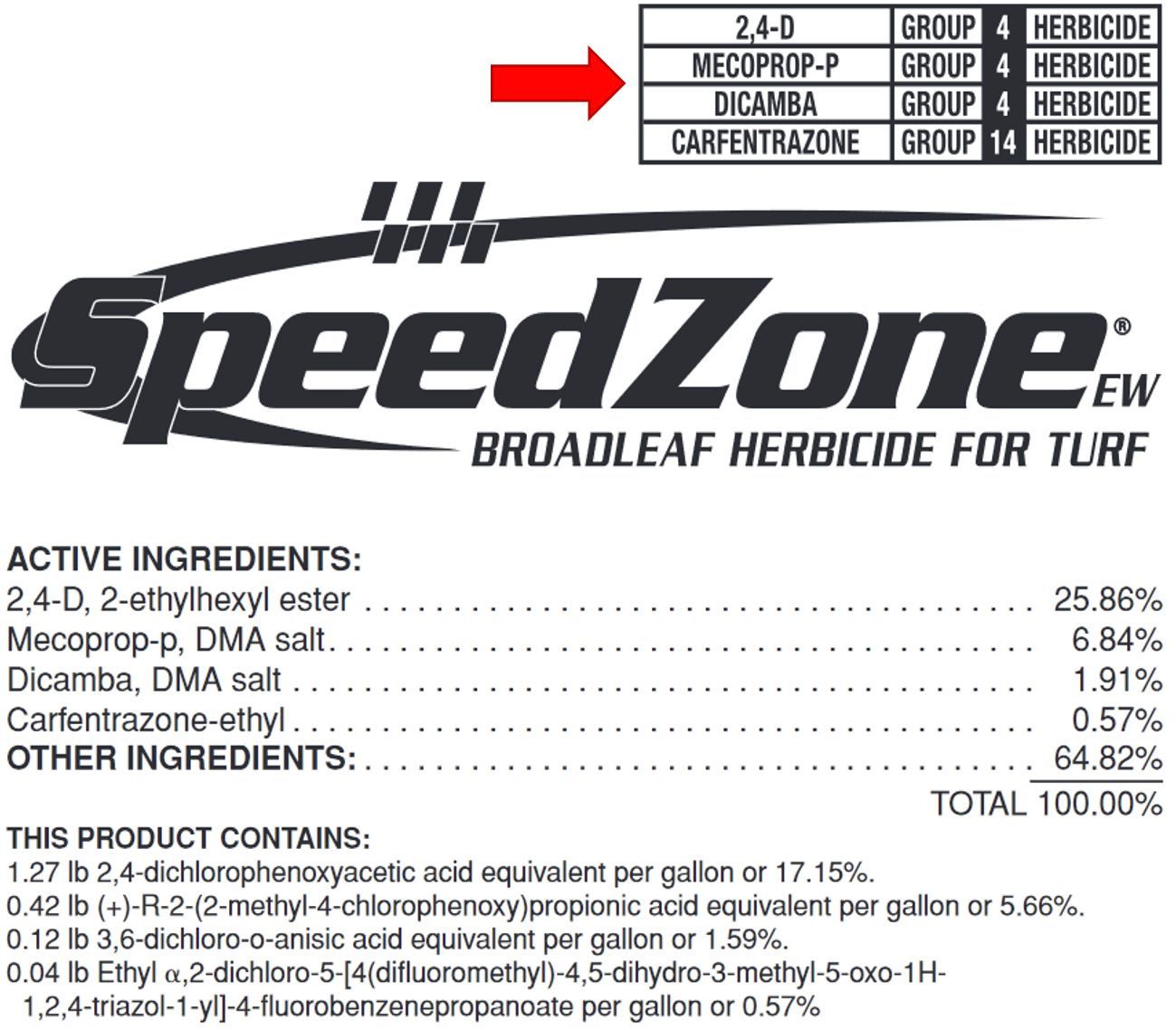
Example of an herbicide product label with an icon indicating the herbicides’ mode of action (MOA) classification in Weed Science Society of America (WSSA) and Herbicide Resistance Action Committee (HRAC) harmonized system.
Figure 2. Example of a herbicide product label with an icon indicating the herbicides’ mode of action (MOA) classification in Weed Science Society of America (WSSA) and Herbicide Resistance Action Committee (HRAC) harmonized system.

There are several strategies designed to delay or prevent herbicide resistance development in weeds. The most practical and effective tactic is to rotate the use of herbicides with different MOAs. Simply put, if two herbicides have the same MOA number or code, regardless of different names or active ingredients, they affect weeds in the same way. As previously explained, frequent and repeated use of herbicides with the same MOA will increase the risk of herbicide resistance development. Conversely, using a diverse herbicide program that either rotates or combines herbicides with different MOAs will help delay the development of resistant weeds.

MOA rotation helps delay herbicide resistance because changing the MOA reduces the chances of survival and reproduction of herbicide resistant weeds. In simple terms, if a weed survives a herbicide application with one MOA because it is resistant, the problem can be controlled if the surviving weed is treated with herbicide with a different MOA to which it has not become resistant.

As shown in Table 2, most herbicides for preemergence (PRE) control are inhibitors of microtubule assembly (Group 3) and mitosis inhibitors (Group 15), while postemergence herbicides are predominantly acetolactate synthase (ALS) inhibitors (Group 2). Although many turfgrass professionals base their weed management programs solely on Groups 3 and 2, it is critical that herbicides from other MOA groups be included also. To ensure that the most frequently used herbicides in turfgrass will continue being effective for a long time, herbicides with different MOAs should be included in weed management programs even if they are not as effective or require repeat applications to provide the desired level of control.

Example of groups that are useful for MOA rotation with microtubule assembly inhibitors (Group 3) and mitosis inhibitors (Group 15) in PRE programs in turfgrass:

  • Group 21 – inhibitors of cell wall synthesis at site B
  • Group 29 – inhibitors of cell wall synthesis at site C
  • Group 8 – inhibitors of lipid synthesis other than Acetyl CoA Carboxylase (ACCase) inhibitors
  • Group 14 (specific active ingredients) – oxadiazole family of protoporphyrinogen oxidase (Protox, PPO) inhibitors

Example of groups that are useful for MOA rotation with ALS-inhibitors (Group 2) in POST programs in turfgrass:

  • Group 27 – inhibitors of 4-hydroxyphenyl-pyruvatedioxygenase (4-HPPD)
  • Group 5 – inhibitors of photosynthesis at photosystem II (PSII) site A
  • Group 14 (specific active ingredients) – triazolinones family of PPO inhibitors
  • Group 4 – synthetic auxins
  • Group 6 – inhibitors of PSII site B

Example of groups which, due to their dual activity, could be considered for rotation in both PRE and POST programs in turf:

  • Group 5 (specific active ingredients) – triazine family of PSII site A-inhibitors
  • Group 8 (specific active ingredients) – benzofuran family of inhibitors of lipid synthesis other than Acetyl CoA Carboxylase (ACCase) inhibitors
  • Group 3 (specific active ingredients) – benzamide family of microtubule assembly inhibitors
  • Group 14 (specific active ingredients) – N-phenylphthalimide family of PPO inhibitors
  • Group 30 – tyrosine aminotransferase inhibitors

There are two ways to rotate herbicides in turfgrass settings. The first is to rotate herbicide MOAs from year to year (Figure 3). For example, one could use a Group 21 PRE herbicide in the fall of year 1 and change to Group 3 PRE herbicide in the fall of year 2. Conversely, one could use Group 2 POST herbicide in year 1 and then switch to Groups 4 and 14 POST herbicides in year 2.
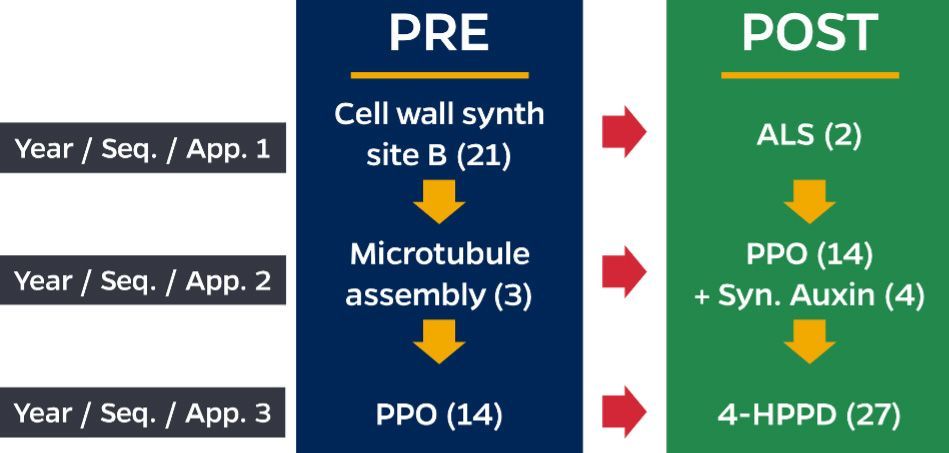
Example of mode of action (MOA) rotation within individual season and across years. MOA change from the preemergence (PRE) to postemergence (POST) applications as well as both PRE and POST herbicide MOA change from year to year.
Figure 3. Example of mode of action (MOA) rotation within individual season and across years. MOA change from the preemergence (PRE) to postemergence (POST) applications as well as both PRE and POST herbicide MOA change from year to year.

The second way is to rotate herbicides within a season (Figure 3). In this approach, the rotation cycle may apply to either individual applications or their entire sequences (i.e., initial application followed by supplemental applications as prescribed on the herbicide label). Overall, there are three possible scenarios applicable to this approach. In all of them, the tactic is to change the herbicide MOA to eradicate plants surviving previous application(s), which are often referred to as “escapes.” This approach is called the "double-knock down" strategy because weed control is based on two consecutive actions.

In the first scenario, one could apply a Group 21 PRE herbicide at the beginning of the season and switch to a Group 2 POST herbicide to kill plants that may still be emerging and were not prevented by the initial PRE application.

The second and third scenarios are similar to each other and often apply to environments with extended growing seasons, such as Florida’s. For example, one could use a Group 21 PRE herbicide prior to expected germination of a target weed and then perform a sequential, follow-up application. However, when residual efficacy of those treatments is expected to diminish, then one could switch to a Group 3 PRE herbicide to ensure no germination occurs later in the season. Similarly, when applying POST herbicides, MOAs should be rotated between 2 POST applications/sequences within same season to target the escapes from the initial application.

Another strategy is to use either tank-mixes or premixes of various active ingredients containing different MOAs. There are also many premix options available in the market; however, most contain 1 to 3 active ingredients from the same MOA group, which is not beneficial from a herbicide resistance management standpoint. The addition of certain active ingredients or even MOAs will broaden their efficacy on additional groups/species of weeds; however, they will not boost the efficacy on the target weed. Therefore, from a herbicide resistance management perspective, it is important that all components of either a tank-mix and/or a rotation program have the capacity to control the target weed.

Lastly, the turf’s own ability to outcompete other species is the key to both successful weed control and reduced herbicide resistance risk. A healthy, dense turfgrass enhances competitiveness against weeds and reduces their encroachment. To ensure successful weed control and to minimize herbicide resistant weed development, all of the strategies discussed should be combined with practices aimed to provide the best possible growing conditions for turfgrass along with proper sanitation practices to avoid reintroduction of problematic plants.

Table 1. Mode of action (MOA) classification according to the Weed Science Society of America (WSSA) and the Herbicide Resistance Action Committee (HRAC) for preemergence (PRE) and postemergence (POST) herbicides registered for use in turfgrass.

HRAC WSSA Groupa

Chemical Family

Common Name

[Active Ingredient(s)]

Primary Activity

Commercial Product Example(s)

Single MOA Compounds

Acetyl CoA Carboxylase (ACCase) Inhibitors

Standalones

1

Aryloxyphenoxy-propionate ('FOP')

Fenoxaprop-P

POSTb

Acclaim Extra

1

Aryloxyphenoxy-propionate ('FOP')

Fluazifop-P-butyl

POST

Fusilade II, Ornamec 170, Ornamec Over-The-Top

1

Phenylpyrazoline ('DEN')

Pinoxaden

POST

Manuscript

1

Cyclohexanedione ('DIM')

Sethoxydim

POST

Segment, Segment II

Acetolactate Synthase (ALS) or Acetohydroxy Acid Synthase (AHAS) Inhibitors

Standalones

2

Imidazolinone

Imazapic

PREb + POST

Plateau

2

Imidazolinone

Imazaquin

POST

Scepter T&O 70 WDG

2

Pyrimidinyl(thio)benzoate

Bispyribac-sodium

POST

Velocity PM

2

Pyrimidinyl(thio)benzoate

Pyrimisulfan

POST

Arkon, Vexis

2

Sulfonylurea

Flazasulfuron

PRE + POST

Katana

2

Sulfonylurea

Foramsulfuron

POST

Revolver

2

Sulfonylurea

Halosulfuron-methyl

POST

Avalaire Halo 75 WDG, Halo 5WDG Select, Halo 75WDG Select, Profine 75, Prosedge, Sandea, SedgeHammer, SedgeHammer+

2

Sulfonylurea

Imazosulfuron

POST

Celero

2

Sulfonylurea

Metsulfuron-methyl (MSM)

POST

Equil Pasture and Turf MSM, Manor, Mansion, MSM 25OD, MSM 60, Omni Brand MSM 60 DF, Quali-Pro MSM Turf, Rometsol, Tide MSM 60 DF

2

Sulfonylurea

Rimsulfuron

PRE + POST

Rimsulfuron 25DF, TranXit

2

Sulfonylurea

Sulfometuron-methyl

PRE + POST

Oust XP, LPI Sulfometuron Methyl, Sulfometuron Methyl 75

2

Sulfonylurea

Sulfosulfuron

POST

Certainty

2

Sulfonylurea

Trifloxysulfuron-sodium

POST

Monument 75WG

2

Triazolopyrimidine

Florasulam

POST

Defendor

2

Triazolopyrimidine

Penoxsulam

POST

LockUp on fert., Sapphire

Two-way Premixes

2

+ 2

Pyrimidinyl(thio)benzoate

+ triazolopyrimidine

Pyrimisulfan

+ penoxsulam

POST

Aethon

2

+ 2

Sulfonylurea

+ sulfonylurea

Metsulfuron-methyl (MSM)

+ rimsulfuron

POST

Negate 37WG

2

+ 2

Sulfonylurea

+ sulfonylurea

Sulfometuron-methyl

+ metsulfuron-methyl (MSM)

PRE + POST

Oust EXTRA

Three-way Premixes

2

+ 2

+ 2

Sulfonylaminocarbonyl-triazolinone

+ sulfonylurea

+ sulfonylurea

Thiencarbazone-methyl

+ foramsulfuron

+ halosulfuron-methyl

POST

Tribute Total

2

+ 2

+ 2

Sulfonylaminocarbonyl-triazolinone

+ sulfonylurea

+ sulfonylurea

Thiencarbazone-methyl

+ iodosulfuron-methyl-sodium

+ halosulfuron-methyl

POST

Celsius XTRA

Special Premixes

2

+ S

Sulfonylurea

+ safener

Trifloxysulfuron-sodium

+ metcamifen

POST

Recognition

Inhibitors of Microtubule Assembly

Standalones

3

Benzamide

Pronamide

PRE

Kerb 50WP, Kerb SC T&O

3

Dinitroaniline

Benefin

PRE

Balan 2.5G, Balan DF

3

Dinitroaniline

Oryzalin

PRE

Harrier 4L, Oryzalin 4, Surflan AS Specialty

3

Dinitroaniline

Pendimethalin

PRE

1.71% Pendimethalin DG Pro, Corral 2.68G, Pendulum 2G, Pendulum 3.3 EC, Pendulum AquaCap, PRE-M 3.3 EC

3

Dinitroaniline

Prodiamine

PRE

Barricade 4FL, Barricade 65WG, ProClipse 65 WDG, Prodiamine 4L, Prodiamine 65 WDG, RegalKade 50

3

Pyridine

Dithiopyr

PRE + EPOSTb

Dimension 2EW, Dimension EC, Dimension Ultra 40WP

Two-way Premixes

3

+ 3

Dinitroaniline

+ dinitroaniline

Benefin

+ oryzalin

PRE

Surflan XL 2G, XL 2G

3

+ 3

Dinitroaniline

+ dinitroaniline

Benefin

+ trifluralin

PRE

2% Team on DG Pro, Team 2G, Team Pro MU

Synthetic Auxins

Standalones

4

Benzoic acid

Dicamba

POST

Banvel, Banvel 480, Clash, Cruise Control, Diablo, Sterling Blue, Vanquish, Vision

4

Phenoxy carboxylic acid

2,4-D

POST

2,4-D Amine, 2,4-D LV 6, Barrage HF, Clean Amine, Hardball, Opti-Amine, Saber, Shredder 2,4-D LV4, Shredder 2,4-D LV6, Shredder Amine 4, Shredder E-99, Weedar 64, WEEDestroy AM40, Weedone LV4 EC

4

Phenoxy carboxylic acid

MCPA

POST

MCPA-4 Amine, MCPA Ester 4

4

Phenoxy carboxylic acid

Mecoprop-P (MCPP)

POST

MCPP-p 4 Amine, Mecomec 4

4

Pyridine carboxylic acid

Clopyralid

POST

Lontrel T&O

4

Pyridine carboxylic acid

Fluroxypyr

POST

Vista XRT

4

Pyridine carboxylic acid

Triclopyr

POST

Triclopyr 4, Trycera, Turflon Ester, Turflon Ester Ultra

4

Quinoline carboxylic acid

Quinclorac

POST

Acclaim Accelerate, Drive XLR8, Q-Ball, Quinclorac, Quinclorac 75DF, Quinclorac 75DF Select, QuinPro Herbicide, Quintessential, Rook 4L

Two-way Premixes

4

+ 4

Phenoxy carboxylic acid

+ phenoxy carboxylic acid

2,4-D

+ dichlorprop (2,4-DP)

POST

Patron 170

4

+ 4

Phenoxy carboxylic acid

+ pyridine carboxylic acid

2,4-D

+ triclopyr

POST

AquaSweep, Chaser, Chaser 2 Amine, Crossroad

4

+ 4

Pyridine carboxylic acid

+ pyridine carboxylic acid

Fluroxypyr

+ triclopyr

POST

Tailspin

4

+ 4

Pyridine carboxylic acid

+ pyridine carboxylic acid

Triclopyr

+ clopyralid

POST

2-D, Confront

Three-way Premixes

4

+ 4

+ 4

Phenoxy carboxylic acid

+ benzoic acid

+ phenoxy carboxylic acid

2,4-D

+ dicamba

+ dichlorprop (2,4-DP)

POST

Brushmaster, Super Trimec

4

+ 4

+ 4

Phenoxy carboxylic acid

+ benzoic acid

+ pyridine carboxylic acid

2,4-D

+ dicamba

+ clopyralid

POST

Millennium Ultra 2

4

+ 4

+ 4

Phenoxy carboxylic acid

+ benzoic acid

+ quinoline carboxylic acid

2,4-D

+ dicamba

+ quinclorac

POST

2DQ, Terradex Crabgrass & Broadleaf, Triad QC Select, Trimec Crabgrass Plus Lawn Weed Killer, Momentum Q, Quincept

4

+ 4

+ 4

Phenoxy carboxylic acid

+ pyridine carboxylic acid

+ benzoic acid

2,4-D

+ fluroxypyr

+ dicamba

POST

Escalade 2

4

+ 4

+ 4

Phenoxy carboxylic acid

+ pyridine carboxylic acid

+ pyridine carboxylic acid

2,4-D

+ fluroxypyr

+ halauxifen-methyl

POST

GameOn

4

+ 4

+ 4

Phenoxy carboxylic acid

+ phenoxy carboxylic acid

+ benzoic acid

2,4-D

+ mecoprop-P (MCPP)

+ dicamba

POST

3-D, Eliminate LO, Eliminate-D, EndRun, MEC Amine-D, Strike-3, Threesome, Three-Way, Trimec 1000, Trimec 992, Trimec Bentgrass Formula, Trimec Classic, Trimec Southern, Triplet Low Odor, Triplet SF

4

+ 4

+ 4

Phenoxy carboxylic acid

+ phenoxy carboxylic acid

+ phenoxy carboxylic acid

2,4-D

+ mecoprop-P (MCPP)

+ dichlorprop (2,4-DP)

POST

Spoiler, Triamine

4

+ 4

+ 4

Phenoxy carboxylic acid

+ pyridine carboxylic acid

+ pyridine carboxylic acid

2,4-D

+ triclopyr

+ fluroxypyr

POST

Momentum FX2

4

+ 4

+ 4

Phenoxy carboxylic acid

+ pyridine carboxylic acid

+ benzoic acid

MCPA

+ fluroxypyr

+ dichlorprop (2,4-DP)

POST

Chaser Ultra 2

4

+ 4

+ 4

Phenoxy carboxylic acid

+ pyridine carboxylic acid

+ benzoic acid

MCPA

+ fluroxypyr

+ dicamba

POST

Change Up

4

+ 4

+ 4

Phenoxy carboxylic acid

+ pyridine carboxylic acid

+ pyridine carboxylic acid

MCPA

+ fluroxypyr

+ triclopyr

POST

Battleship III

4

+ 4

+ 4

Phenoxy carboxylic acid

+ phenoxy carboxylic acid

+ benzoic acid

MCPA

+ mecoprop-P (MCPP)

+ dicamba

POST

Trimec Encore, Tri-Power

4

+ 4

+ 4

Phenoxy carboxylic acid

+ pyridine carboxylic acid

+ phenoxy carboxylic acid

MCPA

+ triclopyr

+ dicamba

POST

Cool Power, Eliminate, Horsepower, Spurge Power, Three-Way Ester II

4

+ 4

+ 4

Quinoline carboxylic acid

+ phenoxy carboxylic acid

+ benzoic acid

Quinclorac

+ mecoprop-P (MCPP)

+ dicamba

POST

Onetime

Four-way Premixes

4

+ 4

+ 4

+ 4

Phenoxy carboxylic acid

+ pyridine carboxylic acid

+ benzoic acid

+ phenoxy carboxylic acid

2,4-D

+ triclopyr

+ dicamba

+ MCPA

POST

Terradex Power Premix

Inhibitors of Photosynthesis at Photosystem II Site A

Standalones

5

Triazine

Atrazine

PRE + POST

AAtrex 4L, AAtrex Nine-O, Atrazine 4L, Atrazine 90DF

5

Triazine

Simazine

PRE + POST

Princep Liquid, Simazine 4L, Simazine 90DF, Sim-Trol 4L, Sim-Trol 90DF

5

Triazinone

Metribuzin

POST

Sencor 75%

5

Triazinone

Hexazinone

POST

Velpar DF VU

5

Triazolinone

Amicarbazone

POST

Xonerate 2SC

Inhibitors of Photosynthesis at Photosystem II Site B

Standalones

6

Benzothiadiazinone

Bentazon

POST

Basagran T&O

6

Nitrile

Bromoxynil

POST

Broclean, Brox 2EC, Buctril, Buctril 4EC, Maestro 2EC, Maestro 4EC, MOXY 2E

Inhibitors of Lipid Synthesis; Not ACCase Inhibition

Standalones

8

Benzofuran

Ethofumesate

PRE + POST

Etho 4 SC, Ethofumesate 4SC, PoaConstrictor, Prograss EC, Prograss SC

8

Phosphorodithioate

Bensulide

PRE

Bensumec 4LF

Inhibitors of 5-enolypyruvyl-shikimate-3-phosphate Synthase (EPSPS)

Standalones

9

Glycine

Glyphosate

NS (TOTAL) b

Accord Concentrate, Accord XRT, Accord XRT II, Aquamaster, Aqua Neat, Aqua Star, Buccaneer, Buccaneer Plus, Buccaneer K, Cinco, Clearout 5 Extra, Cornerstone Plus, Credit 41 Extra, Credit 5.4 Extra, Credit Xtreme, CropSmart Glyphosate 41% Extra, Duplicator 6, Four Power Plus, Gly Star 5 Extra, Gly Star K-Plus, Gly Star Original, Gly Star Plus, Glyphomate 41, Glyphosate 5.4, Glyphosate Plus, Honcho Plus, Imitator Aquatic, Imitator DA, Imitator Plus, KleenUp Pro, Mad Dog, Mad Dog 5.4, Mad Dog Plus, Makaze, Pronto Big N' Tuf, Prosecutor Pro, Ranger Pro, Razor, Razor Pro, Razor Xtreme, Rodeo, Roundup Custom, Roundup Pro, Roundup Pro Concentrate, Roundup PROMAX, Showdown, Shypho-AQ Aquatic & VM, Signature Glyphosate 5.4#, Sunphosate 41%, Sunphosate 5 Plus, Tomahawk 4, Top Dog Glycel 41% Plus Herbicide, Top Dog Glycel Super Max Herbicide, Top Dog Glycel Ultra Max, Willowood Glypho 6, Touchdown Pro

Inhibitors of Glutamine Synthetase

Standalones

10

Phosphinic acid

Glufosinate-ammonium

NS (TOTAL)

Axill Solutions Glufosinate 280SL, Cheetah Pro, Finale, Finale VU, Finale XL T&O, GroSpurt Royce 280 SL, Interline, Opportunity, Reckon 280SL, Surmise, Surmise 5, Surmise Pro, Total, Total 2.3, Total SL, Total TNV, Wynca USA Glufosinate 280 SL

Inhibitors of Protoporphyrinogen Oxidase (Protox, PPO)

Standalones

14

N-phenylphthalimide

Flumioxazin

PRE + POST

SureGuard SC, StayGuard on fert., Flumioxazin 51% WDG, Flumishield SC

14

Phenylpyrazole

Pyraflufen-ethyl

POST

Octane 2% SC

14

Triazolinone

Carfentrazone-ethyl

POST

Quicksilver T&O

14

Triazolinone

Sulfentrazone

PRE + POST

Anatares Pro, Aquesta 4F, Dismiss, Expel, Spartan 4F, Surepyc

14

Oxadiazole

Oxadiazon

PRE

Oxadiazon 2G, Oxa-Pro G, Ronstar FLO

Two-way Premixes

14

+ 14

Triazolinone

+ triazolinone

Carfentrazone-ethyl

+ sulfentrazone

PRE + POST

Dismiss NXT, Spartan Charge

Mitosis Inhibitors

Standalones

15

Acetamide

Napropamide

PRE

Devrinol 2-XT, Devrinol DF-XT

15

Chloroacetamide

Dimethenamid-P

PRE

Tower

15

Chloroacetamide

Pethoxamid

PRE

StriCore

15

Chloroacetamide

S-metolachlor

PRE

Pennant Magnum

Inhibitors of 7,8-dihydro-preroate Synthetase (DHP)

Standalones

18

Carbamate

Asulam

PRE

Asulox

Inhibitors of Cell Wall Synthesis Site B

Standalones

21

Benzamide

Isoxaben

PRE

Gallery 75 Dry Flowable, Gallery SC, Isoxaben 75 WG

Photosystem I Electron Diverters

Standalones

22

Bipyridylium

Diquat

NS (TOTAL)

Dessicash L&A, Diquash, Diquat, Diquat 2 L AG, Diquat SPC 2 L, Reward, Tribune, Tsunami DQ, Verdure-X

Inhibitors of 4-hydroxyphenyl-pyruvatedioxygenase (4-HPPD)

Standalones

27

Triketone

Mesotrione

PRE + POST

Tenacity, Lucto

27

Pyrazolone

Topramezone

POST

Pylex

Inhibitors of Cell Wall Synthesis Site C

Standalones

29

Alkylazine

Indaziflam

PRE

Specticle FLO, Specticle G

Inhibitors of Tyrosine Aminotransferase

Standalones

30

Unspecified

Methiozolin

PRE + POST

PoaCure SC

Unknown MOA

Standalones

0

Carboxylic acid

Pelargonic acid

NS (TOTAL)

Scythe

Multiple MOA Compounds

Groups 2 + 3 + 5

Three-way Premixes

3

+ 2

+ 5

Dinitroaniline

+ imidazolinone

+ triazine

Prodiamine

+ imazaquin

+ simazine

PRE + POST

Coastal

Groups 2 + 4

Two-way Premixes

2

+ 4

Sulfonylurea

+ benzoic acid

Halosulfuron-methyl

+ dicamba

POST

Yukon

2

+ 4

Sulfonylurea

+ benzoic acid

Metsulfuron-methyl (MSM)

+ dicamba

POST

Fahrenheit

Three-way Premixes

2

+ 2

+ 4

Sulfonylaminocarbonyl-triazolinone

+ sulfonylurea

+ benzoic acid

Thiencarbazone-methyl

+ iodosulfuron-methyl-sodium

+ dicamba

POST

Celsius WG

Groups 2 + 4 + 14

Four-way Premixes

2

+ 4

+ 4

+ 14

Triazolopyrimidine

+ phenoxy carboxylic acid

+ benzoic acid

+ triazolinone

Penoxsulam

+ 2,4-D

+ dicamba

+ sulfentrazone

POST

Avenue South

Groups 2 + 14

Two-way Premixes

2

+ 14

Imidazolinone

+ triazolinone

Imazethapyr

+ sulfentrazone

POST

Dismiss South, Sulfen Southern

2

+ 14

Imidazolinone

+ triazolinone

Imazaquin

+ sulfentrazone

POST

Surepyc IQ

14

+ 2

Triazolinone

+ sulfonylurea

Sulfentrazone

+ metsulfuron-methyl (MSM)

POST

Blindside

Groups 3 + 4

Two-way Premixes

3

+ 4

Dinitroaniline

+ quinoline carboxylic acid

Prodiamine

+ quinclorac

PRE + POST

Cavalcade PQ, LESCO Stonewall PQ

Groups 3 + 14

Two-way Premixes

3

+ 14

Dinitroaniline

+ triazolinone

Prodiamine

+ sulfentrazone

PRE + POST

Echelon 4SC, Echelon on fert.

14

+ 3

Oxadiazole

+ dinitroaniline

Oxadiazon

+ prodiamine

PRE

Regalstar II, Regalstar G

Groups 3 + 15

Two-way Premixes

3

+ 15

Dinitroaniline

+ chloroacetamide

Pendimethalin

+ dimethenamid-P

PRE

FreeHand 1.75G

Groups 3 + 21

Two-way Premixes

3

+ 21

Pyridine

+ benzamide

Dithiopyr

+ isoxaben

PRE

Crew, Fortress

3

+ 21

Dinitroaniline

+ benzamide

Prodiamine

+ isoxaben

PRE

Gemini, Gemini Granular, Prodoxaben 3.7 SC, Prodoxaben G

Groups 4 + 6

Two-way Premixes

4

+ 6

Phenoxy carboxylic acid

+ nitrile

MCPA

+ bromoxynil

POST

Maestro Advanced, Maestro MA

Groups 4 + 14

Two-way Premixes

14

+ 4

Triazolinone

+ quinoline carboxylic acid

Sulfentrazone

+ quinclorac

POST

Solitare, Solitare WSL

Four-way Premixes

4

+ 4

+ 4

+ 14

Phenoxy carboxylic acid

+ phenoxy carboxylic acid

+ benzoic acid

+ triazolinone

2,4-D

+ MCPA

+ dicamba

+ sulfentrazone

POST

Terradex Quick Strike, Triad SFZ Select

4

+ 4

+ 4

+ 14

Phenoxy carboxylic acid

+ pyridine carboxylic acid

+ benzoic acid

+ phenylpyrazole

2,4-D

+ triclopyr

+ dicamba

+ pyraflufen-ethyl

POST

4-Speed XT

4

+ 4

+ 4

+ 14

Phenoxy carboxylic acid

+ pyridine carboxylic acid

+ pyridine carboxylic acid

+ N-phenylphthalimide

2,4-D

+ triclopyr

+ fluroxypyr

+ flumioxazin

POST

Sure Power

4

+ 4

+ 4

+ 14

Phenoxy carboxylic acid

+ phenoxy carboxylic acid

+ benzoic acid

+ triazolinone

2,4-D

+ dichlorprop (2,4-DP)

+ dicamba

+ carfentrazone-ethyl

POST

SpeedZone Southern EW

14

+ 4

+ 4

+ 4

Triazolinone

+ phenoxy carboxylic acid

+ phenoxy carboxylic acid

+ benzoic acid

Carfentrazone-ethyl

+ 2,4-D

+ mecoprop-P (MCPP)

+ dicamba

POST

SpeedZone EW

14

+ 4

+ 4

+ 4

Triazolinone

+ phenoxy carboxylic acid

+ phenoxy carboxylic acid

+ benzoic acid

Carfentrazone-ethyl

+ MCPA

+ mecoprop-P (MCPP)

+ dicamba

POST

PowerZone

4

+ 4

+ 14

+ 4

Pyridine carboxylic acid

+ pyridine carboxylic acid

+ triazolinone

+ phenoxy carboxylic acid

Fluroxypyr

+ triclopyr

+ sulfentrazone

+ 2,4-D

POST

Momentum 4-Score

4

+ 14

+ 4

+ 4

Quinoline carboxylic acid

+ triazolinone

+ phenoxy carboxylic acid

+ benzoic acid

Quinclorac

+ sulfentrazone

+ 2,4-D

+ dicamba

POST

Q4 Plus

14

+ 4

+ 4

+ 4

Triazolinone

+ phenoxy carboxylic acid

+ phenoxy carboxylic acid

+ benzoic acid

Sulfentrazone

+ 2,4-D

+ mecoprop-P (MCPP)

+ dicamba

POST

SureZone, Surge

4

+ 14

+ 4

+ 4

Pyridine carboxylic acid

+ triazolinone

+ phenoxy carboxylic acid

+ benzoic acid

Triclopyr

+ sulfentrazone

+ 2,4-D

+ dicamba

POST

TZone SE, Triad TZ Select

Groups 5 + 14

Two-way Premixes

5

+ 14

Triazinone

+ triazolinone

Metribuzin

+ sulfentrazone

POST

Sulfencore

Groups 8 + 14

Two-way Premixes

8

+ 14

Phosphorodithioate

+ oxadiazole

Bensulide

+ oxadiazon

PRE

Goosegrass/Crabgrass Control

Groups 9 + 22

Two-way Premixes

9

+ 22

Glycine

+ bipyridylium

Glyphosate

+ diquat

NS (TOTAL)

QuickPro, Razor Burn

a HRAC=Herbicide Resistance Action Committee; WSSA=Weed Science Society of America; Group=Herbicide mode of action (MOA) group as classified by HRAC and WSSA.

b PRE=preemergence; POST=postemergence; EPOST=early postemergence; NS (TOTAL)=non-selective/total.

Mention of a commercial or herbicide brand name or chemical does not constitute a recommendation or warranty of the product by the authors or UF/IFAS, nor does it imply approval of the product to the exclusion of other products that may also be suitable.

Professional-grade herbicides should be handled by trained and licensed/certified personnel and applied using calibrated equipment. Always refer to the label for specific uses, application rates, turfgrass tolerance, and handler and environment safety. Always check for specific precautions and restrictions.

Table 2. Turfgrass tolerance (based on label information) to professional-grade preemergence (PRE) and postemergence (POST) herbicides, organized by mode of action (MOA) classification as defined by the Weed Science Society of America (WSSA) and the Herbicide Resistance Action Committee (HRAC).

HRAC WSSA Groupa

Active Ingredient(s)

(simplified)

Turfgrass Species

Commercial Product Example(s)

BERb

STA

BAHI

CARP

CENT

PASP

ZOYS

RYE

Single MOA Compounds

Acetyl CoA Carboxylase (ACCase) Inhibitors

Standalones

1

Fenoxaprop

Dc

NI

D

NI

NI

NI

T

T

Acclaim Extra

1

Fluazifop

NI

NI

NI

NI

NI

NI

T

NI

Fusilade II, Ornamec 170, Ornamec Over-The-Top

1

Pinoxaden

T

R

D

NI

T

D

T

NI

Manuscript

1

Sethoxydim

D

NI

D

NI

T

NI

NI

D

Segment, Segment II

Acetolactate Synthase (ALS) or Acetohydroxy Acid Synthase (AHAS) Inhibitors

Standalones

2

Imazapic

R

NI

R

NI

T

NI

NI

D

Plateau

2

Imazaquin

T

T

D

D

T

D

T

D

Scepter T&O 70 WDG

2

Bispyribac

R

NI

NI

NI

NI

NI

NI

T

Velocity PM

2

Pyrimisulfan

T

T

T

D

T

T

T

T

Arkon, Vexis

2

Flazasulfuron

T

D

D

D

R

R

T

D

Katana

2

Foramsulfuron

T

NI

NI

NI

NI

NI

T

D

Revolver

2

Halosulfuron

NI

NI

NI

NI

NI

NI

NI

NI

Avalaire Halo 75WDG, Halo 75WDG Select, Profine 75, Prosedge, Sandea

T

T

T

NI

T

T

T

T

Halo 5WDG Select, SedgeHammer, SedgeHammer+

2

Imazosulfuron

T

T

NI

NI

T

NI

T

T

Celero

2

Metsulfuron

R

R

D

NI

R

NI

R

D

Equil Pasture and Turf MSM, Manor, Mansion, MSM 25OD, Omni Brand MSM 60 DF, Quali-Pro MSM Turf, Tide MSM 60 DF

R

NI

D

NI

NI

NI

NI

D

MSM 60, Rometsol

2

Rimsulfuron

R

NI

NI

NI

R

NI

R

D

Rimsulfuron 25DF, TranXit

2

Sulfometuron

R

NI

R

NI

R

NI

NI

D

Oust XP, LPI Sulfometuron Methyl, Sulfometuron Methyl 75

2

Sulfosulfuron

T

R

T

NI

T

R

T

D

Certainty

2

Trifloxysulfuron

T

R

D

NI

NI

NI

T

D

Monument 75WG

2

Florasulam

T

T

T

NI

T

NI

T

T

Defendor

2

Penoxsulam

NI

NI

NI

NI

NI

NI

NI

NI

LockUp on fert.

T

NI

D

D

NI

NI

T

R

Sapphire

Two-way Premixes

2

Pyrimisulfan

+ penoxsulam

T

T

NI

D

T

T

T

D

Aethon

2

Metsulfuron

+ rimsulfuron

R

NI

D

NI

NI

NI

R

D

Negate 37WG

2

Sulfometuron

+ metsulfuron

R

NI

D

NI

R

NI

NI

D

Oust EXTRA

Three-way Premixes

2

Thiencarbazone

+ foramsulfuron

+ halosulfuron

T

D

D

NI

D

D

T

D

Tribute Total

2

Thiencarbazone

+ iodosulfuron

+ halosulfuron

T

T

D

NI

T

D

T

D

Celsius XTRA

Special Premixes

2

Trifloxysulfuron

+ metcamifen

T

T

D

NI

NI

NI

T

D

Recognition

Inhibitors of Microtubule Assembly

Standalones

3

Pronamide

T

T

NI

NI

T

NI

T

D

Kerb 50WP

T

T

NI

NI

T

T

T

D

Kerb SC T&O

3

Benefin

T

T

T

NI

T

NI

T

T

Balan 2.5G

NI

NI

NI

NI

NI

NI

NI

NI

Balan DF

3

Oryzalin

T

T

T

NI

T

NI

T

NI

Harrier 4L, Oryzalin 4, Surflan AS Specialty

3

Pendimethalin

NI

NI

NI

NI

NI

NI

NI

NI

1.71% Pendimethalin DG Pro

T

T

T

NI

T

NI

T

NI

Corral 2.68G

T

T

T

NI

T

T

T

T

Pendulum 2G, Pendulum 3.3 EC, Pendulum AquaCap, PRE-M 3.3 EC

3

Prodiamine

T

T

T

NI

T

T

T

T

Barricade 4FL, Barricade 65WG, ProClipse 65 WDG, Prodiamine 4L, Prodiamine 65 WDG, RegalKade 50

3

Dithiopyr

R

T

T

T

T

T

T

T

Dimension 2EW, Dimension EC, Dimension Ultra 40WP

Two-way Premixes

3

+ 3

Benefin

+ oryzalin

T

T

T

NI

T

NI

T

D

Surflan XL 2G, XL 2G

3

+ 3

Benefin

+ trifluralin

T

T

T

NI

T

NI

T

T

2% Team on DG Pro, Team 2G, Team Pro MU

Synthetic Auxins

Standalones

4

Dicamba

T

R

NI

R

NI

NI

NI

T

Banvel, Banvel 480, Cruise Control, Diablo

NI

R

NI

R

NI

NI

NI

NI

Clash, Sterling Blue, Vanquish, Vision

4

2,4-D

T

D

NI

NI

NI

NI

NI

NI

2,4-D Amine, Shredder E-99, Weedar 64, Weedone LV4 EC

NI

D

NI

NI

NI

NI

NI

NI

2,4-D LV 6, Opti-Amine, Shredder 2,4-D LV4, Shredder 2,4-D LV6, Shredder Amine 4, WEEDestroy AM40

NI

D

NI

D

D

NI

NI

T

Barrage HF, Saber

NI

NI

NI

NI

NI

NI

NI

NI

Clean Amine

R

D

R

D

R

NI

R

T

Hardball

4

MCPA

T

R

NI

R

R

NI

NI

T

MCPA-4 Amine

NI

R

NI

R

NI

NI

NI

NI

MCPA Ester 4

4

MCPP

NI

D

NI

NI

D

NI

NI

NI

MCPP-p 4 Amine, Mecomec 4

4

Clopyralid

T

T

T

NI

T

T

T

T

Lontrel T&O

4

Fluroxypyr

R

R

T

NI

T

NI

T

T

Vista XRT

4

Triclopyr

D

D

D

NI

D

NI

D

T

Triclopyr 4, Trycera, Turflon Ester, Turflon Ester Ultra

4

Quinclorac

R

D

D

NI

D

R

T

T

Acclaim Accelerate, Q-Ball, Quinclorac, Quinclorac 75DF, Quinclorac 75DF Select, Quintessential

R

D

D

D

D

R

T

T

Drive XLR8

R

D

D

NI

D

NI

T

T

QuinPro Herbicide, Rook 4L

Two-way Premixes

4

+ 4

2,4-D

+ 2,4-DP

NI

D

NI

D

D

NI

NI

NI

Patron 170

4

+ 4

2,4-D

+ triclopyr

D

D

D

D

D

D

D

T

AquaSweep, Chaser, Chaser 2 Amine, Crossroad

4

+ 4

Fluroxypyr

+ triclopyr

D

D

D

D

D

D

D

T

Tailspin

4

+ 4

Triclopyr

+ clopyralid

R

NI

T

NI

T

NI

R

NI

2-D, Confront

Three-way Premixes

4

+ 4

+ 4

2,4-D

+ dicamba

+ 2,4-DP

NI

D

NI

D

NI

NI

NI

NI

Brushmaster, Super Trimec

4

+ 4

+ 4

2,4-D

+ dicamba

+ clopyralid

R

D

T

R

D

NI

T

T

Millennium Ultra 2

4

+ 4

+ 4

2,4-D

+ dicamba

+ quinclorac

R

T

T

NI

T

NI

T

T

2DQ

R

D

D

D

D

D

R

T

Terradex Crabgrass & Broadleaf, Triad QC Select, Momentum Q, Quincept

R

D

D

D

D

D

T

T

Trimec Crabgrass Plus Lawn Weed Killer

4

+ 4

+ 4

2,4-D

+ fluroxypyr

+ dicamba

T

D

T

R

D

NI

T

T

Escalade 2

4

+ 4

+ 4

2,4-D

+ fluroxypyr

+ halauxifen

R

D

NI

NI

D

NI

T

T

GameOn

4

+ 4

+ 4

2,4-D

+ MCPP

+ dicamba

R

R

R

D

R

NI

R

T

3-D, Eliminate LO, Strike-3, Threesome, Three-Way, Triplet Low Odor, Triplet SF

T

R

T

D

R

NI

T

T

Eliminate-D

R

D

R

D

NI

NI

R

T

EndRun, Trimec 992, Trimec 1000

R

R

R

NI

R

NI

R

T

MEC Amine-D

NI

R

NI

D

R

NI

NI

NI

Trimec Bentgrass Formula

R

R

T

D

R

NI

T

T

Trimec Classic

R

R

NI

NI

R

R

T

NI

Trimec Southern

4

+ 4

+ 4

2,4-D

+ MCPP

+ 2,4-DP

R

NI

T

D

NI

NI

T

T

Spoiler

R

R

R

D

R

NI

R

T

Triamine

4

+ 4

+ 4

2,4-D

+ triclopyr

+ fluroxypyr

R

NI

R

NI

R

NI

R

T

Momentum FX2

4

+ 4

+ 4

MCPA

+ fluroxypyr

+ 2,4-DP

T

D

T

D

D

NI

T

T

Chaser Ultra 2

4

+ 4

+ 4

MCPA

+ fluroxypyr

+ dicamba

T

T

T

T

T

NI

T

T

Change Up

4

+ 4

+ 4

MCPA

+ fluroxypyr

+ triclopyr

R

NI

R

NI

R

NI

R

T

Battleship III

4

+ 4

+ 4

MCPA

+ MCPP

+ dicamba

R

R

T

D

R

NI

R

T

Trimec Encore

T

D

D

D

D

NI

T

T

Tri-Power

4

+ 4

+ 4

MCPA

+ triclopyr

+ dicamba

R

R

R

D

R

NI

R

T

Cool Power

T

R

T

D

R

NI

T

T

Eliminate, Horsepower, Spurge Power, Three-Way Ester II

4

+ 4

+ 4

Quinclorac

+ MCPP

+ dicamba

R

D

D

D

D

R

T

T

Onetime

Four-way Premixes

4

+ 4

+ 4

+ 4

2,4-D

+ triclopyr

+ dicamba

+ MCPA

R

R

R

R

R

NI

R

T

Terradex Power Premix

Inhibitors of Photosynthesis at Photosystem II Site A

Standalones

5

Atrazine

R

T

NI

NI

T

NI

T

NI

AAtrex 4L, AAtrex Nine-O, Atrazine 4L, Atrazine 90DF

5

Simazine

R

T

NI

NI

T

NI

R

D

Princep Liquid, Simazine 4L, Simazine 90DF, Sim-Trol 4L, Sim-Trol 90DF

5

Metribuzin

T

NI

NI

NI

NI

NI

NI

NI

Sencor 75%

5

Hexazinone

R

NI

R

NI

NI

NI

NI

D

Velpar DF VU

5

Amicarbazone

T

T

T

NI

T

T

T

T

Xonerate 2SC

Inhibitors of Photosynthesis at Photosystem II Site B

Standalones

6

Bentazon

T

T

T

T

T

T

T

R

Basagran T&O

6

Bromoxynil

T

T

R

R

R

NI

T

T

Broclean, Brox 2EC, Buctril, Buctril 4EC, Maestro 2EC, Maestro 4EC, MOXY 2E

Inhibitors of Lipid Synthesis; Not ACCase Inhibition

Standalones

8

Ethofumesate

R

T

NI

NI

NI

T

D

T

Etho 4SC, Prograss EC, Prograss SC

R

T

NI

NI

NI

NI

D

T

Ethofumesate 4SC, PoaConstrictor

8

Bensulide

T

T

T

NI

T

NI

T

T

Bensumec 4LF

Inhibitors of 5-enolypyruvyl-shikimate-3-phosphate Synthase (EPSPS)

Standalones

9

Glycine

R

NI

R

NI

NI

NI

NI

D

Accord Concentrate, Accord XRT, Accord XRT II, Aquamaster, Aqua Neat, Aqua Star, Buccaneer, Buccaneer K, Buccaneer Plus, Cinco, Clearout 5 Extra, Cornerstone Plus, Credit 41 Extra, Credit 5.4 Extra, Credit Xtreme, CropSmart Glyphosate 41% Extra, Duplicator 6, Four Power Plus, Gly Star 5 Extra, Gly Star K-Plus, Gly Star Original, Gly Star Plus, Glyphomate 41, Glyphosate 5.4, Glyphosate Plus, Honcho Plus, Imitator Aquatic, Imitator DA, Imitator Plus, KleenUp Pro, Mad Dog, Mad Dog 5.4, Mad Dog Plus, Makaze, Pronto Big N' Tuf, Prosecutor Pro, Ranger Pro, Razor, Razor Pro, Razor Xtreme, Rodeo, Roundup Custom, Roundup Pro, Roundup Pro Concentrate, Roundup PROMAX, Showdown, Shypho-AQ Aquatic & VM, Signature Glyphosate 5.4#, Sunphosate 41%, Sunphosate 5 Plus, Tomahawk 4, Top Dog Glycel 41% Plus Herbicide, Top Dog Glycel Super Max Herbicide, Top Dog Glycel Ultra Max, Willowood Glypho 6, Touchdown Pro

Inhibitors of Glutamine Synthetase

Standalones

10

Glufosinate

R

NI

NI

NI

NI

NI

NI

D

Axill Solutions Glufosinate 280SL, Finale VU, GroSpurt Royce 280 SL, Interline, Opportunity, Reckon 280SL, Surmise, Surmise 5, Surmise Pro, Total, Total 2.3, Total SL, Total TNV, Wynca USA Glufosinate 280 SL

R

NI

R

NI

NI

NI

NI

D

Cheetah Pro, Finale

R

NI

R

NI

R

NI

NI

D

Finale XL T&O

Inhibitors of Protoporphyrinogen Oxidase (Protox, PPO)

Standalones

14

Flumioxazin

R

NI

NI

NI

NI

NI

NI

D

SureGuard SC, Flumishield SC

T

NI

NI

NI

D

NI

NI

NI

StayGuard on fert.

R

R

NI

NI

R

R

R

D

Flumioxazin 51% WDG

14

Pyraflufen

T

T

T

D

R

NI

T

T

Octane 2% SC

14

Carfentrazone

T

T

T

D

T

T

T

T

Quicksilver T&O

14

Sulfentrazone

T

R

R

T

T

T

R

T

Anatares Pro, Dismiss, Expel

NI

NI

NI

NI

NI

NI

NI

NI

Aquesta 4F

T

T

T

T

T

T

T

T

Spartan 4F, Surepyc

14

Oxadiazon

R

R

NI

D

D

NI

T

T

Oxadiazon 2G

R

R

NI

D

D

R

T

T

Oxa-Pro G

R

R

NI

D

NI

NI

R

NI

Ronstar FLO

Two-way Premixes

14

+ 14

Carfentrazone

+ sulfentrazone

T

R

R

T

T

T

R

T

Dismiss NXT

T

T

T

T

T

T

T

T

Spartan Charge

Mitosis Inhibitors

Standalones

15

Napropamide

T

T

T

NI

T

NI

NI

D

Devrinol 2-XT, Devrinol DF-XT

15

Dimethenamid-P

T

T

R

NI

T

T

T

R

Tower

15

Pethoxamid

T

T

T

T

T

T

T

T

StriCore

15

S-metolachlor

T

T

T

NI

T

NI

T

NI

Pennant Magnum

Inhibitors of 7,8-dihydro-preroate Synthetase (DHP)

Standalones

18

Asulam

R

R

NI

NI

NI

NI

NI

NI

Asulox

Inhibitors of Cell Wall Synthesis Site B

Standalones

21

Isoxaben

T

T

T

NI

T

NI

T

T

Gallery 75 Dry Flowable, Isoxaben 75 WG

T

T

T

NI

T

T

T

T

Gallery SC

Photosystem I Electron Diverters

Standalones

22

Diquat

R

NI

NI

NI

NI

NI

R

NI

Dessicash L&A, Diquash, Diquat, Diquat 2 L AG, Diquat SPC 2 L, Reward, Tribune, Tsunami DQ, Verdure-X

Inhibitors of 4-hydroxyphenyl-pyruvatedioxygenase (4-HPPD)

Standalones

27

Mesotrione

R

R

NI

NI

T

D

D

R

Tenacity, Lucto

27

Topramezone

R

D

D

D

T

R

D

T

Pylex

Inhibitors of Cell Wall Synthesis Site C

Standalones

29

Indaziflam

R

R

T

NI

R

T

T

D

Specticle FLO, Specticle G

Inhibitors of Tyrosine Aminotransferase

Standalones

30

Methiozolin

T

NI

NI

NI

NI

T

T

T

PoaCure SC

Unknown MOA

Standalones

0

Pelargonic acid

NI

NI

NI

NI

NI

NI

NI

D

Scythe

Multiple MOA Compounds

Groups 2 + 3 + 5

Three-way Premixes

3

+ 2

+ 5

Prodiamine

+ imazaquin

+ simazine

T

T

D

NI

T

NI

T

D

Coastal

Groups 2 + 4

Two-way Premixes

2

+ 4

Halosulfuron

+ dicamba

NI

NI

NI

NI

NI

NI

NI

NI

Yukon

2

+ 4

Metsulfuron

+ dicamba

R

R

D

NI

R

NI

R

NI

Fahrenheit

Three-way Premixes

2

+ 2

+ 4

Thiencarbazone

+ iodosulfuron

+ dicamba

T

T

D

D

T

D

T

D

Celsius WG

Groups 2 + 4 + 14

Four-way Premixes

2

+ 4

+ 4

+ 14

Penoxsulam

+ 2,4-D

+ dicamba

+ sulfentrazone

T

T

T

D

T

T

T

T

Avenue South

Groups 2 + 14

Two-way Premixes

2

+ 14

Imazethapyr

+ sulfentrazone

R

D

R

NI

R

D

R

R

Dismiss South

T

R

R

NI

T

NI

R

R

Sulfen Southern

2

+ 14

Imazaquin

+ sulfentrazone

T

R

D

NI

T

NI

T

D

Surepyc IQ

14

+ 2

Sulfentrazone

+ metsulfuron

T

T

NI

NI

R

NI

R

NI

Blindside

Groups 3 + 4

Two-way Premixes

3

+ 4

Prodiamine

+ quinclorac

T

D

D

D

D

T

T

R

Cavalcade PQ, LESCO Stonewall PQ

Groups 3 + 14

Two-way Premixes

3

+ 14

Prodiamine

+ sulfentrazone

T

R

T

T

T

T

R

T

Echelon 4SC, Echelon on fert.

14

+ 3

Oxadiazon

+ prodiamine

T

NI

NI

NI

NI

NI

NI

T

Regalstar II

T

T

NI

NI

NI

T

T

T

Regalstar G

Groups 3 + 15

Two-way Premixes

3

+ 15

Pendimethalin

+ dimethenamid-P

T

T

T

NI

T

T

T

D

FreeHand 1.75G

Groups 3 + 21

Two-way Premixes

3

+ 21

Dithiopyr

+ isoxaben

T

T

T

T

T

T

T

T

Crew

NI

NI

NI

NI

NI

NI

NI

NI

Fortress

3

+ 21

Prodiamine

+ isoxaben

T

R

T

NI

T

T

T

T

Gemini

NI

NI

NI

NI

NI

NI

NI

NI

Gemini Granular

R

R

T

NI

T

T

T

T

Prodoxaben 3.7 SC

T

T

T

NI

T

T

T

T

Prodoxaben G

Groups 4 + 6

Two-way Premixes

4

+ 6

MCPA

+ bromoxynil

T

T

T

NI

NI

NI

T

T

Maestro Advanced, Maestro MA

Groups 4 + 14

Two-way Premixes

14

+ 4

Sulfentrazone

+ quinclorac

R

NI

NI

NI

T

T

R

T

Solitare, Solitare WSL

Four-way Premixes

4

+ 4

+ 4

+ 14

2,4-D

+ MCPA

+ dicamba

+ sulfentrazone

R

D

T

D

R

NI

T

T

Terradex Quick Strike, Triad SFZ Select

4

+ 4

+ 4

+ 14

2,4-D

+ triclopyr

+ dicamba

+ pyraflufen

R

NI

T

D

NI

NI

T

T

4-Speed XT

4

+ 4

+ 4

+ 14

2,4-D

+ triclopyr

+ fluroxypyr

+ flumioxazin

NI

D

NI

D

D

NI

NI

T

Sure Power

4

+ 4

+ 4

+ 14

2,4-D

+ 2,4-DP

+ dicamba

+ carfentrazone

T

R

T

D

T

T

T

T

SpeedZone Southern EW

14

+ 4

+ 4

+ 4

Carfentrazone

+ 2,4-D

+ MCPP

+ dicamba

T

D

D

D

D

D

T

T

SpeedZone EW

14

+ 4

+ 4

+ 4

Carfentrazone

+ MCPA

+ MCPP

+ dicamba

R

R

NI

D

NI

NI

T

T

PowerZone

4

+ 4

+ 14

+ 4

Fluroxypyr

+ triclopyr

+ sulfentrazone

+ 2,4-D

D

D

D

D

D

D

D

T

Momentum 4-Score

4

+ 14

+ 4

+ 4

Quinclorac

+ sulfentrazone

+ 2,4-D

+ dicamba

R

D

D

D

D

NI

R

T

Q4 Plus

14

+ 4

+ 4

+ 4

Sulfentrazone

+ 2,4-D

+ MCPP

+ dicamba

R

D

T

D

R

NI

T

T

SureZone, Surge

4

+ 14

+ 4

+ 4

Triclopyr

+ sulfentrazone

+ 2,4-D

+ dicamba

R

D

R

D

NI

NI

R

T

TZone SE, Triad TZ Select

Groups 5 + 14

Two-way Premixes

5

+ 14

Metribuzin

+ sulfentrazone

T

NI

NI

NI

NI

NI

NI

NI

Sulfencore

Groups 8 + 14

Two-way Premixes

8

+ 14

Bensulide

+ oxadiazon

T

NI

NI

NI

NI

NI

T

T

Goosegrass/Crabgrass Control

Groups 9 + 22

Two-way Premixes

9

+ 22

Glyphosate

+ diquat

R

NI

R

NI

NI

NI

NI

D

QuickPro, Razor Burn

a HRAC=Herbicide Resistance Action Committee; WSSA=Weed Science Society of America; Group=herbicide mode of action (MOA) group as classified by HRAC and WSSA.

b BER=Bermudagrass; STA=St. Augustinegrass; BAHI=Bahiagrass; CARP=Carpetgrass; CENT=Centipedegrass; PASP=Seashore paspalum; ZOYS=Zoysiagrass; RYE=Perennial ryegrass.

c T=tolerant at labeled rates on well-established (mature, dense turf having a well-anchored root system and healthy, vigorous top growth), healthy turf when applied in optimal conditions; R=some injury may occur, and/or may cause some minor damage to mature, healthy turf, and/or specific restrictions may apply, and/or crop safety may differ between certain products; D=potentially damaging — do not use; NI=no information provided on the label or not registered for use on this species — use not recommended.

Mention of a commercial or herbicide brand name or chemical does not constitute a recommendation or warranty of the product by the authors or UF/IFAS, nor does it imply approval of the product to the exclusion of other products that may also be suitable.

Professional-grade herbicides should be handled by trained and licensed/certified personnel and applied using calibrated equipment. Always refer to the label for specific uses, application rates, turfgrass tolerance, and handler and environment safety. Always check for specific precautions and restrictions.