
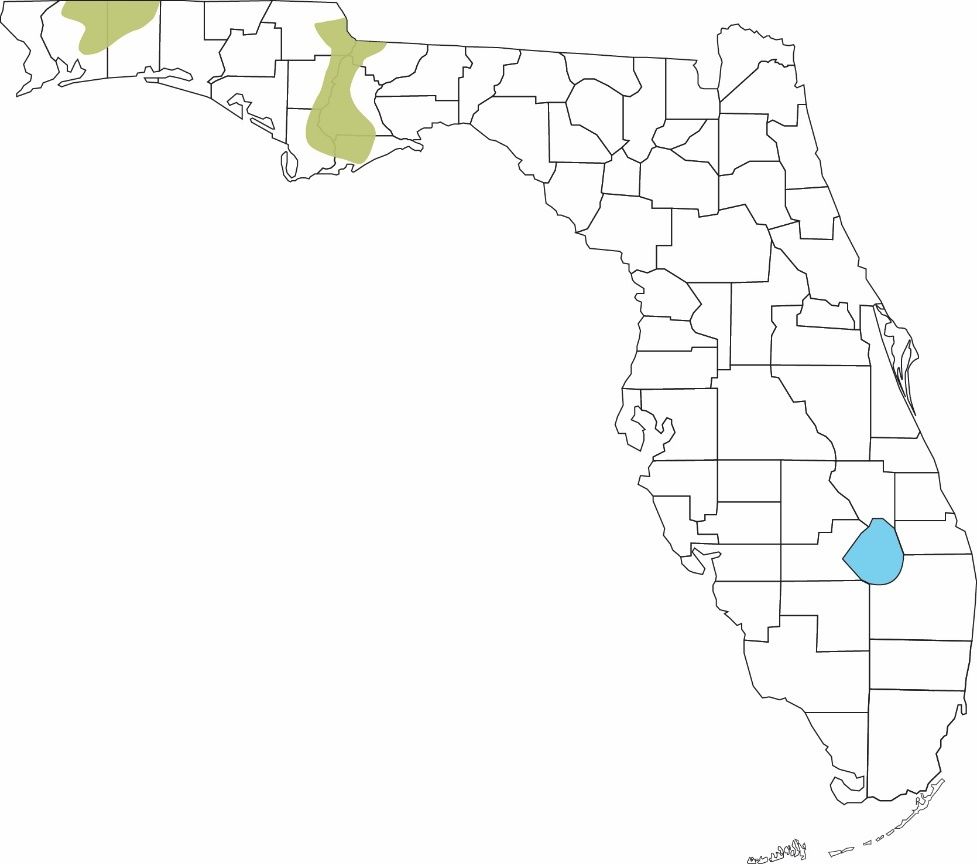
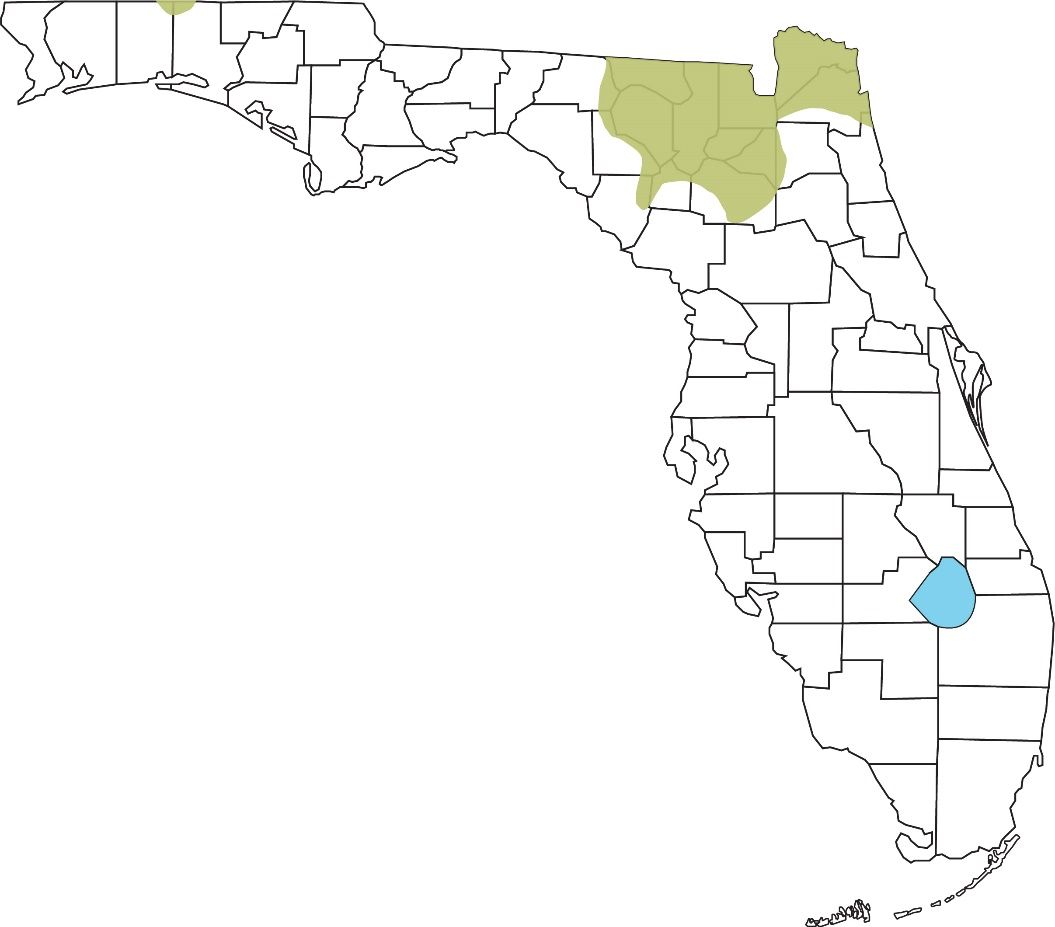
Florida is home to about 50 species of native snakes, seven of which are venomous (snakes are not poisonous—"poisonous" refers to something that is toxic when ingested). The venomous species include six pit vipers (eastern diamondback rattlesnake, timber rattlesnake, pygmy rattlesnake, copperhead, and cottonmouth—2 species) and the coral snake. Copperheads and timber rattlesnakes have a limited range in Florida. Copperheads only occur in a small area just west of Tallahassee as well as in a few counties in the western Panhandle, and timber rattlesnakes are usually only found in northern Florida as far south as Gainesville, although there are few known a little further south. The other four venomous species are found throughout the state. Florida's venomous snakes occur in a variety of natural habitats, ranging from swamps to dry woods.
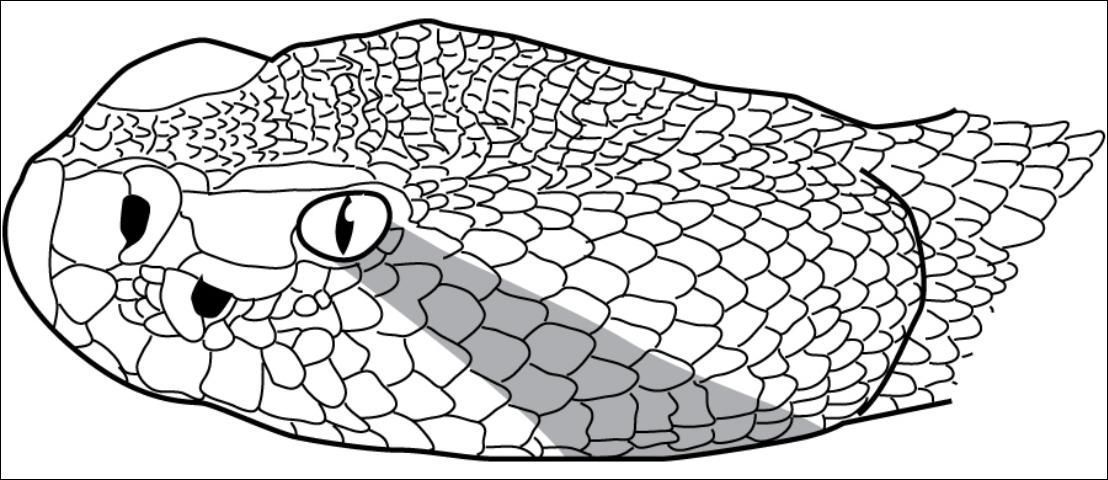
The six species of pit vipers all share several characteristics. The pupils of their eyes are vertical (cat-like) and they have a deep facial pit between each eye and nostril (Figure 1). These characteristics can be difficult to see unless a snake is examined closely, so do not rely on them to differentiate venomous from non-venomous species. Florida's pit vipers have thick blocky heads that are distinctly broader than their necks. A triangular head does not indicate a snake is venomous. Some nonvenomous species will flatten their head and flare their jaws when they feel threatened, making their head triangular. Florida’s pit vipers also have keeled scales (thin ridge) on their backs, giving them a somewhat dull appearance. Relative to their length, these species are heavy-bodied snakes.
Credit: Dale A. Johnson 2007
Although each of the seven venomous species in Florida have unique characteristics that allow them to be readily identified by experts, there are many non-venomous species with which the venomous species may be confused. Therefore, it is best not to attempt to capture, harass, or harm any snake. Doing so may put you at risk of being bitten by a venomous species.
Cottonmouth/Water Moccasin
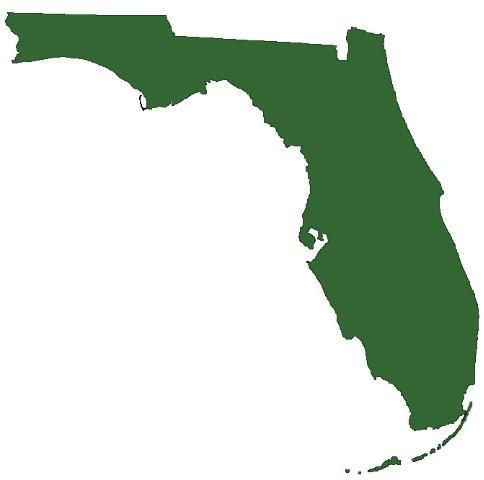
The cottonmouth is the most aquatic of Florida's venomous snakes and occurs throughout the state (Figure 2). Scientist now recognize two species, but they are treated as one species in this publication. Although they may exceed five feet in length, most adult cottonmouths observed in Florida are about three feet long. This species prefers the margins of lakes, rivers, and wetlands. Adults are dark-colored and may have a faint crossband pattern or be a uniform black. The eye is camouflaged by a broad, dark facial band that runs from the eye to the back of the head.
Credit: Esther Langan, University of Florida
Credit: Steve A. Johnson, University of Florida
Credit: Steve A. Johnson, U.S. Geological Survey
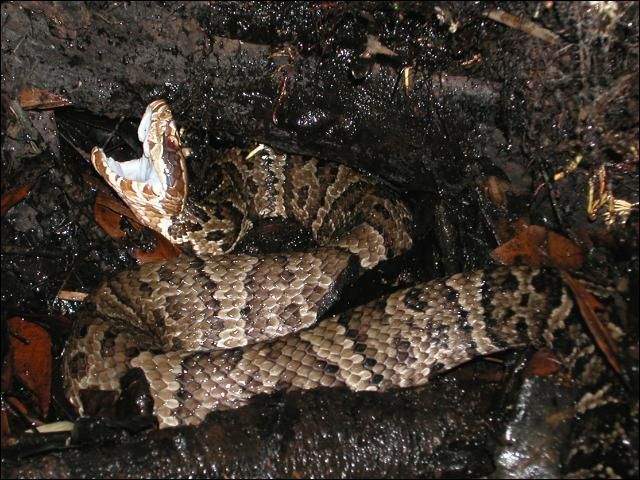
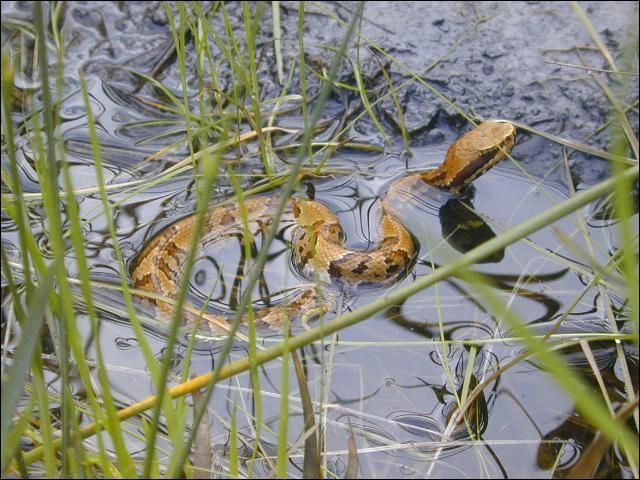
As a defensive response when threatened, cottonmouths often open their mouths wide, revealing the cotton-white interior (Figure 3). Young cottonmouths (Figure 4) are brightly colored with reddish-brown crossbands and a yellow-colored tail. When young they look very similar to the copperhead and are sometimes confused as such. Be sure to check range maps!
Several species of harmless water snakes are often mistaken as cottonmouths. Water snakes are not venomous, but they tend to be aggressive and quick to bite. To avoid confusion and the potential for being bitten, it is best to leave all water snakes alone.
Copperhead
In Florida, copperheads only occur in a small area of Florida's Panhandle just west of Tallahassee, primarily along the Apalachicola River and its tributaries. They also are found in several of the westernmost counties in the state (Figure 5).
Credit: Tracy Bryant, University of Florida
Credit: Steve A. Johnson, University of Florida.
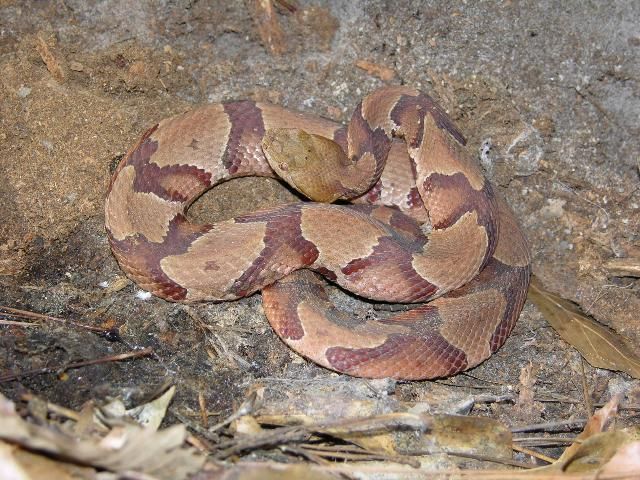
Copperheads prefer to remain near streams and wet areas but may be found away from such places. A full-grown copperhead is usually less than three feet long. Copperheads are relatively thick-bodied with bold markings (Figure 6). The general body color of these snakes is light brown to gray, and there are large bands of darker brown along their backs. Because of constrictions in the darker bands along the center of the back of this species, the darker bands have an hourglass shape. The alternating pattern of lighter and darker bands provides copperheads with exceptional camouflage in the forested areas where they live. Young copperheads look very similar to adults except the tips of their tails are yellowish in color.
Eastern Diamondback Rattlesnake
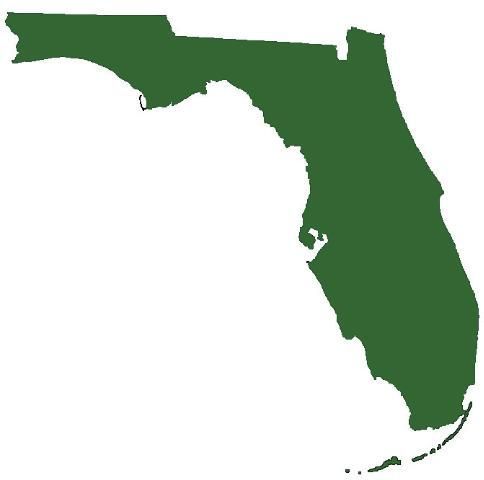
This is a potentially very dangerous snake and should not be approached. The eastern diamondback rattlesnake is the largest venomous snake in the U.S. and may exceed six feet in length. It occurs throughout Florida in a variety of dry habitats, such as pinelands, scrub, and golf courses (Figure 7).
Credit: Esther Langan, University of Florida
Credit: Steve A. Johnson, U.S. Geological Survey
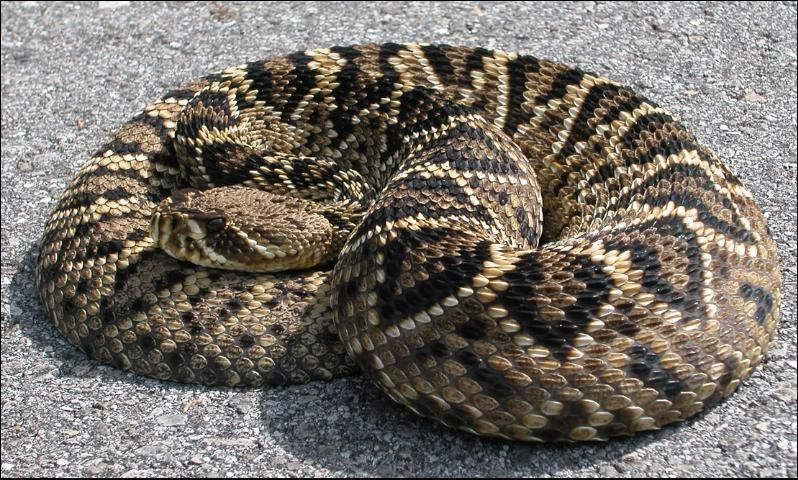
Eastern diamondback rattlesnakes have bold markings down their backs that include a row of large, dark diamonds with brown centers and cream-colored borders (Figure 8). The tail ends in a rattle that is used to make a loud buzzing sound when the snake feels threatened. Some individuals may not rattle, even when they are poised to strike. The large, thick head has a light-bordered, dark facial band running diagonally through the eye to the rear of the jaw. The scales of this species are strongly keeled (i.e., there is a ridge along the center of each scale), giving these snakes a rough appearance. The young are similar to adults in color pattern.
Timber Rattlesnake
The timber rattlesnake (a.k.a. canebrake rattlesnake) has a relatively small range in the state; it is normally only found in northern Florida as far south as Gainesville (Figure 9). However, there are a few confirmed sightings a little farther south.
Credit: Tracy Bryant, University of Florida
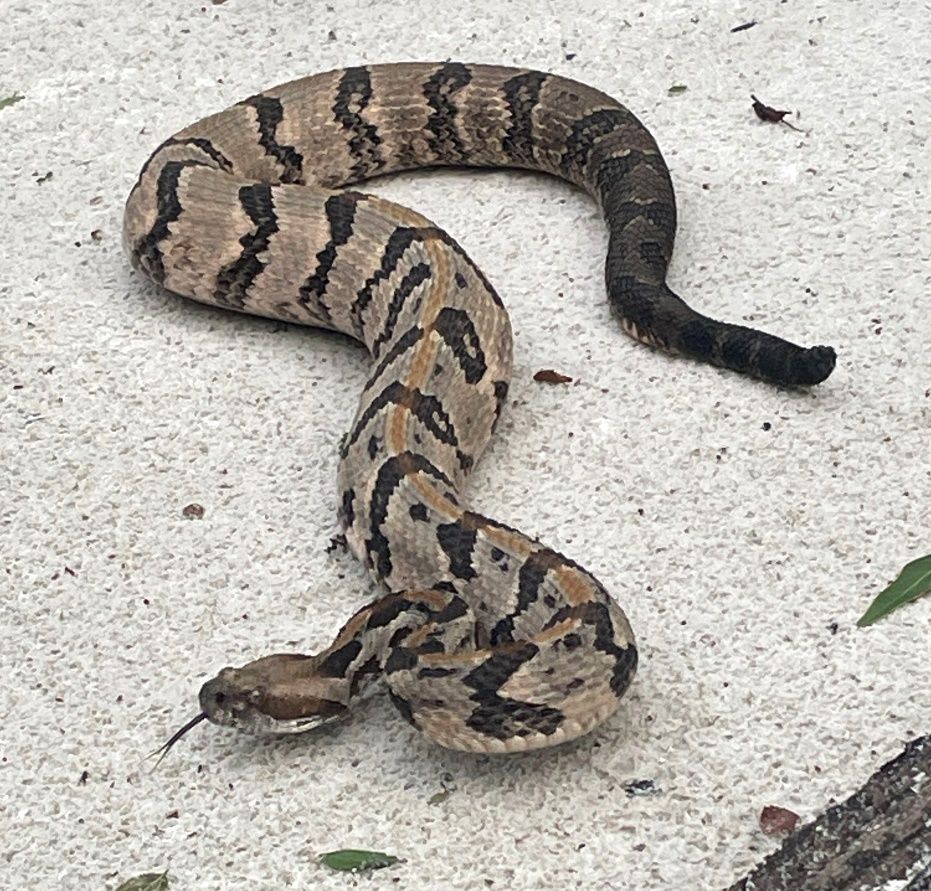
This species prefers moist pinelands, river bottomlands, and hammocks. Timber rattlesnakes can grow to five feet or longer. These snakes usually have a pinkish-gray to tan body color (although some are very dark colored) with prominent, irregularly shaped dark marks and bands (Figure 10). A reddish-brown stripe runs along the middle of the back of timber rattlesnakes.
Credit: Steve A. Johnson, UF/IFAS
The tail of the species is dark brown or black and ends with a large rattle. Timber rattlesnakes have large, thick heads, and there may be a dark facial band running from each eye to the rear of the head. The scales of this species are strongly keeled, giving these snakes a rough appearance. The young are similar to adults in color pattern.
Pygmy Rattlesnake
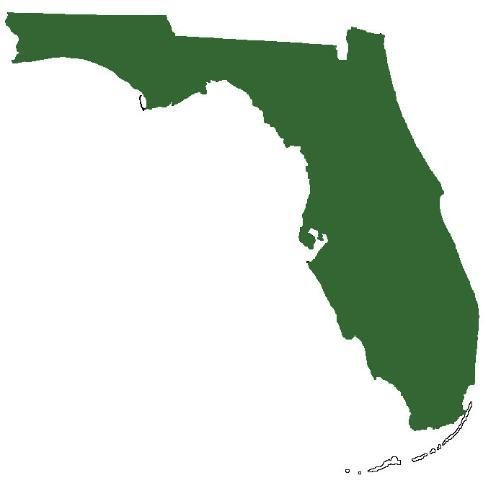
Pygmy rattlesnakes are the smallest of Florida's venomous snake species. Adults rarely exceed 20 inches in length. Pygmy rattlesnakes range throughout the state and occur in many different habitats that include pine flatwoods, oak scrub, open pinelands, and palm hammocks (Figure 11).
Credit: Esther Langan, University of Florida
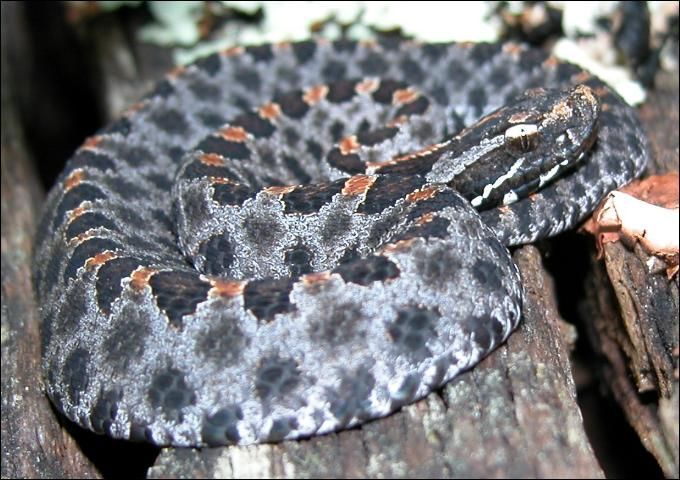
This is one of the most commonly encountered venomous snakes that occasionally is found in residential neighborhoods. Pygmy rattlesnakes have a dark facial band that runs from each eye to the rear of the jaw (Figure 12). Their bodies are covered with numerous dark blotches with a row of darker blotches running down the middle of the snake's back. Usually a series of reddish-brown marks can be seen between the blotches on the back.
Credit: Steve A. Johnson, U.S. Geological Survey
The rattle on the tip of the tail of this species is so small that it cannot be heard even when shaken vigorously by the snake. Pygmy rattlesnakes are bold and will often hold their ground if approached. They will bob their head and strike into the air if they feel threatened.
Coral Snake
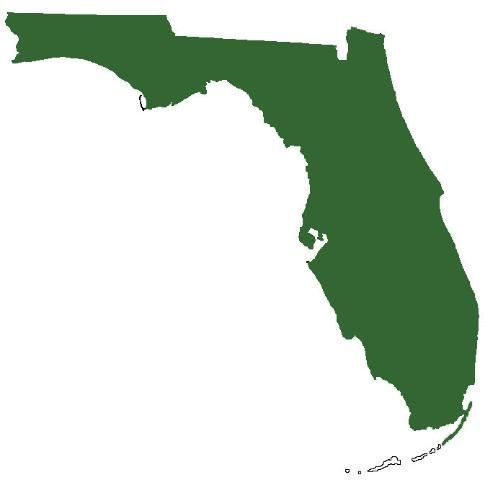
Coral snakes occur in many types of habitats throughout the state (Figure 13) but are seldom encountered because they are quite secretive and spend much of their lives underground.
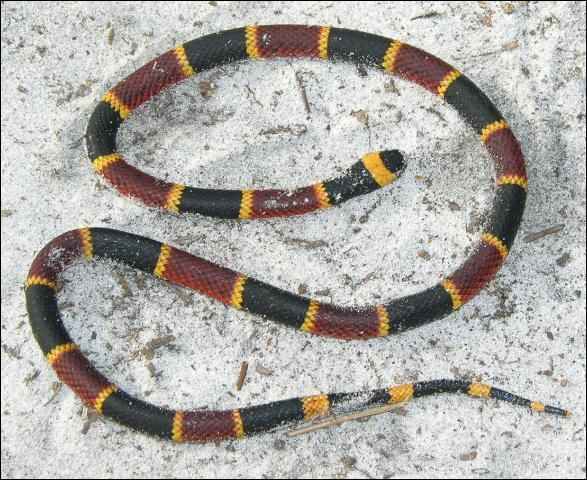
They are rarely longer than 30 inches and are usually no bigger around than a quarter. Coral snakes are identified by their black nose and alternating bands of black, yellow, and red that give this species its bold appearance (Figure 14).
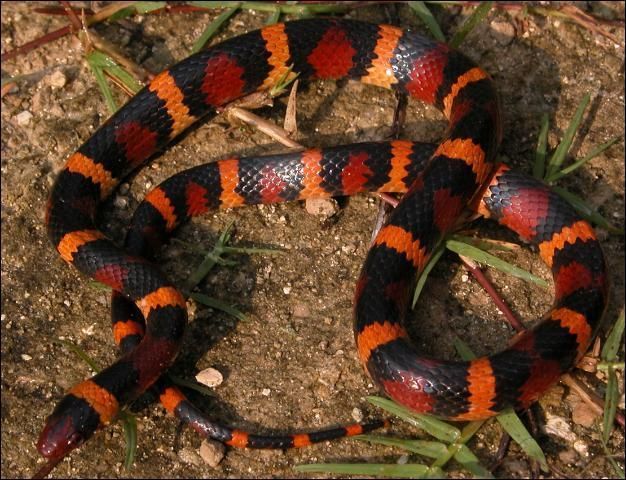
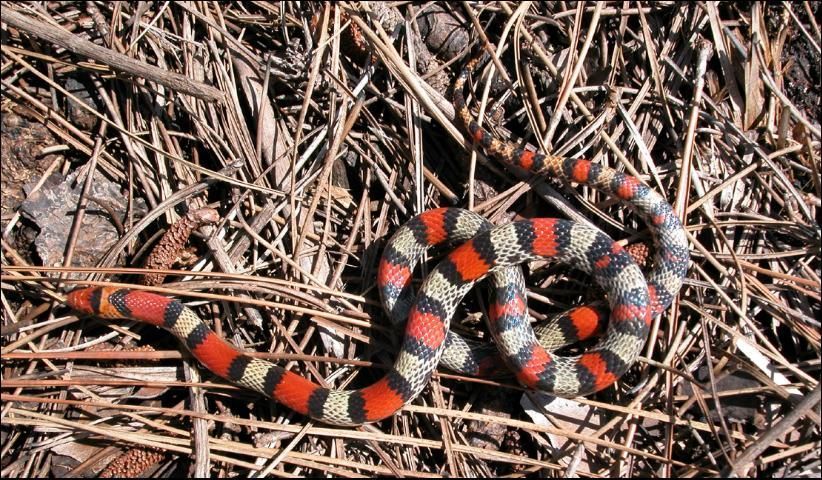
Two non-venomous species (Figures 15 and 16) look very similar to coral snakes because they also have bands of red, black, and yellow (or orange or white). However, the arrangement of the bands differs between the non-venomous species (scarlet kingsnake and scarlet snake) and the coral snake. In the two non-venomous species, the red bands touch only black bands, but in coral snakes the red bands only touch yellow bands. Remember the stoplight phrase "yellow, red, STOP!" If the red and yellow bands are next to each other, like the colors of a stoplight, it is a coral snake. Note this should only be applied to coral snakes in North America. Another feature of the coral snake is its blunt, black snout, which is followed by a band of yellow on the head. Neither the scarlet kingsnake nor the scarlet snake have black snouts; their snouts are more pointed and red.
Credit: Esther Langan, University of Florida
Credit: Steve A. Johnson, University of Florida
Credit: William J. Barichivich, U.S. Geological Survey
Credit: Jennifer S. Staiger, U.S. Geological Survey
Additional Resources
This document is part of a four-document series produced by the UF/IFAS Department of Wildlife Ecology and Conservation:
- Dealing with Venomous Snakes in Florida School Yards
- Preventing Encounters between Children and Snakes
- Emergency Snakebite Action Plan
- Recognizing Florida's Venomous Snakes
Poison Control Hotline: 1-800-222-1222
Good Books on Florida Snakes
Conant, R., and J. Collins. 1998. Peterson Field Guide to Reptiles and Amphibians of Eastern and Central North America, 3rd edition. Boston: Houghton Mifflin Company.
Carmichael, P., and W. Williams. 2004. Florida's Fabulous Reptiles and Amphibians. Tampa: World Publications.
Gibbons, W., and M. Dorcas. 2005. Snakes of the Southeast. University of Georgia Press.
Snake Resources on the Internet
Dr. J's Wildlife Web Page—Online guide to Florida's Snakes: https://ufwildlife.ifas.ufl.edu/snakes/florida.shtml
Florida Museum of Natural History—Online guide to Florida snakes: https://www.floridamuseum.ufl.edu/florida-snake-id/
Florida Fish and Wildlife Conservation Commission: Living with Snakes: https://myfwc.com/conservation/you-conserve/wildlife/snakes/
Partners in Amphibians and Reptile Conservation (PARC) site: https://parcplace.org/