
Production risk is one of the main risks that growers are subject to. A grower can combine the same inputs every year and yet obtain different yields each time. The main source of risk and therefore the extent to which yields may differ from year to year in crop production stems from the unpredictable nature of weather, pests, and diseases.
Another source of risk for growers is market or price risk. Because growers are typically price takers, they are exposed to the supply-and-demand market forces for inputs and outputs. Thus, commodity prices can vary each year and even within a given season. In addition, growers seldom know for certain the prices of farm inputs and outputs at the time they must make decisions about how much inputs to use or what and how much of various outputs to produce. Therefore, market risk includes risks derived from cyclical and seasonal price fluctuations of agricultural products, trade restrictions (i.e., market access), subsidies, and currency exchange rates. Contracts with buyers and suppliers can mitigate market risk, but when selling a commodity, contracts can also limit a price increase that would benefit the grower.
In this chapter, I describe the main crop insurance policies available to citrus growers and provide examples that illustrate the calculations involved. The commonality among all policies is that by purchasing crop insurance, the grower transfers part of the risk in exchange for a premium (which is the cost of purchasing insurance).
Crop Insurance as a Tool for Managing Risk
Federal crop insurance is provided through a partnership between public institutions and private companies. The Risk Management Agency (RMA) acts on behalf of the Federal Crop Insurance Corporation (FCIC) to administer all federal crop insurance programs. The RMA designates private insurance companies to market, underwrite, and adjust claims for crop insurance policies. It is important to realize that premium rates and insurance terms and conditions are established by the FCIC. Therefore, the premium for a specific policy and coverage level is the same across companies; insurance companies compete only with their knowledge, customer service, and related insurance products. In addition, to increase participation in the program, the federal government subsidizes crop insurance premiums.
The Basics
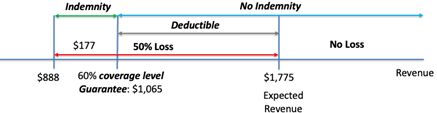
At the time of enrollment, the grower chooses a certain coverage level, which determines two components of the policy. First, it determines the guarantee or liability (the amount at which the grower is insuring for). Second, the coverage level chosen also determines the deductible (the amount of loss for which the grower will not receive an indemnity). In the event of a loss, any level below the guarantee will trigger an indemnity. Figure 1 illustrates the basics of how crop insurance works with a 1-acre example. Assume a grower expects revenue to be $1,775 and chooses a 60% coverage level. His choice of coverage level sets the guarantee at $1,065 and establishes the premium the grower will pay for insuring at such level. If, for example, the grower experiences a 50% loss, the actual farm revenue will be $888. The indemnity will then be equal to $177, which is the difference between the guarantee and the actual farm revenue.
Credit: Ariel Singerman, UF/IFAS
Crop Insurance Policies for Citrus
There are two insurance policies specifically available for Florida citrus growers based on maximum reference dollar amounts set by the RMA: tree insurance and fruit/crop insurance. In addition, Catastrophic Risk Protection (CAT) is available for both policies and is set at 50% coverage and 55% of the reference dollar amount. Thus, the coverage is very limited because payments are only triggered for losses that are greater than 72.5% (=1 - 50% × 55%) of the maximum reference dollar amount. The advantage of CAT, however, is that it has a low cost: $358 for early- and mid-season oranges and $392 for late-season oranges per county regardless of acreage.
Tree insurance is based on reference prices established by the RMA that differ according to tree age. For example, orange trees older than six years have a reference price of $100 per tree. Causes of insurable loss under this policy are excess moisture, flooding, freeze, and wind. Coverage levels range from 50% to 75% in 5% increments. For example, the premium subsidy for 60% coverage is 64%, so the grower has to pay the remaining 36%.
Citrus fruit/crop insurance is based on a reference maximum dollar amount per acre. This policy offers coverage for fruit from trees that are at least five years old. Insurable causes of loss under this policy are excess wind, fire, freeze, hurricane, hail, and tornado. Growers can choose coverage levels ranging from 50% to 85% in 5% increments. Table 1 illustrates how the fruit dollar-amount policy works using 1 acre of late-season oranges from nine-year-old trees located in Polk County. The reference maximum dollar amount established by the RMA for 2025 is $1,775 per acre. Assuming the grower chooses a 60% coverage level, the guarantee is set at $1,065 and the deductible at $710. The calculations in Table 1 also show the total premium is $39, but because crop insurance is subsidized, the grower only needs to pay $14 per acre. In the case of a 50% loss, the amount lost would equal $888, triggering an indemnity of $177 so as to provide the guarantee of $1,065. Note that the Florida Citrus Fruit Dollar Plan will be terminated following the 2026 crop year.
Whole Farm Revenue Protection (WFRP) is available nationwide and provides coverage against losses in farm revenue for the entire farm. In other words, all farm revenue is insured together under one policy. Thus, individual commodity losses are not considered. The approved revenue amount under this policy is the lower of (1) historic farm revenue (five-year average based on tax records) or (2) expected revenue. Coverage level ranges from 50% to 85% in 5% increments. Eligibility criteria include having no more than $2 million in expected revenue from animals and animal products; having no more than $2 million from greenhouse and nursery products; and having no more than $17 million in insured (i.e., approved) revenue.
The federal premium subsidy for WFRP depends on how many commodities are grown on the farm and the level of coverage chosen (see Table 2). Farm diversification affects not only the premium subsidy but also the premium rate.
Table 3 illustrates how WFRP works for a 1-acre farm located in Polk County. For comparison purposes, the values chosen are similar to those in the previous example. Assuming the farm generated $1,800 in revenue each of the past five years and is expected to generate $1,775 next year, the approved revenue is $1,775. Assuming the grower chooses a 60% coverage level, the guarantee is set at $1,065 and the deductible at $710. Table 3 illustrates the calculations for three different examples regarding the number of commodities grown on the farm. Note that the premium subsidy is 80% in all three cases (because the coverage level is 60%).
In case of a 50% loss (as in the example for the fruit dollar amount policy above), the amount lost would equal $888, triggering an indemnity of $177.
Even though the numbers used for the examples in the fruit dollar amount policy and WFRP were purposely made to be the same, it is important to realize the significant differences between the policies and the type of coverage they offer. One of the main differences is that WFRP is based on the insured farm's records, not on an amount the RMA establishes. In addition, the dollar-amount policy covers production risk (decrease in yield), whereas WFRP covers production and market risk (decrease in both yield and price).
In crop year 2022, the Risk Management Agency (RMA) started offering Actual Production History (APH) to Florida citrus growers for insuring their crop; it provides coverage for yield losses based on a farm’s historical records. However, the price used to establish the premium and liability amount for each combination of crop, type, and grove practice is set by the Federal Crop Insurance Corporation (FCIC). Growers can elect to insure at a lower price than established or, alternatively, can provide a contract price, if available. APH coverage levels range from 50% to 85% in 5% increments. Causes of insurable loss under this policy include excess wind, drought, freeze, hail, hurricane, tornado, fire, diseases (if specified in the special provisions), and postbloom fruit drop provided recommended disease control measures are applied. Coverage is offered for fresh and processed oranges and grapefruit, fresh mandarins/tangerines, tangelos, and tangors grown in central and southwest Florida counties. Coverage for fresh and processed lemons is available in some counties.
The basis to establish the guarantee and premium in APH is called the APH approved yield, which consists of the average of the grower’s yield records for the last 10 seasons, called APH database. Growers need to provide at least four years of yield records to obtain APH coverage. If such records are not available, the grower will be assigned transitional yields (T-yields)—an estimated yield figure based on historical average county yields—for each missing year. The number of years for which the grower has records available will determine what percentage of transitional yield is used to complete the missing years. To determine whether any adjustments to the APH database are warranted either due to alternate bearing or downward trend patterns, the insurance company will perform high variability tests. Note that the RMA instructed insurance companies to exclude 2022/23 from high variability tests calculations given the catastrophic weather events during that season.
Table 4 illustrates the estimated amounts of APH premium and indemnity at the 60%, 70%, and 80% coverage levels when using Polk County as an example (in lieu of farm-level records). Table 4, Panel A shows the values needed for computing the premium and indemnity. For example, the FCIC established the price for early- and mid-season oranges at $12.29 per box. Thus, the value of production per acre was set at $1,942 (=$12.29 per box times the estimated Polk County APH of 158 boxes per acre). The assumed realization of yield in 2024/25 of 79 boxes per acre implies that there would have been a loss of 50% relative to the APH yield. Thus, the value of the production to count (and the loss) would have been $971 per acre. Table 4, Panel B shows the guarantee, liability, deductible amounts, and the amounts for the farmer premium and indemnity for the three different coverage levels. Panel B also shows that a grower who would have chosen 60% (70%) [80%] coverage would have had to pay $11 ($31) [$87] per acre as the premium, and should the yield be 79 boxes per acre, the grower would receive $197 ($393) [$578] per acre as indemnity.
As citrus yield continues to follow a downward trend in Florida due to the combined impact of HLB and weather shocks, it is important to keep in mind that blocks with trees that are eight years of age or older are required to have produced at least 100 boxes per acre in any of the three previous years to be insurable under APH. A grower could request the RMA regional office for a determined yield to insure acreage not meeting such a requirement. However, the determined yield may not exceed 80% of the average yield for the entire APH database, as stated as part of the APH Special Provisions.
Conclusion
Dollar-amount policies for insuring citrus trees and fruit are based on reference prices established by the RMA, not on farm's records as with WFRP or APH. In addition, the coverage that dollar-amount policies provide are for specific perils. WFRP allows eligible growers to insure their entire farm revenue under one policy. Importantly, a dollar-amount policy covers production risk (decrease in yield), whereas WFRP covers production and market risk (decrease in both yield and price). The APH policy offers coverage against yield losses based on farm records for the past 10 seasons and, therefore, could be advantageous given the continuous impact of HLB on citrus yield in Florida.
Table 1. Fruit dollar-amount policy example for 1 acre in Polk County, Florida.
Table 2. Premium subsidy for each level of Whole Farm Revenue Protection (WFRP) coverage and number of commodities grown on the farm.
Table 3. Whole Farm Revenue Protection (WFRP) example for 1 acre in Polk County, Florida.
Table 4. Actual Production History (APH): Illustration of the calculation of the premium and indemnity for the 2024/25 season for 60%, 70%, and 80% coverage for 1 acre of ’Valencia’ oranges when using Polk County, Florida, as an example.
A. Parameters needed for computing the APH premium rate and indemnity.
B. APH Premium and indemnity for 60%, 70%, and 80% coverage.