
Gardening in raised beds is becoming more popular as more people try growing their own food. Using raised beds is like growing plants in large containers. The planting area is raised above the existing soil level and usually enclosed within a structure to form a planting bed.
Raised beds offer many advantages. Traditional gardening takes a toll on knees and backs, whereas gardening in raised beds helps save the joints (Figure 1). Many gardeners cannot grow vegetables in traditional gardens because soils are poor, too wet, compacted, or plagued with nematodes and other soilborne pests. Raised beds allow you to control the soil to avoid these issues. Another plus is that soils aboveground heat up more quickly so you can get a jump on the spring gardening season. Also, raised beds are typically more productive than in-ground vegetable gardens because the planting medium is easier to improve and there is no wasted space for walkways between rows.
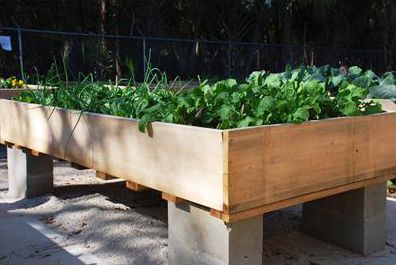
Credit: Terry DelValle, UF/IFAS
Getting Started
Select a location that receives at least 6–8 hours of direct sun and is close to a water source. Find a level area for the raised bed or one where minor modifications will make it level. If the area has turf, remove the top layer of grass or place recycled cardboard or multiple layers of newspaper on top to suppress the existing grass or weeds. Herbicide can be used but read the label to make sure it is safe for edible crops.
Next, determine the size and height of the raised bed. It should be no wider than 4' because most people can only comfortably reach 2' to the center. The length varies and depends on the site. A common size is 4' wide × 8' long × 16" × 24" deep. The height really depends on the level that is most comfortable for you and the investment you want to make in materials. The site may lend itself to multiple beds but make sure to give yourself ample room between beds—about 18" to 24". Beds can be various shapes (e.g., square, rectangle, L shaped, triangle). Raised beds can be basic or very elaborate and esthetically pleasing in the landscape (Figure 2).
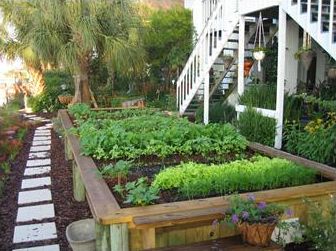
Credit: Aline Clement, UF/IFAS Extension Duval County Master Gardener
Materials for Raised Beds
When choosing a building material for your raised garden bed, consider durability, cost, and environmental impact. Options include stone, bricks, concrete blocks, synthetic/recycled materials, corrugated metal, or wood. If using concrete, pre-cast concrete blocks are acceptable to use for creating raised beds for edibles and will last many years. Wood is the most common material and is relatively inexpensive, but untreated lumber starts to rot within a year. For longevity and cost effectiveness, use modern pressure treated lumber, also known as Alkaline Copper Quaternary (ACQ) lumber, which is treated with copper preservatives and approved by the Food and Drug Administration for food production. Cedar, redwood, and synthetic wood (Figure 3) are naturally rot-resistant, but they are more expensive than pressure treated lumber. Do not use railroad ties or old pressure treated lumber purchased prior to January 2004 for edibles because of the potential for food contamination from creosote and arsenic.
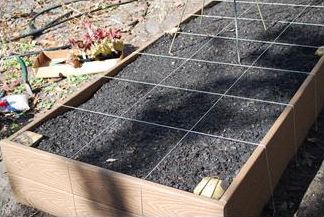
Credit: Terry DelValle
Consider constructing a raised bed that can easily be moved or dismantled if need be. Simply install corner posts that allow 2" thick wood sides to slide into them. Many gardening supply stores have sturdy premade raised bed corner brackets, which makes raised bed construction super easy (Figure 4). The bed dimensions are up to the individual because lumber is available in an assortment of sizes. For example, most backyards can accommodate a raised bed that measures 4' × 8'. Raised beds should be at least 6” high and can be built to 24” high for mobility challenged gardeners. Choose a width from 3’ to 4’ wide, depending on your reach. Leave a walkway of 18” or more between beds; 30” walkways are recommended if you plan to use a wheelbarrow.
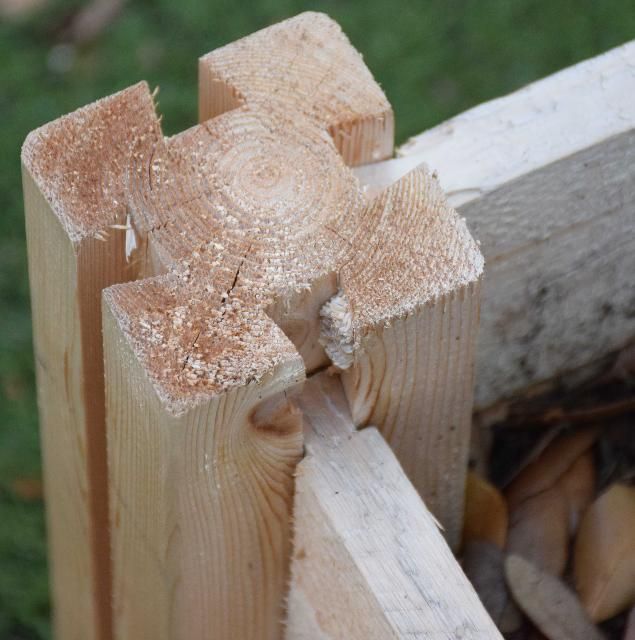
Credit: Terry DelValle, UF/IFAS
Design of a Raised Bed
For a basic design of a bed that is 4' wide × 8' long × 21¾" high, let's use nine 2" × 8" (actual 1 ½" × 7 ¼") × 8' long pressure treated lumber planks for the sides and two 4" × 4" × 8' long pressure treated posts that can be cut into six 21¾" posts (one for each corner and one in the middle along the long sides). Stainless steel screws are preferred when using pressure treated lumber. Alternatively, if you are on a limited budget, look for screws with a coated finish guaranteed not to corrode when used with pressure treated lumber.
Supplies needed for 4' × 8' x 21¾" high raised bed:
- Nine (9) 2" × 8" × 8' long ACQ treated lumber
- Two (2) 4" × 4" × 8' long ACQ treated posts
- 90 (ninety) 3" long stainless-steel screws for pressure treated lumber
- 2.15 cubic yards of raised bed soil
Construction
Cut the posts into six pieces measuring 21¾" to secure the inside corners of the bed and the middle along the long sides, or anchor with metal corner brackets screwed to the inside. (Another option is to cut them 24" long and drive the additional 2¼" into the ground to anchor the bed.) Cut three of the lumber pieces in half (4' long) for the ends (Figure 5).
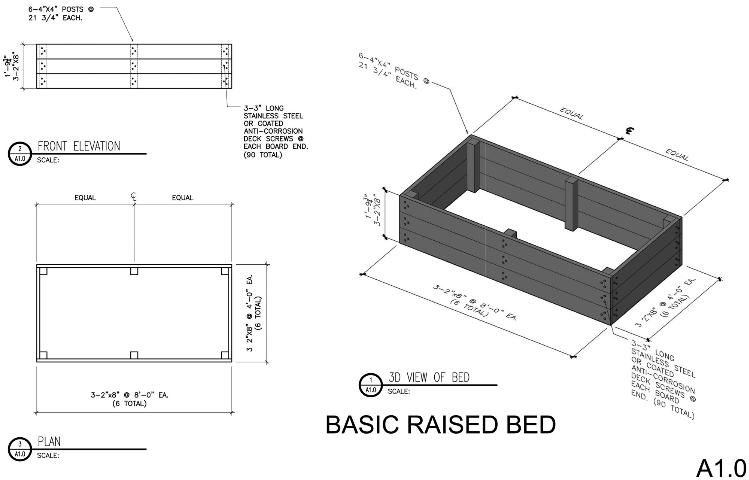
Move all the materials to the site and level if needed. First attach the 4' long boards to the post and then add the 8' long boards using three screws for each connection. Alternate the placement of the screws that occur at right angles, so they do not hit one another when going into the post. There will be three boards stacked on each side of the bed with a total height of 21¾". Make sure the tops of the six posts are at the same height. Soil may need to be added or removed to level it. If beds are made longer, additional supports are necessary to keep the boards from buckling.
Filling Your Raised Bed
Selection of a good lightweight media rich in organic matter is important. For raised garden beds, the ideal growing medium would provide nutrients, water retention, and aeration. Raised garden bed soil can be purchased by the cubic yard or in bags for easier handling. You can make your own by using one or more of these components: compost, composted pine bark, composted manures, peat moss, perlite, vermiculite, and topsoil. Depending on the components used, lime may be needed to obtain the preferred soil pH. To determine the number of cubic yards needed, multiply length by width by height to get cubic feet and divide by 27 cubic feet to calculate cubic yards. For the example above: 8' × 4' × 1.81' divided by 27 = 2.15 cubic yards. Fill to the very top of the raised bed. This may seem high, but once it settles, the level may drop by about 2". Over time, the soil in the bed shrinks, so top it off after each planting season to bring it up to the original planting level in the raised bed.
Irrigation
Irrigation is critical to success since soil used in raised beds is typically well drained and may dry quickly. Install low-volume irrigation by using soaker hoses, microsprayers, or drip tubing to conserve water and keep it off the plant leaves. The best time of the day to water is early in the morning. Use an automatic timer to set the watering time and duration of water. Adjust the timer depending on plant growth stage and seasonal rainfall. Seedlings require more frequent irrigation for short durations while established plants benefit from less frequent irrigation for a longer duration to promote a deep root system.
Planting
Mix a fertilizer into the top 6" of the garden bed. A 6-6-6, 10-10-10, or a balanced, slow-release vegetable fertilizer is suitable. The amount to use is based on the analysis, which can be found on the fertilizer label, and the square feet of the surface area. Now you are ready to plant. When gardening in raised beds, try planting using the square foot gardening method where you plant in blocks instead of rows. Eliminate the space for rows because that area is not needed to work the garden. Now the entire garden is an intensive production area. For recommended varieties, plant spacing, and fertilizer rates, follow the guidelines in the Florida Vegetable Gardening Guide, https://edis.ifas.ufl.edu/vh021.
Whether you try gardening in raised beds or growing in traditional vegetable gardens, enjoy the rewards of a convenient, fresh, and nutritious food supply. For more information on building and maintaining raised garden beds see Gardening Solutions: Raised Beds, https://gardeningsolutions.ifas.ufl.edu/design/types-of-gardens/raised-beds/.