
Executive Summary
This guide provides essential regulatory information for all drone operators at the University of Florida (UF) and beyond, ensuring legal compliance with state, federal, and UF regulations for Unmanned Aerial Vehicle (UAV) operations while maximizing the benefits of UAV technology.
This publication offers practical guidance on registration requirements, certification processes, operational limitations, and specific protocols for drone operations on UF campuses. It addresses Federal Aviation Administration (FAA) and Florida state considerations as well as UF specific requirements. Understanding and following these regulations help both recreational and commercial operators avoid penalties while ensuring safe compliant flights.
Introduction
Recent technological advances have dramatically improved UAV capabilities. Developments in artificial intelligence (AI), electronics, battery technology, miniaturization, and affordability have enhanced cameras and sensors, propelling UAVs into multiple fields including forestry, natural resource management, and agriculture.
UAV and UAS (Unmanned Aircraft System) are often used interchangeably, but they refer to different components. UAV refers specifically to the aircraft, while UAS includes the entire system, that is, aircraft, ground control station, software, hardware, and communication links. While this guide uses the technical terms UAV and UAS where appropriate, it also uses “drone” for accessibility. The term drone is commonly used in public and media discourse to refer to both UAVs and UASs.
UAVs serve numerous functions: They map terrain and soil erosion, support forest management, assess damage from hurricanes and wildfires, spray crops, pollinate plants, enhance farm security, monitor livestock, and inspect infrastructure (Ahmed et al. 2022). Modern applications now integrate aerial data collection with onboard analytics and field-based action delivery.
These versatile aerial machines now permeate our everyday lives, requiring regulation to protect public safety. Laws worldwide limit UAV use to reduce risks and preserve privacy (Mandourah and Hochmair 2024). While regulations may seem complex, they establish essential frameworks for ensuring safe integration of UAVs into our airspace. This publication explores these requirements at federal, state, and university levels, with special attention to University of Florida protocols.
It serves multiple audiences, including UF students and faculty conducting research with UAVs, commercial operators working on or near a UF campus, recreational users in the university community, and UF staff responsible for ensuring regulatory compliance. Understanding these regulations is essential for both legal operation and public safety. Federal Aviation Administration (FAA) enforcement actions for violations can have serious consequences for different user types:
- Individual operators: Up to $100,000 per violation
- Organizations: Up to $1,200,000 per violation
Beyond legal consequences, compliance ensures safe operations, protects privacy, maintains university insurance coverage, and preserves the viability of drone research and operations in academic settings. By following these guidelines, operators can confidently navigate complex regulatory requirements while maximizing the benefits of this transformative technology.
UAV Classification
Operational needs have led to the development of three primary types of UAVs (Figure 1):
- Fixed-Wing UAVs: Operators launch these UAVs by hand or from a runway to enable long-distance coverage, high-altitude and high-speed operations, and extended flight durations.
- Rotary-Wing UAVs: Featuring multiple rotors (typically four), these UAVs are capable of vertical takeoff and landing (VTOL), making them suitable for precision tasks in tight or uneven environments. They offer high-resolution imaging and low-altitude maneuverability.
- Hybrid VTOL UAVs: These platforms integrate wings and rotors, allowing for VTOL functionality combined with efficient cruising. They are ideal for missions requiring both versatility and broad-area coverage.
Each type offers unique strengths for various precision agriculture applications and operational requirements (Delavarpour et al. 2021).
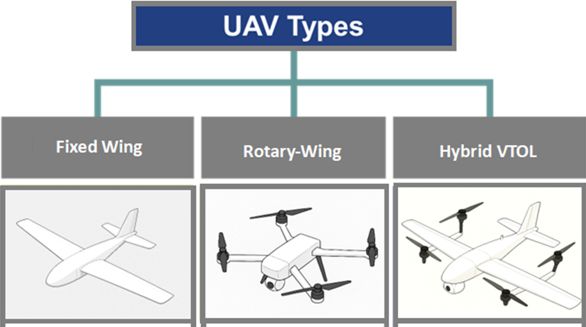
Credit: Images generated using DALL·E (OpenAI)
From a regulatory perspective, operating weight determines who can fly a UAV and how it needs to be operated. The FAA requires registration and Remote ID compliance for all drones weighing more than 0.55 pounds (250 grams), whether used for recreational or commercial purposes. For drones weighing over 55 pounds, operators must complete traditional aircraft registration under 14 C.F.R. Part 47. For more information about Remote ID and drone registration, visit the FAA’s web portal.
Federal regulations under 14 C.F.R. §107.39 prohibit the operation of small unmanned aircraft systems (sUAS) over non-participating persons unless specific conditions are met. However, Part 107 Subpart D establishes four operational categories (Categories 1 through 4) that permit such flights based on the aircraft’s weight, design, and safety features. Each category has distinct requirements: For example, Category 1 aircraft must weigh 0.55 pounds or less and have no exposed rotating parts; Categories 2 and 3 require the aircraft to be listed on an FAA-accepted Declaration of Compliance; and Category 4 aircraft must have an FAA-issued airworthiness certificate.
Is it unmanned?
Despite the term "unmanned" in "UAV," remote pilots control all UAV movements. Human oversight ensures safe, responsible operation, especially in complex environments. Federal regulations mandate this human involvement because UAVs have not yet achieved full autonomy or decision-making capabilities across all situations. While AI advances continue to enhance autonomous capabilities, human operators remain essential for monitoring UAV operations, particularly when facing unpredictable conditions that require complex decisions (Chen et al. 2022). Therefore, operators need waivers for beyond-visual-line-of-sight (BVLOS) operations covering large areas for all UAV types.
Registering the UAV with the FAA
The UAV registration with FAA helps authorities track drones in national airspace and ensures operators understand safety regulations. Pilots complete the registration process through the FAA’s FAADroneZone web portal by submitting basic personal and aircraft information. Any person of age 13 or older can register a drone and receive a unique registration number that they must clearly mark on the aircraft.
Since September 16, 2023, the FAA requires all registered UAVs to comply with the Remote ID rule. Remote ID functions as a digital license plate, broadcasting the drone's location and identification information to help authorities monitor airspace safety. Operators can satisfy this requirement in one of three ways:
- Standard Remote ID drones: Aircraft with built-in broadcast capabilities.
- Remote ID broadcast modules: External devices that attach to older drones.
- FAA-Recognized Identification Area (FRIA): A designated zone where drones without Remote ID can legally operate.
UF requires UAV operators on campus to use either built-in Remote ID or broadcast modules, as most campus operations take place outside designated FRIA zones.
Recreational Pilots
Recreational UAV operators must take the Recreational UAS Safety Test (TRUST) to comply with FAA regulations. This test educates pilots about safety and regulatory requirements and serves as a prerequisite for anyone flying under the Exception for Recreational Flyers (Table 1). While recreational pilots do not need Part 107 certification, they must follow these specific steps:
- Understand the rules for recreational flyers.
- Fly only for personal enjoyment (non-commercial purposes).
- Use the FAA's B4UFLY service to select an authorized app for essential airspace information.
- Complete the free online TRUST test and carry the completion certificate during flight operations.
- Register their UAV if it weighs more than 0.55 pounds (250 grams).
Commercial Pilots
Commercial UAV operations encompass any activity generating direct or indirect compensation. These activities range from wedding photography and film production to technical applications such as construction site imaging and equipment inspections. Operators who sell aerial stock photos or monetize UAV videos on platforms like YouTube also engage in commercial use.
The FAA regulates commercial UAV operations under 14 C.F.R. Part 107. All commercial drone pilots must obtain a Remote Pilot Certificate by passing the FAA's aeronautical knowledge test to demonstrate their understanding of safe UAV procedures (Table 1). Commercial operators must comply with additional requirements compared to recreational pilots, including:
- Report accidents to the FAA within 10 days if they result in serious injury or property damage exceeding $500 (§107.9).
- Conduct thorough pre-flight inspections to ensure the aircraft is safe for operation (§107.49).
- Maintain maintenance records for specific operations, particularly those conducted under waivers or advanced categories (§107.120, §107.130, §107.140).
- Comply with operational limitations not applicable to recreational flyers (e.g., operations at night, over people, or beyond visual line of sight require specific conditions or waivers).
- Register all drones used for commercial purposes, regardless of weight.
Table 1. FAA Recreational vs. Commercial UAV Requirements
Safe Operation
FAA regulations prioritize safe UAV operation, with particular emphasis on protecting manned aircraft. Operators must keep UAVs at or below a maximum altitude of 400 feet in uncontrolled (Class G) airspace to maintain airspace safety. The regulations prohibit entry into controlled airspace (e.g., Class B, C, D, or E near airports) without specific authorization as detailed in the Remote Pilot – Small Unmanned Aircraft Systems Study Guide.
To fly in controlled airspace, pilots must obtain authorization through the Low Altitude Authorization and Notification Capability (LAANC) system, which provides automated application processing and near real-time approval.
Essential Operating Rules
The FAA establishes critical safety parameters that all UAV operators must follow to ensure airspace safety per Small UAS Regulations Part 107 (Table 1):
- Maximum altitude: Fly at or below 400 feet above ground level (AGL) in uncontrolled airspace. You may fly higher if your drone remains within 400 feet of a structure.
- Airspace restrictions: Obtain proper authorization before entering controlled airspace using LAANC or the FAADroneZone web portal.
- Visual line of sight (VLOS): Maintain unaided visual contact with your UAV throughout the entire operation. First-person view (FPV) is allowed only if a visual observer maintains VLOS.
- Remote ID compliance: Ensure your UAV transmits identification and location data during all flight operations, unless flying in an FAA-Recognized Identification Area (FRIA).
- Weather minimums: Operate only when visibility is at least 3 statute miles and maintain at least 500 feet below and 2,000 feet horizontally from clouds.
These standardized rules enable UAVs to operate safely alongside manned aircraft within the National Airspace System (NAS).
Airspace Classification Reference
UAV operators must understand the different airspace classifications to conduct safe and legal flights. The FAA divides the NAS into distinct classes, each with specific requirements for drone operations. Table 2 provides a comprehensive guide to these airspace types and their authorization requirements.
Table 2. Airspace Classifications and UAV Operating Requirements
Table 2 shows how different airspace classes interact within the UAS Traffic Management (UTM) operational environment. By understanding these boundaries and requirements, UAV operators lay the groundwork for legal flight operations and identify when and where they must obtain authorization before flying.
Additional Airspace Considerations
Federal Lands: The National Park Service (NPS) prohibits UAV operations in National Parks, Wildlife Refuges, and other federally managed lands without special authorization. Launching, landing, or operating drones within park boundaries is banned unless specifically permitted for scientific research, search and rescue, or administrative purposes.
Online Apps
Flight condition and planning apps provide essential tools for assessing both the safety and the legality of UAV operations. These specialized applications deliver comprehensive information including detailed weather forecasts, airspace maps, Notices to Air Missions (NOTAMs), Temporary Flight Restriction (TFR) alerts, and UAS Facility Maps showing altitude limits near airports.
Weather data helps operators make informed decisions about flight safety. Wind speed and direction information ensures UAV stability and control during operations, while precipitation forecasts help prevent water damage to sensitive electronic components. Cloud cover and temperature data allow pilots to assess visibility conditions and potential icing risks at higher altitudes.
To find appropriate applications for flight planning, drone operators can search for drone flight planning apps or UAV weather apps in their preferred app store or visit the FAA's website for more information about safe and legal drone operations.
LAANC and FAADroneZone
The FAA’s LAANC system provides drone pilots near real-time access authorization to controlled airspace at or below 400 feet. FAA-approved UAS Service Suppliers (USS) deliver this access, allowing pilots to quickly obtain authorization for compliant operations.
When LAANC cannot authorize a flight, such as in areas above UAS Facility Map ceilings or outside LAANC coverage, pilots must submit a manual request through the FAADroneZone web portal. These requests usually take 7–14 days to process.
Understanding UAS Facility Maps
Drone pilots can use UAS Facility Maps to determine the maximum altitudes (0–400 feet) they can fly near airports. These maps clearly indicate where pilots can receive automated LAANC approval and where they must request manual FAA authorization. A zero-foot ceiling on the map signals that pilots must submit a manual request before flying.
Figure 2 shows an FAA UAS Facility Map for Punta Gorda, Florida. It highlights the grid-based altitude limits the FAA uses to manage airspace access and streamline LAANC authorizations. By reviewing these maps, pilots can plan safe and compliant flights more effectively.
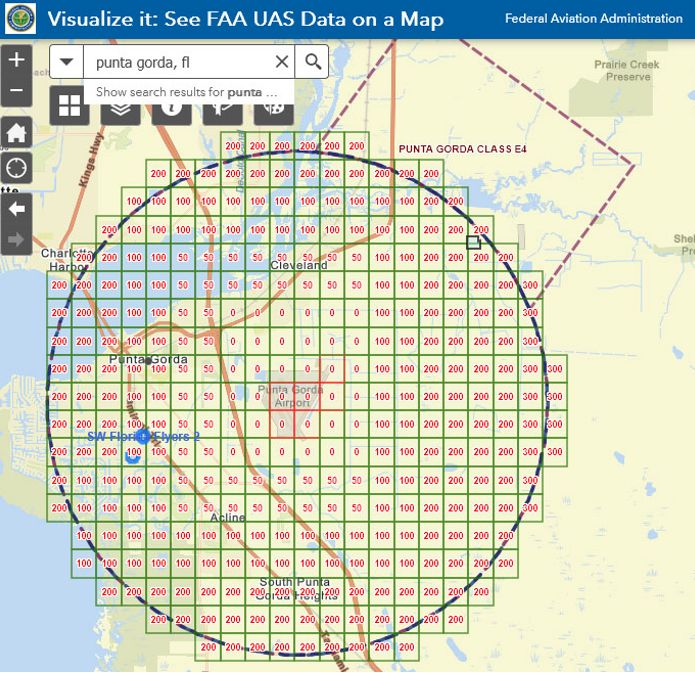
Credit: US Federal Aviation Administration (FAA.gov)
14 CFR Part 107 Remote Pilot Certification (“Part 107”)
Commercial drone pilots must comply with Part 107 regulations to legally operate their UAVs. These FAA rules establish specific operational requirements, including flight restrictions, airspace classifications, certification processes, and safety protocols.
Terminology note: The FAA issues a Remote Pilot Certificate for Part 107 operations. People often say “license,” but “certificate” is the correct term and officially authorizes commercial drone use under Part 107.
Part 107 sets several key limitations on UAV operations. Pilots must fly below 400 feet AGL and maintain VLOS throughout the flight. The regulation prohibits flying over people without a waiver, unless operating under an approved category. Nighttime flights require anti-collision lighting visible for at least 3 statute miles (1 mile = 5,280 feet). Additionally, operators must understand airspace classifications, respect Temporary Flight Restrictions (TFRs), and obtain authorization before operating in controlled airspace.
Becoming a certified remote pilot involves passing the FAA's aeronautical knowledge test and completing the application process through FAADroneZone. The test covers topics such as regulations, airspace classification, weather, drone operation, and emergency procedures. Once certified, pilots receive a Remote Pilot Certificate valid for 24 months. For comprehensive information about these requirements, visit the Certificated Remote Pilots page or review the complete Part 107 regulations in the Code of Federal Regulations.
State and Local Considerations (Florida)
Florida law restricts drone use for surveillance and critical infrastructure protection. Under Chapter 934.50, Florida Statutes drone operators may not record private property or individuals without consent if a reasonable expectation of privacy exists. Law enforcement must obtain a warrant or meet specific exceptions to use drones for surveillance.
Chapter 330.41 prohibits flying drones over critical infrastructure like power plants, water treatment facilities, and prisons. Florida also preempts local governments from regulating drone operations, except in cases involving privacy, harassment, or public safety.
Before flying, check Florida statutes and any applicable local ordinances. Violations can result in state or local penalties in addition to federal enforcement.
UAV Operation at UF
Beyond the federal and state regulations outlined earlier, the UF Environmental Health and Safety (EHS) office, through its Drones & Unmanned Aircraft System Policy – UF/EHS, maintains its own comprehensive framework for drone operations on campus and university properties. This structured approach ensures safety, compliance, and coordination across all university-affiliated UAV activities.
The UF/EHS Office of Unmanned Aircraft Systems administers this protocol through a systematic, six-step process:
- Pilot Registration begins the compliance journey. All operators—regardless of their intentions for use of their UAVs—must complete a registration form that documents their FAA Pilot Certificate number, issue date, and departmental affiliation. This creates a verified roster of qualified pilots authorized for campus operations.
- Aircraft Registration requires detailed documentation of each UAV including the FAA registration number, serial number, aircraft type (fixed-wing or rotary), manufacturer specifications, model designation, and weight classification (Figure 3).
- Aircraft Evaluation must occur before receiving flight approval. Every drone undergoes a thorough inspection by UF/EHS personnel to ensure all UAVs meet the university's safety standards and operate with appropriate functionality for campus environments.
- Risk Assessment forms a critical component of the approval process. Operators must methodically identify potential hazards associated with their planned flights and develop specific strategies to mitigate these risks. This proactive approach helps prevent incidents before they occur.
- Liability Insurance requirements apply to non-university operators and those conducting recreational flights. These pilots must provide verification of insurance coverage that satisfies the university's established minimums to protect against potential damage or injury.
- Flight Plan Request (Figure 4) is the final step, submitted at least 48 hours before takeoff. This comprehensive document includes
- Pilot identification (FAA Certificate Number, full name);
- Aircraft details (Registration Number, Serial Number);
- Operational specifics (campus location confirmation, contact information);
- Flight parameters (takeoff date/time, airspace class, duration, altitude);
- Geographic information (coordinates, route and location descriptions);
- Mission characteristics (purpose type such as photography or research); and
- Equipment information (payload description).
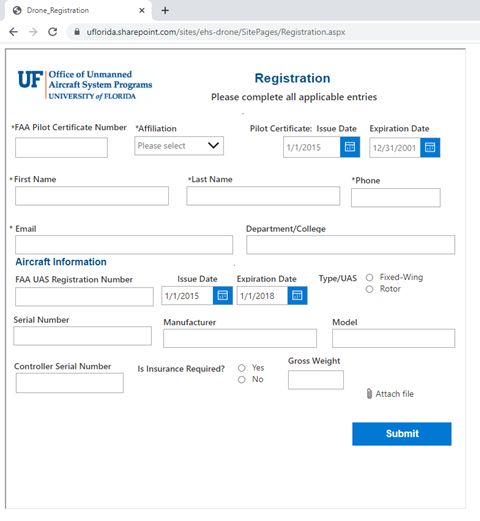
Credit: University of Florida
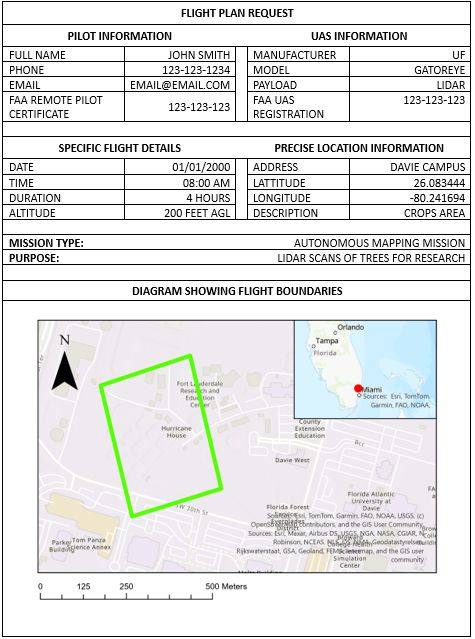
Credit: UF/IFAS
For emergencies involving drones, contact:
Local Emergency Services
911
If there is an emergency (if anyone has been hurt or people or property are in danger), call 911 immediately. Provide as much information as you can about the location of the emergency.
For drone incidents at UF, contact:
UF Police Department (UFPD)
352-392-1111
If you witness an incident involving illegal drone operations on campus, contact UF Police as soon as possible.
For questions about drone operations at UF, contact:
UF Office of Unmanned Aircraft Systems
Environmental Health and Safety (EHS)
352-392-1591
uas@ehs.ufl.edu
Training and Resources
For complete information about UF's drone requirements visit the Environmental Health’s UF Office of Unmanned Aircraft Systems webpage and the Training and Resources link.
Frequently Asked Questions
Q: Do I need certification to fly a drone recreationally?
A: Recreational pilots don't need a Part 107 certification but must complete the free Recreational UAS Safety Test (TRUST) and carry the completion certificate when flying. They must also follow recreational flying rules, which include flying only for personal enjoyment. If your drone weighs over 0.55 pounds (250 grams), you must register with the FAA.
Q: How high can I legally fly my drone?
A: The maximum allowable altitude for UAV operations under FAA regulations is 400 feet above ground level in uncontrolled airspace.
Q: Do I need special permission to fly on the UF campus?
A: Yes. All UAV operations on UF property require completion of the university's protocol including pilot registration, aircraft registration, aircraft evaluation, risk assessment, and submission of a flight plan. Non-UF operators also need proof of liability insurance.
Q: What is the difference between LAANC and standard airspace authorization?
A: LAANC provides near real-time authorization for operations in controlled airspace below approved altitudes, while standard authorization requests through the FAADroneZone can take 7–14 days to process.
Q: Do I need Remote ID for my drone?
A: Yes, if your drone weighs more than 0.55 pounds, it must have Remote ID capability. The FAA's policy requiring Remote ID compliance is now fully enforced.
Q: Can I fly my drone at night?
A: Recreational flyers cannot fly at night without appropriate lighting on the drone. Commercial operators (Part 107) can fly at night if the drone has appropriate anti-collision lighting visible for at least 3 statute miles.
Q: What are UAS Facility Maps and how do they affect my drone operations?
A: UAS Facility Maps show maximum altitudes (0–400 feet) where drones can operate near airports with LAANC approval. These gridded maps help pilots quickly determine where automated authorizations are possible and what altitude restrictions apply. Areas marked as zero require manual authorization through the FAADroneZone.
Glossary of Key Terms
AGL: Above Ground Level. The altitude measured from the ground surface directly below the aircraft rather than from mean sea level.
BVLOS: Beyond Visual Line of Sight. Operations where the remote pilot cannot see the unmanned aircraft with unaided vision.
FAA: Federal Aviation Administration. The US government agency responsible for regulating civil aviation.
FRIA: FAA-Recognized Identification Area. Designated locations where unmanned aircraft may operate without Remote ID capability.
LAANC: Low Altitude Authorization and Notification Capability. An automated system providing near real-time airspace authorizations for UAV operations in controlled airspace.
MSL: Mean Sea Level. A reference point for altitude measurements based on the average surface level of the ocean.
NAS: National Airspace System. The network of US airspace, navigation facilities, and airports, along with associated rules and regulations.
NOTAM: Notice to Air Missions. Time-critical aeronautical information that could affect flight safety.
Remote ID: Technology that enables a drone to broadcast identification and location information to others in the vicinity.
sUAS: Small Unmanned Aircraft System. An unmanned aircraft weighing less than 55 pounds.
TFR: Temporary Flight Restriction. A restriction on aircraft operations within designated areas.
UAS: Unmanned Aircraft System. The complete system including the drone, ground control station, communications links, and other support equipment.
UAV: Unmanned Aerial Vehicle. Aircraft operated without an onboard human pilot.
VLOS: Visual Line of Sight. Operating an unmanned aircraft so that the remote pilot can always see it without visual aids.
VTOL: Vertical Take-Off and Landing. Aircraft capability of taking off and landing vertically without requiring a runway.
Literature Cited
Ahmed, F., J. C. Mohanta, A. Keshari, and P. S. Yadav. 2022. "Recent Advances in Unmanned Aerial Vehicles: A Review." Arabian Journal for Science and Engineering 47: 7963–7984. https://doi.org/10.1007/s13369-022-06738-0
Chen, J., J. Sun, and G. Wang. 2022. "From Unmanned Systems to Autonomous Intelligent Systems." Engineering 12:16–19. https://doi.org/10.1016/j.eng.2021.10.007
Delavarpour, N., C. Koparan, J. Nowatzki, S. Bajwa, and X. Sun. 2021. "A Technical Study on UAV Characteristics for Precision Agriculture Applications and Associated Practical Challenges." Remote Sensing 13 (6): 1204. https://doi.org/10.3390/rs13061204
Mandourah, A., and H. H. Hochmair. 2024. "Analyzing the Violation of Drone Regulations in Three VGI Drone Platforms across the US, UK, and France." Geo-spatial Information Science 27:364–383. https://doi.org/10.1080/10095020.2022.2072240
Vlaminck, M., L. Diels, W. Philips, et al. 2023. "A Multisensor UAV Payload and Processing Pipeline for Generating Multispectral Point Clouds." Remote Sensing 15 (6): 1524. https://doi.org/10.3390/rs15061524
Web Resources
FAA Registration and Identification
- Official Website for Managing Drone Services (FAADroneZone) https://faadronezone-access.faa.gov/
- FAA Ends Discretionary Enforcement Policy on Drone Remote Identification https://www.faa.gov/newsroom/faa-ends-discretionary-enforcement-policy-drone-remote-identification
- FAA DroneZone—Waiver Requests https://faadronezone.faa.gov/
- Register Your Drone https://www.faa.gov/uas/getting_started/register_drone
- Aircraft Registration—Unmanned Aircraft (UA) https://www.faa.gov/licenses_certificates/aircraft_certification/aircraft_registry/UA/index.cfm
- Aircraft Registration for Drones Over 55 lbs. https://www.faa.gov/licenses_certificates/aircraft_certification/aircraft_registry/RID
- Remote Identification of Drones https://www.faa.gov/uas/getting_started/remote_id
Pilot Certification
- Recreational UAS Safety Test (TRUST) https://www.faa.gov/uas/recreational_flyers/knowledge_test_updates
- Remote Pilot Certificate with a small UAS (Part 107) https://www.faa.gov/uas/commercial_operators
- Remote Pilot—Small Unmanned Aircraft Systems Study Guide https://www.faa.gov/sites/faa.gov/files/regulations_policies/handbooks_manuals/aviation/remote_pilot_study_guide.pdf
- Remote Pilot—Become a Certificated Remote Pilot https://www.faa.gov/uas/commercial_operators/become_a_drone_pilot
Regulations and Compliance
- Electronic Code of Federal Regulations—14 CFR Part 107 https://www.ecfr.gov/current/title-14/chapter-I/subchapter-F/part-107
- Small Unmanned Aircraft Systems (UAS) Regulations (Part 107) https://www.faa.gov/newsroom/small-unmanned-aircraft-systems-uas-regulations-part-107
- Code of Federal Regulations Title 14, §107.39—Operation over human beings https://www.ecfr.gov/current/title-14/chapter-I/subchapter-F/part-107/subpart-B/section-107.39
- Code of Federal Regulations Title 14, Part 107, Subpart D—Operations Over Human Beings https://www.ecfr.gov/current/title-14/chapter-I/subchapter-F/part-107/subpart-D
- FAA—Order 8040.6A: Unmanned Aircraft Systems (UAS) Safety Risk Management Policy https://www.faa.gov/regulations_policies/orders_notices/index.cfm/go/document.information/documentID/1042092
- FAA Legal Enforcement Actions https://www.faa.gov/about/office_org/headquarters_offices/agc/practice_areas/enforcement/enforcement_actions
State and Local Regulations
- Florida Statutes—Chapter 934.50: Searches and Seizure Using a Drone https://www.flsenate.gov/Laws/Statutes/2021/934.50
- Florida Statutes—Chapter 330.41: Unmanned Aircraft Systems Act https://m.flsenate.gov/Statutes/330.41
Airspace Information
- Low Altitude Authorization and Notification Capability (LAANC) https://www.faa.gov/uas/getting_started/laanc
- FAA-Approved UAS Service Suppliers for LAANC https://www.faa.gov/uas/getting_started/laanc#approved
- Inside LAANC and UAS Facility Maps https://faa.maps.arcgis.com/apps/webappviewer/index.html?id=9c2e4406710048e19806ebf6a06754ad
- FAA—UAS Facility Maps https://www.faa.gov/uas/commercial_operators/uas_facility_maps
Operational Guidelines
- Here's what drone pilots should know about operations over people https://medium.com/faa/heres-what-drone-pilots-should-know-about-operations-over-people-92b40f368422
- National Park Service—Unmanned Aircraft in the National Parks Unmanned Aircraft Systems (UAS) - Natural Sounds (U.S. National Park Service) https://www.nps.gov/subjects/sound/uas.htm
- The Drone Life—The sky is no longer the limit https://thedronelifenj.com/verify-drone-pilot-licensed/
University of Florida Resources
- UF Drones and Unmanned Aircraft Systems Policy https://www.ehs.ufl.edu/departments/occupational-safety-risk/drones-uas/
- Environmental Health and Safey Training and Resources https://www.ehs.ufl.edu/departments/occupational-safety-risk/drones-uas/training-and-resources/
- UF Pilot registration form https://uflorida.sharepoint.com/sites/ehs-drone/SitePages/Registration.aspx
- UF Aircraft registration form https://uflorida.sharepoint.com/sites/ehs-drone/SitePages/Aircraft.aspx
- UF Flight Plan request form https://uflorida.sharepoint.com/sites/ehs-drone/SitePages/Flights.aspx