
Abstract
This EDIS publication provides consumers with insights on the proper cooking of food to ensure optimal safety and quality. It reviews key concepts of cooking practices and explains how they can ensure the safety of the food product. Additionally, this publication provides resources for further recommendations on best cooking practices.
Introduction
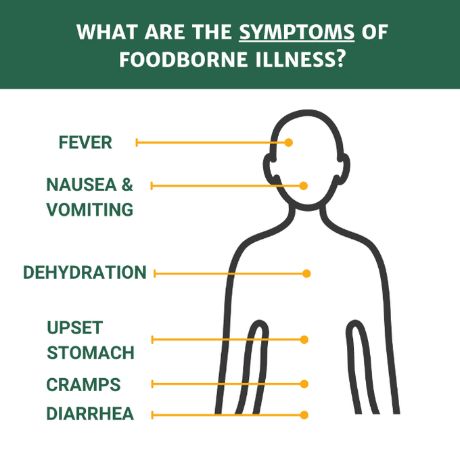
If you have ever suffered from nausea, vomiting, and/or diarrhea after consuming some “bad” food, you may have been one of the estimated 48 million people who suffer from foodborne illness in the United States each year (FSIS 2025a). This type of illness occurs when people ingest microbial pathogens, such as bacteria, viruses, and parasites, that are present in contaminated food products. Pathogens are microorganisms that occur naturally in the environment and may occasionally contaminate food products. Contamination can occur through water, soil, and air, as well as from contact with animals, other foods, contact surfaces, or food handlers. Although foods in the United States are generally safe, contamination can still lead to illness in consumers.
Credit: FSIS (2021)
For many, foodborne illness only causes temporary confinement to one’s toilet, while others who are at greater risk, such as those with weakened immune systems, young children, and pregnant individuals, can suffer from more severe symptoms that may prove to be fatal. However, you can reduce the chance of becoming sick from the food that you eat through a combination of proper food preparation techniques, such as practicing good personal hygiene and cooking the food product long enough to reach an adequate internal temperature, measured at the center of the thickest part of the food product.
Why is properly cooking food important?
Food is at the cornerstone of daily life, sustaining the daily functions of our body, while also serving as a form of self-expression and reflection of culture. Cooking is a form of communication that requires great care to ensure those who consume it are supplied with food that is delicious, nutritious, and safe.
Along with providing a desirable flavor to the food product, cooking is responsible for producing a more desirable texture through the breakdown of macromolecules, such as proteins and carbohydrates (Carmody and Wrangham 2009). Cooking emphasizes certain flavors, enables easier chewing, improves digestibility, and increases nutrient availability (Carmody and Wrangham 2009). Besides these benefits, cooking is one of the most effective techniques to kill potential pathogens in contaminated food. Adequate cooking is the key to ensuring people can eat safe and nutritious food that is also pleasurable to eat. Depending on the selected food product, safeguarding food by cooking involves several considerations, including the right combination of cooking time and target internal temperature. It is important to be aware of these considerations before starting the cooking process to ensure the safety of the food product.
How do I ensure my food is safe?
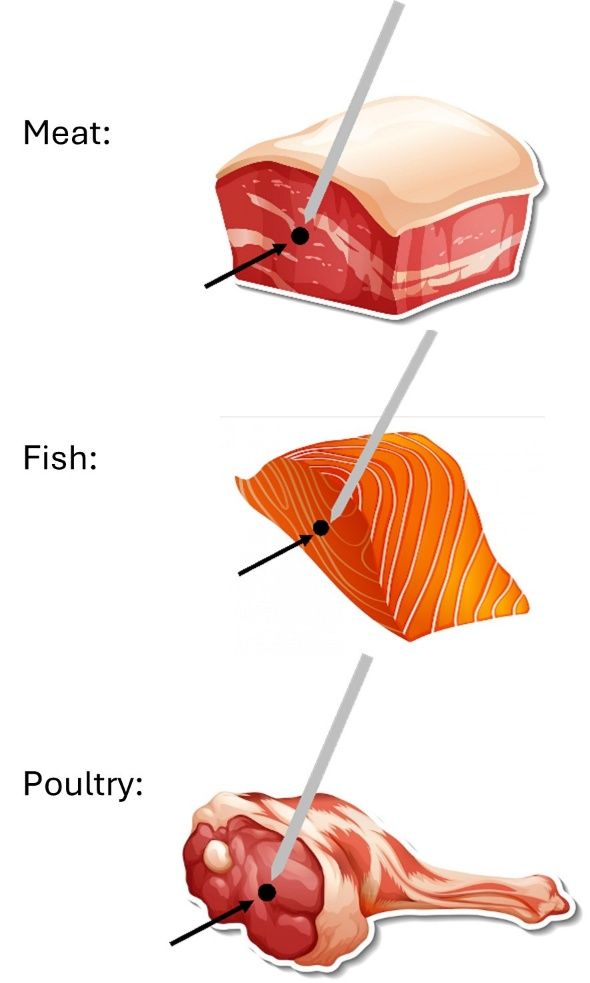
Visually inspecting food is not recommended to determine whether food is safe or not, as pathogens usually do not alter the food’s appearance, odor, or taste. Whenever cooking is recommended for a particular food, applying sufficient heat for an adequate amount of time is critical to ensure it is safe for consumption. Various food properties, such as conductivity, thickness, shape, and size, can influence the way that heat moves through the product and can impact the time it takes for the food product to reach a specific temperature. Therefore, a food thermometer is the best tool available to ensure that cooking time is sufficient to reach the desired temperature. To properly use a food thermometer, it is essential to understand the different components of cooking and how they can impact the overall product:
Credit: Designed using Freepik
Methods of Cooking
The method of applying heat affects the time food takes to reach a certain temperature. Heat can be transferred to food through conduction, convection, or radiation. Conduction occurs when heat transfers from a heat source to the food product through direct contact, such as when food is heated up in a pan. Convection is the result of heat transferring to a food product through indirect contact with a hot liquid or air medium, such as in boiling, frying, and air frying. Radiation involves the indirect transfer of energy to the food product in the form of heat or light waves and occurs when using a microwave, grill, or oven. However, heat transfer within solid foods primarily relies on conduction. Since most solid foods have low thermal conductivity, cooking can be slow; it takes time for heat to reach the center and achieve the recommended internal temperature. In liquid foods, heat transfer occurs mainly by convection rather than conduction. Therefore, the cooking time to reach a specific internal temperature can vary by cooking method and food phase (solid or liquid); for instance, the time needed to cook meat thoroughly will differ between baking and grilling (Farid 2019).
Cooking Time and Temperature
Time and temperature are two critical factors that influence the internal temperature of a food product. Using lower cooking temperatures might require a longer cooking time, and the opposite is true as well. Using the appropriate cook time and temperature allows for sufficient killing of the target pathogens.
Measuring Internal Temperature of Food
To accurately measure the internal temperature of your food product, insert the thermometer into the thickest part, as this place will take the longest to reach the desired internal temperature. When placing the thermometer, make sure to position it away from fat, bone, and gristle, as these can all impact the temperature reading (FSIS 2025b). Some cooking techniques, such as the use of a microwave oven, may result in uneven cooking and leave undercooked (“cold”) spots. Therefore, using a food thermometer in various spots is necessary to ensure the proper internal temperature has been reached. Covering the dish, adding liquid, and occasionally mixing during cooking can help ensure thorough cooking (FSIS 2024a).
At what temperature should I cook my food?
For enhanced consumer accessibility, several public health governmental sources have reported internal temperature guidelines for many different food products (as seen in Table 1). According to these sources, some cooking conditions can rely only on changes in food appearance. For example, cooking raw eggs is recommended until the yolk and whites are firm. In the case of shrimp, lobster, crab, and scallop, cook until the flesh is pearly or white and opaque. Under this guideline, shell openness can indicate doneness in cooked shellfish, such as clams, oysters, and mussels. Consuming certain types of food products, such as cookie dough, is not advised due to the use of raw eggs or untreated flour. In such cases, cooking or baking the batter will make the dough safe to eat; other alternative methods are to use heat-treated flour and pasteurized eggs, egg substitutes (such as flaxseed), or no eggs at all (CDC 2024).
Table 1. Minimum safe internal temperatures of various meat products.
Key Takeaway: Cooking is not a fail-safe!
While cooking does reduce the risk of foodborne illness, it is not an all-encompassing strategy to ensure the safety of those consuming the product. This is especially important, as people who are more susceptible to illnesses may become very ill and potentially lose their lives from complications associated with pathogens such as Salmonella, Listeria, Escherichia coli, hepatitis virus, and norovirus. The following four guidelines of food preparation outlined by the USDA are essential steps to prevent foodborne illness and protect public health (FSIS 2024c):
Clean
Cleaning the surrounding environment and the food handler’s hands often and thoroughly will help prevent the introduction of pathogens to food. For example, food is often chopped on cutting boards and then moved to another area for further preparation or cooking. The recommended cleaning procedure for cutting boards includes washing them with hot, soapy water after each use, rinsing with water, and then either air drying or patting them dry with a clean paper towel, since cloth towels may harbor bacteria (FSIS 2024b). Additionally, the USDA does not recommend washing your meat and poultry products, as this can increase the spread of pathogens in your surrounding cooking areas (FSIS 2024d).
Separate
Make sure to separate raw meat from other foods, particularly those that will remain uncooked, such as raw fruits and vegetables. It is highly recommended to use separate utensils and cutting boards for raw meat, poultry, and seafood preparation, especially if using a wood or porous cutting board, as these are harder to clean (FSIS 2024b).
Cook
Thorough cooking is the best way to ensure the safety of your food. However, if you suspect the presence of harmful pathogens, it is best to discard the food. Remember, when in doubt, toss it out! If your food product has been recalled, discard it immediately to prevent further exposure; cooking is to be avoided under this circumstance. Some recalled products may contain a high concentration of pathogens. If the contaminated food product is not cooked properly, then the risk of illness remains high. Furthermore, not all foods are withdrawn from the marketplace, and cooking those items does not make them safe.
Proper Handling
Food preparation steps (before cooking), such as cutting and seasoning, increase the chance of individuals coming into contact with pathogens. Personal hygiene, separating raw from cooked food, not washing raw meats (FDA 2024), and cleaning and then sanitizing kitchenware (Carothers and Okonta 2019) are crucial in preventing the spread of pathogens to other foods and surfaces.
Chill
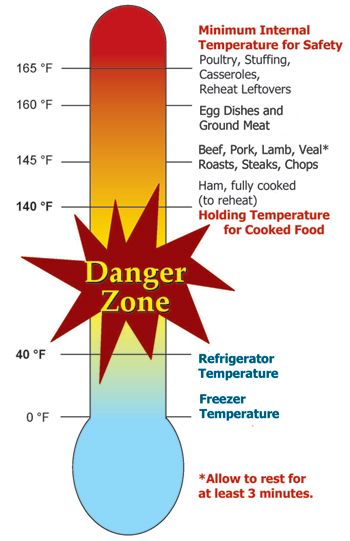
After enjoying a delicious meal with a group of friends and family, it is not uncommon to allow the food to sit around as you enjoy each other’s company; however, this can allow for some pathogens, like bacteria, to grow even faster if the food reaches the danger zone (between 40°F [4°C] and 140°F [60°C]). Therefore, the general rule of thumb is to keep hot food hot (140°F or higher), to keep cold food cold (40°F or lower), and never let food sit out for longer than two hours.
Credit: FSIS (2017)
Overall, preparing food that is both delicious and safe to eat extends beyond cooking food adequately. While this is not an exhaustive guide for every single component of food safety, this publication serves as a starting point and resource for additional educational materials that are critical to preventing foodborne illness.
Additional Resources from the USDA Food Safety and Inspection Service (FSIS)
- Current Recalls and Public Health Alerts
- Meat and Poultry Hotline: 1-888-MPHotline (1-888-674-6854), to get your food safety questions answered on weekdays year-round.
- Resources for Public Health Partners
- Food Safety Brochure for At-Risk Populations
- Guide to Cleanliness and Preventing Foodborne Illness
- General Overview of Foodborne Illness and Disease
- Consumer’s Guide for Food Safety During Severe Storms and Hurricanes
- Food Safety Consumer Research Project on Washing Poultry
References
Carmody, R. N., and R. W. Wrangham. 2009. “Cooking and the Human Commitment to a High-Quality Diet.” Cold Spring Harb Symposia on Quantitative Biology 74: 427–434. Cold Spring Harbor Laboratory Press. https://doi.org/10.1101/sqb.2009.74.019
Carothers, M., and C. Okonta. 2019. “Clean THEN Sanitize: A One-Two Punch to Stop Foodborne Illness in the Kitchen.” USDA. https://www.usda.gov/about-usda/news/blog/clean-then-sanitize-one-two-punch-stop-foodborne-illness-kitchen
CDC. 2024. “Raw Flour and Dough.” Food Safety. Last updated April 29, 2024. Archived on August 28, 2025. https://web.archive.org/web/20250828003420/https://www.cdc.gov/food-safety/foods/no-raw-dough.html
Farid, M. 2019. “Chapter 17—Heat and Mass Transfer in Food Processing.” In Handbook of Farm, Dairy and Food Machinery Engineering, edited by M. Kutz. Third ed. Academic Press. https://doi.org/10.1016/B978-0-12-814803-7.00017-8
FDA. 2024. “Safe Food Handling.” Last updated March 5, 2024. https://www.fda.gov/food/buy-store-serve-safe-food/safe-food-handling
FSIS. 2017. “‘Danger Zone’ (40°F–140°F).” Food Safety Basics. Last updated June 28, 2017. https://www.fsis.usda.gov/food-safety/safe-food-handling-and-preparation/food-safety-basics/danger-zone-40f-140f
FSIS. 2024a. “Cooking with Microwave Ovens.” U.S. Department of Food and Agriculture. Last updated June 27, 2024. https://www.fsis.usda.gov/food-safety/safe-food-handling-and-preparation/food-safety-basics/cooking-microwave-ovens
FSIS. 2024b. “Cutting Boards.” Food Safety Basics. U.S. Department of Food and Agriculture. Last updated August 27, 2024. https://www.fsis.usda.gov/food-safety/safe-food-handling-and-preparation/food-safety-basics/cutting-boards
FSIS. 2024c. “Keep Food Safe! Food Safety Basics.” U.S. Department of Food and Agriculture. Last updated January 5, 2024. https://www.fsis.usda.gov/food-safety/safe-food-handling-and-preparation/food-safety-basics/steps-keep-food-safe
FSIS. 2024d. “Washing Food: Does it promote food safety?” U.S. Department of Food and Agriculture. Last updated February 7, 2024. https://www.fsis.usda.gov/food-safety/safe-food-handling-and-preparation/food-safety-basics/washing-food-does-it-promote-food
FSIS. 2025a. “Foodborne Illness and Disease.” U.S. Department of Food and Agriculture. Last updated February 7, 2025. https://www.fsis.usda.gov/food-safety/foodborne-illness-and-disease
FSIS. 2025b. “Food Thermometers.” U.S. Department of Food and Agriculture. Last updated on March 21, 2025. https://www.fsis.usda.gov/food-safety/safe-food-handling-and-preparation/food-safety-basics/food-thermometers
FSIS (@USDAFoodSafety). 2021. “It’s important to know that symptoms of foodborne illness could develop a whole week after eating a contaminated product. Know the signs. Follow the steps!...” X, November 30. https://x.com/USDAFoodSafety/status/1465751733309788160
U.S. Department of Health and Human Services (HHS). 2024. “Cook to a Safe Minimum Internal Temperature.” FoodSafety.gov. Last reviewed November 21, 2024. https://www.foodsafety.gov/food-safety-charts/safe-minimum-internal-temperatures