
Introduction
Papaya is native to southern Mexico and Central America (Chávez-Pesqueira and Núñez-Farfán 2017; Ward 2011). It was likely introduced to Florida by Native Americans from the Calusa tribe through their contact with indigenous Caribbean people no later than 300 A.D. Some of the evidence for this introduction comes from seeds found in the Native American mounds of the Pineland Site Complex in Pine Island, Florida. While papaya did not originate in Florida, it is considered naturalized, meaning that it successfully established itself throughout many parts of Florida about 1,700 years ago and can reproduce without human intervention (Horvitz et al. 1998). Evidence of this naturalization occurs where significant windstorms have denuded the forest canopy and some of the first plants to emerge in these new high-light areas are feral (wild) papaya plants, which disappear after the woody plants reestablish their tree canopies. This publication introduces home gardeners, growers, and Extension agents to the feral papayas in Florida landscapes, their importance for Florida papaya production, and their use as potential genetic resources for breeding programs.
Feral Papaya Plants in South Florida
The papaya (Carica papaya L.) is a fruit tree cultivated commercially and in dooryard landscapes. It is also present in native areas of central-south and southern Florida.
In 2024 and 2025, we conducted a survey to locate feral papayas in central-south and south Florida and to collect germplasm for potential use in the UF/IFAS Tropical Fruit Breeding and Genetics Program. In south Florida, wild papaya plants could be found growing along roadsides, on abandoned farms, and in the lowland forests (Figure 1). Feral papayas were also observed in the areas surrounding Lake Okeechobee, including Indianatown, Lakeport, Clewiston, Lake Harbor, Buckhead Ridge, and South Bay. Additionally, a few plants were located alongside roads in the Weston area (Broward County). Interestingly, not many feral trees were observed in the Homestead area, though a couple of plants were found in the natural area at the UF/IFAS Tropical Research and Education Center. Most wild papaya plants were found near water bodies, alongside canals or sites with stagnant water.
These feral papayas are dioecious, meaning there are separate male and female plants. The sizes of the plants are diverse, with some plants being tall and some short. Usually, the males are shorter than the females (Figure 1). The wild papayas showed consistency in morphological traits but more variation in leaf and plant traits than reproductive traits. The fruit on female plants are of varying size but remain relatively small and seedy (Figures 1 and 2). The edible pulp is very limited compared to the commercial cultivars (Figure 2B). The pulp color also varies from yellow to orange. The fruit maturity is uneven on the same plant, having both ripe and unripe fruit; however, most of the fruit are unripe (Figure 1).
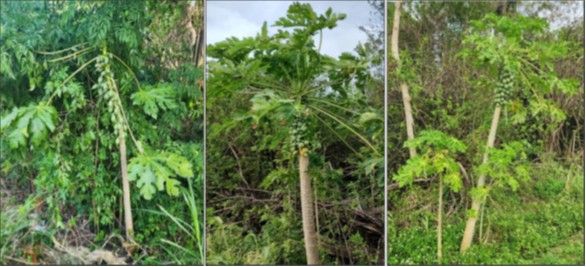
Credit: J. Singh and S. Jangra, UF/IFAS
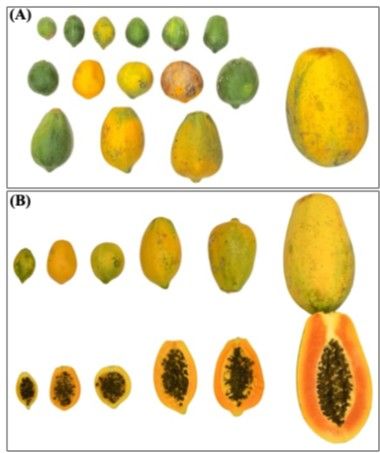
Credit: J. Singh and S. Jangra, UF/IFAS
The seeds from feral papaya fruit are relatively smaller than commercial cultivars. Moreover, documented accounts have supported that seeds of the wild papaya have a greater capacity to remain dormant (i.e., can still germinate after a prolonged storage period) and have greater viability compared to those of commercial hybrids.
Potential Importance of Feral Papaya Plants for Breeding
Feral plants may possess unique and useful genetic traits, including disease resistance or tolerance, increased plant vigor, and superior tolerance to adverse environmental conditions such as flooding, drought, and saline soil or water contamination (Singh and van der Knaap 2022). In fact, wild papaya plants from Mexico have shown drought tolerance that led to the identification of key genes controlling this trait (Estrella-Maldonado et al. 2021). Traits from feral plants may be useful in a breeding program for creating superior papaya cultivars, which could be grown commercially. In addition, they may be of interest as an ornamental or a unique specimen plant in the home landscape.
The most devastating disease of papaya is the papaya ringspot virus (PRSV). This virus debilitates plant growth and potential for fruit production. Symptoms include distorted leaves, a reduction in leaf size, mottling (light and dark green lesions) of the blades (lamina), a lack of flower and fruit production, and dark green C-shaped rings on the peel of the fruit (Figure 3). These feral papaya plants can serve as a source of inoculum for papaya diseases, including PRSV, which pose threats to commercial papaya production. Interestingly, the feral papaya plants observed in this study appeared disease-free, particularly free of PRSV. This could be a genetic trait (resistance) or a result of less disease pressure (i.e., less exposure to infected papaya plants or the aphids that transmit the virus from one plant to another). We are currently evaluating the collected feral papaya germplasm against multiple biotic and abiotic stresses to identify useful genetic stocks for papaya breeding and improvement.

Credit: J. Singh and S. Jangra, UF/IFAS
Acknowledgment
This study was supported by startup funds provided to the UF/IFAS Tropical Fruit Breeding and Genetics program from UF/IFAS Dean for Research.
References
Chávez-Pesqueira, M., and J. Núñez-Farfán. 2017. “Domestication and Genetics of Papaya: A Review.” Frontiers in Ecology and Evolution 5: 155. https://doi.org/10.3389/fevo.2017.00155
Estrella-Maldonado, H., A. G. Ramírez, G. F. Ortiz, et al. 2021. “Transcriptomic analysis reveals key transcription factors associated to drought tolerance in a wild papaya (Carica papaya) genotype.” PLOS One 16: e0245855. https://doi.org/10.1371/journal.pone.0245855
Horvitz, C. C., J. B. Pascarella, S. McMann, A. Freedman, and R. H. Hofstetter. 1998. “Functional Roles of Invasive Non-Indigenous Plants in Hurricane-Affected Subtropical Hardwood Forests.” Ecological Applications 8 (4): 947–974. https://doi.org/10.1890/1051-0761(1998)008[0947:FROINI]2.0.CO;2
Singh, J., and E. van der Knaap. 2022. “Unintended Consequences of Plant Domestication.” Plant Cell Physiology 63 (11): 1573–1583. https://doi.org/10.1093/pcp/pcac083
Ward, D. B. 2011. “Native or Not? Studies of a Problematic Species, Carica papaya.” Palmetto 28 (1): 8–11.