
Did you know there are over 320 species of bees in Florida, and over 4,000 in the United States? This is an abridged introductory guide to some of the common bee groups and species you may encounter in Florida. Wild bees vary widely in behavior, color, size, and shape.

Credit: Photos courtesy of USGS Bee Inventory and Monitoring Lab.
Sweat bees
Sweat bees of the family Halictidae are a diverse and common group of bees. These small-to-medium sized and often brilliantly metallic colored bees are attracted to sweat and will land on your skin for a drink.
- Size: Very Small to Medium
- Number of Species: ~66

Credit: Photos courtesy of USGS Bee Inventory and Monitoring Lab.
Leafcutter bees
Leafcutters are a diverse group of solitary bees in the genus Megachile known for cutting round segments of leaves used to line their nest cells. They are most easily identified by the pollen-carrying hairs under their abdomens. These bees may occupy bee houses and hotels.
- Size: Medium to large
- Florida Species: ~26

Credit: Photos courtesy of USGS Bee Inventory and Monitoring Lab.
Mason bees
Mason bees are also solitary bees in the family Megachilidae and tribe Osmiini. Most are metallic dark blue, though some are black and white striped. They are known for lining their nest cavities and entrances with mud. These bees may occupy bee houses and hotels.
- Size: Small to large
- Florida Species: ~14

Credit: Photos courtesy of USGS Bee Inventory and Monitoring Lab.
Bumble bees
Bumble bees in the family Apidae, genus Bombus, are most easily identified by their robust size, hairy abdomens, and packed pollen balls on female hind legs similar to honey bees. The hairs on the abdomen vary in color including black, yellow, white, and orange.
- Size: Large tp very large
- Florida Species: ~6

Credit: Photos courtesy of USGS Bee Inventory and Monitoring Lab.
Carpenter bees
These are wood-boring bees in the family Apidae. There are two genera of carpenter bees, large (Xylocopa) and small (Ceratina). Large carpenter bees may be mistaken for bumble bees but have a shiny, smooth, and less hairy abdomen. Small carpenter bees are dark and shiny.
- Size: very small or very large
- Florida Species: ~5

Credit: Photos courtesy of USGS Bee Inventory and Monitoring Lab.
Longhorned bees
These bees in the family Apidae, tribe Eucerini, include specialists on squash and sunflowers. Females can be recognized by very hairy and robust hind legs while males have very long atennae, giving rise to their common name.
- Size: medium to large
- Florida Species: ~24

Credit: Photos courtesy of USGS Bee Inventory and Monitoring Lab.
Mining bees
Mining bees are a diverse group of ground-nesting bees in the family Andrenidae. In Florida there are two main genera, Andrena (small to large-sized bees) and Perdita (very small bees). These bees are known for digging deep holes in the ground in which they nest.
- Size: very Small to large
- Florida Species: ~63

Credit: Photos courtesy of USGS Bee Inventory and Monitoring Lab.
Plasterer bees
Plasterer or cellophane bees get their name from the cellophane-like substance that they create to line their nests. Plasterer bees are found within two genera: Colletes (black with light hairs, often striped abdomens) and Hylaeus (yellow-faced bees).
- Size: very small to large
- Florida Species: ~26

Credit: Photos courtesy of USGS Bee Inventory and Monitoring Lab.
Cuckoo bees
Cuckoo bees are kleptoparasitic nest parasites of other bees. Female bees will enter other bee nests and lay their eggs on pollen collected by other bees. Over time, these bees have lost much of their pollen-carrying hairs and thus may appear more wasp-like.
- Size: Small to large
- Florida Species: ~73

Credit: Photos courtesy of USGS Bee Inventory and Monitoring Lab.
Honey bees
Honey bees are ubiquitous, medium-sized bees that live in large colonies and are used intensively for agricultural pollination, honey production, and as a hobbyist pastime. There is only one honey bee species in Florida, the non-native European honey bee, Apis mellifera. Most honey bees in Flori-da are from managed hives, but feral colonies are also common.
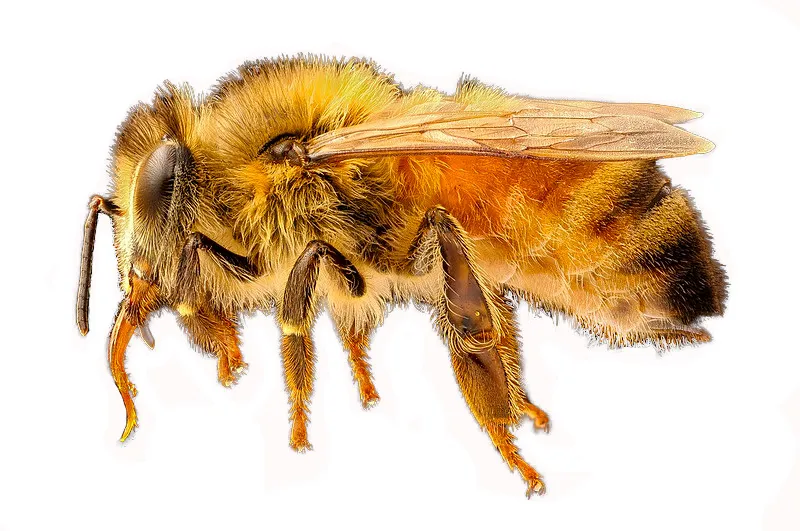
Credit: Photos courtesy of USGS Bee Inventory and Monitoring Lab.