
The Featured Creatures collection provides in-depth profiles of insects, nematodes, arachnids and other organisms relevant to Florida. These profiles are intended for the use of interested laypersons with some knowledge of biology as well as academic audiences.
Introduction
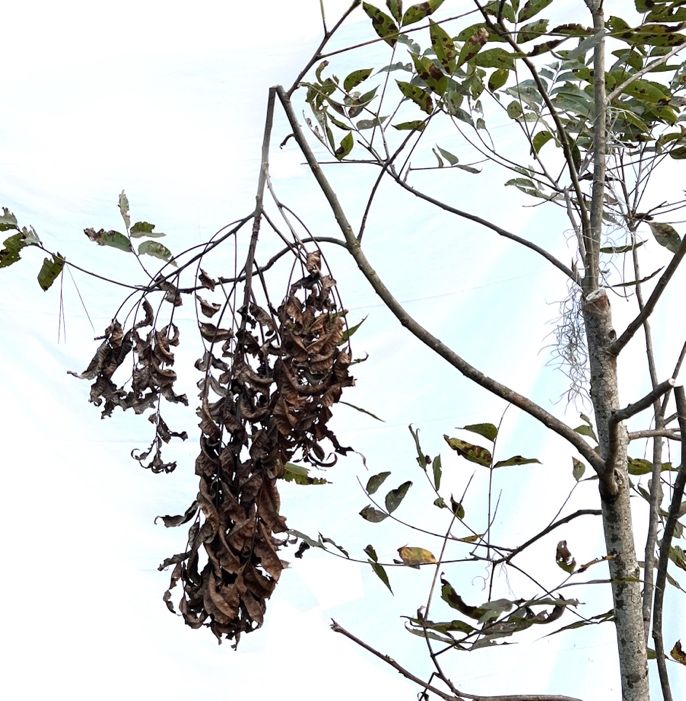
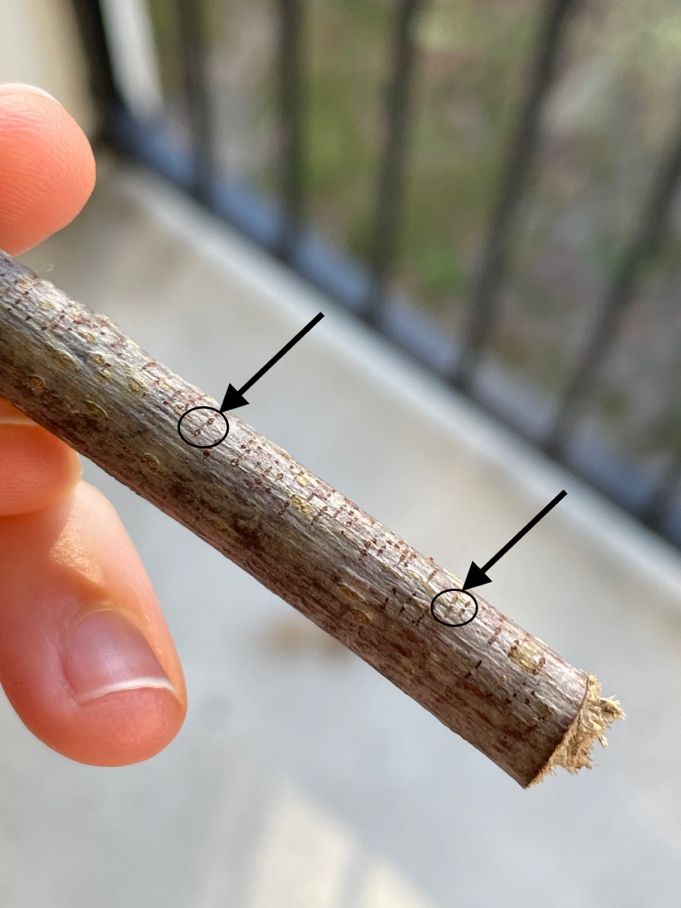
The start of autumn evokes the image of falling leaves, but in Florida, it may also come with falling twigs (Figure 1), particularly from pecans and hickories. Take a closer look at where such twigs have become detached from the rest of the tree. Are the ends cleanly whittled and smooth around the edges, with a jagged break towards one side? Does the cut run curiously perpendicular to the branch? Then examine the rest of the twig. Is its bark covered in small, scattered notches, parallel to the original injury (Figure 2)?
Credit: Jiri Hulcr, UF/IFAS
Credit: Miranda Barnes, UF/IFAS
If so, congratulations! You’ve likely just encountered the master craftsmanship of a female twig girdler. These long-horned beetles (Coleoptera: Cerambycidae) have a unique way of caring for their offspring: they lay eggs in twigs they sever from small branches. Though they may become tree pests in pecan orchards, more often, they offer a fascinating look into the world of dead and dying twigs and the complex ecology of the insects all around us.
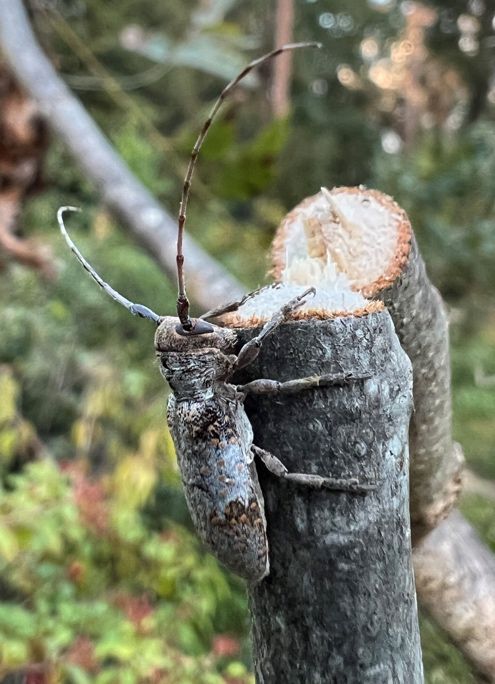
Despite being easily recognizable and common in Florida, the twig girdlers remain poorly studied and almost never documented. As such, raising them from twigs offers an exciting opportunity for home experiments, and catching one in the act can be a trophy shot for nature photographers (see Figure 3).
Credit: Jiri Hulcr, UF/IFAS
Taxonomy and Distribution
Strictly speaking, “twig girdler” refers to members of a specific tribe within the Cerambycidae (long-horned beetles), subfamily Lamiinae: the Onciderini. This group is defined by a combination of physical features: obvious tubercles (bumps) on the antennae, a pronotum (the plate covering the beetle’s neck) that is broader than it is long, and elytra (wing covers) with rounded ends and knoblike structures on the “shoulders” (Nearns et al., 2011). These characteristics may occur in other cerambycid groups, but only in the Onciderini do they consistently show up together.
Though this tribe is extremely diverse in the tropics, only three genera and eight species of twig girdlers are native to the United States (Nearns et al., 2011).
- Oncideres cingulata [with two subspecies, Oncideres cingulata cingulata (Say, 1826) and Oncideres cingulata texana Horn, 1885]
- Oncideres pustulata (LeConte, 1854)—huisache girdler
- Oncideres quercus (Skinner, 1905)
- Oncideres rhodosticta (Bates, 1885)—mesquite girdler
- Cacostola lineata (Hamilton, 1896)
- Cacostola salicicola (Linsley, 1934)
- Lochmaeocles cornuticeps cornuticeps Schaeffer, 1906
- Lochmaeocles marmoratus Casey, 1913
Of these species, Florida residents are most likely to encounter Oncideres cingulata in their yards. Its range stretches from Missouri to Texas through the eastern U.S., but it has been recorded as far north as Iowa and New England (Marlin E. Rice & Doug A. Veal, 2006). Oncideres texana was previously recognized as a separate species but is now treated as a subspecies of Oncideres cingulata (Herrick, 1902). Within the U.S., Oncideres pustulata has been recorded in Texas (L. A. Rodríguez-del-Bosque & R. D. Garza-Cedillo, 2008), Oncideres quercus in Arizona (Beyer, 1908), and Oncideres rhodosticta with mesquite in the southwestern United States (Polk & Ueckert, 1973). The Cacostola species listed—and many other Lamiinae, despite the name—do not actually girdle branches and therefore remain understudied (Nearns et al., 2011).
Description and Life Cycle
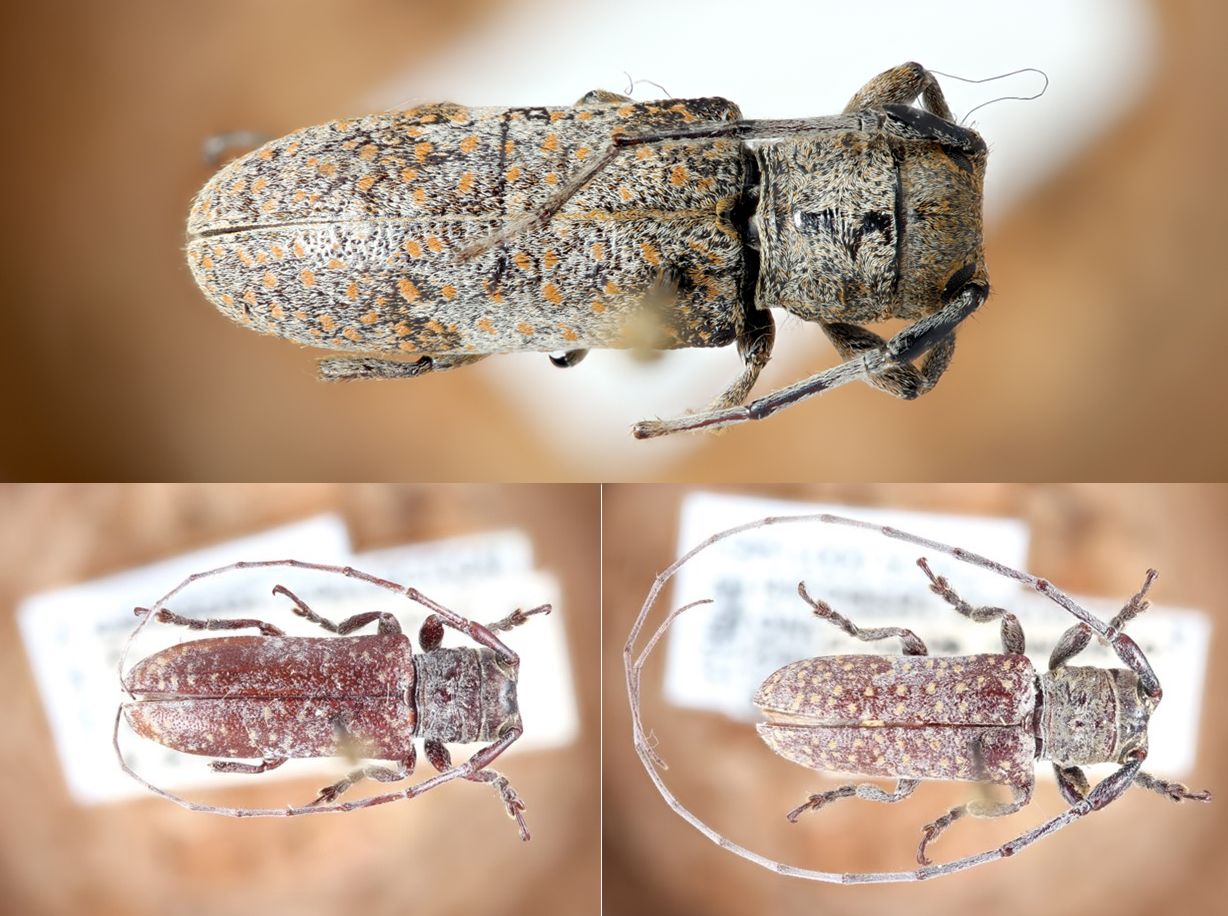
Adult Oncideres cingulata cingulata are grey to brown, with small yellow spots appearing across the elytra (the hardened forewings) (Figures 4 and 5). The middle third of each elytron looks especially gray due to its dense pubescence (seen elsewhere on the beetle, but particularly concentrated in this location). They are about 1 cm–1.5 cm (0.4–0.6 in) in length (less than half an inch). Like all long-horned beetles, they have long, prominent antennae. These sensory structures are especially extensive in males and may substantially exceed the length of the body (Herrick, 1902; Polk & Ueckert, 1973).
Credit: Miranda Barnes, UF/IFAS
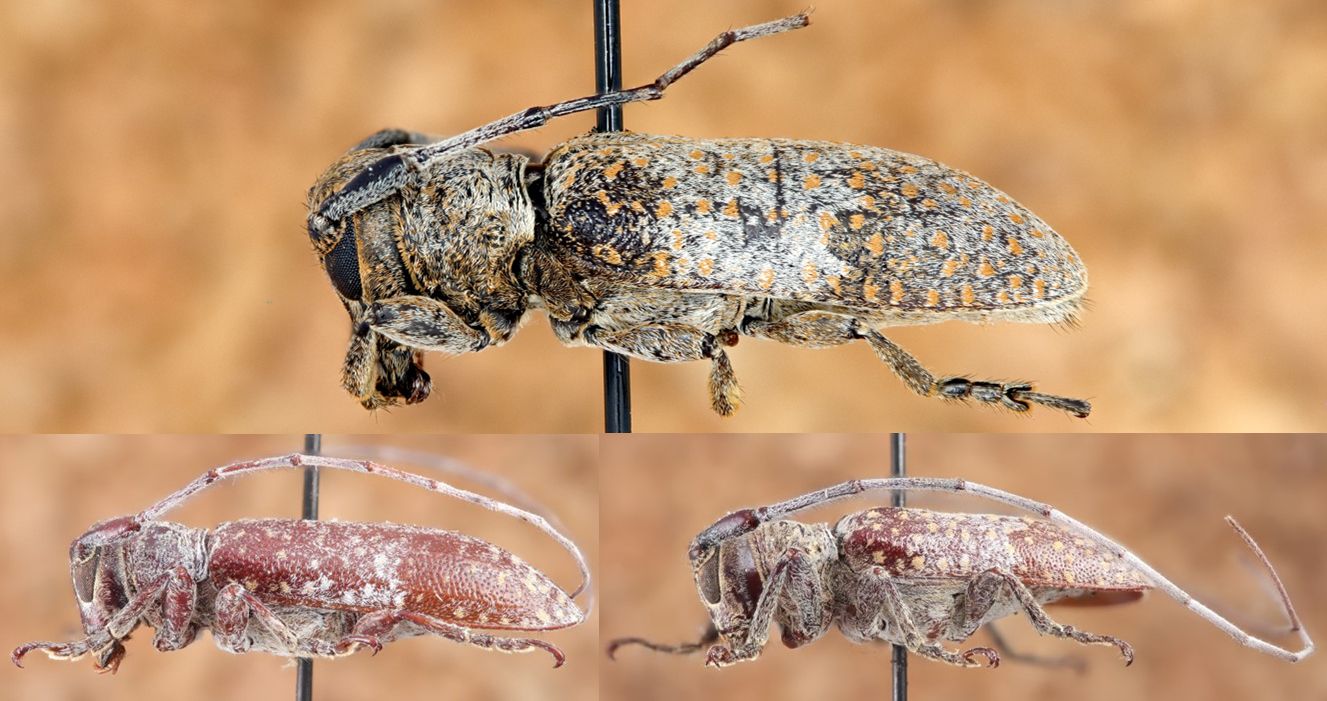
Credit: Miranda Barnes, UF/IFAS
In the fall, adult female Oncideres cingulata will begin selecting suitable branches for oviposition. They use their sense of smell to find the right tree species, which commonly includes hickory and pecan (Park & Thompson, 2023) (but see the Hosts section below for more detail). The length of the chosen twig seems to vary between beetle species, but the diameter remains consistent between different kinds of trees at the site of the girdle. For Oncideres cingulata and Oncideres rhodosticta, it hovers around 7 mm–11 mm (0.3–0.4 in) in diameter (Forcella, 1984). Oncideres pustulatus generally chooses branches that are much thicker, around 20 mm–40 mm (0.8–1.6 in) in diameter (Polk & Ueckert, 1973). After making her decision, the female will chew a ring around the outside of the twig with her mandibles, leaving a part of the bottom side attached (Rogers, 1977). Alternatively, she may “cheat” and select a branch that has already been girdled by another beetle (Cramer, 1998). As the female prepares the twig, her male counterpart remains close (likely to guard against competing males) but offers no help (Herrick, 1902).
Having completed her girdled ring, the female makes several additional small marks in the bark (Rogers, 1977). The exact number of these notches varies but seems to be most heavily influenced by the size of the branch (Bryan R. Coppedge, 2011). Most notches are in the middle of the severed twig, with fewer at each end (Cramer, 1998). The purpose of these notches remains unknown. The actual oviposition sites are larger, lens-shaped holes into which the females deposit a small, white, elliptical egg about 2.5 mm (0.1 in) across (see Figure 6) (Herrick, 1902). The first-instar larvae stay in place, stationary and generally not eating, through to late autumn (Rogers, 1977). Larvae are predominately white but possess black mandibles and very short, dark hairs, which are visible under slight magnification (e.g., with a hand lens) (Herrick, 1902).
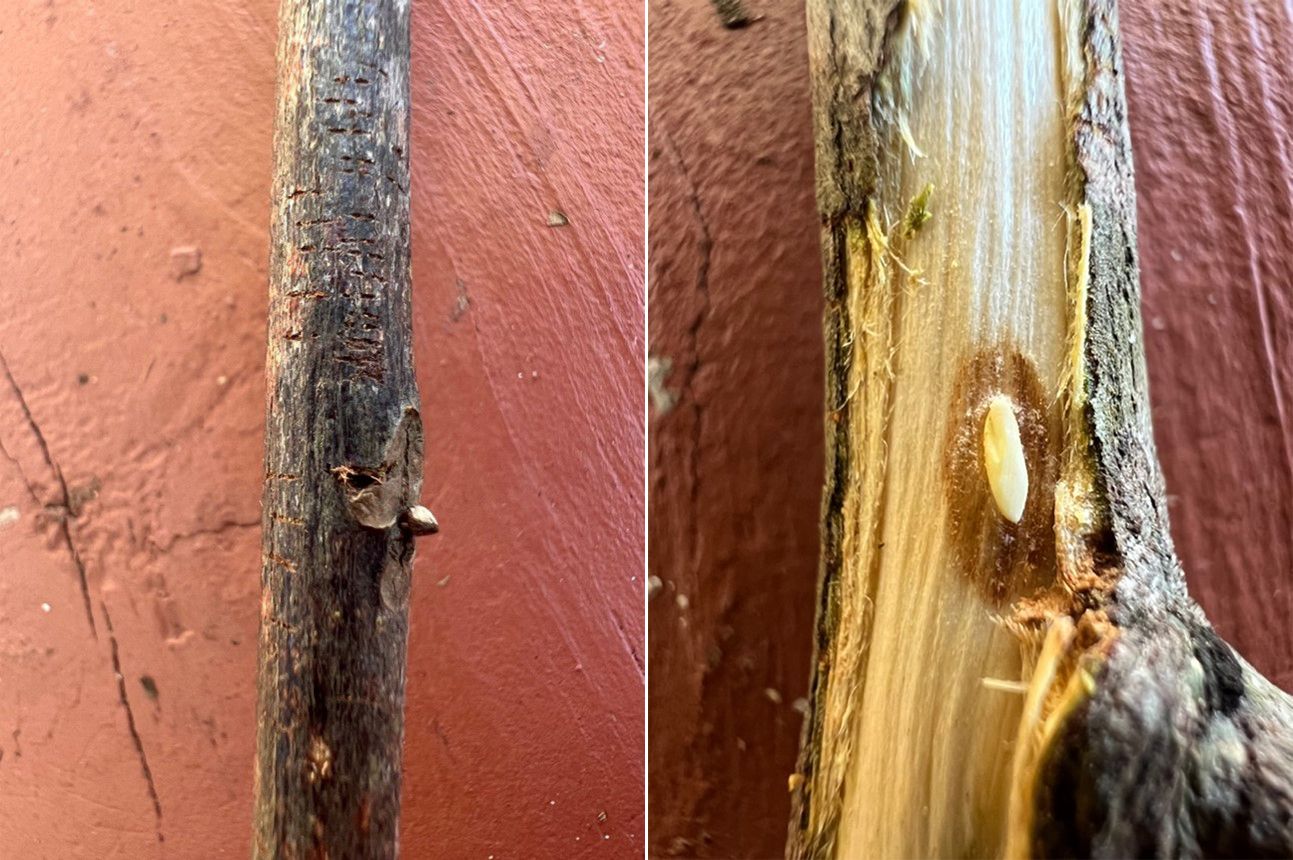
Credit: Jiri Hulcr, UF/IFAS
Throughout this period, the larva may be attacked by various parasitoid wasps, which can easily access it through the bark (Rogers, 1977). Only when the larvae molt to the second instar do they start to tunnel into and consume woody tissue within the interior of the girdled twig (Rogers, 1977). The young beetle will spend the winter in this stage, then continue eating in the spring and molt into the third and fourth larval stages. These may be better protected from parasitoids, but their larger size makes them preferred meals for birds that may pull them out of the wood (Rogers, 1977). Through all of this, larvae must also compete with other branch-dwelling insects, particularly other woodboring beetles (discussed in more detail in Ecology) (Cramer, 1998).
You are likely to find many girdled branches on the ground beneath a given host tree. The impact of girdled branches falling to the ground on beetle development (relative to branches that remain attached to the tree) seems to be dependent on the species, host, and climate. In desert environments, for example, research suggests that if a branch falls off after being girdled, the likelihood that larvae will survive to adulthood decreases substantially (Rogers, 1977). In these circumstances, girdled branches that remain in the canopy may keep resident twig girdlers safe from adverse conditions (Polk & Ueckert, 1973). However, in literature from other hosts and climates, twigs rarely remain on the tree, and larvae are more likely to complete their life cycle in fallen branches (Cramer, 1998). The circumstances preferred by twig girdlers in Florida, where damp conditions could lead to overgrowth of fungi within dislodged material, remain largely unstudied. Either way, twigs that become too wet or dry and/or too hot or cold will kill developing larvae (Bryan R. Coppedge, 2011). This is especially true for species like Oncideres pustulata, which are not adapted to extreme winter temperatures (L. A. Rodríguez-del-Bosque & R. D. Garza-Cedillo, 2008; Rice, 1986).
Before pupation, the fourth-instar larvae will create a small opening in the branch and then plug the gallery behind it with wood shavings (Herrick, 1902). The beetles then either undergo a two-week pupation period in late summer or (less commonly) spend another winter as larvae and emerge as adults the following spring (Rogers, 1977). The pupae possess similar coloration to the larvae but also have spines running along the sides of their bodies (Herrick, 1902). In Oncideres rhodosticta, pupae can sometimes be observed to move within the wood by bracing these spines against gallery surfaces (Polk & Ueckert, 1973). Once pupation is complete, the adult beetles emerge to breed and prepare twigs for the next generation.
Hosts
Oncideres cingulata most commonly girdles hickories and pecans (Carya spp.) in the U.S. (Cramer, 1998; Forcella, 1984), but other hosts include persimmon (Diospyros virginiana), American elm (Ulmus americana), birch (Betula spp.), honey locust (Gleditsia triacanthos) (Bryan R. Coppedge, 2011), and Nuttall oak (Quercus texana) (Kennedy, 1981). In Texas, Oncideres cingulata will often also utilize mesquite (Prosopis glandulosa), though with notably high mortality per generation, with less than 1% of beetles reaching adulthood (Rogers, 1977). The factors shaping host selection are unclear but may be related to the suite of anti-herbivory chemicals produced by different types of trees. Other hypotheses suggest that antimicrobial compounds in hickories make them preferable because they keep the wood from rotting long enough for beetles to complete development (Forcella, 1982).
Other members of the genus have different host preferences. Oncideres pustulata girdles many plants, but it is typically associated with huisache (Vachellia farnesiana) and Leucaena spp. (L. A. Rodríguez-del-Bosque & R. D. Garza-Cedillo, 2008). Oncideres rhodosticta is predominately recorded on mesquite (Polk & Ueckert, 1973). Oncideres quercus has not been as well-studied, but where records exist, it (predictably) girdles oak (Quercus spp.) (Beyer, 1908).
Ecology
Why do twig girdlers girdle twigs, rather than simply colonizing branches that have already fallen to the ground? The answer may lie in how trees distribute nutrients during different times of year. In the autumn, trees preparing to drop their leaves will seek to retain nitrogen-containing compounds by exporting them out of the dying (or more accurately, “senescing”) leaf into the trunk and roots. These can then help support the development of new shoots the following year (Millard & Grelet, 2010). Just like trees, beetles (and other insects) need nitrogen to survive. By girdling the twigs, beetles may ensure that this organic nitrogen is not exported back to the tree, but instead trapped and concentrated in the twig where the larvae can use it for their own growth and development (Forcella, 1982). Indeed, larval survival seems to be positively correlated with twig nitrogen content (Forcella, 1981).
The twig girdler isn’t the only species to benefit from these trapped nutrients. In fact, these beetles have been shown to act as “ecosystem engineers” that increase the diversity of other arthropods in twigs by providing a safe and nutritious niche (Calderon-Cortes et al., 2011). For example, numerous other cerambycid beetles take advantage of branches prepared by Oncideres (Beyer, 1908; Hovore & Penrose, 1982). The bark beetle Chramesus hicoriae colonizes Oncideres quercus girdles, the twigs then support both insects at once (Hovore & Penrose, 1982). Other reported co-inhabitants include auger (family Bostrichidae), jewel (family Buprestidae), and net-winged beetles (family Lycidae) (Calderon-Cortes et al., 2011).
Not all the branch’s new tenants are good roommates. Likely all secondary colonizers compete to some degree with Oncideres for nutrients and space within the wood, decreasing overall survival rates for the offspring of the original “engineer”. Others have more nuanced interactions with the beetles. For example, in mesquite, infestation of girdled twigs by Xylobiops texanus (an auger beetle in the family Bostrichidae) weakens the structural integrity of the branch, causing it to fall off the tree prematurely (leaving the twig girdler larvae to overheat on the hot, desert ground) (Rogers, 1977).
Beyond engineering an environment for other organisms to thrive, twig girdlers support their ecological communities in other ways typical of wood-boring beetles. They and their co-colonizers act as food for birds such as flickers and woodpeckers (Rogers, 1977). They are preyed upon by checkered beetles (family Cleridae) and clown beetles (family Histeridae), and they also serve as hosts for several parasitoid wasps (Rogers, 1977).
On a larger ecological scale, twig girdlers have been proposed to regulate the size and density of hickory trees due to their general tendency to attack bigger individual plants in more closely packed stands (Forcella, 1984). Elsewhere, Oncideres rhodosticta shapes the architecture of mesquite canopies (Martínez et al., 2009). This species has even been proposed to contribute to desertification in the Chihuahuan Desert by promoting increased stem density in mesquite and thus accelerating the rate at which these plants contribute to dune formation (Duval & Whitford, 2008).
Management
Oncideres cingulata (and other girdlers in the U.S.) can be considered a pest within certain contexts. In Florida, girdled twigs are common in pecan groves, and twig girdler injuries are suggested to reduce growth and the quality of timber in this species (Kennedy, 1981). However, no robust quantitative data have been published on the impacts of twig girdler damage, and the amount of damage is small compared to other common pecan pests (pecan grower J. Ewel, personal communication).
The main evidence of twig girdler infestation is as described above: the presence of severed twigs with clean, whittled edges perpendicular to the branch and many small notches running parallel to the cut. The conventional cultural control is to remove and destroy these inhabited twigs (through burning, burying, chipping, or dry heat exposure) (Day & Dellinger, 2020). Because they are such minor pests, there have been no substantial efforts to find effective biological control agents. Pest management literature suggests that pesticides could be used to control particularly intense infestations (Kennedy, 1981; Royer et al., 2007), but the amount of damage is so minimal compared to other common pecan pests, diseases, and wind that insecticide application against twig girdlers isn’t very cost-effective (pecan grower J. Ewel, personal communication).
In non-agricultural settings, including urban backyards and forests where tree growth rate is not a concern, treatment for twig girdlers is unnecessary. Instead, this beetle is best appreciated as another natural component of Florida’s native fauna.
How can you find twig girdlers? Some species (particularly the males) will come to lights at night. They “play dead” by falling off host trees as a defensive strategy (Polk & Ueckert, 1973). When handled, they make a chirping sound by rubbing the rear edge of their pronotum (the plate covering the “neck” of the beetle) against a small, ridged piece of exoskeleton lying just above the base of the elytra (Figure 7) (Polk & Ueckert, 1973).

Credit: Miranda Barnes, UF/IFAS
The girdled branches can be a fun object for home experiments as well: you never know what may emerge. If you find a girdled branch, it is possible to rear beetles from the wood over the course of a year, but be prepared: sometimes Oncideres cingulata creates such an effective microhabitat that it is outcompeted by other beetles in the twig, a casualty that stands as a testament to the effectiveness of twig girdling as a behavioral strategy and the ability of these insects to support a community larger than themselves.
Selected References
Ansley R, Meadors C, Jacoby P. 1990. Preferential attraction of the twig girdler, Oncideres cingulata texana Horn, to moisture-stressed mesquite. Southwestern Entomologist 15: 469–47.
Beyer G. 1908. Notes on Oncideres quercus Skinner. Journal of the New York Entomological Society 16: 32–32.
Calderon-Cortes N, Quesada M, Escalera-Vazquez L. 2011. Insects as Stem Engineers: Interactions Mediated by the Twig-Girdler Oncideres albomarginata chamela Enhance Arthropod Diversity. PLOS ONE. https://doi.org/10.1371/journal.pone.0019083
Coppedge BR. 2011. Twig Morphology and Host Effects on Reproductive Success of the Twig Girdler Oncideres cingulata (Say) (Coleoptera: Cerambycidae). The Coleopterists Bulletin 65: 405–410. https://doi.org/10.1649/072.065.0417
Cramer KL. 1998. Effects of Twig Morphology on Oviposition Behavior and Hatching Success of the Twig-Girdling Beetle Oncideres cingulata (Say) (Coleoptera: Cerambycidae). The Coleopterists Bulletin 52: 186–193.
Day ER, Dellinger TA. 2020. Twig Girdler and Twig Pruner. Virginia Cooperative Extension, Virginia Tech, and Virginia State University.
Duval BD, Whitford WG. 2008. Resource regulation by a twig-girdling beetle has implications for desertification. Ecological Entomology 33: 161–166. https://doi.org/10.1111/j.1365-2311.2007.00928.x
Forcella F. 1981. Twig nitrogen content and larval survival of twig-girdling beetles, Oncideres cingulata (Say) (Coleoptera: Cerambycidae). Coleopterists Bulletin 35: 211–212.
Forcella F. 1982. Why twig-girdling beetles girdle twigs. Naturwissenschaften 69: 398–400. https://doi.org/10.1007/BF00396699
Forcella, F. 1984. Trees Size and Density Affect Twig-Girdling Intensity of Oncideres cingulata (Say) (Coleoptera: Cerambycidae). The Coleopterists Bulletin 38: 37–42.
Herrick GW. 1902. Notes on the Life-History and Habits of Oncideres texana. Journal of the New York Entomological Society 10: 15–19.
Holland V, Fragner L, Jungcurt T, Weckwerth W, Brüggemann W. 2016. Girdling interruption between source and sink in Quercus pubescens does not trigger leaf senescence. Photosynthetica 54: 589–597. https://doi.org/10.1007/s11099-016-0646-3
Hovore FT, Penrose RL. 1982. Notes on Cerambycidae Co-Inhabiting Girdles of Oncideres pustulata Leconte (Coleoptera: Cerambycidae). The Southwestern Naturalist 27: 23–27. https://doi.org/10.2307/3671403
Kennedy HE. 1981. Twig Girdler, Oncideres cingulata (Say), Attacks Terminals of Plantation-Managed Pecans. vol. 263 (US Department of Agriculture, Forest Service, Southern Forest Experiment Station). https://doi.org/10.2737/SO-RN-263
Martínez AJ, López-Portillo J, Eben A, Golubov J. 2009. Cerambycid girdling and water stress modify mesquite architecture and reproduction. Population Ecology 51: 533–541. https://doi.org/10.1007/s10144-009-0149-1
Millard P, Grelet G. 2010. Nitrogen storage and remobilization by trees: ecophysiological relevance in a changing world. Tree Physiology 30: 1083–1095. https://doi.org/10.1093/treephys/tpq042
Mulder P. 2007. "Twig Pruner and Girdler, Identification and Management." Oklahoma State University Plant Disease and Insect Advisory 6 (26): 4–6
Nearns EH, Lord NP, Miller KB. 2011–2013. Oncid ID: Tool for Diagnosing Adult Twig Girdlers (Cerambycidae: Lamiinae: Onciderini). The University of New Mexico and Center for Plant Health Science and Technology, USDA, APHIS, PPQ. http://cerambycids.com/oncidid/
Neck RW. 1988. Utilization of Australian Pine (Casuarina glauca) as a Larval Foodplant by Oncideres pustulatus (Coleoptera: Cerambycidae) in Deep Southern Texas. The Coleopterists Bulletin 42: 84–86.
Park I, Thompson DC. 2023. The role of field-collected cues in the host recognition of twig girdlers (Oncideres rhodosticta) on honey mesquite (Prosopis glandulosa). Journal of Asia-Pacific Entomology 26: 102032. https://doi.org/10.1016/j.aspen.2022.102032
Polk KL, Ueckert DN. 1973. Biology and Ecology of a Mesquite Twig Girdler, Oncideres rhodosticta, in West Texas. Annals of the Entomological Society of America 66: 411–417. https://doi.org/10.1093/aesa/66.2.411
Rice ME. 1986. Winter Mortality of Oncideres pustulatus LeConte (Coleoptera: Cerambycidae) Larvae Induced by Freezing Temperatures. Journal of the Kansas Entomological Society 59: 423–427.
Rice ME. 1995. Branch Girdling by Oncideres cingulata (Coleoptera; Cerambycidae) and Relative Host Quality of Persimmon, Hickory, and Elm. Annals of the Entomological Society of America 88: 451–455. https://doi.org/10.1093/aesa/88.4.451
Rice ME, Veal DA. 2006. New Distribution and Adult Host Records for Longhorned Beetles (Cerambycidae) from Iowa. The Coleopterists Bulletin 60: 255–263. https://doi.org/10.1649/898.1
Rodríguez-del-Bosque LA. 2013. Feeding and Survival of Oncideres pustulata (Coleoptera: Cerambycidae) Adults on Acacia farnesiana and Leucaena leucocephala (Fabaceae). Southwestern Entomologist 38: 487–498. https://doi.org/10.3958/059.038.0311
Rodríguez-del-Bosque LA, Garza-Cedillo RD. 2008. Survival, Emergence, and Damage by Oncideres pustulata (Coleoptera: Cerambycidae) on Huisache and Leucaena (Fabaceae) in Mexico. Southwestern Entomologist 33: 209–217. https://doi.org/10.3958/0147-1724-33.3.209
Rogers CE. 1977. Bionomics of Oncideres cingulata (Coleoptera: Cerambycidae) on Mesquite. Journal of the Kansas Entomological Society 50: 222–228.
Ueckert DN, Polk KL, Ward CR. 1971. Mesquite twig girdler: a possible means of mesquite control. Rangeland Ecology & Management/Journal of Range Management Archives 24: 116–118. https://doi.org/10.2307/3896518