
Introduction
There are 25 bee species (Hymenoptera: Anthophila) listed as Species of Greatest Conservation Need in the Florida State Wildlife Action Plan (FWC 2019). Bees provide pollination services vital to the stability of ecosystems and the prosperity of our food systems. A diverse and abundant wild bee community is often far more effective at crop pollination than honey bees (Garibaldi et al. 2011; 2013). Beyond crop pollination, bee pollinators are essential for the reproduction and biodiversity of flowering plants, with an estimated 85% of flowering plants requiring pollinators (Ollerton et al. 2011). Despite the clear need for bee pollinators, bees are understudied relative to the charismatic megafauna that typically garner public, media, and government attention (Diniz-Filho et al. 2010). In recent years, public support for pollinator conservation has greatly increased; however, knowledge and awareness of the diversity of wild bees is lacking (Wilson et al. 2017).
This Extension publication was created to raise awareness among the public of the diversity of Florida’s bees and their life histories. Additionally, this publication synthesizes the current information available on each bee species of conservation concern for quick reference by researchers and land managers interested in efforts to conserve these species.
Florida Bee Species of Greatest Conservation Need
The Florida State Wildlife Action Plan uses the following four criteria to determine Species of Greatest Conservation Need (SGCN), with species needing to meet at least one of the four criteria to be included (FWC 2019):
- Florida Federally Listed Taxa
- State Listed Taxa
- Biologically Vulnerable Taxa:
- Taxa with NatureServe conservation status ranks of S1 (sub-nationally critically imperiled), G1 (globally critically imperiled), or S2G2 (a combined sub-national and global ranking of imperiled)
- Taxa with a Florida Fish and Wildlife Conservation Commission (FWC) Species Ranking System biological score of 27 or higher
- Taxa described on the International Union for Conservation of Nature (IUCN) list as “vulnerable” or above
4. Taxa of Concern:
- Newly described species within the last five years
- State delisted species within the last five years
- Species that are state listed in Alabama or Georgia
- U.S. Fish and Wildlife Service (USFWS) At-Risk species
- National Marine Fisheries Service (NMFS) Species of Concern
- Vulnerable to an emerging risk factor:
- Drastic decline in large parts of their range
- Devastating disease that may cause large declines in population
Using the above criteria, the 2019 Florida State Action Plan lists the following bee species as SGCNs:
- Ashmeadiella floridana (Robertson 1897) — southeastern Ashmeadiella bee
- Bombus fervidus (Fabricius 1798) — yellow bumble bee
- Bombus fraternus (Smith 1854) — Southern Plains bumble bee
- Bombus pensylvanicus (De Geer 1773) — American bumble bee
- Bombus variabilis (Cresson 1872) — variable cuckoo bumble bee
- Caupolicana electa (Cresson 1878) — southeastern fork-tongue bee
- Caupolicana floridana Michener and Deyrup 2004 — giant scrub plasterer bee
- Centris errans Fox 1899 — Florida locust-berry oil-collecting bee
- Colletes francesae M. A. Deyrup and L. D. Deyrup 2011 — tough buckthorn bee
- Colletes longifacies Stephen 1954 — long-faced cellophane bee
- Colletes titusensis Mitchell 1951 — no common name
- Hesperapis oraria Snelling and Stage 1997 — Barrier Island Hesperapis bee
- Hylaeus formosus Krombein 1953 — no common name
- Lasioglossum flaveriae (Mitchell 1960) — no common name
- Lasioglossum surianae (Mitchell 1960) — Florida Keys sweat bee
- Lasioglossum tahitensis Mitchell 1960 — Tahiti Beach sweat bee
- Osmia calaminthae Rightmyer, Ascher, and Griswold 2011 — blue calamintha bee
- Perdita blatchleyi Timberlake 1952 — Blatchley's Perdita bee
- Perdita graenicheri Timberlake 1947 — no common name
- Perdita mitchelli Timberlake 1947 — no common name
- Perdita townesi Timberlake 1968 — no common name
- Stelis ater Mitchell 1962 — southwest Florida Stelis bee
- Trachusa crassipes (Cresson 1878) — no common name
- Triepeolus monardae Mitchell 1962 — large monarda cuckoo bee
- Triepeolus rugosus Mitchell 1962 — punctate central Florida cuckoo bee
Two species listed above and included in the 2019 Florida State Action Plan were excluded in this document: Bombus fervidus, which is not considered to be found in Florida (Colla et al. 2011), and Lasioglossum tahitensis, which was recently synonymized with L. flaveriae (Gibbs 2011).
Definitions
Cavity-nesting bees — Bees that construct their nests in pre-existing holes such as cavities in wood, other plant materials, or human-made structures
Cleptoparasite bees — Cleptoparasitic bees are solitary bees that do not construct their own nests and do not gather their own pollen provision for their offspring. Instead, they lay their eggs in the nests of other bees, and their larvae feed on the provisions collected by the host species. Cleptoparasitic larvae will develop faster than host larvae and may kill and/or consume the host larvae.
Communal nesting bees — Bees that share a common entrance to many individual nests
Congeners/congeneric species — Species that share a genus
Corbicula — Pollen-carrying structure on the hind tibia of corbiculate bees (honey bees, bumble bees, stingless bees, and orchid bees) that forms a smooth, scoop-like basket
Declining species — Species with published literature documenting their decline
Gregarious nesting bees — Solitary bees that nest in aggregations where many individuals construct nests in a small area
Ground nesting bees — Bees that construct their nests in soil
Limited range/endemic species — Species restricted to a specific locality or geographic region
Rare species — For the purposes of this guide, species with few recent records unrelated to endemism (limited native range)
Scopa — Pollen-carrying structure comprised of many dense hairs
Social bees — Bees that form colonies and exhibit a division of labor between morphologically and physiologically different castes, such as queens (reproductive females), who are responsible for reproduction, and workers (non-reproductive females), who are responsible for foraging and rearing offspring
Social parasite bees — Socially parasitic bees kill and/or mimic a queen bee to then use the existing workers to rear her offspring
Solitary bees — Solitary bees do not have castes. Females are responsible only for their own offspring and do not provide maternal care beyond constructing the nest, provisioning the nest with pollen, and laying eggs. Solitary bees may nest singly, gregariously, or communally.
Known Biology and Ecology of Florida’s Bee Species of Greatest Conservation Need
The online databases linked below in the bee-species subsections provide additional information about the individual bee species described. Explorer.NatureServe.org hosts a database of species and their conservation statuses across the United States and Canada. DiscoverLife.org provides information about more than a million species worldwide with emphasis on bees, moths, and birds.
Ashmeadiella floridana (Robertson 1897), Megachilidae
Common Name(s)
southeastern Ashmeadiella bee
Reason(s) for Concern
rare
Description
7 mm–8 mm (1/4 in–1/3 in) long. Entirely black. Face and thorax with short white hairs. Abdomen striped with white hairs. Abdominal scopa white. Full description in Mitchell 1962.
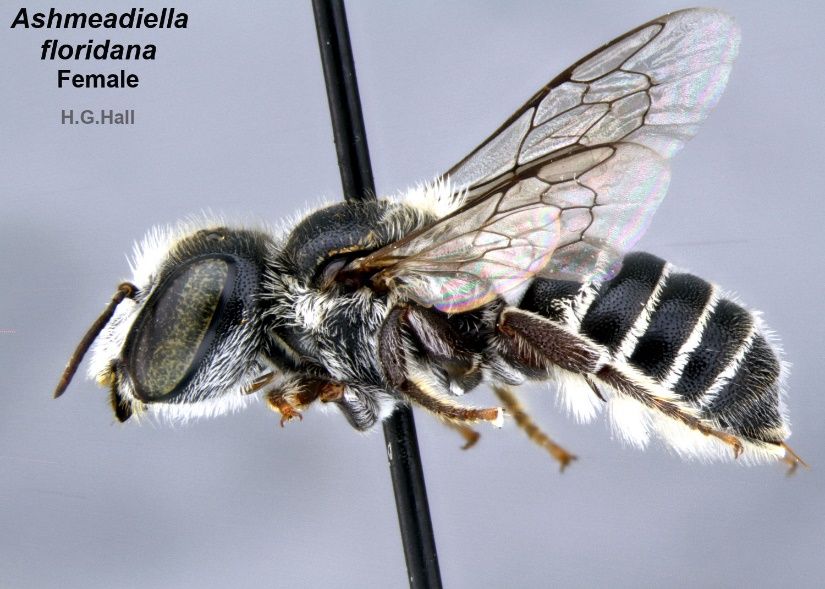
Credit: Harlan Glenn Hall, “The Bees of Florida,” used with permission https://entnemdept.ufl.edu/hallg/melitto/floridabees/ashmeadiella.htm
Range
Scattered observations in eastern North Carolina, South Carolina, Georgia, and north Florida. See DiscoverLife.org’s Ashmeadiella floridana page.
Flight Period
April to July
Nesting Behavior
Undescribed. Assumed to be a solitary, cavity-nesting species based on congeners. Other Ashmeadiella spp. often use plant material or mud to form their nests.
Floral Records
Lupinus spp. (Lamiaceae)
Notes
While there have been recent observations, most of the few records that exist date back many decades. Only member of its genus in the southeastern United States.
References
Mitchell 1962; Murray et al. 2021; Pascarella and Hall 2006.
Also See
Explorer.NatureServe.org’s southeastern Ashmeadiella bee page.
Bombus fraternus (Smith 1854), Apidae
Common Name(s)
Southern Plains bumble bee
Reason(s) for Concern
declining
Description
15 mm–19 mm (2/3 in–3/4 in) long. Densely covered in short hairs. Black hairs on head, yellow hairs on the front and rear of the thorax. First segments of the abdomen with yellow hairs, the remainder with black hairs. Full description in Williams et al. 2014.
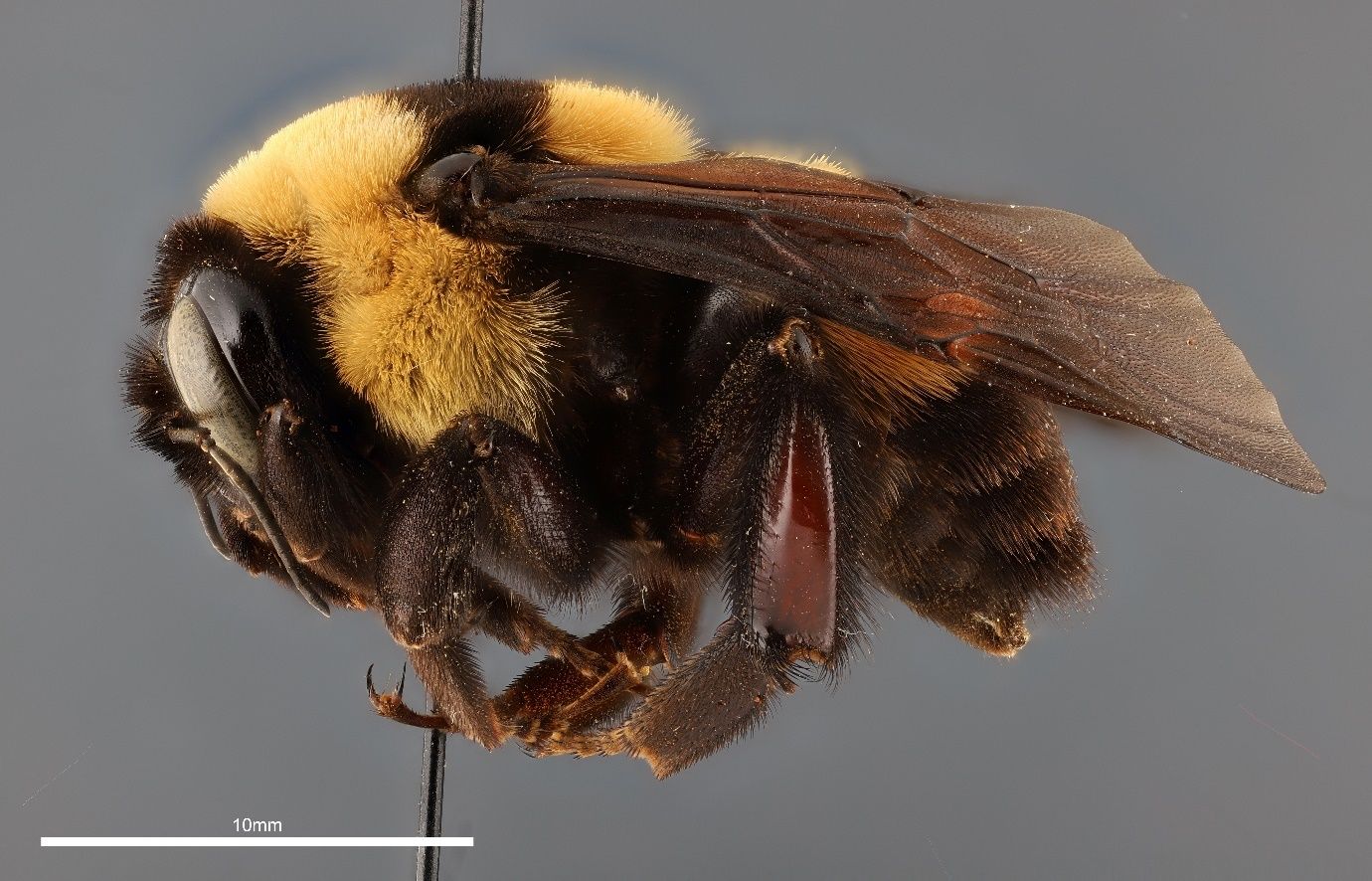
Credit: Jonathan Bremer, Florida State Collection of Arthropods, used with permission
Range
Central and eastern United States extending into northern Mexico and central Florida. See DiscoverLife.org’s Bombus fraternus page
Flight Period
April to October
Nesting Behavior
Social, forming colonies in underground cavities.
Floral Records
Numerous (polylectic)
Notes
While at first glance B. fraternus could look very similar to many other Bombus spp., subtle characters, like the shape of a spur on the hind leg and the width of the cheek, can eliminate look-alikes.
References
Colla et al. 2011; Grixti et al. 2009; Pascarella and Hall 2006; Williams et al. 2014.
Also See
Explorer.NatureServe.org’s Bombus fraternus page
Bombus pensylvanicus (De Geer 1773), Apidae
Common Name(s)
American bumble bee
Reason(s) for Concern
declining
Description
13 mm–19 mm (1/2 in–3/4 in) long. Covered in short hairs. Black hairs covering the head and sides of the thorax. Yellow hairs on the top of the thorax are variable in pattern. Upper half of the abdomen covered in yellow hairs, the lower half with black hairs. Full description in Williams et al. 2014.
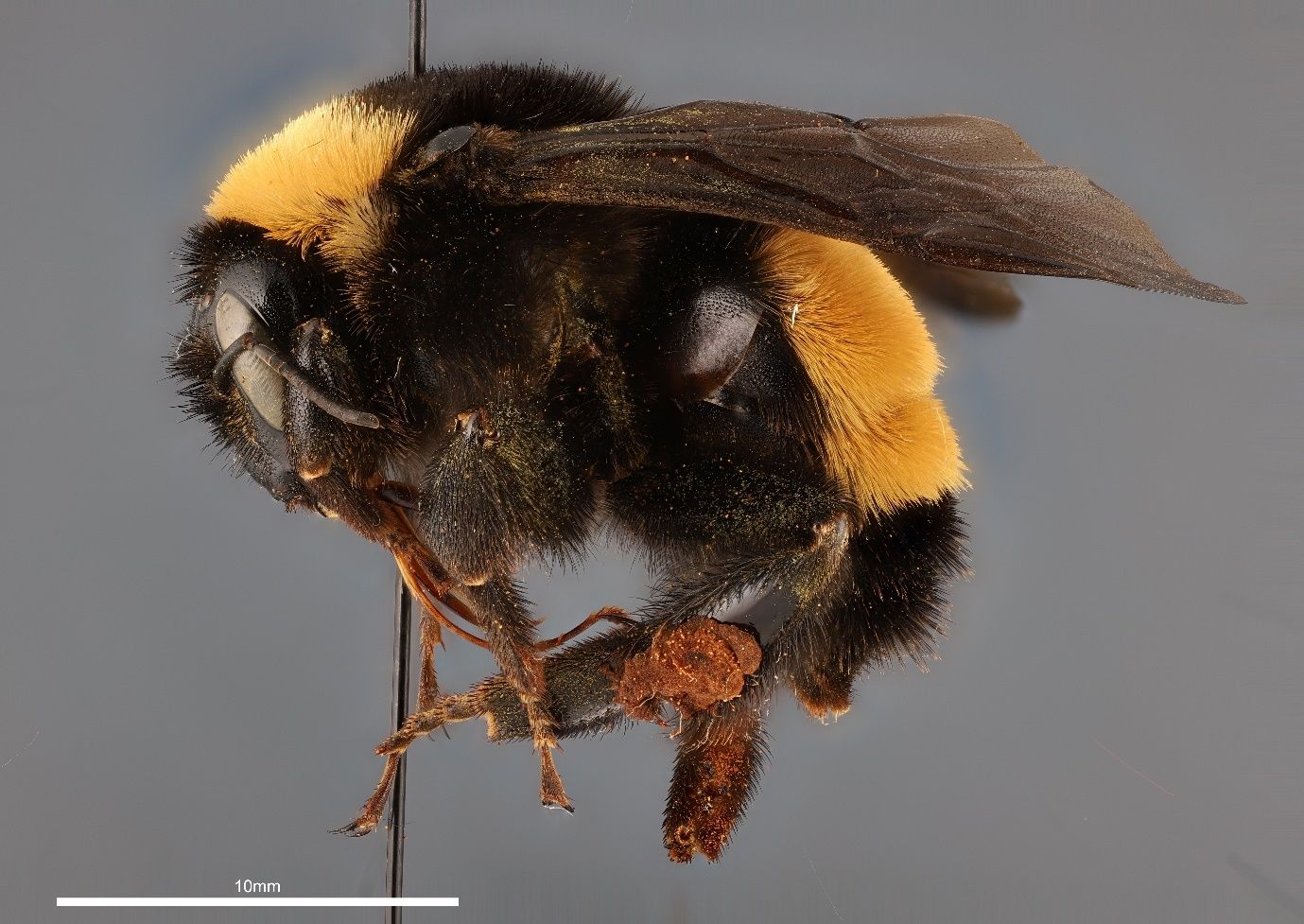
Credit: J. Bremer, FSCA, used with permission
Range
Widely distributed across southern Canada, the United States, and Mexico. See DiscoverLife.org’s Bombus pensylvanicus page.
Flight Period
February to November
Nesting Behavior
Social, forming colonies primarily above ground in clumps of long grass. Occasionally will take up nesting sites in underground cavities.
Floral Records
Numerous (polylectic)
Notes
Decline in this species is due to a host of factors, including habitat loss, pesticide use, and pathogen pressure, with effects most striking in the Midwest, Canada, and New England. In the southern parts of the range of B. pensylvanicus, the flight period is nearly year-round.
References
Colla et al. 2011; Grixti et al. 2009; Williams 2014.
Also See
Explorer.NatureServe.org’s Bombus pensylvanicus page
Bombus variabilis (Cresson 1872), Apidae
Common Name(s)
variable cuckoo bumble bee
Reason(s) for Concern
declining, rare
Description
18 mm–22 mm (3/4 in–7/8 in) long. Black hair on the face. Variably patterned yellow hairs on the thorax. Wings dark brown. Hair on the abdomen very short and entirely black. Corbicula absent due to parasitic life history. Full description in Williams et al. 2014.
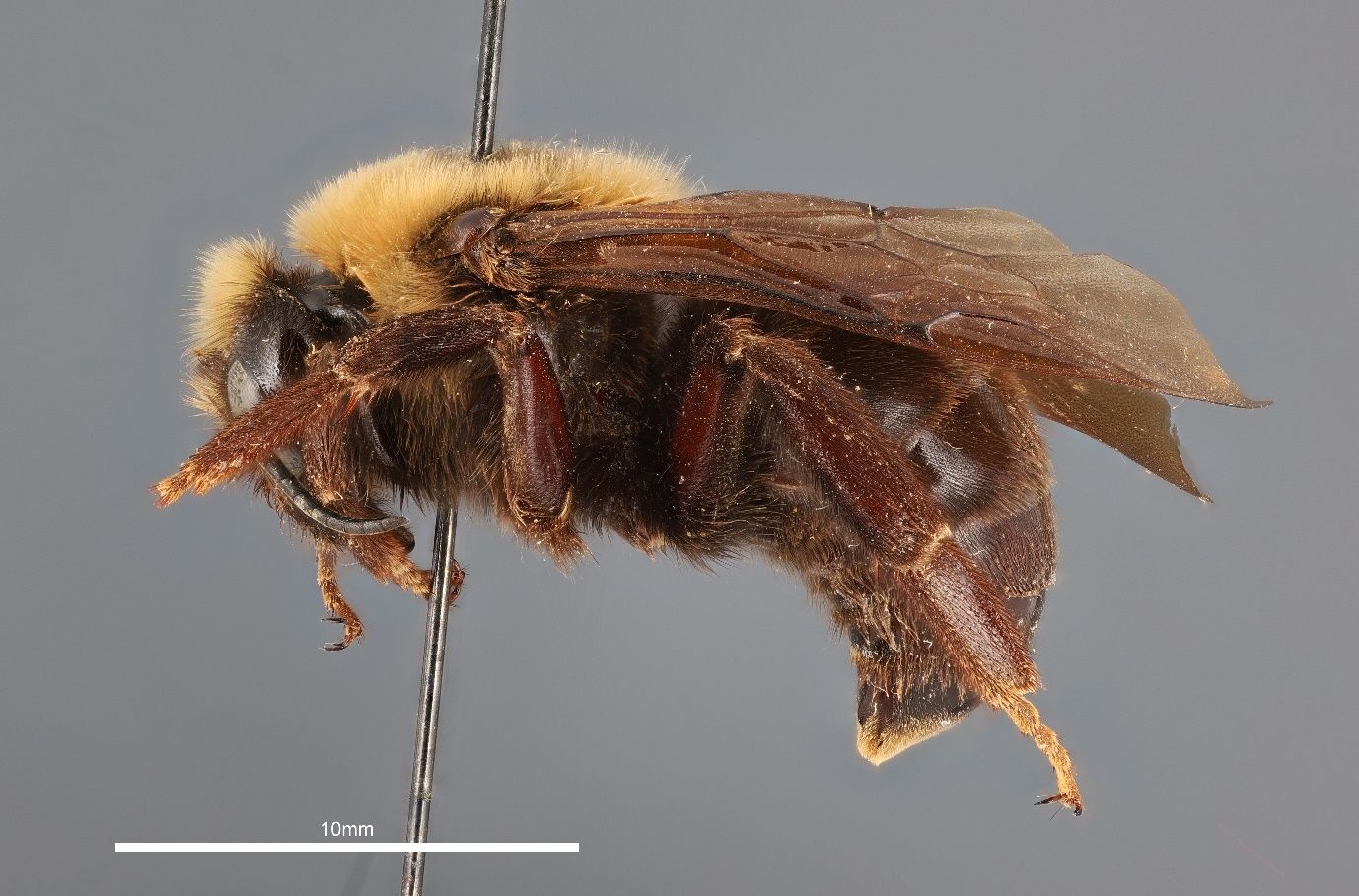
Credit: J. Bremer, FSCA, used with permission
Range
Distributed across the central and eastern United States. See DiscoverLife.org’s Bombus variabilis page.
Flight Period
March to October
Nesting Behavior
Social parasite of B. pensylvanicus
Floral Records
Numerous (polylectic)
Notes
The decline of this species is closely related to the decline of its host, B. pensylvanicus. No recent observations in Florida. Social parasites like B. variabilis tend to emerge about a month after their host does and invade newly established nests. No worker caste is present due to parasitic life history. Females recorded as early as January in Miami-Dade County.
References
Colla et al. 2011; Grixti et al. 2009; Pascarella and Hall 2006; Williams et al. 2014.
Also See
Explorer.NatureServe.org’s Bombus variabilis page
Caupolicana electa (Cresson 1878), Colletidae
Common Name(s)
southeastern fork-tongue bee
Reason(s) for Concern
rare
Description
18 mm–23 mm (3/4 in–7/8 in) long. Yellow hairs cover the head, thorax, and legs. Abdomen covered in short black hairs. White bands of hair are thin or absent. Full description in Michener and Deyrup 2004.
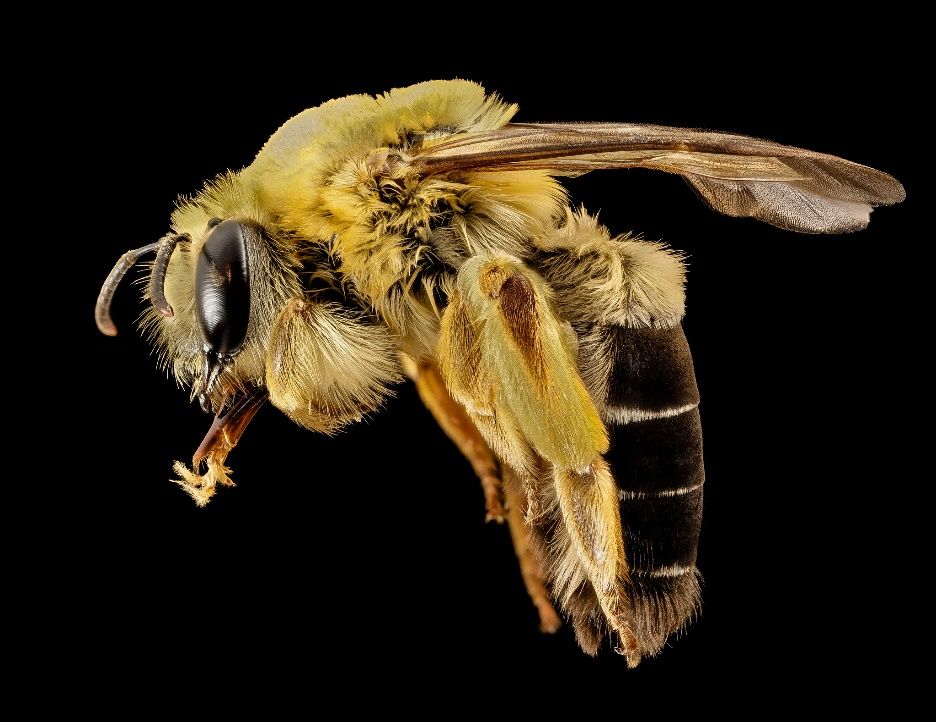
Credit: United States Geological Survey Bee Monitoring and Inventory Lab, Caupolicana electa, f, ga, baker, used under Public Domain
Range
Scattered occurrences in northwest Florida, southern Mississippi, and eastern Louisiana. Believed to be extirpated from North Carolina and South Carolina. See DiscoverLife.org’s Caupolicana electa page.
Flight Period
September and October
Nesting Behavior
Undescribed. Solitary, ground-nesting species based on congeners. Other Caupolicana spp. in the Southwest and Mexico nest in sandy soils.
Floral Records
Agalinis spp. (Orobanchaceae), Aureolaria spp. (Orobanchaceae), and Trichostema spp. (Lamiaceae)
Notes
C. electa and C. floridana are the only Caupolicana spp. in the southeastern United States. Distinguished from C. floridana by hair bands and size.
References
Michener 1966; Michener and Deyrup 2004; Owens 2018; Pascarella and Hall 2006.
Also See
Explorer.NatureServe.org’s Caupolicana electa page
Caupolicana floridana (Michener and Deyrup 2004), Colletidae
Common Name(s)
giant scrub plasterer bee, Florida fork-tongue bee
Reason(s) for Concern
limited range/endemic, rare
Description
16 mm–18 mm (2/3 in–3/4 in) long. Yellow hairs cover the head, thorax, and legs. Abdomen covered in short black hairs. Conspicuous white bands across the abdomen. Full description in Michener and Deyrup 2004.
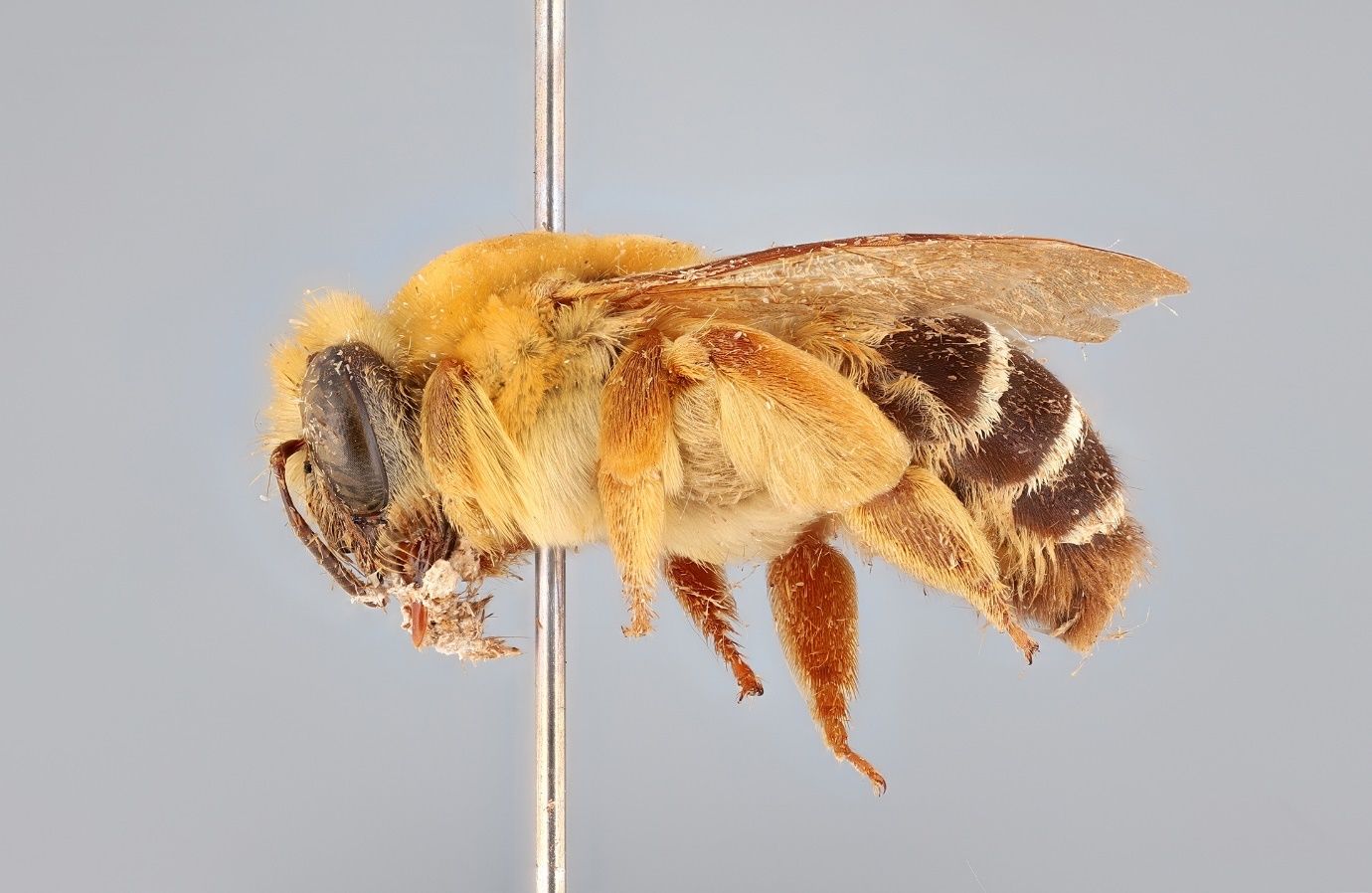
Credit: J. Bremer, FSCA, used with permission
Range
Archbold Biological Station, Lake Placid, Florida. See DiscoverLife.org’s Caupolicana floridana page.
Flight Period
September and October
Nesting Behavior
Undescribed. Solitary, ground-nesting species based on congeners. Other Caupolicana spp. in the Southwest and Mexico nest in sandy soils.
Floral Records
Dicerandra spp. (Lamiaceae), Trichostema spp. (Lamiaceae), and Seymeria spp. (Orobanchaceae)
Notes
C. floridana and C. electa are the only Caupolicana spp. in the southeastern United States. Distinguished from C. electa by hair bands and size. Recorded pre-1900 as C. yarrowi in Dade County, Florida, where it is believed to have been extirpated since then due to development.
References
Michener and Deyrup 2004; van Hoose 2021a.
Also See
Explorer.NatureServe.org’s Caupolicana floridana page
Centris errans (Fox 1899), Apidae
Common Name(s)
Florida locust-berry oil-collecting bee, wandering Centris
Reason(s) for Concern
limited range/endemic
Description
13 mm–14 mm (1/2 in) long. Top of the head and thorax are covered in dense yellow-brown hairs. Thorax is accented with pale, whitish hairs. Abdomen is a rusty brown color. Full description as Centris versicolor in Mitchell 1962.
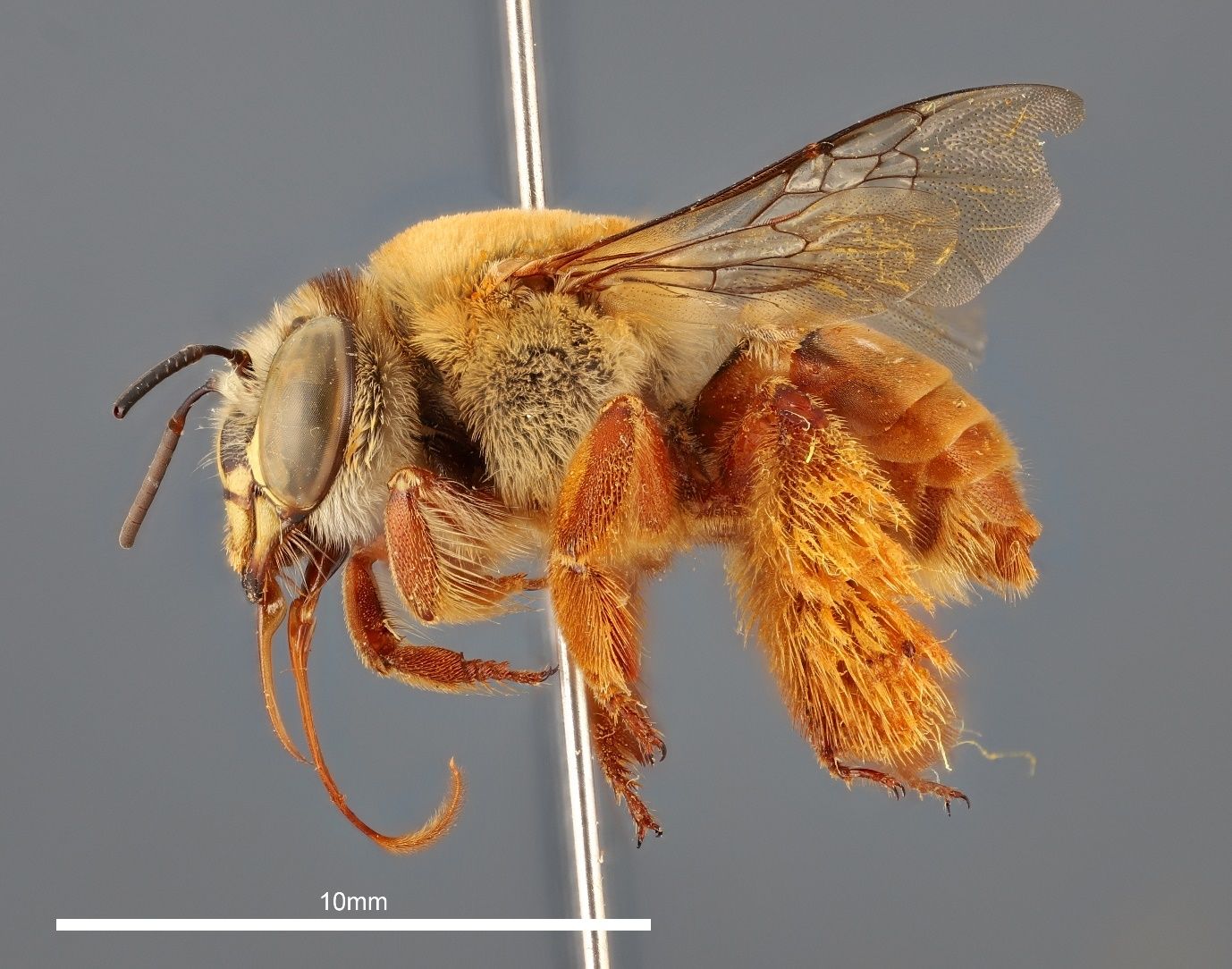
Credit: J. Bremer, FSCA, used with permission
Range
Broward, Dade, and Monroe Counties, Florida. Most abundant in the southern Everglades and the lower Florida Keys. Also found on select islands in the Bahamas. See DiscoverLife.org’s Centris errans page.
Flight Period
March to June
Nesting Behavior
Undescribed. Assumed to be a solitary, ground-nesting species based on congeners. Other Centris (Centris) spp. nest in the ground.
Floral Records
Oil collection on Brysonima lucida (P. Mill.) DC. (Malpighiaceae), Stigmaphyllon sagraeanum Juss. (Malpighiaceae), and Galphimia gracilis Bartl. (Malpighiaceae). Brysonima lucida is the only native oil host in Florida. Recorded on a diversity of other plants for nectar and pollen.
Notes
Recently found in Ft. Lauderdale outside the range of B. lucida, its only native plant host for oil rewards. Range expansion may be facilitated by non-native plant species that provide suitable oil rewards.
References
Coville et al. 1983; Mitchell 1962; Pascarella et al. 1999; Pascarella and Hall 2006; Pemberton and Liu 2008a; 2008b.
Also See
Explorer.NatureServe.org’s Centris errans page
Colletes francesae (M. A. Deyrup and L. D. Deyrup 2011), Colletidae
Common Name(s)
tough buckthorn bee
Reason(s) for Concern
limited range/endemic, rare
Description
About 12 mm (1/2 in) long. Head, thorax, and front of the abdomen covered in whitish hairs. Remainder of the abdomen black with white bands of hair. Full description in Deyrup and Deyrup 2011.
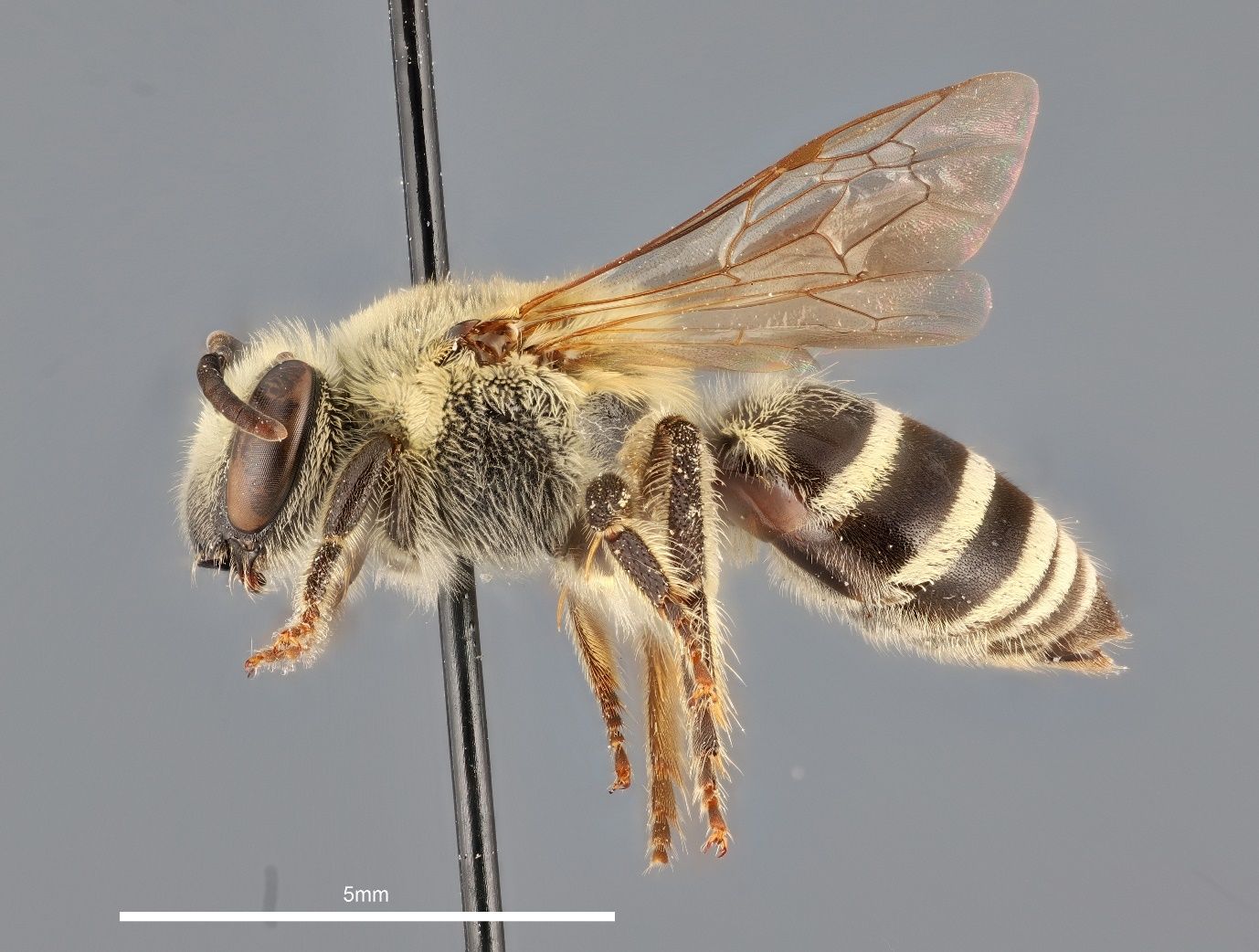
Credit: J. Bremer, FSCA, used with permission
Range
Scattered across Lake Wales Ridge, Polk Co., Florida. See DiscoverLife.org’s Colletes francesae page.
Flight Period
May and June
Nesting Behavior
Undescribed. Solitary, ground-nesting species based on congeners. The majority of other Colletes spp. nest in soil.
Floral Records
Sideroxylon tenax L. (Sapotaceae)
Notes
Its floral host, S. tenax, exists in seemingly suitable habitats in other parts of the Lake Wales Ridge, and even other parts of the state. Additional surveys for C. francesae are needed to confirm its range.
References
Deyrup and Deyrup 2011.
Also See
Explorer.NatureServe.org’s Colletes francesae page
Colletes longifacies (Stephen 1954), Colletidae
Common Name(s)
long-faced cellophane bee
Reason(s) for Concern
rare, limited range/endemic
Description
About 11 mm (~3/8 in) long. Head and thorax are covered in dense white-gray hairs. Wings whitish with black veins. Abdomen with white bands of hair. Females described in Mitchell 1960. Males later described in Hall and Ascher 2014.
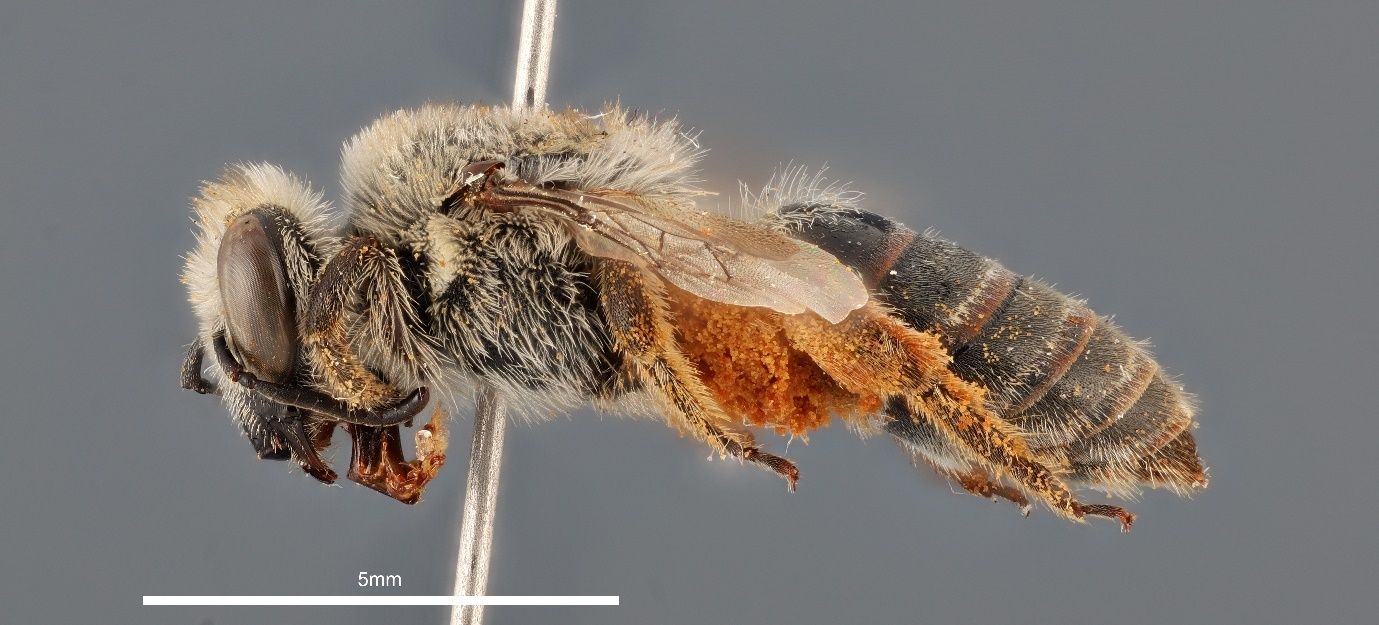
Credit: J. Bremer, FSCA, used with permission
Range
Scattered occurrences across north-central Florida. See DiscoverLife.org’s Colletes longifacies page.
Flight Period
October
Nesting Behavior
Undescribed. Solitary, ground-nesting species based on congeners. The majority of other Colletes spp. nest in soil.
Floral Records
Liatris tenuifolia Nutt. (Asteraceae)
Notes
The long face of this bee is likely evidence of its close association with L. tenuifolia, an aster with deep florets.
For more information, see Hall and Ascher 2014; Mitchell 1960; Pascarella and Hall 2006.
Also See
Explorer.NatureServe.org’s Colletes longifacies page
Colletes titusensis (Mitchell 1951), Colletidae
Common Name(s)
No common name
Reason(s) for Concern
rare, limited range/endemic
Description
About 8 mm (1/3 in) long. Face covered in white hairs. Thorax covered in light brown hair. The legs covered in white hairs. Abdomen with short white bands of hairs. Full description in Mitchell 1960.
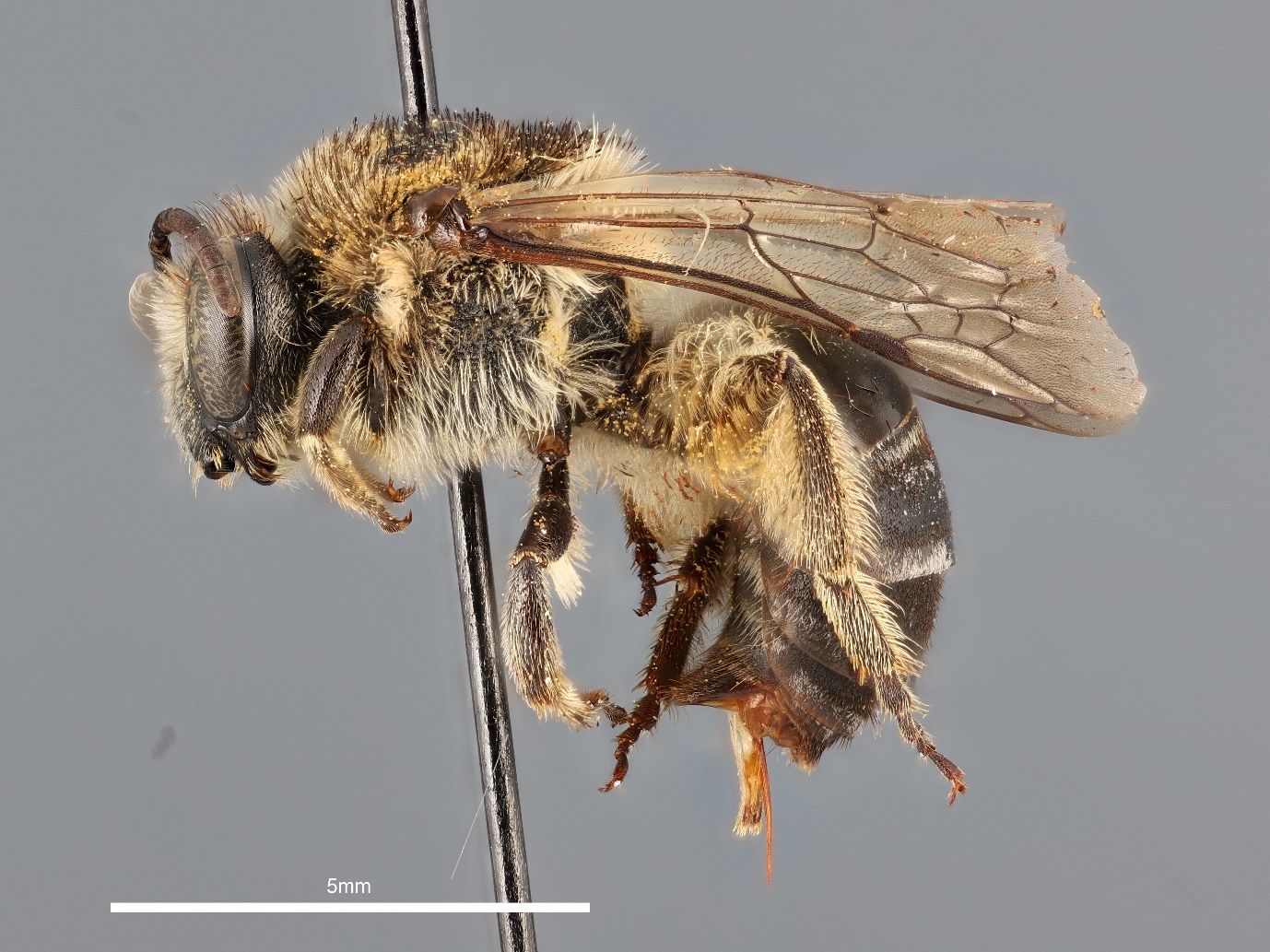
Credit: J. Bremer, FSCA, used with permission
Range
Occurs in coastal Titusville and in the Tampa area. See DiscoverLife.org’s Colletes titusensis page.
Flight Period
April and May
Nesting Behavior
Undescribed. Solitary, ground-nesting species based on congeners. The majority of other Colletes spp. nest in soil.
Floral Records
Campanula floridana S. Wats. ex Gray (Campanulaceae)
Notes
First observation in decades in 2013 from a pan trap at Cape Canaveral National Seashore. Recent observations of the species in the Tampa area suggest that C. titusensis specializes on C. floridana.
References
Hall et al. 2016; Mitchell 1960; Pascarella and Hall 2006.
Also See
Explorer.NatureServe.org’s Colletes titusensis page
Hesperapis oraria (Snelling and Stage 1997), Melittidae
Common Name(s)
Barrier Island Hesperapis bee, Gulf Coast solitary bee, Coastal Plain Hesperapis, Gulf Coast evening bee
Reason(s) for Concern
limited range/endemic
Description
11 mm–13 mm (~3/8 in–1/2 in) long. Face covered in dull yellow to whitish hairs. Thorax covered in dense yellow hairs. Wings clear with light brown veins. Abdomen covered in short brown hairs with bands of white hairs. Full description in Cane et al. 1996.
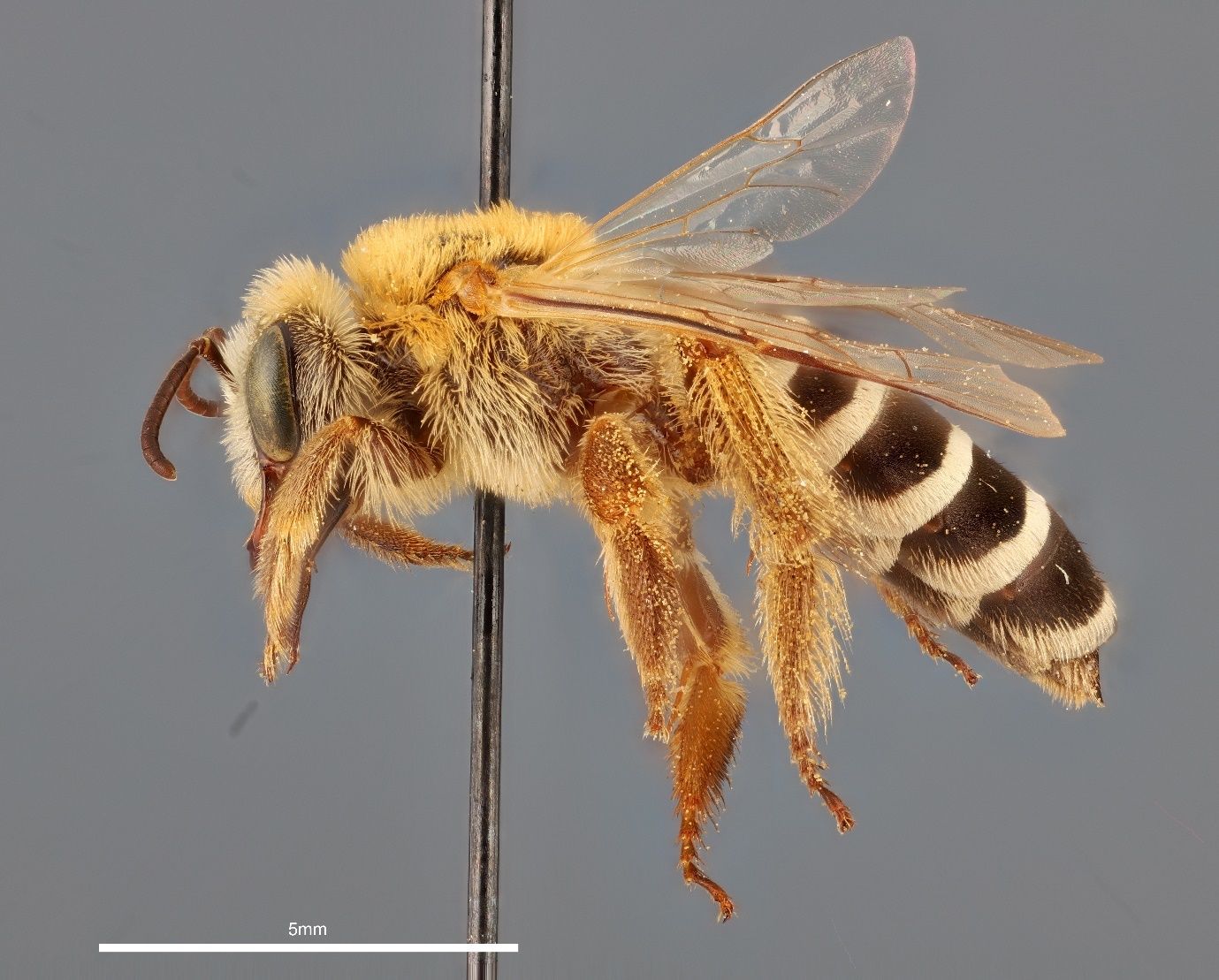
Credit: J. Bremer, FSCA, used with permission
Range
Shore and barrier island dunes of Mississippi, Alabama, and the Florida Panhandle. See DiscoverLife.org’s Hesperapis oraria page.
Flight Period
September and October
Nesting Behavior
Undescribed. Assumed to be a solitary, ground-nesting species based on congeners. All other Hesperapis spp. nest descriptions are in sandy soils.
Floral Records
Balduina angustifolia (Pursh) B. L. Robins. (Asteraceae)
Notes
Only Hesperapis species known to occur east of the Mississippi River. Hesperapsis shares similar modified hairs found on Carinapsis, its sister genus, that are thought to aid in burrowing in sandy soils. This supports the thinking that H. oraria's range is highly dependent on suitable nesting in dunes as, despite the presence of its sole floral host (B. angustifolia) well inland, H. oraria is absent more than two to three kilometers from the shore. See Davis et al. 2020 for more information.
References
Cane et al. 1996; Davis et al. 2020; Pascarella and Hall 2006.
Also See
Explorer.NatureServe.org’s Hesperapis oraria page
Hylaeus formosus (Krombein 1953), Colletidae
Common Name(s)
No common name
Reason(s) for Concern
rare
Description
About 5 mm (~1/8 in) long. Largely hairless, black. Face, legs, and abdomen with brown markings. Many members of this genus could be mistaken for small wasps as they lack scopa. Females described in Mitchell 1960 as Hylaeus metopii. No description of males.
Range
Recent observations in Guantanamo, Cuba. Many observations from the 1980s in the Florida Keys. Also seen on an island in the Bahamas and in Pinar del Rio, Cuba. See DiscoverLife.org’s Hylaeus formosus page.
Flight Period
Varies across range
Nesting Behavior
Undescribed. Assumed to be a solitary, cavity-nesting species based on congeners. Other Hylaeus spp. nest in various locations, often inside the stems of plant debris.
Floral Records
Metopium toxiferum (L.) Krug and Urban (Anacardiaceae)
Notes
Limited observations across varying climates makes describing an exact flight period difficult. Observed in winter, spring, and summer months. Hylaeus do not carry pollen in a scopa but instead carry it internally in their crop.
References
Genaro 2016; Mitchell 1960; Pascarella and Hall 2006.
Also See
Explorer.NatureServe.org’s Hylaeus formosus page
Lasioglossum flaveriae (Mitchell 1960), Halictidae
Common Name(s)
No common name
Reason(s) for Concern
rare
Description
About 4mm long. Largely hairless, head and thorax green-blue. Wings clear with yellow-brown veins. Abdomen reddish-brown. Full description in Gibbs 2011.
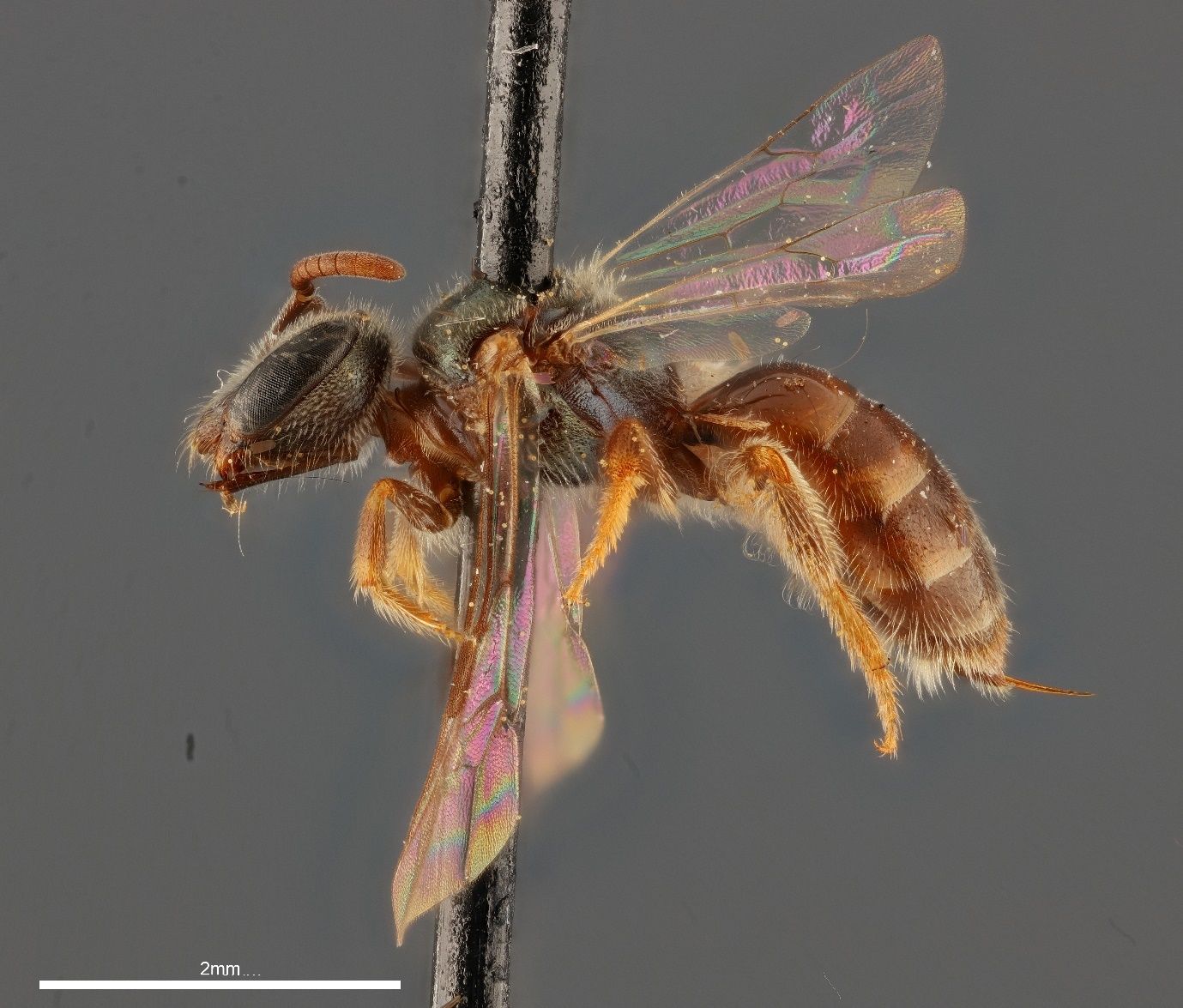
Credit: J. Bremer, FSCA, used with permission
Range
Scattered occurrences in the coastal regions of south Florida as well as an island in the Bahamas. See DiscoverLife.org’s Lasioglossum flaveriae page.
Flight Period
March to August
Nesting Behavior
Undescribed. Gibbs lists 97 Lasioglossum (Dialictus) spp. in eastern North America alone, with many more around the world. The nesting within the subgenus is highly diverse. No assumptions can be made about nesting.
Floral Records
Ardisia escallonioides Schlechtendal and Chamisso (Primulaceae), Achyranthes spp. (Amaranthaceae), Flaveria linearis Lag. (Asteraceae), Mikania spp. (Asteraceae), Sartwellia flaveriae Gray (Asteraceae), Lyonia mariana (L.) D. Don (Ericaceae).
Notes
Lasioglossum (Dialictus) spp. can be difficult to identify to species.
References
Gibbs 2011; Pascarella et al. 1999; Pascarella and Hall 2006.
Also See
Explorer.NatureServe.org’s Lasioglossum flaveriae page
Lasioglossum surianae (Mitchell 1960), Halictidae
Common Name(s)
Florida Keys sweat bee
Reason(s) for Concern
rare
Description
About 4 mm (1/8 in) long. Head and thorax gold-green. Largely hairless. Abdomen reddish-brown. Wings clear with red-brown veins. Full description in Gibbs 2011.
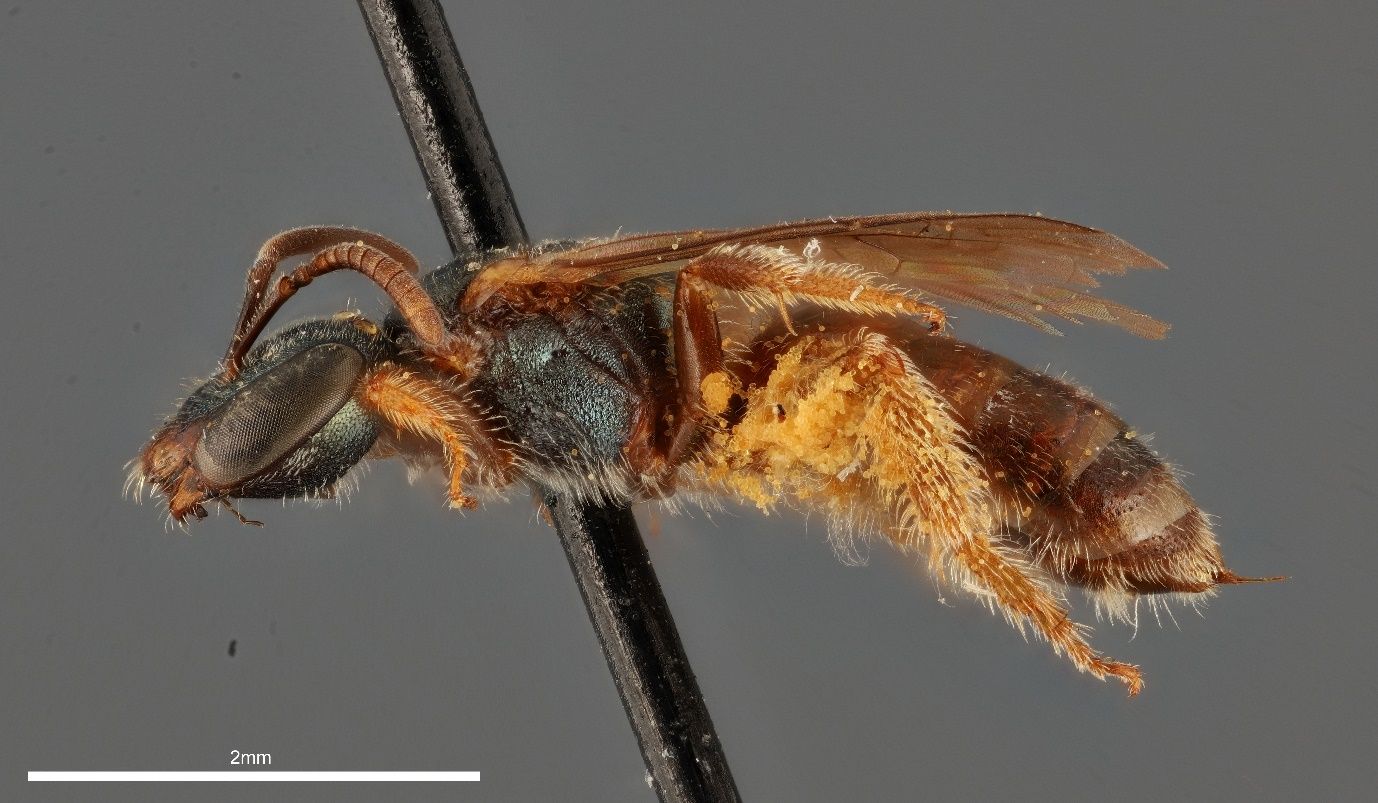
Credit: J. Bremer, FSCA, used with permission
Range
Big Pine Key and Stock Island of the Florida Keys with more recent observations in Biscayne National Park, Highlands County, as well as two islands in the Bahamas. See DiscoverLife.org’s Lasioglossum surianae page.
Flight Period
May to December
Nesting Behavior
Assumed to be ground nesting based on congeners. L. surianae is a part of the L. (Dialictus) tegulare species group, from which other members have been reported as ground nesting. See L. (Dialictus) tegulare in Cuminale 2023 and Brokaw et al. 2023.
Floral Records
Bidens pilosa L. (Asteraceae), Jacquemontia spp. (Convolvulaceae), and Suriana maritima L. (Surianaceae)
Notes
Lasioglossum (Dialictus) spp. can be difficult to identify to species.
References
Gibbs 2011; Gibbs 2009; Pascarella et al. 1999.
Also See
Explorer.NatureServe.org’s Lasioglossum surianae page
Osmia calaminthae (Rightmyer, Ascher, and Griswold 2011), Megachilidae
Common Name(s)
blue calamintha bee
Reason(s) for Concern
limited range/endemic
Description
10 mm–11 mm (~3/8 in) long. Dark blue. Face with short hairs used as a scopa. Thorax and front of the abdomen covered in white hairs. Wings light brown. Remainder of the abdomen hairless except for the scopa on the underside. Full description in Rightmyer et al. 2011.
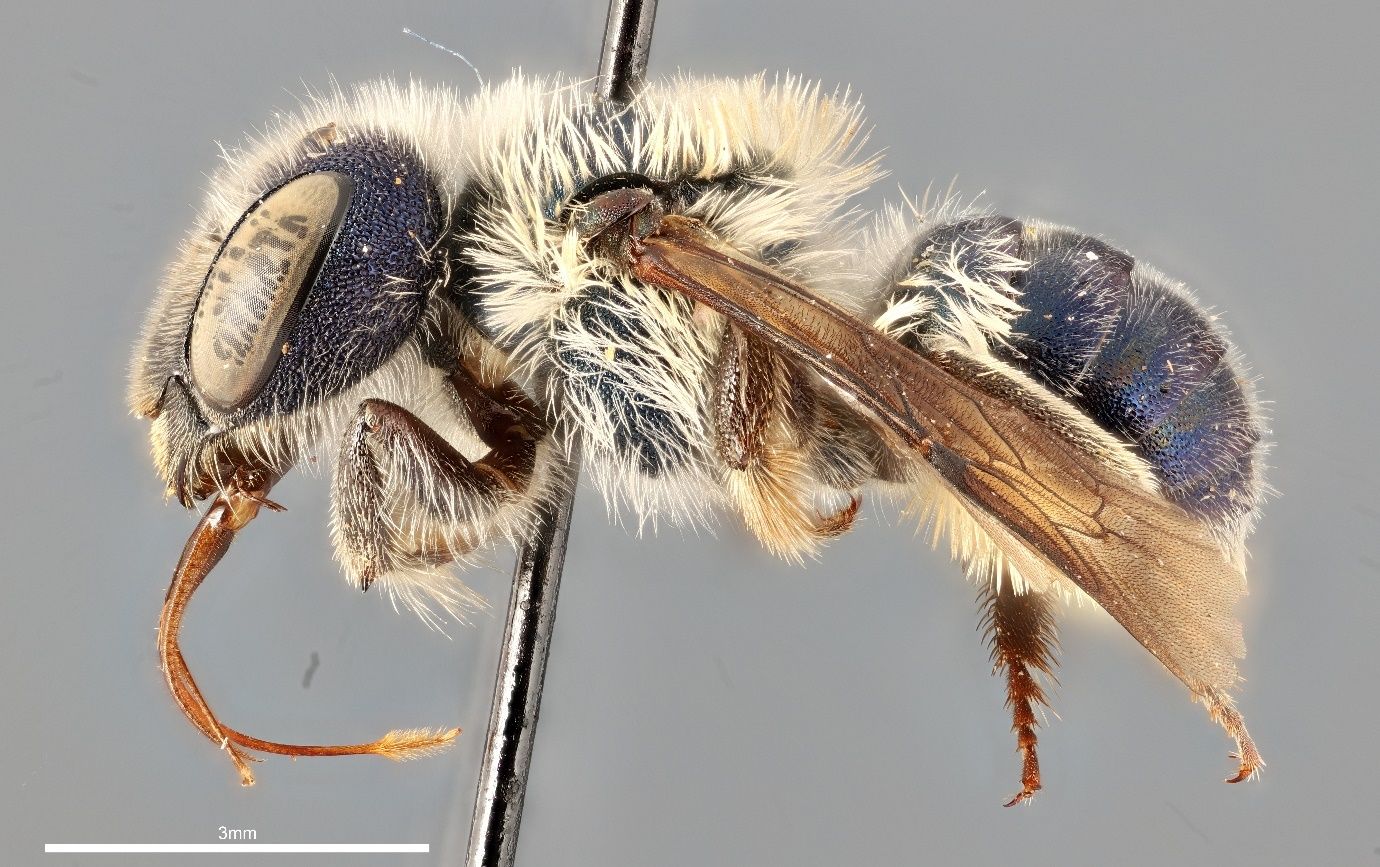
Credit: J. Bremer, FSCA, used with permission
Range
Southern 20 miles of Lake Wales Ridge near Lake Placid, Florida. Recently found in select locations in Ocala National Forest. See DiscoverLife.org’s Osmia calaminthae page.
Flight Period
March and April
Nesting Behavior
Solitary bee nesting belowground in the root structure of grass clumps. The majority of other Osmia spp. nest aboveground in woody vegetation and debris, making O. calaminthae one of the rare exceptions. Osmia spp. use mud and foliage to line their nests.
Floral Records
Clinopodium ashei (Weatherby) Small (syn. Calamintha ashei) and Conradina brevifolia Shinners (Lamiaceae).
Notes
Once considered the most range-restricted floral specialist in the country until it was discovered in Ocala National Forest in 2021. Highly specialized forager, once thought to only forage on C. ashei but more recently discovered to also visit C. brevifolia.
References
Burns et al. 2019; Cane et al. 2007; Rightmyer et al. 2011; Srinivasan 2020; van Hoose 2021a.
Also See
Explorer.NatureServe.org’s Osmia calaminthae page
Perdita blatchleyi (Timberlake 1952), Andrenidae
Common Name(s)
Blatchley's Perdita bee
Reason(s) for Concern
rare, limited range/endemic
Description
5 mm–6 mm (~1/8 in–1/4 in) long. Covered in sparse white hairs. Head and thorax dark green. Wings clear with brown veins. Abdomen dull brown. Face and abdomen with light yellow markings. Females described in Mitchell 1960. Males described in Hall and Ascher 2014.
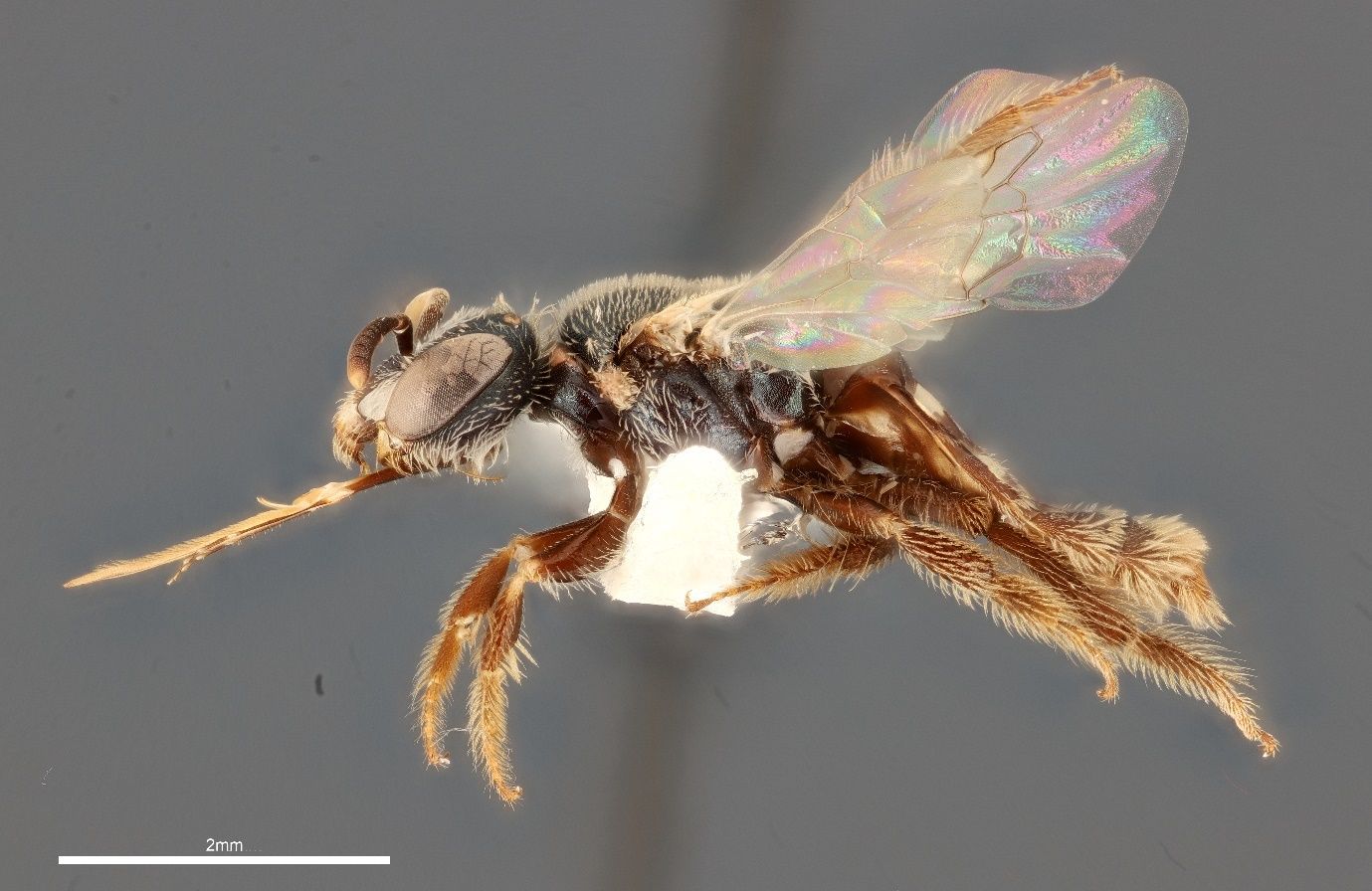
Credit: J. Bremer, FSCA, used with permission
Range
Scattered occurrences across central Florida, including observations at Archbold Biological Station, Ordway-Swisher Biological Station, and Alachua County. See DiscoverLife.org’s Perdita blatchleyi page.
Flight Period
September and October
Nesting Behavior
Undescribed. Assumed to be ground-nesting based on congeners. Nesting habit varies across the genus, including solitary, gregarious, and communal nesting habits.
Floral Records
Pityopsis graminifolia (Michx.) Nutt. (Asteraceae), Heterotheca subaxillaris (Lam.) Britt. and Rusby (Asteraceae), Agalinis filifolia (Nutt.) Raf. (Orobanchaceae), Solidago spp. (Asteraceae)
References
Deyrup et al. 2002; Mitchell 1960; Hall and Ascher 2014; Pascarella and Hall 2006.
Also See
Explorer.NatureServe.org’s Perdita blatchleyi page
Perdita graenicheri (Timberlake 1947), Andrenidae
Common Name(s)
No common name
Reason(s) for Concern
limited range/endemic, rare
Description
About 4.5 mm (~1/8 in) long. Covered in sparse white hairs. Head and thorax dark green. Wings clear with light yellow, nearly clear, veins. Abdomen dull yellow-brown. Face and abdomen with light yellow markings. Full description in Mitchell 1960. Corrections in Norden 1992.
Range
Recorded from Archbold Biological Station in south central Florida. Several observations from the 1920s in Miami and West Palm Beach. See DiscoverLife.org’s Perdita graenicheri page.
Flight Period
August to November
Nesting Behavior
Gregarious ground-nester in the sandy soils of scrub and sandhill communities
Floral Records
Heterotheca subaxillaris (Lam.) Britt. and Rusby (Asteraceae), Pityopsis graminifolia (Michx.) Nutt. (Asteraceae), and Solidago odora Ait. (Asteraceae)
References
Deyrup et al. 2002; Mitchell 1960; Norden et al. 1992; Pascarella and Hall 2006.
Also See
Explorer.NatureServe.org’s Perdita graenicheri page
Perdita mitchelli (Timberlake 1947), Andrenidae
Common Name(s)
No common name
Reason(s) for Concern
rare
Description
About 4.5 mm (~1/8 in) long. Covered in sparse white hairs. Head and thorax blue-green. Wings whitish with nearly clear veins. Abdomen dark brown. Full description in Mitchell 1960.
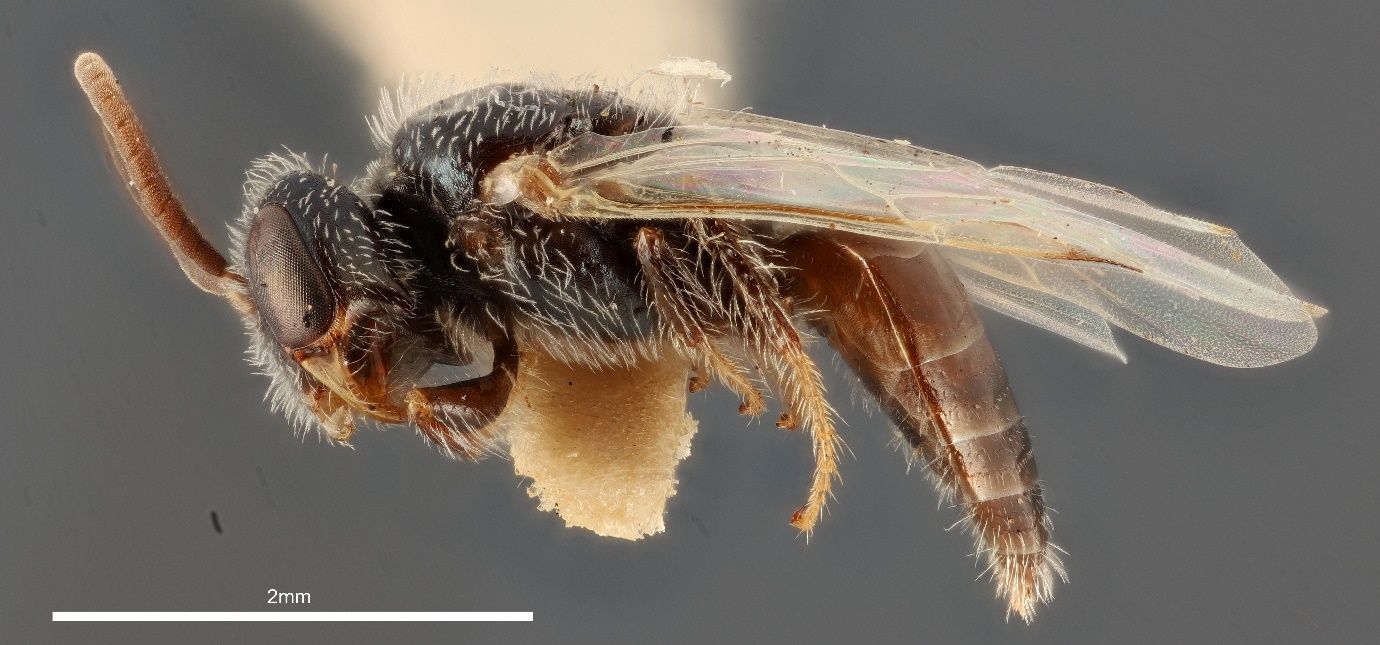
Credit: J. Bremer, FSCA, used with permission
Range
Single recent observation in Apalachicola National Forest, with another in Bradford County, Florida, in the 1950s. Mitchell 1960 and Timberlake 1947 report this species as found in Mississippi, Alabama, and North Carolina. See DiscoverLife.org’s Perdita mitchelli page.
Flight Period
June
Nesting Behavior
Undescribed. Assumed to be ground-nesting based on congeners. Nesting habit varies across the genus, including solitary, gregarious, and communal nesting habits.
Floral Records
Ceanothus spp. (Rhamnaceae), Cyrilla spp. (Cyrillaceae), and Oxydendrum arboreum (L.) DC. (Ericaceae)
References
Mitchell 1960; Pascarella and Hall 2006.
Also See
Explorer.NatureServe.org’s Perdita mitchelli page
Perdita townesi (Timberlake 1968), Andrenidae
Common Name(s)
No common name
Reason(s) for Concern
rare
Description
5 mm–6 mm (~1/8 in–1/4 in) long. Covered in sparse white hairs. Head and thorax dark green, face with yellow markings. Wings whitish with pale brown veins. Abdomen black with yellow bands that may be broken into two spots. Full description in Timberlake 1968.
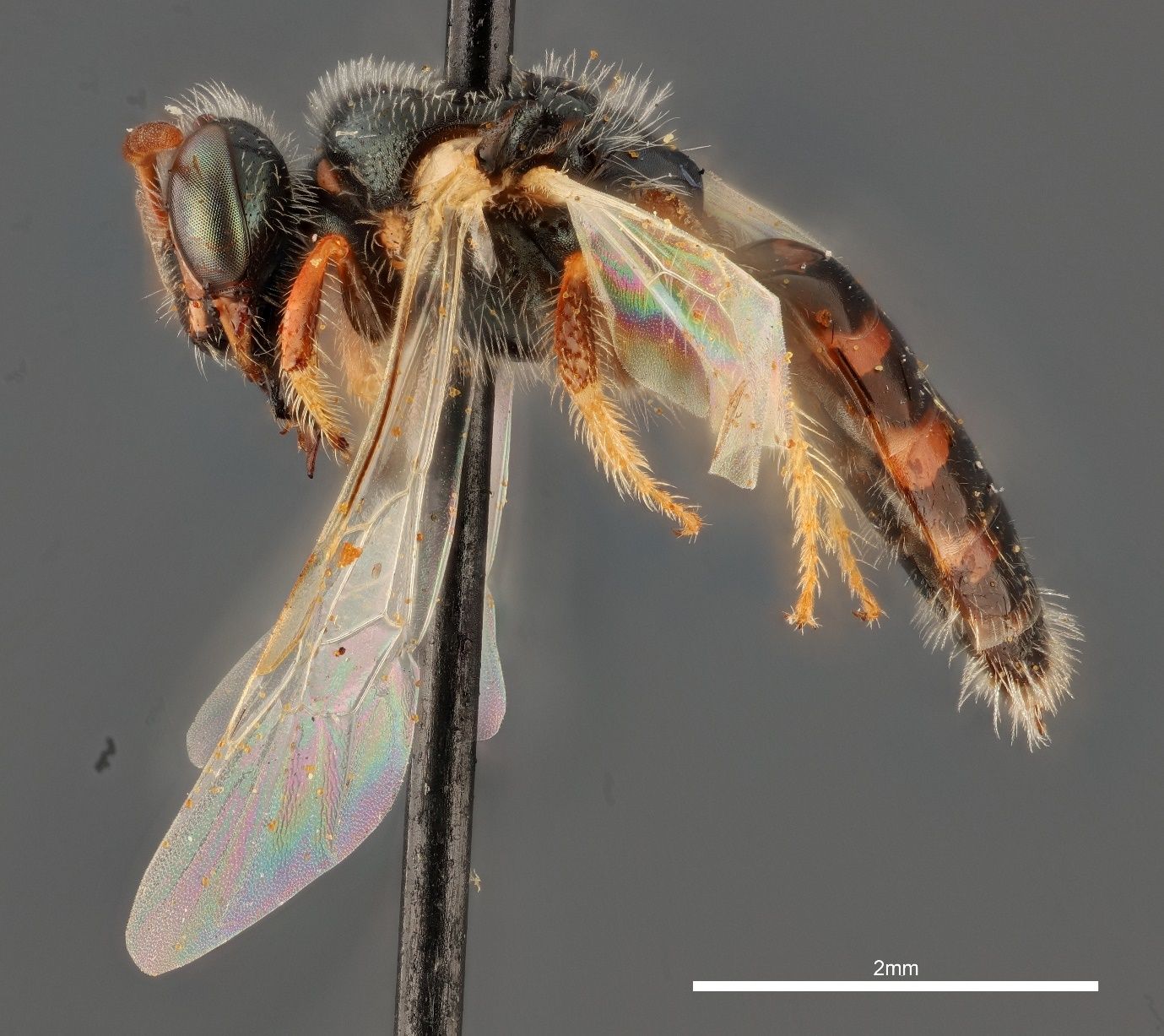
Credit: J. Bremer, FSCA, used with permission
Range
Scattered occurrences across central Florida, as well as in Georgia and South Carolina. See DiscoverLife.org’s Perdita townesi page.
Flight Period
March to May
Nesting Behavior
Undescribed. Assumed to be ground-nesting based on congeners. Nesting habit varies across the genus, including solitary, gregarious, and communal nesting habits.
Floral Records
Ilex spp. (Aquifoliaceae), Nyssa sylvatica Marsh. (Nyssaceae), Ceanothus microphyllus Michx. (Rhamnaceae), Diospyros virginiana L. (Ebenaceae), and Vaccinium spp. (Ericaceae)
Notes
Most recent observation was in the 1970s. Females are difficult to distinguish from P. bradleyi.
References
Timberlake 1968; Pascarella and Hall 2006.
Also See
Explorer.NatureServe.org’s Perdita townesi page
Stelis ater (Mitchell 1962), Megachilidae
Common Name(s)
southwest Florida Stelis bee, Florida black dark bee
Reason(s) for Concern
limited range/endemic, rare
Description
10 mm (3/8 in) long. Covered in sparse white hairs. Entirely black. Wings dark with black veins. First description in Mitchell 1962. Males first recorded in Hall and Ascher 2010.
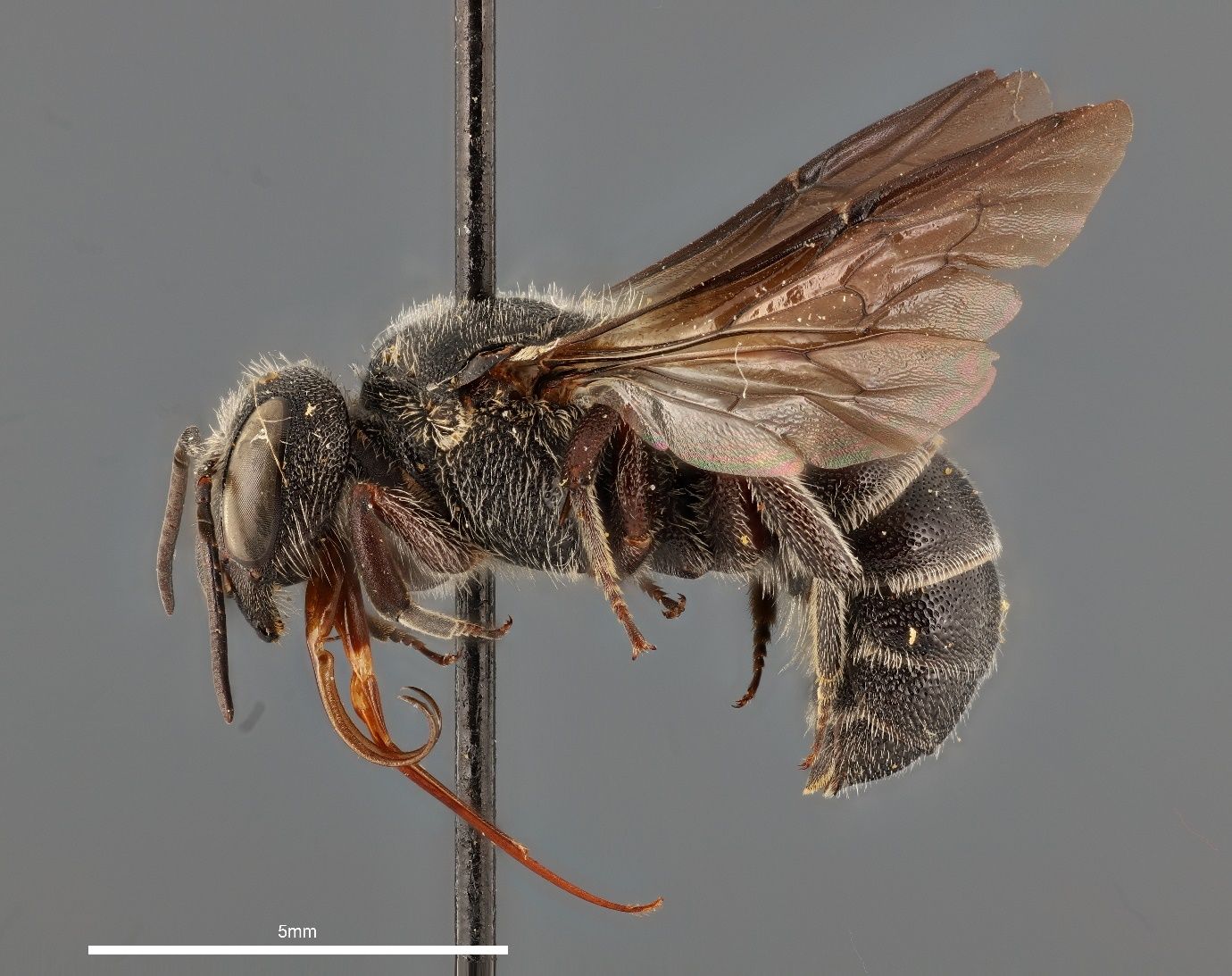
Credit: J. Bremer, FSCA, used with permission
Range
Scattered across central Florida. See DiscoverLife.org’s Stelis ater page.
Flight Period
January to April
Nesting Behavior
Cleptoparasite of Osmia chalybea (Smith 1853)
Floral Records
Circium spp. (Asteraceae), which are also floral hosts of O. chalybea
References:
Hall and Ascher 2010; Mitchell 1962; Pascarella and Hall 2006; Rozen and Hall 2011.
Also See:
Explorer.NatureServe.org’s Stelis ater page
Trachusa crassipes (Cresson 1878), Megachilidae
Common Name(s)
No common name
Reason(s) for Concern
rare
Description
About 10 mm (3/8 in) long. Nearly hairless except for whitish hairs on the face. Black. Many yellow markings across the body. Wings light brown with black veins. Abdominal scopa white. Full description in Mitchell 1962 as Heteranthidium crassipes.
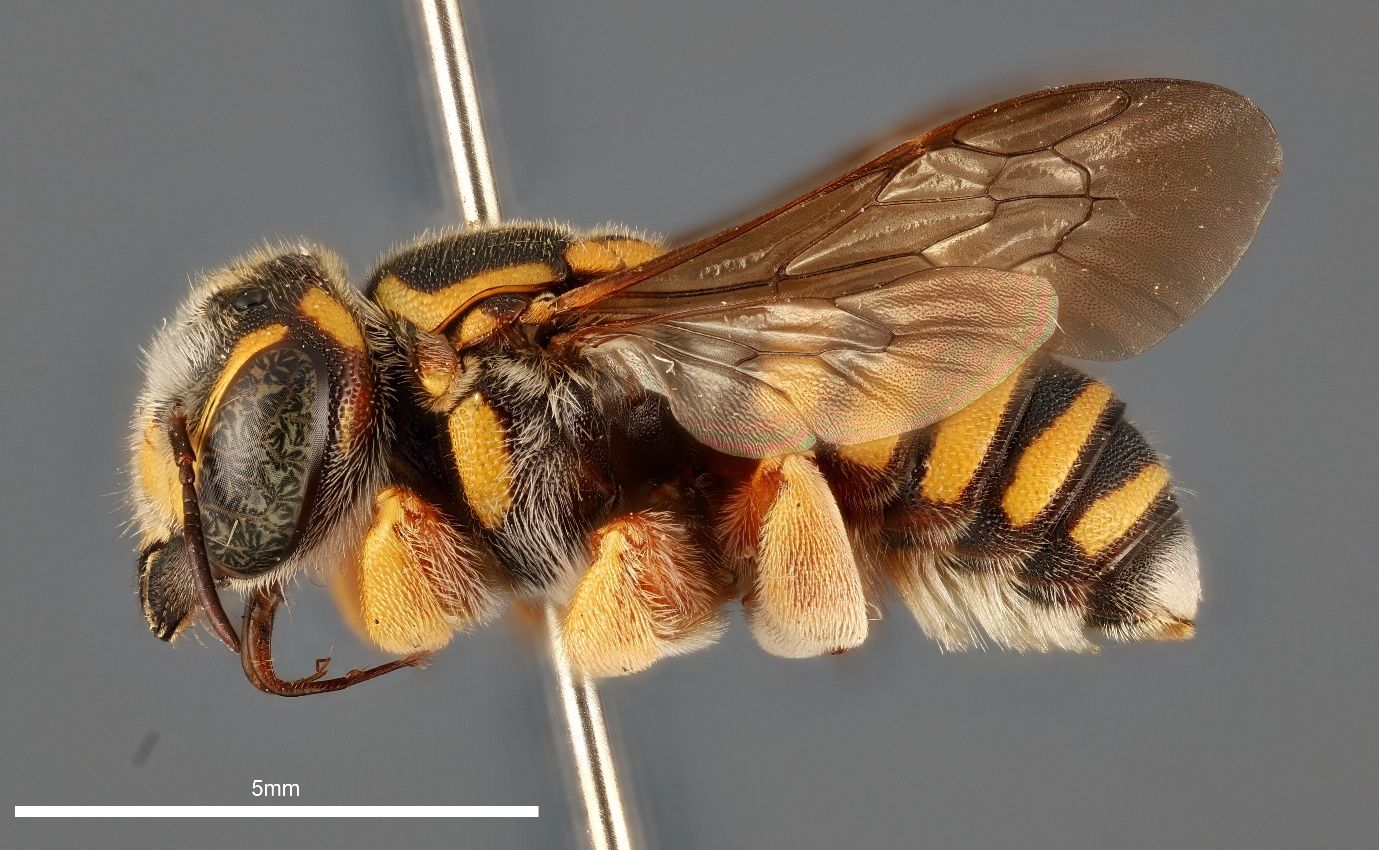
Credit: J. Bremer, FSCA, used with permission
Range
Observations in northern Florida, Alabama, and Mississippi. See DiscoverLife.org’s Trachusa crassipes page.
Flight Period
June to October
Nesting Behavior
Undescribed. Assumed to be a solitary, ground-nesting species based on congeners. Several other Trachusa spp. nest in soil.
Floral Records
Galactia spp. (Fabaceae)
Notes
One of three Trachusa spp. found in the southeastern United States. Differentiated geographically from T. dorsalis. Distinguished from T. fontemvitae by size.
References
Brooks and Griswold 1988; Mitchell 1962; Pascarella and Hall 2006.
Also See
Explorer.NatureServe.org’s Trachusa crassipes page
Triepeolus monardae (Mitchell 1962), Apidae
Common Name(s)
large monarda cuckoo bee
Reason(s) for Concern
rare
Description
15 mm–18 mm (~1/2 in–3/4 in) long. Black with short dense yellow hairs across the thorax and in bands across the abdomen. Full description in Rightmyer 2008.
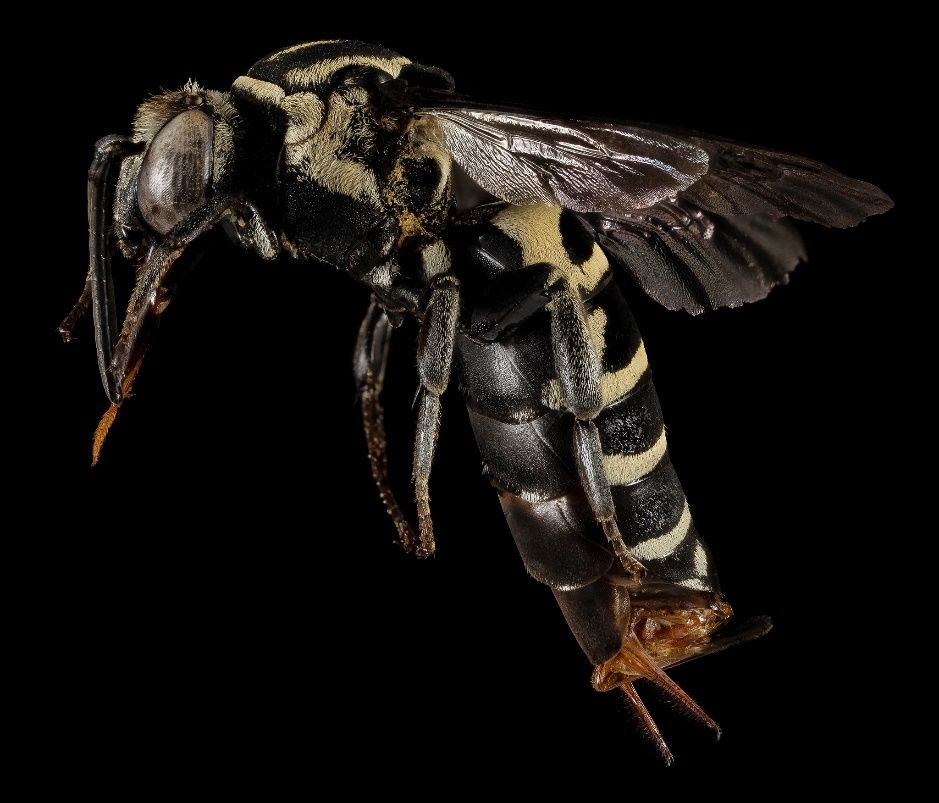
Credit: USGS BMIL, Triepeolus monardae, F, Side, GA, Baker County, used under Public Domain
Range
Occurrences in Florida, Georgia, and North Carolina. See DiscoverLife.org’s Triepeolus monardae page.
Flight Period
August and September
Nesting Behavior
Undescribed. Triepeolus spp. are cleptoparsitic with hosts across several bee families, though most are cleptoparasites of Eucerini. The host species for T. monardae is unknown.
Floral Records
Monarda punctata L. (Lamiaceae), Solidago bicolor L. (Asteraceae)
References
Michener 2007 and Rightmyer 2008.
Also See
Explorer.NatureServe.org’s Triepeolus monardae page
Triepeolus rugosus (Mitchell 1962), Apidae
Common Name(s)
punctate central Florida cuckoo bee
Reason(s) for Concern
rare
Description
8.5 mm–10 mm (1/3 in–3/8 in) long. Black. Thorax covered in short, dense white-gray hairs. Abdomen with similar short, dense, white-gray hairs in bands. Full description in Rightmyer 2008.
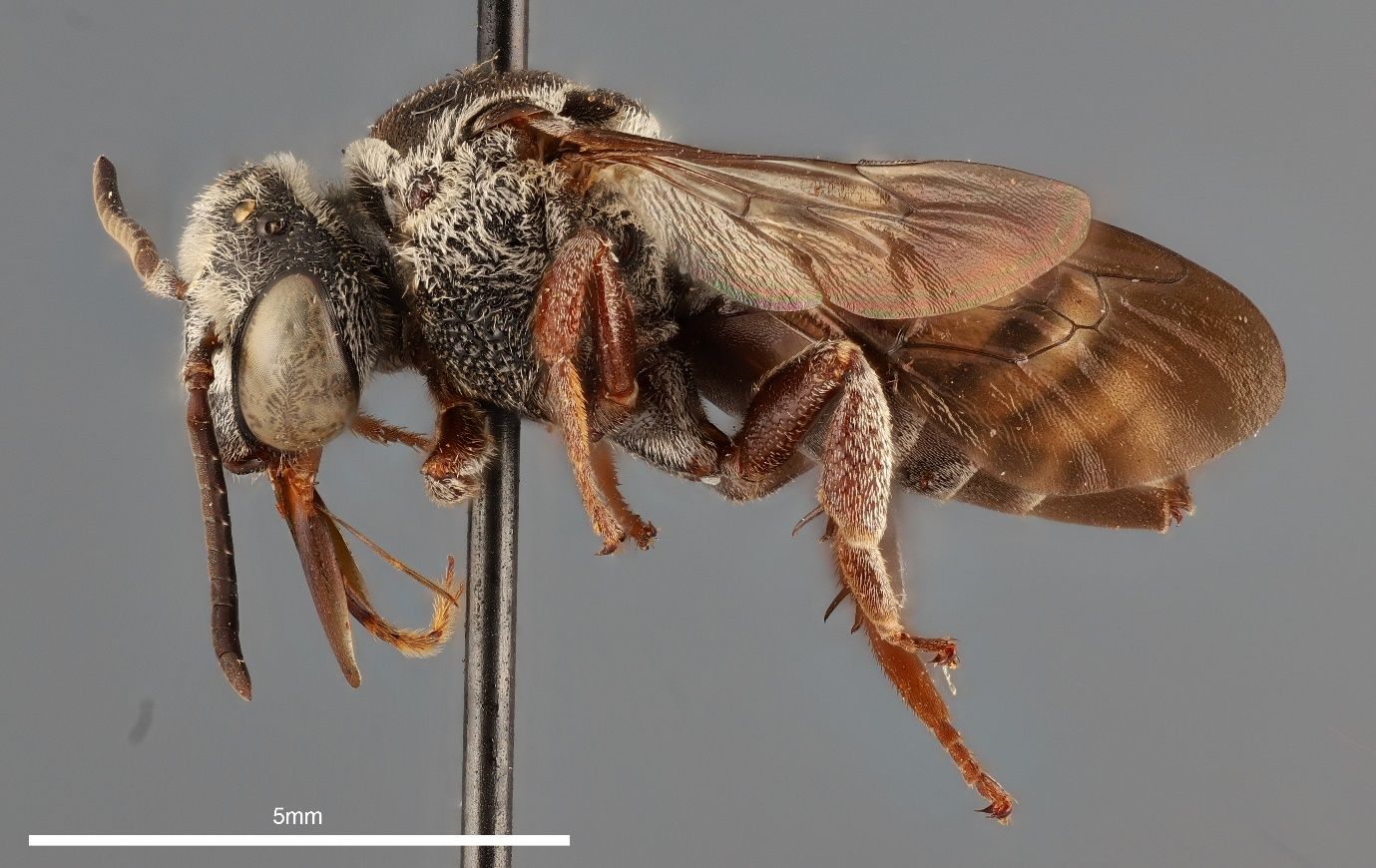
Credit: J. Bremer, Florida State Collection of Arthropods, used with permission
Range
Several occurrences throughout central Florida and in New Jersey. See DiscoverLife.org’s Triepeolus rugosus page.
Flight Period
March to July
Nesting Behavior
Undescribed. Triepeolus spp. are cleptoparsitic with hosts across several bee families, though most are cleptoparasites of Eucerini. The host species for T. rugosus is unknown.
Floral Records
Pontederia spp. (Pontederiaceae)
References
Michener 2007; Pascarella and Hall, 2006; Rightmyer 2008.
Also See
Explorer.NatureServe.org’s Triepeolus rugosus page
Species Pages on DiscoverLife and NatureServe
Ashmeadiella floridana (Robertson 1897), Megachilidae
https://www.discoverlife.org/mp/20q?search=Ashmeadiella+floridana
https://explorer.natureserve.org/Taxon/ELEMENT_GLOBAL.23.30729/Ashmeadiella_floridana
Bombus fraternus (Smith 1854), Apidae
https://www.discoverlife.org/20/q?search=Bombus+fraternus
https://explorer.natureserve.org/Taxon/ELEMENT_GLOBAL.2.832125/Bombus_fraternus
Bombus pensylvanicus (De Geer 1773), Apidae
https://www.discoverlife.org/20/q?search=Bombus+pensylvanicus
https://explorer.natureserve.org/Taxon/ELEMENT_GLOBAL.2.744953/Bombus_pensylvanicus
Bombus variabilis (Cresson 1872), Apidae
https://www.discoverlife.org/mp/20q?search=Bombus+variabilis
https://explorer.natureserve.org/Taxon/ELEMENT_GLOBAL.2.819626/Bombus_variabilis
Caupolicana electa (Cresson 1878), Colletidae
https://www.discoverlife.org/mp/20q?search=Caupolicana+electa
https://explorer.natureserve.org/Taxon/ELEMENT_GLOBAL.23.30719/Caupolicana_electa
Caupolicana floridana (Michener and Deyrup 2004), Colletidae
https://www.discoverlife.org/mp/20q?search=Caupolicana+floridana
https://explorer.natureserve.org/Taxon/ELEMENT_GLOBAL.23.30723/Caupolicana_floridana
Centris errans (Fox 1899), Apidae
https://www.discoverlife.org/mp/20q?search=Centris+errans
https://explorer.natureserve.org/Taxon/ELEMENT_GLOBAL.23.30748/Centris_errans
Colletes francesae (M. A. Deyrup and L. D. Deyrup 2011), Colletidae
https://www.discoverlife.org/20/q?search=Colletes+francesae
https://explorer.natureserve.org/Taxon/ELEMENT_GLOBAL.23.31227/Colletes_francesae
Colletes longifacies (Stephen 1954), Colletidae
https://www.discoverlife.org/mp/20q?search=Colletes+longifacies
https://explorer.natureserve.org/Taxon/ELEMENT_GLOBAL.23.30713/Colletes_longifacies
Colletes titusensis (Mitchell 1951), Colletidae
https://www.discoverlife.org/mp/20q?search=Colletes+titusensis&flags=subgenus:
https://explorer.natureserve.org/Taxon/ELEMENT_GLOBAL.23.30716/Colletes_titusensis
Hesperapis oraria (Snelling and Stage 1997), Melittidae
https://www.discoverlife.org/20/q?search=Hesperapis+oraria
https://explorer.natureserve.org/Taxon/ELEMENT_GLOBAL.23.30424/Hesperapis_oraria
Hylaeus formosus (Krombein 1953), Colletidae
https://www.discoverlife.org/mp/20q?search=Hylaeus+formosus
https://explorer.natureserve.org/Taxon/ELEMENT_GLOBAL.23.30707/Hylaeus_formosus
Lasioglossum flaveriae (Mitchell 1960), Halictidae
https://www.discoverlife.org/mp/20q?search=Lasioglossum+flaveriae&guide=Lasioglossum
https://explorer.natureserve.org/Taxon/ELEMENT_GLOBAL.23.30669/Lasioglossum_flaveriae
Lasioglossum surianae (Mitchell 1960), Halictidae
https://www.discoverlife.org/20/q?search=Lasioglossum+surianae
https://explorer.natureserve.org/Taxon/ELEMENT_GLOBAL.23.30738/Lasioglossum_surianae
Osmia calaminthae (Rightmyer, Ascher, and Griswold 2011), Megachilidae
https://www.discoverlife.org/20/q?search=Osmia+calaminthae
https://explorer.natureserve.org/Taxon/ELEMENT_GLOBAL.2.872575/Osmia_calaminthae
Perdita blatchleyi (Timberlake 1952), Andrenidae
https://www.discoverlife.org/20/q?search=Perdita+blatchleyi
https://explorer.natureserve.org/Taxon/ELEMENT_GLOBAL.23.30726/Perdita_blatchleyi
Perdita graenicheri (Timberlake 1947), Andrenidae
https://www.discoverlife.org/mp/20q?search=Perdita+graenicheri&guide=Perdita_female&flags=subgenus:
https://explorer.natureserve.org/Taxon/ELEMENT_GLOBAL.23.31249/Perdita_graenicheri
Perdita mitchelli (Timberlake 1947), Andrenidae
https://www.discoverlife.org/mp/20q?search=Perdita+mitchelli
https://explorer.natureserve.org/Taxon/ELEMENT_GLOBAL.2.902541/Perdita_mitchelli
Perdita townesi (Timberlake 1968), Andrenidae
https://www.discoverlife.org/mp/20q?search=Perdita+townesi&flags=subgenus:
https://explorer.natureserve.org/Taxon/ELEMENT_GLOBAL.2.902542/Perdita_townesi
Stelis ater (Mitchell 1962), Megachilidae
https://www.discoverlife.org/mp/20q?search=Stelis+ater
https://explorer.natureserve.org/Taxon/ELEMENT_GLOBAL.23.30732/Stelis_ater
Trachusa crassipes (Cresson 1878), Megachilidae
https://www.discoverlife.org/mp/20q?search=Trachusa+crassipes
https://explorer.natureserve.org/Taxon/ELEMENT_GLOBAL.2.902544/Trachusa_crassipes
Triepeolus monardae (Mitchell 1962), Apidae
https://www.discoverlife.org/mp/20q?search=Triepeolus+monardae&guide=Triepeolus_female
https://explorer.natureserve.org/Taxon/ELEMENT_GLOBAL.2.902543/Triepeolus_monardae
Triepeolus rugosus (Mitchell 1962), Apidae
https://www.discoverlife.org/mp/20q?search=Triepeolus+rugosus
https://explorer.natureserve.org/Taxon/ELEMENT_GLOBAL.23.30744/Triepeolus_rugosus
References
Ascher, J. S., and J. Pickering. 2020. “Discover Life Bee Species Guide and World Checklist (Hymenoptera: Apoidea: Anthophila).” http://www.discoverlife.org/mp/20q?guide=Apoidea_species&flags=HAS
Bartomeus, I., J. S. Ascher, J. Gibbs, et al. 2013. “Historical Changes in Northeastern US Bee Pollinators Related to Shared Ecological Traits.” Proceedings of the National Academy of Sciences 110 (12): 4656–4660. https://doi.org/10.1073/pnas.1218503110
Brokaw, J., Z. M. Portman, B. Bruninga‐Socolar, and D. P. Cariveau. 2023. “Prescribed Fire Increases the Number of Ground‐Nesting Bee Nests in Tallgrass Prairie Remnants.” Insect Conservation and Diversity 16 (3): 355–367. https://doi.org/10.1111/icad.12628
Brooks, R. W., and T. L. Griswold. 1988. “A Key to the Species of Trachusa Subgenus Heteranthidium with Descriptions of New Species from México (Hymenoptera: Megachilidae; Anthidiini).” Journal of the Kansas Entomological Society 332–346.
Burns, K. L., M. A. Deyrup, and E. S. Menges. 2019. “The Blue Calamintha Bee.” Florida Scientist 82 (2/3): 73–81. https://www.jstor.org/stable/26826908
Cane, J. H. 1989. “Nesting Biology Notes for Perdita (Alloperdita) bradleyi Viereck (Hymenoptera: Andrenidae).” Journal of the Kansas Entomological Society 140–143.
Cane, J. H., T. Griswold, and F. D. Parker. 2007. “Substrates and Materials Used for Nesting by North American Osmia Bees (Hymenoptera: Apiformes: Megachilidae).” Annals of the Entomological Society of America 100 (3): 350–358. https://doi.org/10.1603/0013-8746(2007)100[350:SAMUFN]2.0.CO;2
Cane, J. H., R. R. Snelling, and L. J. Kervin. 1996. “A New Monolectic Coastal Bee, Hesperapis oraria Snelling and Stage (Hymenoptera: Melittidae), with a Review of Desert and Neotropical Disjunctives in the Southeastern US.” Journal of the Kansas Entomological Society 238–247.
Colla, S. R., L. Richardson, and P. Williams. 2011. “Bumblebees of the Eastern United States.” FS-972. USDA Forest Service and the Pollinator Partnership. 103 pp.
Coville, R. E., G. W. Frankie, and S. B. Vinson. 1983. “Nests of Centris segregata (Hymenoptera: Anthophoridae) with a Review of the Nesting Habits of the Genus.” Journal of the Kansas Entomological Society 109–122.
Cuminale, A. 2023. “Evaluating the Effects of Soil Tillage on Ground Nesting Bees in the Southeastern United States” (Master’s thesis, Auburn University). Auburn University Electronic Theses and Dissertations. https://etd.auburn.edu//handle/10415/9060
Davis, H. K., D. L. Miller, and M. Thetford. 2020. “Habitat Suitability of an At-Risk, Monolectic, Ground-Nesting Bee Hesperapis oraria and Its Floral Host Balduina angustifolia at Two Spatial Scales along the Northern Gulf of Mexico.” Journal of Insect Conservation 24 (3): 561–573. https://doi.org/10.1007/s10841-020-00236-0
Deyrup, M., J. Edirisinghe, and B. Norden. 2002. “The Diversity and Floral Hosts of Bees at the Archbold Biological Station, Florida (Hymenoptera: Apoidea).” Insecta Mundi 544. https://digitalcommons.unl.edu/insectamundi/544
Deyrup, M. A., and L. D. Deyrup. 2011. “Colletes francesae, a New Species of Colletid Bee (Hymenoptera: Colletidae) Associated with Sideroxylon tenax (Sapotaceae) in Florida Scrub Habitat.” Florida Entomologist 94 (4): 897–901. https://doi.org/10.1653/024.094.0425
Diniz‐Filho, J. A. F., P. De Marco Jr, and B. A. Hawkins. 2010. “Defying the Curse of Ignorance: Perspectives in Insect Macroecology and Conservation Biogeography.” Insect Conservation and Diversity 3 (3): 172–179. https://doi.org/10.1111/j.1752-4598.2010.00091.x
Florida Fish and Wildlife Conservation Commisison (FWC). 2019. Florida's Wildlife Legacy Initiative: Florida's State Wildlife Action Plan. Tallahassee, Florida.
Garibaldi, L. A., I. Steffan-Dewenter, C. Kremen, et al. 2011. “Stability of Pollination Services Decreases with Isolation from Natural Areas Despite Honey Bee Visits.” Ecology Letters 14 (10): 1062–1072. https://doi.org/10.1111/j.1461-0248.2011.01669.x
Garibaldi, L. A., I. Steffan-Dewenter, R. Winfree, et al. 2013. “Wild Pollinators Enhance Fruit Set of Crops Regardless of Honey Bee Abundance.” Science 339 (6127): 1608–1611. https://doi.org/10.1126/science.1230200
Genaro, J. A. 2016. “Especies nuevas y nuevos registros de abejas para las Antillas (Hymenoptera: Anthophila; Colletidae, Halictidae).” Novitates Caribaea (10): 38–51. https://doi.org/10.33800/nc.v0i10.28
Gibbs, J. 2009. “Integrative Taxonomy Identifies New (and Old) Species in the Lasioglossum (Dialictus) tegulare (Robertson) Species Group (Hymenoptera, Halictidae).” Zootaxa 2032 (1): 1–38. https://doi.org/10.11646/zootaxa.2032.1.1
Gibbs, J. 2011. “Revision of the Metallic Lasioglossum (Dialictus) of Eastern North America (Hymenoptera: Halictidae: Halictini).” Zootaxa 3073 (1): 1. https://doi.org/10.11646/zootaxa.3073.1.1
Grixti, J. C., L. T. Wong, S. A. Cameron, and C. Favret. 2009. “Decline of Bumble Bees (Bombus) in the North American Midwest.” Biological Conservation 142 (1): 75–84. https://doi.org/10.1016/j.biocon.2008.09.027
Hall, H. G., D. T. Almquist, and J. S. Ascher. 2016. “A New Species of Colletes (Hymenoptera: Apoidea: Colletidae) from Northern Florida and Georgia, with Notes on the Colletes of Those States.” Journal of Melittology (58) 1. https://doi.org/10.17161/jom.v0i58.4993
Hall, H. G., and J. S. Ascher. 2010. “Surveys of Bees (Hymenoptera: Apoidea: Anthophila) in Natural Areas of Alachua County in North-Central Florida.” Florida Entomologist 93 (4)” 609–629, 621. https:/doi.org/10.1653/024.093.0419
Hall, H. G., and J. S. Ascher. 2014. “The Distinctive Bee Fauna (Hymenoptera: Apoidea: Anthophila) of Sandhill Habitat at the Ordway-Swisher Biological Station in North-Central Florida.” Journal of the Kansas Entomological Society 87 (1): 1–21, 21. https:/doi.org/10.2317/JKES130224.1
Michener, C. D. 1966. “The Classification of the Diphaglossinae and North American Species of the Genus Caupolicana (Hymenoptera, Colletidae).” University of Kansas Science Bulletin 44 (20): 717–751. https://doi.org/10.5962/bhl.part.20080
Michener, C. D. 2007. The Bees of the World. Second edition. The Johns Hopkins University Press, Baltimore, Maryland.
Michener, C. D., and M. Deyrup. 2004. “Caupolicana from Florida (Hymenoptera: Colletidae).” Journal of the Kansas Entomological Society 77 (4): 774–782. https://doi.org/10.2317/E2.1
Mitchell, T. B. 1960. Bees of the Eastern United States. Vol. I. North Carolina, Agricultural Experiment Station Technical Bulletin 141. 538 pp.
Mitchell, T. B. 1962. Bees of the Eastern United States. Vol. II. North Carolina, Agricultural Experiment Station Technical Bulletin 152. 557 pp.
Murray, E. A., L. Evanhoe, S. Bossert, M. A. Geber, T. Griswold, and S. M. McCoshum. 2021. “Phylogeny, Phenology, and Foraging Breadth of Ashmeadiella (Hymenoptera: Megachilidae).” Insect Systematics and Diversity 5 (3). https://doi.org/10.1093/isd/ixab010
Norden, B., K. Krombein, and B. Danforth. 1992. “Taxonomic and Bionomic Observations on a Floridian Panurgine Bee, Perdita (Hexaperdita) graenicheri Timberlake (Hymenoptera: Andrenidae).” Journal of Hymenoptera Research 1 (1): 107–118.
Ollerton, J., R. Winfree, and S. Tarrant. 2011. “How many flowering plants are pollinated by animals?” Oikos 120 (3): 321–326. https://doi.org/10.1111/j.1600-0706.2010.18644.x
Owens, B. E., L. Allain, E. C. V. Gorder, J. L. Bossart, and C. E. Carlton. 2018. “The Bees (Hymenoptera: Apoidea) of Louisiana: An Updated, Annotated Checklist.” Proceedings of the Entomological Society of Washington 120 (2): 272. https://doi.org/10.4289/0013-8797.120.2.272
Pascarella, J. B., and H. Glenn Hall. 2006. “The Bees of Florida.” University of Florida Agricultural Experiment Station. Retrieved 3/2/2022 from https://entnemdept.ufl.edu/hallg/melitto/intro.htm
Pascarella, J. B., K. D. Waddington, and P. R. Neal. 1999. “The Bee Fauna (Hymenoptera: Apoidea) of Everglades National Park, Florida, and Adjacent Areas: Distribution, Phenology, and Biogeography.” Journal of the Kansas Entomological Society 32–45.
Pemberton, R. W., and H. Liu. 2008a. “Naturalization of the Oil Collecting Bee Centris nitida (Hymenoptera, Apidae, Centrini), a Potential Pollinator of Selected Native, Ornamental, and Invasive Plants in Florida.” Florida Entomologist 91 (1): 101–109. https://doi.org/10.1653/0015-4040(2008)091[0101:NOTOCB]2.0.CO;2
Pemberton, R. W., and H. Liu. 2008b. “Potential of Invasive and Native Solitary Specialist Bee Pollinators to Help Restore the Rare Cowhorn Orchid (Cyrtopodium punctatum) in Florida.” Biological Conservation 141 (7): 1758–1764. https://doi.org/10.1016/j.biocon.2008.04.016
Rightmyer, M. G. 2008. “A Review of the Cleptoparasitic Bee Genus Triepeolus (Hymenoptera: Apidae). Part I.” Zootaxa 1710 (1): 115. https://doi.org/10.11646/zootaxa.1710.1.1
Rightmyer, M. G., M. Deyrup, J. S. Ascher, and T. Griswold. 2011. “Osmia Species (Hymenoptera, Megachilidae) from the Southeastern United States with Modified Facial Hairs: Taxonomy, Host Plants, and Conservation Status.” ZooKeys (148):257–278. https://doi.org/10.3897/zookeys.148.1497
Rozen, J. G., and H. G. Hall. 2011. “Nesting and Developmental Biology of the Cleptoparasitic Bee Stelis ater (Anthidiini) and Its Host, Osmia chalybea (Osmiini) (Hymenoptera: Megachilidae).” American Museum Novitates 2011 (3707): 1–38, 38. https://doi.org/10.1206/3707.2
Srinivasan, N. 2020. “Florida’s Rare Blue Bee Rediscovered at Lake Wales Ridge.” In: Florida Museum of Natural History. Retrieved from https://www.floridamuseum.ufl.edu/science/floridas-rare-blue-calamintha-bee-rediscovered/
Timberlake, P. H. 1968. “A Revisional Study of the Bees of the Genus Perdita F. Smith, with Special Reference to the Fauna of the Pacific Coast (Hymenoptera, Apoidea) Part Vll (Including Index to Parts l to Vll).” University of California Publications in Entomology 49:1.
Tylianakis, J. M. 2013. “The Global Plight of Pollinators.” Science 339 (6127): 1532–1533. https://doi.org/10.1126/science.1235464
van Hoose, N. 2021a. “Scientists Discover Nest, New Northern Range of Florida’s Rare Blue Calamintha Bee.” In: Florida Museum of Natural History. Retrieved from https://www.floridamuseum.ufl.edu/science/discover-nest-northern-range-blue-calamintha-bee/
van Hoose, N. 2021b. “Have you seen these big, hairy bees? Scientists tracking two rare species in Florida, Georgia.” In: Florida Museum of Natural History. Retrieved from https://www.floridamuseum.ufl.edu/science/help-track-plasterer-bees/
Williams, P. H., R. W. Thorp, L. L. Richardson, and S. R. Colla. 2014. Bumble Bees of North America: An Identification Guide. Princeton University Press.
Wilson, J. S., M. L. Forister, and O. M. Carril. 2017. “Interest Exceeds Understanding in Public Support of Bee Conservation.” Frontiers in Ecology and the Environment 15 (8): 460–466. https://doi.org/10.1002/fee.1531