
This publication is intended for Florida homeowners and landscape maintenance professionals to help them successfully establish lawns. The two primary methods of establishing turfgrass are seed and vegetative propagation. Vegetative propagation includes sodding, sprigging, and plugging. Although propagating vegetatively is labor-intensive, all warm-season grasses can be planted by this method. Seeding is usually the easiest and most economical method of planting grasses. However, not all warm-season grasses can establish from seed, and seed establishment requires a longer period to develop complete grass cover. Table 1 shows the establishment methods for the turfgrasses grown in Florida lawns.
Table 1. Establishment methods for turfgrasses grown in Florida lawns.
Regardless of the planting method, properly preparing the soil before planting is essential. A healthy, attractive, long-lived lawn can be established only if you select high quality planting material and select turfgrasses that are well-adapted to the soil and climate. Refer to EDIS publication ENH-02, “Preparing to Plant a Florida Lawn,” for instructions on site preparation and grass planting.
Seeding
Seeding is the easiest and most economical way to establish a lawn. However, success depends on seed quality, proper seeding time, rate, and method of seeding. Table 2 shows recommended seeding rates for the turfgrass species that can be planted by seed. Additionally, many of the cultivars derived from seed do not possess the quality of vegetatively propagated cultivars due to their genetic limitations.
Seed Quality
To successfully establish a lawn from seed, good-quality seed must be used. Federal and state laws require that each container of seed have a tag listing turfgrass species and cultivar, purity, percent germination, and weed seed content. Purity tells the amounts (as percentages) of desired seed, any other seed, and inert matter. Percent germination tells the amount of seed expected to germinate under optimum conditions. The quantity of weed seeds is also listed. Read the tag thoroughly to be sure you are purchasing good-quality seed. Try to purchase seed that has a purity of 90% or higher and a germination of 85% or higher. Always select the best quality seed of the cultivar you wish to plant. Seed with poor germination (<50%) and poor purity (<80%) are sometimes used to save money but usually result in poor establishment and subsequent weed invasion. Seed sold in retail stores often contain high percentages of cool-season turfgrass (e.g., ryegrass, fescue) blended with desirable warm-season species. The cool-season grasses will germinate quickly but will also die quickly in Florida’s warm climate.
Seeding Time and Rate
Year-round planting is commonplace in most parts of Florida, and good-quality lawns can be produced. However, the best time to seed warm-season grass is often during the spring and summer months when grass grows the quickest. In many parts of Florida, this timing allows the grass to establish before cold weather.
In south Florida, year-round planting may produce a good-quality lawn. In north Florida, planting young seedling grasses too late in the fall may result in winter-kill.
Seeding rates vary with species and cultivar of grass. The seeding rates in Table 2 will give adequate coverage and produce a mature lawn with good post-planting care. Rates vary from 0.25 pounds per 1,000 square feet for centipedegrass, which has a very small seed, to 10 pounds per 1,000 square feet for bahiagrass, which has a large seed. Seeding rates can be reduced, but the trade-off is a more open turf area subject to weed invasion and soil erosion.
Table 2. Seeding rates for Florida turfgrasses.
Seeding methods range from planting by hand to the use of mechanical equipment for large turf areas. No matter what method you use, it is important to distribute seeds evenly to keep the lawn uniform. The seedbed should be moist, well-prepared, and leveled. Rake the entire area with a heavy garden rake to produce furrows into which the seeds are planted. For the most uniform application, apply seeds with a drop spreader. For the best distribution of seed, apply one-half the total required seed in back and forth passes in two directions and apply the remainder at right angles to the first direction. When sowing very small seed, like centipedegrass and bermudagrass, apply the seed more easily and uniformly by mixing it with dry sand, topsoil, or another convenient carrier that adds bulk to the spreader.
After sowing, cover the seed lightly by working it into the soil with a rake. Ideally, seed should be topdressed with 1/4–1/2 inch of soil, but this may not be practical for most home lawns. In the absence of topdressing, cover seeds reasonably well by raking. If the seedbed was furrowed before seeding, then raking or dragging with a board will work the seed into the furrows and adequately cover it. Roll the seeded area with a lightweight roller to firm up the soil and to ensure good contact between seed and soil. The area can be mulched with weed-free grass, hay, or straw, so that 50%–75% of the bare ground is covered. Mulching helps conserve soil moisture, moderates soil temperature, and prevents erosion of the topsoil and washing away the seed. As a general rule, one bale of hay will cover approximately 1,000 square feet.
Proper watering is the most critical step in establishing turfgrasses from seed. The soil must be kept moist but not excessively wet until seeds have germinated. Supplying water two or three times a day in small quantities for approximately two weeks should provide adequate moisture for germination. If the surface of the soil dries out at any time after the seeds have begun to swell and before root development, many of the seedlings will die. Improper watering is the most common cause of seeding failure. Initial watering should be from a fine spray, if possible, or from sprinklers with a low precipitation rate. Coarse spray and high-water pressure or high precipitation rates will wash the soil and uncover buried seeds. Avoid overwatering and saturating the soil, which can cause the seeds to float and wash away from the desired location, increasing the incidence of disease that can kill the seedling plants. The frequency of watering should decrease as the seedlings mature and root systems develop, but the volume should increase to water the entire root zone, not just the soil surface. If irrigation water is not available, avoid planting during dry months or times of drought.
Vegetative Planting
Vegetative planting is simply transplanting large or small pieces of grass. Sodding covers the entire site with vegetation. Plugging or sprigging refers to the planting of pieces of sod or individual stems or runners called stolons or rhizomes. Table 3 shows recommended planting rates for each turfgrass species.
Sod
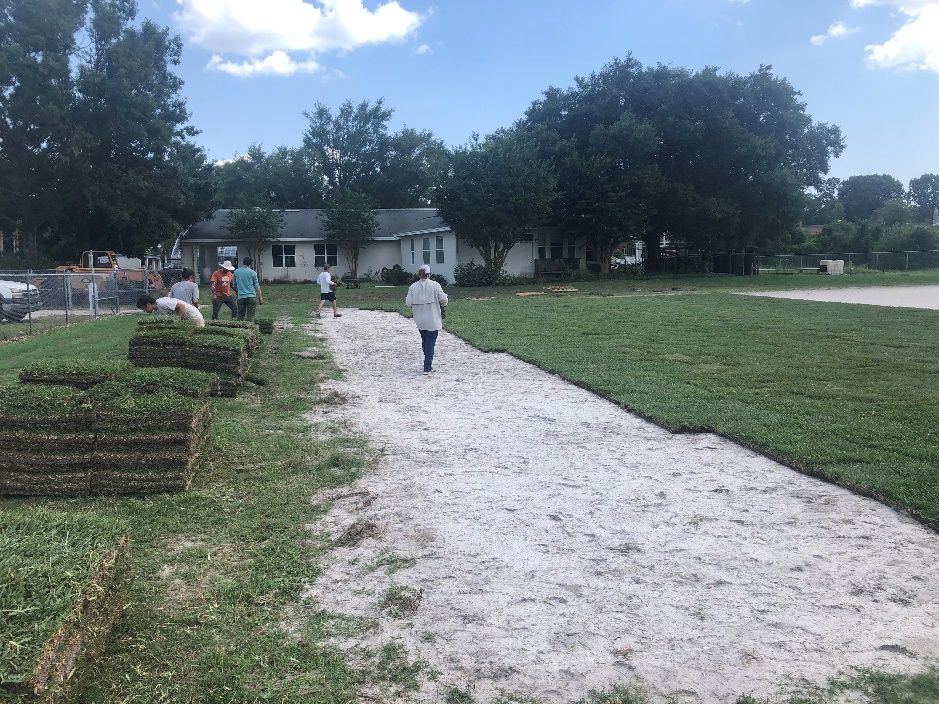
Sodding is more expensive than sprigging or plugging, but it produces an "instant lawn" (Figure 1). However, without proper site preparation and post-installation care, the sod can die almost as easily as any other newly planted area. Upon delivery of sod, inspect it carefully to ensure the absence of visible weeds, insects, or stressed areas. Plant sod as quickly as possible after delivery, but if there are delays, store the sod in a cool, shady place until ready to plant. Sod life on pallets during summer is less than 48 hours. The area to be planted should be properly prepared (e.g., tilled and raked smooth) prior to sod delivery and should be moistened at the time of laying sod. Fit sod pieces together as tightly as possible without stretching them to fit an area. If cracks are evident between pieces, fill them with cut up pieces of sod. Lay the sod in a staggered brick pattern so that the seams are offset between sod pieces. Tamp or roll the sod to remove air pockets and ensure the roots have good contact with the underlying soil so that it does not dry out during establishment.
Credit: A. J. Lindsey, UF/IFAS
Providing irrigation on the correct schedule is important when grass is newly planted. Multiple, short (5–10 minute) irrigations throughout the course of the day for 7–10 days following planting help the grass establish without drying out. For the next 7–10 days, irrigate once a day to apply 1/4–1/2 inch of water. After this, reduce the frequency to two to three times weekly, again applying ¼–½ inch of water. Three to four weeks after sodding, the grass should be fully established, and irrigation can begin on an as-needed basis. For more information, refer to EDIS publication ENH9, “Watering Your Florida Lawn.” Sodding is expensive but recommended where immediate cover is desired for aesthetics or the prevention of soil erosion.
Sprigs
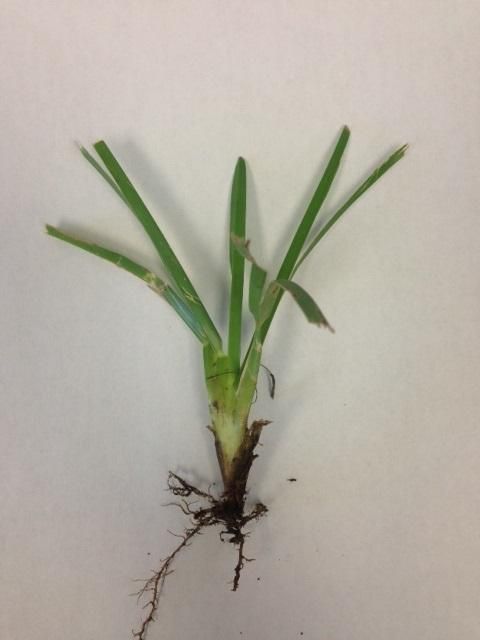
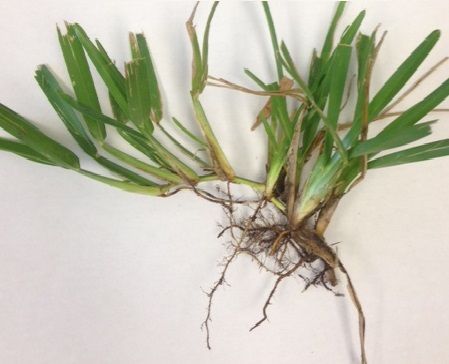
Sprigging is the cheapest vegetative planting method. A sprig is an individual grass stem or piece of stem with at least one node (joint) that has the potential to develop into a grass plant (Figure 2). There is no adhering soil on a sprig. Sprigging is simply the planting of individual grass stems at spaced intervals. A suitable sprig should have two to four nodes from which roots can develop (Figure 3). Sprigs can be bought by the bushel, but more commonly, sod is cut or pulled apart into sprigs.
Credit: L. Trenholm, UF/IFAS
Credit: L. Trenholm, UF/IFAS
There are several methods of planting sprigs. One method is to cut shallow furrows in the prepared planting area by using a push-plow or the edge of a hoe. Place the sprigs end-to-end or every 6–12 inches along the row, cover part of each sprig with soil, and firm the soil by rolling or stepping on the furrow. The closer the sprigs are planted together, the faster the grass will cover the soil. Place rows no more than 6–8 inches apart.
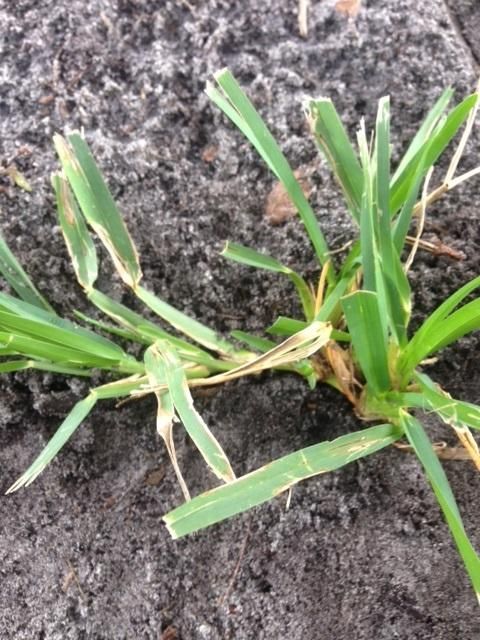
A second method is to place the sprigs on the soil surface at the desired interval end-to-end, about 6 inches apart, and then press one end of the sprig into the soil with a notched stick or blunt piece of metal like a dull shovel. A portion of the sprig should remain aboveground exposed to light (Figure 4). Each sprig should have some leaves, but a node will do if the stolon has no leaves.
Another method of sprigging, which is used where rapid cover is needed, is “stolonizing” or “broadcast sprigging.” The sprigs are prepared by mechanical shredding or by hand tearing sod into individual sprigs or are purchased by the bushel (most common with bermudagrasses). For this method, broadcast the material like a mulch over the area by hand. Cut the sprigs into the soil with a light disk or cover the sprigs with 1/2 inch of soil via topdressing. Then, roll over the soil to ensure good plant-to-soil contact and water the area. This method provides very fast coverage and is often used to plant bermudagrass golf putting greens and fairways.
Regardless of the planting method, tamp or roll each sprig firmly into the soil. This will help keep the sprigs from drying out and dying. As with seeding, keep sprigs moist—not wet—until adequate rooting has occurred. Water lightly once or twice daily for a week or two after planting. Mulching can also be used in vegetative planting for moisture conservation and erosion control.
Credit: L. Trenholm, UF/IFAS
Plugs
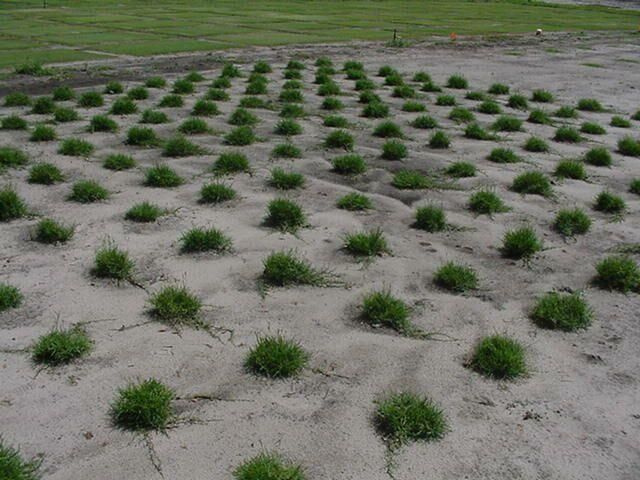
Plugging is the planting of 2-to-4-inch circular or block-shaped pieces of sod with roots at regular intervals (Figure 5). Over time, the stolons (aboveground stems) and/or rhizomes (belowground stems) grow new root and shoot systems that fill in the bare spots between plugs. Several turfgrasses are currently available commercially as plugs in trays. These commercial plugs usually have well-developed root systems and are treated as other plugs described in Table 3.
Credit: L. Trenholm, UF/IFAS
Table 3. Spacing and planting material from sod for vegetative planting (non-broadcast).
Another method is to cut plugs from sod pieces with a shovel, axe, or machete. Then, place the plugs in corresponding-sized holes made in the soil. Plant them on 6-to-12-inch centers. Wider spacing prolongs the establishment phase. Plugs will grow in more slowly than sprigs, but they are less susceptible to desiccation. Mulching will help improve moisture retention and prevent erosion of the soil between the plugs.
Post-Planting Care
As previously mentioned, proper water management after planting is crucial. It is important to keep the planted areas from drying out with light, frequent sprinklings throughout the day. Do not flood the seedbed or apply water in a hard stream, as this can cause seed movement and soil erosion. As the planting material takes root and grows, decrease watering frequency and increase the amount applied each time.
Fertilizing Newly Planted Turf
If a soil test indicates that phosphorus is insufficient, it is important to amend the soil with a phosphorus fertilizer prior to planting. Never apply nitrogen-based fertilizers prior to planting. Newly planted grass, whether it has been established by seed, sprigs, or plugs, has less ability to take up nutrients due to the lack of a deep root system. Research on the fertilization of newly sodded grass indicates that nitrogen can leach through the soil if applied in the first 30–60 days. For seeded, plugged, or sprigged grass, wait until there is a uniform cover (the length of time to achieve this will vary based on time of year, environmental conditions, and location in the state) before fertilizing. For sodded grass, the application of fertilizer should again wait at least 30 days after planting to allow roots to establish to a point where they are able to take up the fertilizer. Most sod has received fertilizer application prior to harvest and will generally have ample levels of needed nutrients in the plant tissue.
Mowing
Begin mowing as soon as the grass roots have pegged down and the grass will no longer "lift" when pulled on at the edges. Use a mower with a sharp blade and do not mow when the grass is wet, if possible. If the clippings are thick enough to shade the grass, catch them or rake and remove them. Otherwise, leave clippings on the ground.
Renovation
Prior to renovating an established lawn, ask these questions:
- Were improper management practices the cause of the need for renovation? If so, then review and adjust these practices to ensure the success of the new lawn.
- Is the existing grass the best choice for the site conditions? If so, will you replace it with the same grass species? If not, what species will replace the existing lawn?
- Is over 50% of the present lawn in need of renovation? Are there adequate time and resources available for renovation and subsequent maintenance?
If an area is to be completely replanted, if over 50% of plants currently present are weeds, or if the turf species is to be changed, the area should be treated with a nonselective herbicide, such as glyphosate. Be sure to follow label directions when applying this or any other pesticide. It will typically require more than one application of glyphosate to completely remove existing vegetation. A second application should be made 14–21 days after the first. If removing bermudagrass, a third application is advisable. Remove as much of the dead vegetative material as possible to provide good soil contact for roots. At this time, conduct a soil test to determine fertilization requirements and/or necessary pH adjustments. Prior to planting, install any required irrigation system. Also, till any soil amendments or organic matter into the soil.