
This publication is a tool to aid sugarcane growers, Extension agents, and the general public in understanding the advantages and disadvantages of manual and mechanical sugarcane planting methods in Florida, particularly in the Everglades Agricultural Area (EAA).
Sugarcane Planting Methods
Sugarcane cultivation has undergone significant evolution over the centuries. From the 18th to the 21st century, animal-drawn furrowing equipment was widely utilized (Ríos and Cárdenas 2003). Despite being less automated than many other major crops, particularly during planting operations, sugarcane farming has witnessed remarkable and rapid advancements in recent years. Private and public entities within the sugarcane industry have collaborated to develop cutting-edge equipment, enhancing planting efficiency, improving machine performance, and creating a higher demand for skilled labor.
Florida is the leading sugarcane-producing state in the United States, and most of this sugarcane is cultivated in the Everglades Agricultural Area (EAA) around Lake Okeechobee. Currently, 95% of the sugarcane area in the EAA is under manual planting (Odero et al. 2022). While local sugarcane growers are moving towards adoption of mechanical planting due to labor shortages, there are several challenges that growers need to be aware of to make informed decisions before switching to mechanical planting.
There are two common methods of sugarcane planting: manual planting and mechanical planting.
Manual Planting
Manual planting is a semi-mechanized process that integrates the use of farm machinery for opening and closing furrows and transporting cane stalks to the planting site, and the use of manual labor for operations such as distributing cane stalks within furrows and subsequently cutting them into billets (seed pieces) with a machete (Odero et al. 2022) (Figure 1). In certain regions worldwide, where soil conditions or terrain pose challenges for the mechanical cultivation of sugarcane fields, the opening and closing of furrows are performed manually, resulting in higher production costs. The individual operations involved in manual planting in Florida are listed below.
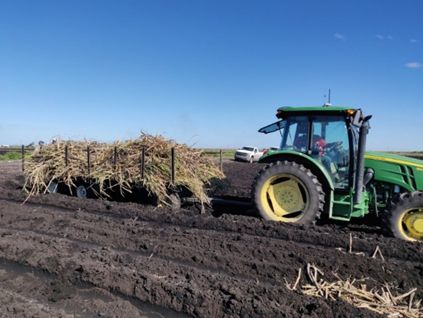
Credit: Hima Varsha Madala, UF/IFAS
- Furrowing: Furrowing is generally accomplished mechanically, following the recommended planting frequency and depth specifications. Nutrients can be applied concurrently with this practice. Modern furrowers are equipped with furrow indicators, which assist operators in maintaining precise furrow dimensions and increasing overall efficiency. The furrow openers vary in size, typically ranging from six to eight furrows wide. The furrow depth is a critical factor, ranging from 15 to 25 centimeters (cm) (6 to 10 inches). In the EAA, the furrow depth is maintained at 8 to 20 cm (3.1 to 8 inches), which are shallow furrow depths (Baucum et al. 2009). For heavy clay soils or under dry conditions, shallower planting depths of around 15 cm (6 inches) are recommended to facilitate germination and seedling emergence. Conversely, in sandy soils or under moist conditions, deeper planting depths of up to 25 cm (10 inches) can be utilized. When planting setts (stem cuttings) with multiple buds, a depth of 15 to 20 cm (6 to 8 inches) is considered suitable. However, for single-bud setts or billet planting, a shallower depth of 10 to 15 cm (4 to 6 inches) is recommended to optimize bud germination and seedling establishment (Nalawade et al. 2018).
- Cutting, loading, and transportation of sugarcane stalks or seed cane: The planting process begins by cutting the sugarcane stalks just above ground level, allowing the stalks to be piled on the ground. Concurrently, the leafy tops are removed from the cane stalks, leaving the elongated stalks suitable for furrow placement. These stalks are then loaded on flatbed wagons for transportation to the planting site. The loading process can be performed either manually or mechanically, utilizing specialized loaders to efficiently hoist the stalks onto the transport vehicles.
- Distribution of seedlings into furrows: This crucial operation, also known as planting, involves strategically distributing cane stalks or seed cane into the prepared furrows. Typically, the stalks are placed in pairs, with an approximate 20% overlap to ensure optimal bud germination and growth. The stalks are positioned in an opposing manner within the furrows, facilitating maximum exposure and development of the buds. This intricate operation is performed manually by skilled workers (Figure 2). Subsequently, these stalks are manually cut into smaller segments called billets (seed cane) using machetes. This cutting process serves two purposes: minimizing apical dominance, which can inhibit bud growth, and promoting the uniform growth of buds at each node along the billet.
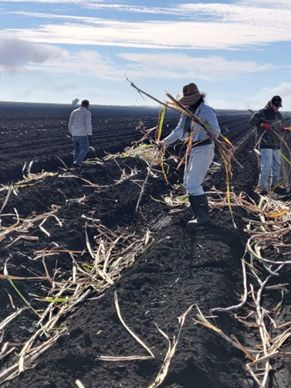
Credit: Hima Varsha Madala, UF/IFAS
4. Covering: The furrows are covered a couple of hours after planting to mitigate moisture loss in the soil and billets due to sun exposure. This operation is performed by a tractor-operated furrow covering rig.
Advantages and Disadvantages of Manual Planting
The manual planting method offers several advantages for sugarcane cultivation in the Florida EAA. Notably, it requires a lower seed cane rate, minimizing input costs (such as costs of seed cane/planting material, fertilizers, and agrochemicals) and maximizing resource utilization. Additionally, the manual process results in less damage to billets and nodes, promoting uniform germination and stand establishment across the field. The manually planted cane exhibits longer billet lengths and a higher number of buds per billet compared to the mechanically planted cane, typically ranging from 3 to 5 buds per billet. Longer billets and minimum damage to buds reduce seed cane vulnerability to fungal pathogens in the soil and incidence of soilborne diseases, improving crop establishment and ultimately enhancing yield potential (Nagapavithra and Umamaheswari 2023; Majhi et al. 2023).
However, the manual planting method has some drawbacks. One of the major disadvantages is the labor-intensive and time-consuming nature of the process, which drives up operational costs through higher wages and extended work hours (Nalawade et al. 2018). Moreover, the Florida EAA region has been experiencing labor shortages in recent years, leading to delays in planting schedules and lower yields in late-planted cane.
To mitigate these challenges, sugarcane growers in the Florida EAA are slowly adopting semi-automated or mechanized planting techniques, which can enhance efficiency while retaining the benefits of careful billet handling and distribution. Additionally, exploring alternative strategies for labor management and optimizing planting schedules could help address the labor shortage issue and ensure timely planting operations, ultimately maximizing yields and profitability.
Mechanical (Semi-Automated) Planting
The adoption of mechanical planting for sugarcane is a relatively recent development, with the prototypes emerging between 1964 and 1978 (Burrows and Shlomowitz 1992). Over the years, significant improvements have been made to mechanized planters (Figure 3), resulting in the availability of several different types of equipment in the market today. Researchers have focused on developing advanced sugarcane planters and evaluating their performance, particularly in terms of billet dropping speed and effectiveness. Studies have demonstrated the impact of these billet planters and concluded that an optimal forward velocity of 2.2 kilometers per hour (km/h) is recommended for operating the planter (Elwakeel et al. 2023).
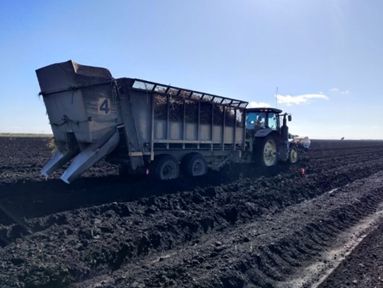
Credit: Hima Varsha Madala, UF/IFAS
There are two primary types of mechanical planting methods. The first method involves manual harvesting of stalks, while the subsequent operations, such as loading, distributing stalks into furrows, and furrow covering, are performed using specialized machinery. The second type is the fully mechanized planting of chopped cane, where a chopper harvester cuts the sugarcane stalks into billets, loads them into planters, and transports them to the planting site (Figure 4). At the site, billets are precisely dropped into the prepared furrows, and the furrow closing operation is then carried out by a tractor-mounted furrow covering rig. In mechanical planting, it is crucial to consider several factors to avoid bud damage during the harvesting of sugarcane stalks. One such factor is the age of the stalks, which should be around 9 to 12 months old to prevent breakage due to insufficient fiber development in younger stalks (Solomon and Singh 2024). Additionally, the adaptation of harvesters and stalk harvesters plays a vital role in reducing the risk of bud injury and ensuring bud viability. The second type of mechanized planting is currently adopted on approximately 20% of the total sugarcane acreage in Florida. Growers plan to adopt this method on higher acreage.
Advantages and Disadvantages of Mechanical Planting
The mechanical planting method offers several compelling advantages. Foremost, it demonstrates labor efficiency, requiring fewer workers compared to manual planting, thereby reducing labor costs and addressing potential labor shortages. Moreover, mechanical planters can plant sugarcane at a significantly faster rate than manual methods, enabling timely planting for optimal crop establishment and growth (Robotham 2004) (Figure 5). This planting method also ensures consistent depth, spacing, and distribution of sugarcane setts, promoting uniform germination and growth, which can ultimately translate into cost savings in the long run (Bakker 2013).
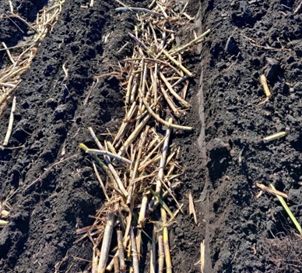
Credit: Hima Varsha Madala, UF/IFAS
However, mechanical planting has its drawbacks. A major disadvantage is the higher seed cane rate required compared to manual planting, which increases input costs and resource utilization. Furthermore, there is a risk of billet and bud damage if the planters are not precisely calibrated, which would lead to reduced germination rates and poor stand establishment. Damaged billets can serve as entry points for soilborne pathogens, consequently reducing cane yield and increasing disease incidence. Additionally, if the machinery is not calibrated or monitored, it can result in the dropping of billets without buds or the creation of gaps (skips) in the sugarcane establishment, further compounding yield losses.
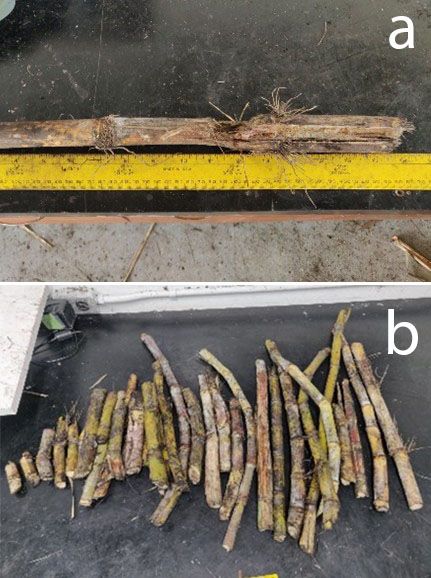
Credit: Hima Varsha Madala, UF/IFAS
To mitigate these drawbacks, sugarcane growers in the EAA are actively engaged in developing advanced mechanical planters that incorporate improved precision in billet dropping to reduce seed cane requirement and minimize bud and billet damage. These state-of-the-art planters will feature sophisticated calibration systems, real-time monitoring mechanisms, and specialized harvesting and chopping mechanisms designed to ensure consistent billet distribution, reduce gaps or skips, preserve bud integrity, and maintain optimal billet lengths. Concurrently, efforts are underway to improve seed cane quality, optimize seeding rates, protect damaged seed cane from fungal pathogens by spraying fungicides, and integrate precision agriculture technologies, such as GPS guidance systems, for accurate and efficient planting operations. By investing in these technological advancements and implementing stringent protocols, growers aim to maximize the benefits of mechanical planting while minimizing its drawbacks, thereby contributing to sustainable and productive sugarcane cultivation practices in the region. While mechanical planting represents a promising solution to address labor shortages and potentially reduce overall planting costs in the long term, growers adopting this technology must carefully balance these benefits against associated risks, such as increased seed cane requirements, potential for billet damage, and greater disease susceptibility — factors that necessitate additional management strategies and technological innovations to ensure successful implementation in commercial sugarcane production systems.
Table 1. Summary of the key differences between manual and mechanical planting methods based on research conducted in the Florida Everglades Agricultural Area (EAA).
References
Bakker, H. 2012. Sugar Cane Cultivation and Management. Springer Science & Business Media.
Baucum, L. E., R. W. Rice, and T. J. Schueneman. 2009. "An Overview of Florida Sugarcane: SS-AGR-232/SC032, rev. 8/2009." EDIS 2009(7). https://doi.org/10.32473/edis-sc032-2009
Burrows, G., and R. Shlomowitz. 1992. "The Lag in the Mechanization of the Sugarcane Harvest: Some Comparative Perspectives." Agricultural History 66(3): 61–75.
Elwakeel, A. E., Y. S. Mazrou, A. S. Eissa, A. M. Okasha, A. H. Elmetwalli, A. H. Makhlouf, K. A. Metwally, W. A. Mahmoud, and S. Elsayed. 2023. "Design and Validation of a Variable-Rate Control Metering Mechanism and Smart Monitoring System for a High-Precision Sugarcane Transplanter." Agriculture 13(12): 2218. https://doi.org/10.3390/agriculture13122218
Majhi, K., R. L. Choudhary, R. Kumar, and D. K. Singh. 2023. "Sugarcane Sustainability in a Changing Climate: Implications for Pest and Disease Management." Frontiers in Agronomy 5: 1423233. https://doi.org/10.3389/fagro.2024.1423233
Nagapavithra, S., and S. Umamaheswari. 2023. "Detection and Classification of Sugarcane Billet Damage Using Aquila Sailfish Optimizer Based Deep Learning." Artificial Intelligence Review 56: 2183–2206. https://doi.org/10.1007/s10462-023-10574-5
Nalawade, S. M., A. K. Mehta, and A. K. Sharma. 2018. "Sugarcane Planting Techniques: A Review." Contemporary Research in India: National Seminar Recent Trends in Plant Sciences and Agricultural Research (PSAR-2018): 98–104.
Odero, D. C., J. M. Beuzelin, M. VanWeelden, C. L. Kammerer, R. N. Raid, S. Swanson, P. Rott, and M. Mossler. 2022. "Florida Crop/Pest Profile: Sugarcane: PI207/PI-171, rev. 12/2022." EDIS 2022(6). https://doi.org/10.32473/edis-pi207-2022
Ríos, A., and J. Cárdenas. 2003. "Animal Traction in Cuba: An Historical Perspective." Havana, Cuba: Instituto de Investigaciones de Mecanización Agropecuaria (IIMA). https://www.academia.edu/6287531/Animal_traction_in_Cuba_an_historical_perspective
Robotham, B. G. 2004. "Sugarcane Planters: Characteristics of Different Types, Soil Disturbance and Crop Establishment."
Solomon, S., and P. Singh. 2024. "Management of Postharvest Quality of Sugarcane: Industry Perspectives." In Biotechnological Transformation for Sugarcane Management. 281–322. Apple Academic Press.