
Energycane is a high-fiber sugarcane (Saccharum spp.) that is considered as a dedicated feedstock for lignocellulosic ethanol production. The energycane cultivar UFCP 74-1010 was developed through collaborative research between the United States Department of Agriculture (USDA) in Canal Point, FL, and the UF/IFAS Everglades Research and Education Center at Belle Glade. Although there is no commercial cultivation of this cultivar in the United States (U.S.), there is an increased interest in the evaluation of this cultivar in domestic and international environments. UFCP 74-1010 is currently being evaluated in the southeastern U.S. as well as internationally in Costa Rica, Guadeloupe, the Dominican Republic, and Argentina. This fact sheet discusses different attributes related to this cultivar’s yield and disease resistance, which may assist growers and the biofuel industry to make an informed decision on cultivation and management of this cultivar.
Energycane (UFCP 74-1010)
UFCP 74-1010 has higher fiber content, plant population or tillering, and dry biomass compared to sugarcane cultivated for sugar production. This cultivar was released in 2013 (Sandhu et al. 2015) for marginal or low-fertility sandy soils. The dry biomass yield of UFCP 74-1010 in marginal soils in Florida is 29.2 Mg/ha with biomass composition of 41.9% cellulose, 27.8% hemicellulose, 22.4% lignin, 5% ash, and 1.6% structural protein. UFCP 74-1010 is moderately resistant to smut and leaf scald disease and resistant to orange rust, brown rust, and mosaic virus. Compared to the check energycane cultivar, L 79-1002 (Bischoff et al. 2008), UFCP 74-1010 produced a 5% higher yield and significantly higher resistance to smut.
The morphological characteristics of UFCP 74-1010 are similar to those of L 79-1002, but differ from the morphological characteristics of sugarcane cultivar CP 96-1252 (Sandhu and Davidson 2017). UFCP 74-1010 has longer and thinner stalks than CP 96-1252. On the other hand, internodes are smaller and thicker in sugarcane (CP 96-1252) than energycane (UFCP 74-1010 and L 79-1002). UFCP 74-1010 is higher in fiber content (>22%) and is generally grown for lignocellulosic ethanol production while CP 96-1252 is lower in fiber (~9%) and is grown for sugar production. To understand the difference between two energycane cultivars and one sugarcane cultivar, see the descriptions of UFCP 74-1010, L 79-1002, and CP 96-1252 in Table 1. The seed cane of UFCP 74-1010 is available at the UF/IFAS Everglades Research and Education Center.
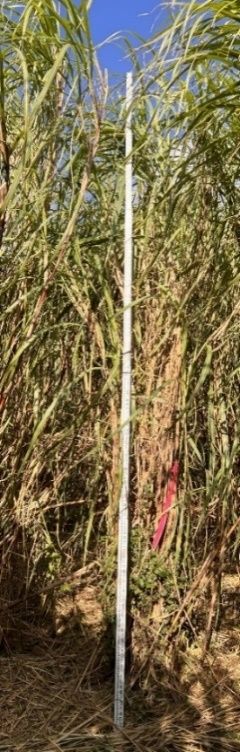
Credit: Amandeep Sharma, UF/IFAS
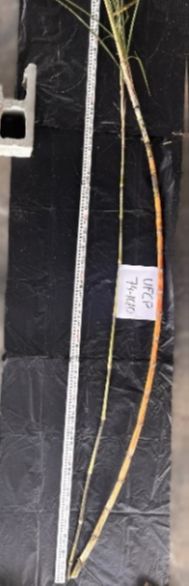
Credit: Amandeep Sharma, UF/IFAS
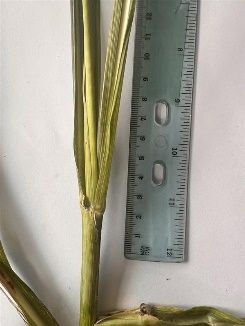
Credit: Amandeep Sharma, UF/IFAS
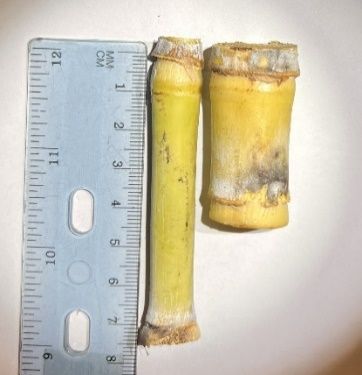
Credit: Amandeep Sharma, UF/IFAS
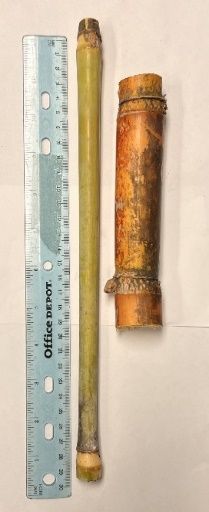
Credit: Amandeep Sharma, UF/IFAS
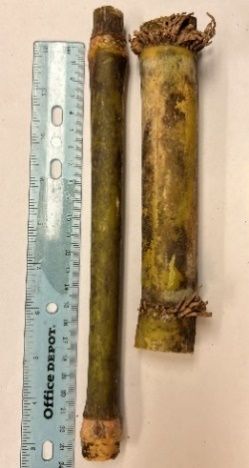
Credit: Amandeep Sharma, UF/IFAS
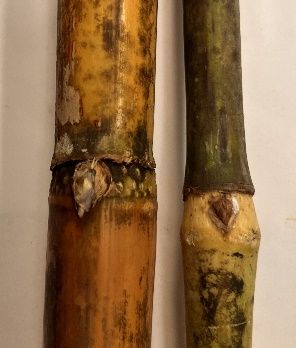
Credit: Amandeep Sharma, UF/IFAS
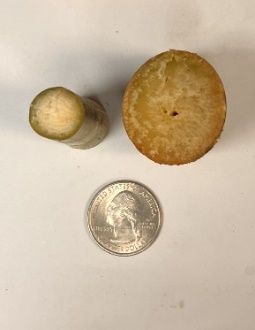
Credit: Amandeep Sharma, UF/IFAS
Glossary of Terms Used in Table 1
Cultivar name: The letters in the name of the cultivar represent the source of this cultivar. UF stands for the University of Florida, and CP stands for Canal Point, Florida. The collaborative work was done between the University of Florida Institute of Food and Agricultural Sciences (UF/IFAS) and USDA-ARS. The next two numbers represent the year in which the first clonal crop of the given cross was planted. The number after the hyphen represents the accession number of the cultivar.
Soil preferences: This describes the soil type in which the cultivar's best performance can be expected. In Florida, this refers to the marginal and sandy soils. Marginal soil has high pH and poor water drainage and is unsuitable for food crop production.
Sugar content: An estimation was made based on a comparison with other cultivars at the UF/IFAS Everglades Research and Education Center. This appears as the rating category as the cultivars can have different ratings. Ratings for sugar content can be changed depending on harvest seasons. Sugar content is rated as high, medium, or low.
Fiber content: The rating of this parameter is the main determining factor in cultivar selection. The rating was done based on comparison with other cultivars. It is rated as high, medium, or low.
Dry biomass: The yield of energycane is calculated on a dry matter basis. This can be influenced by soil type, harvest time, type of ratoon harvesting, and location. It is rated as high, medium, or low.
Leaf width: Measurement of the widest part of the leaf at the fourth node from the top. Rated as narrow, medium, or wide.
Leaf length: Measurement of the top dewlap leaf. Rated as large, medium, or small.
Sheath pubescence: Use of young sheath. The top of the plant is used. Rated as dense, sparse, or none.
Leaf retention: The dead leaves can be retained by the plant, giving a trashy appearance at the bottom of the stool, or they can be tightly retained by the stalks, giving a trashy look to the overall stool. The leaves might be attached but easily shaken off, or they may be stripped of themselves. Rated as self-stripping, loosely attached, or attached.
Canopy characteristics: The canopy qualities can range from dense to wide, influencing exposure to sunlight and sucker development. Canopy growth habits are classed as erect, erect with drooping tips, high arch, medium arch, and broad arch.
Canopy closure: Weed growth and sucker growth can be influenced by the speed of canopy closure. Rated as fast, intermediate, and slow.
Tillering: The number of shoots originating from one stool strongly influenced the yield. Tiller numbers are rated as heavy, medium, or low.
Stalk size: Expressed as a comparative analysis of diameter that strongly influences the cane weight. This also influences the bending or lodging susceptibility of the crop. Rated as large, medium, or small.
Stalk color: Exposed and covered stalk colors are rated as green, wine, red, purple, yellow, brown, or a described color.
Stalk height: The height of each stalk affects the overall yield of the crop. Rated as high, medium, or low.
Stubbling ability: This refers to a cultivar's capacity to regenerate after being harvested. It might be heavily impacted by the level of the cutter blades above the ground line. Rated as good, fair, or poor.
Internode length: Rated as large, medium, or small.
Harvest season: Commercial harvesting begins in October and ends in late April to early May. Rated as late (January 25–April 25), mid (December 1–January 25), or early (October 15–December 1).
Mechanically cut seed: The ease of harvesting a cultivar with a complete stalk harvester. The stalks are laid in furrows, either by hand or machine, and then chopped into billets manually. The alternative mechanical planting method is a billet planter that slices the cane as it is collected, but tends to result in greater cuts and eye injury than the entire stalk harvester. Unless otherwise specified, ratings are for the whole stalk technique. Rated as bad, average, or good.
Diseases: After release, cultivars are deemed to have acceptable disease resistance to all major illnesses identified by the industry at the time. The listed diseases result from novel strains of prevalent diseases or emerging diseases.
Table 1. Basic description, yield, and disease characteristics of two energycane cultivars (UFCP 74-1010, L 79-1002) and a sugarcane cultivar (CP 96-1252).
References
Bischoff, K. P., K. A. Gravois, T. E. Reagan, J. W. Hoy, C. A. Kimbeng, C. M. LaBorde, and G. L. Hawkins. 2008. "Registration of ‘L 79‐1002’ Sugarcane." Journal of Plant Registrations 2(3): 211–217. https://doi.org/10.3198/jpr2007.12.0673crc
Sandhu, H., and W. Davidson. 2017. "Sugarcane Cultivars Descriptive Fact Sheet: CP 96-1252, CP 01-1372 and CP 00-1101: SS-AGR-410/SC102, 12/2016." EDIS 2017(1). https://doi.org/10.32473/edis-sc102-2017
Sandhu, H. S., R. A. Gilbert, J. C. Comstock, V. S. Gordon, P. Korndörfer, N. El-Hout, and R. A. Arundale. 2015. "Registration of ‘UFCP 74‐1010’ Sugarcane." Journal of Plant Registrations 9(2): 179–184. https://doi.org/10.3198/jpr2014.06.0042crc