
Key Points
- The American Association of Equine Practitioners (AAEP) recommends that all horses have a yearly dental examination.
- Equine dentistry involves the diagnosis, treatment, and prevention of dental problems in horses. An individual oral health plan should be developed by your veterinarian.
Introduction
Oral health plays a crucial role in your horse's overall health and well-being. Understanding equine dental anatomy, recognizing signs that indicate the need for dental care, and knowing how to manage dental health through equine dentistry are key responsibilities for every horse owner.
Dental Anatomy
Equine teeth are uniquely adapted for grazing and grinding the forage of an herbivore diet. Horses have three main types of teeth: incisors, premolars, and molars. Each type serves a specific function in the chewing process. Incisors in the front are used for grasping and tearing grass while premolars and molars (also known as check teeth) are used for grinding. Horses have hypsodont teeth, meaning their teeth continuously erupt throughout their lives. The continuous eruption of their teeth compensates for the continuous wear that occurs from chewing fibrous plant material. A horse’s top jaw, the maxilla, is wider than its bottom jaw, the mandible, and horses move their jaws in a circular motion when chewing to help with mastication. Horses typically have between 36 and 44 teeth, depending on the age and sex of the individual horse. Like humans, horses acquire two sets of teeth in their lifetime. Their baby teeth, known as deciduous teeth or caps, are the first set. The second set consists of adult teeth, which will replace the deciduous teeth with permanent ones as they mature. Horses between the ages of 2 to 5 years old will see the most tooth growth and irregularities. Most horses will have all their permanent teeth by 5 years of age.
Dental Examination
Regular dental examinations are essential for maintaining your horse’s oral health. According to the American Association of Equine Practitioners (AAEP), an oral examination should be performed on your horse by a veterinarian within the first 30 days of birth to check for defects and issues, then again at 3 months, and every 6 months until the horse is 5 years old. After 5 years of age, mature horses should be examined yearly.
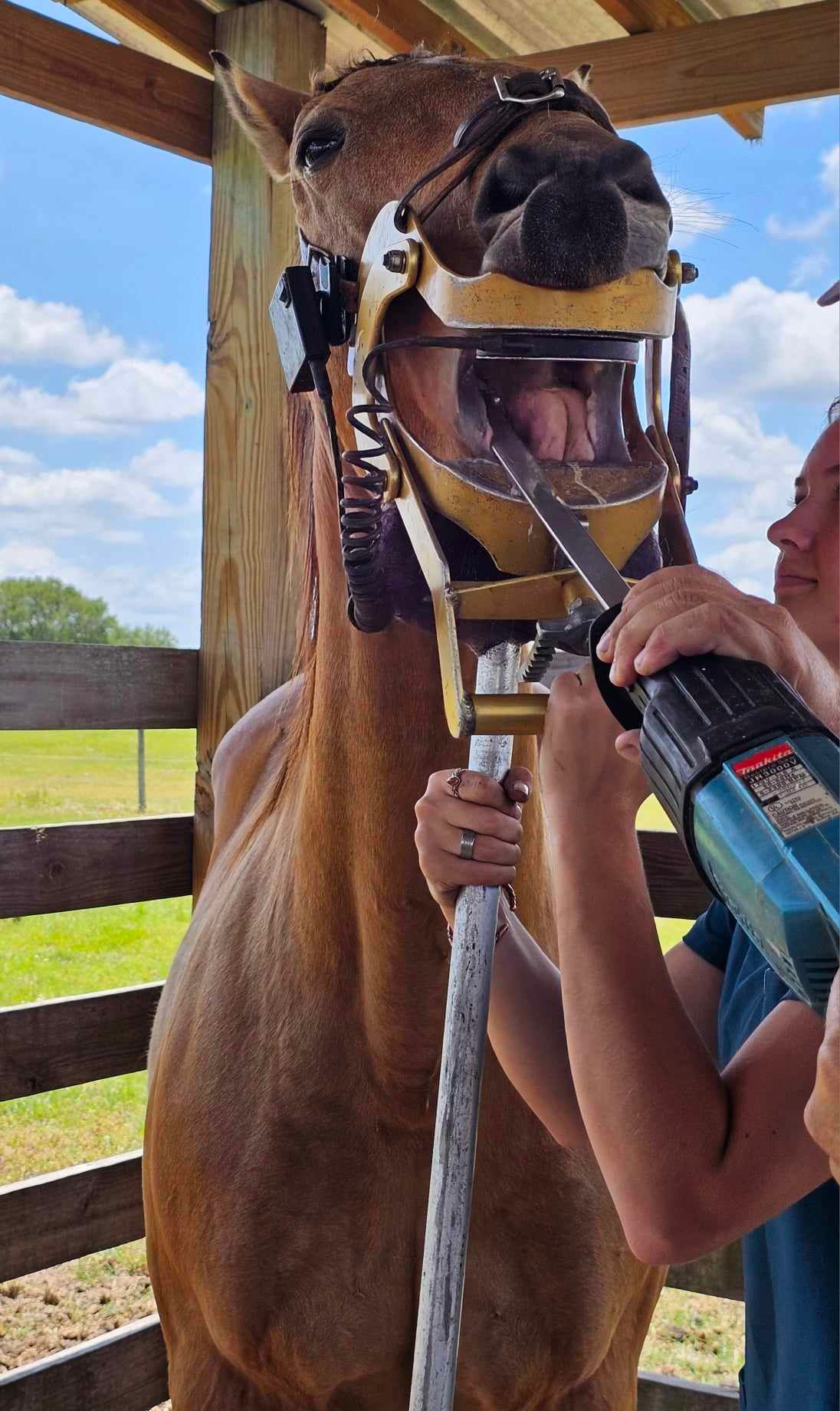
Credit: Brittany Justesen, UF/IFAS
During a dental examination, a veterinarian will sedate the horse and flush the mouth using an antiseptic mouthwash to remove any food particles. Sedation is needed to relax the horse, make a safer work environment, and allow more accurate dentistry. A dental speculum is then placed on the horse to open the horse’s mouth (Figure 1). During an equine oral exam, a head speculum and good lighting are essential for identifying sharp enamel points and irregularities in the mouth that need to be corrected.
Dental Float
After a thorough oral examination, a dental float can be used to correct and prevent any identified dental abnormalities. Dental floating involves rasping or filing down sharp enamel points, dental hooks, and uneven surfaces on the teeth to ensure proper occlusion and comfortable chewing. These sharp points develop as a result of asymmetric tooth wear over time, and can cause oral pain, tongue ulcers, and difficulty chewing. Both hand floats and specialized dental power tools may be used, depending on what type of abnormalities your horse has and the amount of abnormal tooth needing to be removed.
Common Dental Issues
Several dental problems can affect horses, causing impacts that range from minor discomfort to severe health issues. Common issues include the following.
- Sharp points: Irregular wear can lead to the formation of sharp enamel points on the teeth, causing pain and difficulty chewing. Sharp enamel points form on the cheek teeth, outside on the top and inside on the bottom of the mouth. Sharp points are normal for a horse to have, but they need to be maintained by a dental float to prevent ulcers from forming in the mouth. If these sharp enamel points are not filed down, the sharp point may cause ulcers and abrasions on the soft tissue surrounding the points.
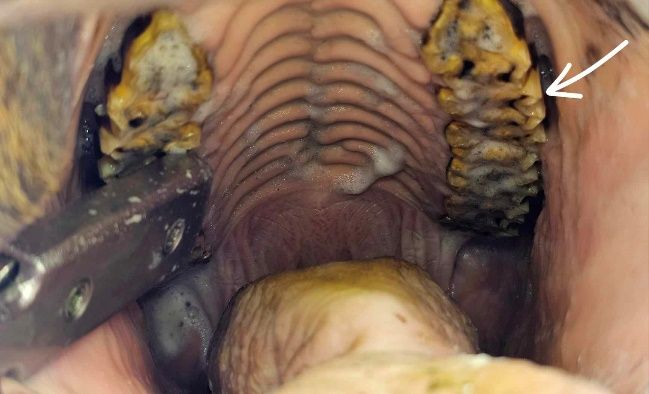
Credit: Brittany Justesen, UF/IFAS
- Hooks and ramps: These sharp projections on the teeth can interfere with proper chewing and may cause oral injuries.
- Malocclusions: Misalignments of the teeth, such as overbites, underbites, or waves, can result in uneven wear and dental problems. Even contact with all teeth including incisors, premolars, molars, and temporomandibular joint is critical to maintain a balanced and working mouth.
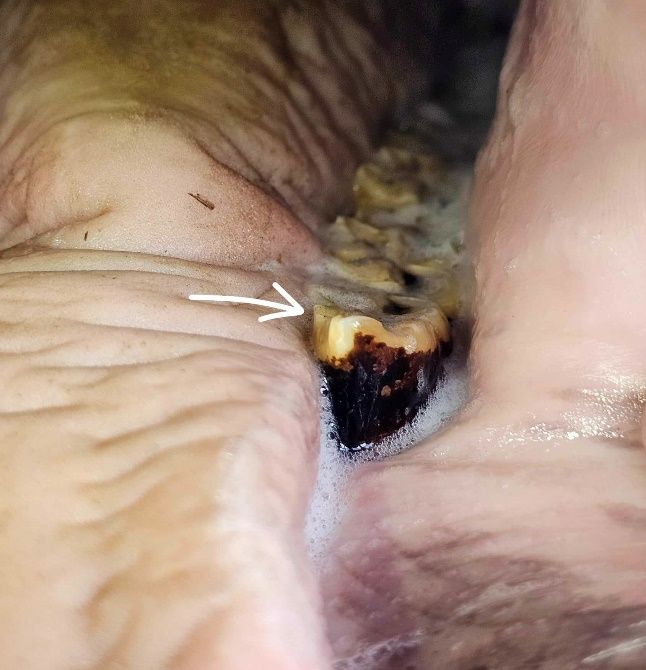
Credit: Brittany Justesen, UF/IFAS
- Periodontal disease: Inflammation of the gums and surrounding tissues can lead to tooth loss and systemic health issues if left untreated.
- Loose teeth: As senior horses age, their teeth eventually wear down and fall out. Some teeth may need to be pulled if they are loose and causing discomfort. Without the opposing tooth surface to wear against, the tooth will continue to erupt, creating a longer tooth.
Recognizing Dental Problems
Horses will show noticeable signs that indicate pain and discomfort in the mouth, but some horses will show no signs at all until a dental problem is severe. Signs that your horse may need a dental float include the following.
- Difficulty chewing: If your horse struggles to chew and drops partially chewed food, it may indicate dental discomfort. Accumulation of balls of feed lodged between the teeth and cheeks (called quidding) and excess salivation could also indicate a dental problem. Long stems and large feed particles may be found in the manure.
- Abnormal behavior: Signs of discomfort, such as head tossing, head tilting while chewing, reluctance to accept the bit, or avoiding or resisting contact with the bridle, can signal dental issues.
- Weight loss: Poor dental health can lead to inefficient digestion and weight loss despite adequate nutrition. Poor dental health can also lead to decreased feed consumption.
- Foul odor or discharge: Bad breath, nasal discharge, swelling of the face and jaw, and blood coming from the mouth may indicate underlying dental problems, such as infection or periodontal disease.
Preventive Measures
In addition to professional dental care and a yearly exam, preventive measures to promote good oral health include the following.
- Quality nutrition: Providing a balanced diet with ample roughage helps promote natural wear and supports dental health.
- Regular monitoring: Keep an eye on your horse's eating habits, drooling, body condition score, and behavior for signs of dental discomfort.
- Appropriate bit fit: Ensure that the bit fits correctly and does not cause unnecessary pressure on the teeth or mouth.
Equine dentistry is essential for maintaining your horse's oral health and overall well-being. Remember that regular dental examinations and preventive care are key components of responsible horse ownership. By understanding the basics of equine dental care and implementing preventive measures, you can help your horse live a longer and healthy life.
Reference
American Association of Equine Practitioners. n.d. “American Association of Equine Practitioners.” https://www.aaep.org