
Introduction
Horses experience different stressors that can impact their production and health. With increased ambient temperatures occurring more frequently, owners and producers must find creative solutions to prevent the consequences of heat-stressed animals. In hot and humid conditions, horses can experience lack of sweating (anhidrosis), heat stroke, electrolyte imbalances, and dehydration. Feed and water intakes are often decreased during hot weather, which can lead to other health risks (e.g., body condition loss and/or colic). To improve horse welfare, it is important to understand the impact of heat stress on horses and to become familiar with different solutions to reduce the negative effects.
In Florida, it is common to experience heat coupled with humidity. During the summer months, temperatures can routinely reach over 38°C (100°F). US Equestrian shared recommendations for equines with varying heat indexes, which is how hot it feels when humidity is factored in. If values fall between 130 and 180, it is crucial to monitor for signs of heat stress. If values are greater than 180, US Equestrian recommends show/event rescheduling (US Equestrian Communications Department 2024). This article provides guidance on monitoring signs of heat stress and management recommendations to improve horse welfare. The information is intended for equine owners, facility managers, and Extension educators.
Temperature Regulation in Horses
Horses can maintain their normal body temperature (~38°C) in most conditions, including hot and cold ambient temperatures. Their body temperature can go up several degrees during intense exercise and return to normal quickly during cooldown. The range where horses are most comfortable is called the thermoneutral zone. While racing, Thoroughbred racehorses generate enough heat to boil a gallon of water every minute, producing the most heat compared to horses engaged in all other equestrian sports. Also, during work, racehorses can lose on average up to 10 liters of sweat per performance, which can result in dehydration and electrolyte imbalance.
Common Signs of Heat Stress
- Rapid/shallow breathing
- Elevated body temperatures (greater than 102°F)
- Rapid heart rate (greater than 60 beats per minute)
- Unpredictable behavior, wobbly or stumbling gait
- Profuse sweating
Horses have natural cooling mechanisms that help reduce body temperature. These include convection, conduction, and evaporation. Convection can be described as the transmission of heat that occurs between the horse’s body and the surrounding air. During hotter months, the coat is thin to facilitate heat loss; during colder months, a thicker hair coat provides insulation to prevent heat loss. Conduction is defined as heat transfer between surfaces, so a horse can emit body heat to the ground when the ground temperature is lower than the horse’s body temperature. Horses mainly rely on evaporation of sweat to dissipate excess body heat. Their sweat glands positioned throughout the body can move large volumes of water to facilitate heat loss. However, when the thermoregulatory system is overwhelmed, it can result in critically high body temperature (Patterson Rosa et al. 2020). As a result, horses must be actively cooled to avoid risk of heat stroke, especially in warmer climates.
Combating Heat Stress
Cooling Recommendations
- Give horses access to shade.
- Hose horses down after the end of a ride/workout.
- Provide access to clean, fresh drinking water at all times.
- During hot/humid months, ride either early in the morning or late at night.
- If possible, provide fans where horses congregate for increased airflow over the skin.
A previous study showed that showering horses continuously with tap water or frequently sweat-scraping and reapplying water from a bucket was the most efficient method of rapidly lowering temperatures (Takahashi et al. 2020). Water is heated on the horse’s skin; thus, it must be quickly removed and replaced with cool water to cool down the animal. Humid environments like those found in Florida and the southeastern United States can limit cooling by evaporation, so covering the horse in water cooler than its body temperature is crucial for this approach to be effective. Another strategy included fitting horses with ice blankets, which were shown to be effective in decreasing skin surface temperature (Ojima et al. 2022). While both strategies are helpful in managing heat stress, they can be expensive and difficult to implement. Cooling horses with showering used more than 20 times the amount of water compared to other methods. Usually, horses have a “cooldown” period after exercise where they walk or trot, which redistributes blood flow and removes lactate from the muscles. The showering method requires horses to remain standing, which limits implementation of a post-exercise cooldown. Ice blankets are difficult to implement and costly due to numerous materials needed for every horse. Additionally, ice blankets only cover the horse’s back and loin, neglecting other areas of the horse that need to be cooled.
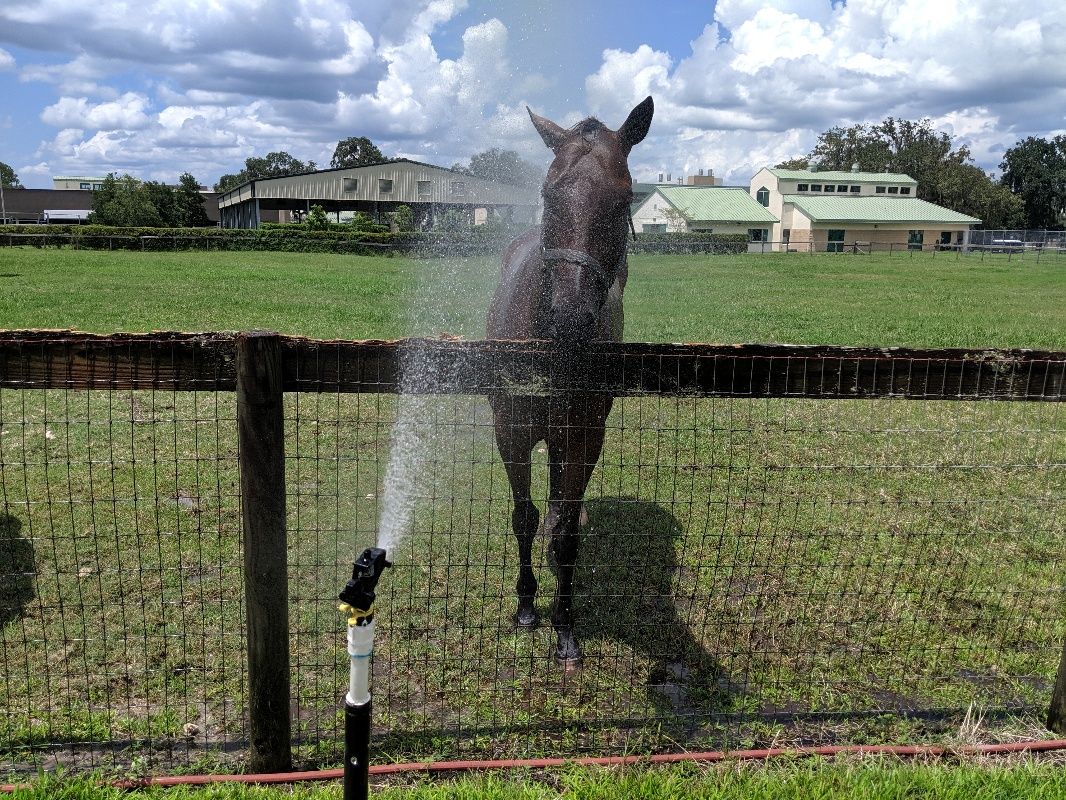
Credit: Sally DeNotta, UF/IFAS
New technologies may provide more efficient ways to manage heat stress in horses. For example, genomics, or the study of all the DNA in an organism, could be applied in the future to select horses better suited to hot weather. Genomic markers for heat tolerance could help to guide breeding programs, and can identify genes important for the equine thermoregulatory response that might be useful targets in developing new treatments for heat stress (Ciosek et al. 2024; Patterson Rosa et al. 2017; Patterson Rosa et al. 2020). For example, UF/IFAS researchers found the that genetic markers around the KCNE4 gene, which has a possible function for sweat gland outflow, were significantly associated with chronic idiopathic anhidrosis, a frustrating condition that is characterized by a loss of the sweat response (Patterson Rosa et al. 2020). A defect in this gene might explain the lowered sweat response in horses with chronic idiopathic anhidrosis. Identification of the genetic origin of this disease could lead to targeted gene therapies to provide much-needed treatments and alleviate heat stress-related suffering in these animals.
Conclusion
Heat stress is an important issue for horses residing in hot and humid climates. Horses must maintain their body temperature to avoid heat stress. However, when high temperatures are paired with high humidity, it becomes difficult for the horse to rely on evaporative cooling as a means to regulate body temperature. Strategies such as continuously showering horses with tap water and applying ice blankets are effective at lowering rectal temperatures. A better understanding of temperature-regulating genes in the horse could be helpful for management of horses living in hot and humid climates.
References
Ciosek, J., C. Wickens, and S. A. Brooks. 2024. “A Primer on Genetic Testing for Horse Owners and Breeders: VM261, 4/2024.” EDIS 2024(3). https://doi.org/10.32473/edis-vm261-2024
Cymbaluk, N. F., and G. I. Christison. 1990. “Environmental Effects on Thermoregulation and Nutrition of Horses.” Veterinary Clinics of North America: Equine Practice 6(2): 355–372. https://doi.org/10.1016/S0749-0739(17)30546-1
Ojima, Y., S. Torii, Y. Maeda, and A. Matsuura. 2022. “Effect of Cooling Blanket on the Heat Stress of Horses in Hot and Humid Environments.” Animals 12(19): 2505. https://doi.org/10.3390/ani12192505
Patterson Rosa, L., M. Mallicote, R. MacKay, and S. Brooks. 2020. “Anhidrosis in the Horse (Non-Sweaters)—What Do We Know? AN362/AN362, 10/2020.” EDIS 2020(6). https://doi.org/10.32473/edis-an362-2020
Patterson Rosa, L., N. Walker, M. Mallicote, R. J. MacKay, and S. A. Brooks. 2021. “Genomic Association of Chronic Idiopathic Anhidrosis to a Potassium Channel Subunit in a Large Animal Model.” Journal of Investigative Dermatology 141(11): 2639–2645.e3. https://doi.org/10.1016/j.jid.2021.05.014
Patterson Rosa, L., C. Wickens, and S. Brooks. 2017. “Galloping into the Future: Genetic Tips and Tools for the Horse Owner: AN333, 5/2017.” EDIS 2017(3). https://doi.org/10.32473/edis-an333-2017
Takahashi, Y., H. Ohmura, K. Mukai, T. Shiose, and T. Takahashi. 2020. “A Comparison of Five Cooling Methods in Hot and Humid Environments in Thoroughbred Horses.” Journal of Equine Veterinary Science 91: 103130. https://doi.org/10.1016/j.jevs.2020.103130
TenBroeck, S. 2021, June 18. “Summer Care for Horses.” UF/IFAS Extension. https://nwdistrict.ifas.ufl.edu/phag/2021/06/18/summer-care-for-horses/
US Equestrian Communications Department. 2024. “Heat Alert: Clarification and Recommendations for Participants and Competition Managers.” United States Equestrian Foundation. https://www.usequestrian.org/media/press-releases/heat-alert-clarification-recommendations-for
Wang, M., Y. Liu, X. Bi, H. Ma, G. Zeng, J. Guo, M. Guo, Y. Ling, and C. Zhao. 2022. “Genome-Wide Detection of Copy Number Variants in Chinese Indigenous Horse Breeds and Verification of CNV-Overlapped Genes Related to Heat Adaptation of the Jinjiang Horse.” Genes 13(4): 603. https://doi.org/10.3390/genes13040603