
Introduction
This EDIS publication serves as an introduction to essential aspects regarding donkeys. The information is intended for equine owners, county Extension agents, and individuals interested in learning more about donkeys. Topics covered include considerations for donkey care and management, donkey behavior, and the societal role of donkeys.
Donkeys are the second most abundant equine globally, with numbers reaching over 50 million worldwide. Domestication of wild donkeys began around 6,000 years ago in Africa. Noting the donkeys’ original habitat is vital for understanding just how efficient these animals are. The ability to withstand high temperatures, navigate difficult terrain, and cope with limited food and water resources influences various aspects of donkey anatomy, physiology, and behavior (The Donkey Sanctuary 2021).
Donkeys are classified based on size: miniature, standard, and mammoth. Miniature donkeys, under 36 inches tall, are often kept as pets. Standard donkeys, ranging from 36 to 48 inches tall, are versatile work animals. Mammoth donkeys, towering over 54 inches, are valued for their strength and ability to carry heavy loads. There are various breeds within each size category such as the Poitou, Andalusian, and Abyssinian, exemplifying diversity (The Donkey Sanctuary 2021).
Nutrition
Donkeys have small muzzles and mobile lips that they use for selective feeding. This means donkeys value feed quality over quantity. They select portions of the forage that have higher nutritional quality to remain efficient in their feed intake. In the wild, donkeys graze up to 18 hours a day, traveling up to 18 miles in search of forage (Wickens and Liburt 2021).
These animals are adapted to foraging high-fiber, low-energy plants. They can utilize the energy found in these plants to meet their low nutritional requirements, making them highly efficient in harsh environments. This adaptation presents a challenge to owners keeping donkeys in more lush environments. Having free access to pasture grasses and hay that contain high levels of non-structural carbohydrate (NSC, i.e., sugar and starch) poses a significant health risk for donkeys. These risks include obesity, laminitis, colic, and hyperlipemia. Limiting the amount of sugar consumed through pasture, grain, hay, and treats is vital to ensure a long and healthy life (Wickens and Liburt 2021).
Hyperlipemia occurs when a donkey (especially one with increased fat deposits from consuming lush pasture) suddenly undergoes dietary changes, either in nutritional/feed quantity or quality, and fails to meet its energy needs. As a result, the donkey begins to utilize its fat reserves to compensate. Donkeys cannot efficiently regulate the release of fat. This can cause an excess amount of fat in the blood, liver, and kidneys. Inappetence and reduced feed consumption can be a result of numerous factors including stress, dietary change, low-quality forage, and dental issues. It is especially important for donkey owners to be aware of the causes and signs of hyperlipemia because the condition requires rapid treatment and is potentially fatal (Wickens and Liburt 2021). For more information on hyperlipemia, consult this article provided by The Donkey Sanctuary (2020).
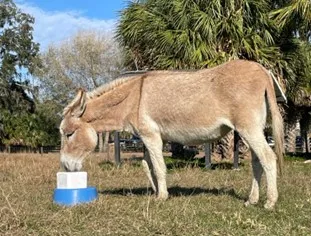
Compared to horses, donkeys have a lower water requirement. Water intake is influenced by the amount of work donkeys are doing, the climate, and the type of feedstuff they are consuming. When presented with a water shortage, wild donkeys can go up to three days without water. Despite this ability, it is important for them to have free access to clean water. The addition of salt to the diet is recommended to encourage drinking and to replenish electrolytes (Wickens and Liburt 2021).
Credit: Isabel Cheng
Hoof Care
Donkeys are known to be sure-footed animals. They have small, cupped hooves that enable them to climb steep and rocky surfaces. These hooves require regular trimming. This should be done every 6–10 weeks, depending on the amount of natural wear the donkey receives in its environment. It is important to maintain a proper hoof shape for a sound and comfortable donkey.
Donkey hooves are susceptible to conditions such as white line disease, hoof abscess, and thrush, especially when exposed to wetter environments. White line disease involves cracks, injury, and hoof weakness that allow pathogens to enter and destroy the inner hoof wall tissue. Injury in the white line or sole can cause an abscess, an infection that results in pus buildup and pain in the hoof. Thrush is a bacterial infection that thrives in moist, dirty conditions, leading to foul-smelling discharge and discomfort for the animal. Regular monitoring of the donkey's feet and thorough cleaning and removal of debris are crucial preventive measures. Proper hoof care not only ensures the donkey's ability to navigate various terrains but also plays a vital role in maintaining overall health and preventing debilitating conditions such as laminitis.
Laminitis is inflammation of soft tissue in the hoof that results in a separation of the pedal bone and hoof wall. This inflammation can be triggered by physical trauma or large amounts of carbohydrates fermenting in the hindgut. This is a very painful and potentially fatal disease. Avoid feeding excess sugar to donkeys. Their efficient digestive ability means they are even more susceptible to this disease.
Climate Tolerance
The coarse texture of donkeys' coats is well adapted to ensure comfort in hot and dry climates. However, this makes them less equipped to endure windy, wet, and cold conditions. A 2017 study revealed that donkeys exhibit less variation in hair length and weight between their summer and winter coats. While they do develop a winter coat, it is thinner in comparison to that of horses. Consequently, donkeys may require additional shelter from cold and wet conditions compared to their equine counterparts (Osthaus et al. 2017).
Similarly, donkeys can struggle in climates where high temperatures are coupled with high humidity. The moisture compromises the thermoregulatory ability of their coats, leading to heat stress, dehydration, and heat stroke. Signs of heat stress include increased respiratory and heart rates, lack of sweating, and lethargy. To prevent overheating, ensure constant access to clean and fresh water, provide ample shade, protect against sunburn with sunscreen applied to the face or with fly masks, and consider clipping their coats during hot months.
Wet conditions also increase susceptibility to various skin conditions including rain scald, mud fever, ringworm, and sweet itch. These conditions often attract flies or result in itching, which can complicate the healing process. Prevention and rapid treatment are key. It is important for owners to regularly examine their donkeys for any lumps, bumps, and wounds under their thick coats and in areas that are less visible.
Behavior
The stereotype of donkeys as stubborn creatures has persisted for centuries. Unraveling the origins of this behavior is crucial for developing a better understanding when interacting with them. While surviving in an environment with limited resources, donkeys have adapted to rely more on the freeze and fight responses rather than the flight response compared to horses. Running from danger often means running from precious resources such as water, while further increasing the need for water. Thus, the donkey is an animal whose first instinct is to stand its ground when it feels uncomfortable or threatened (Burden and Thiemann 2015).
Donkeys are highly intelligent and social animals. They have been observed to form pair-bonds, which are long-lasting partnerships between two donkeys. The separation of bonded pairs can result in extreme stress and a loss of appetite. This loss of energy consumption increases fat mobilization for energy, potentially resulting in hyperlipemia (The Donkey Sanctuary 2020). Recognizing bonded pairs and keeping them together are crucial for donkey health and well-being (Burden and Thiemann 2015).
Donkeys can be described as stoic animals. This characteristic may make it difficult to identify the level of pain they may be experiencing. An owner’s knowledge of what is normal for their donkey is important when assessing potential illness or injury. Additionally, having their bonded companion present for the assessment and treatment is essential (Burden and Thiemann 2015).
Donkey Occupations
Livestock Guardian
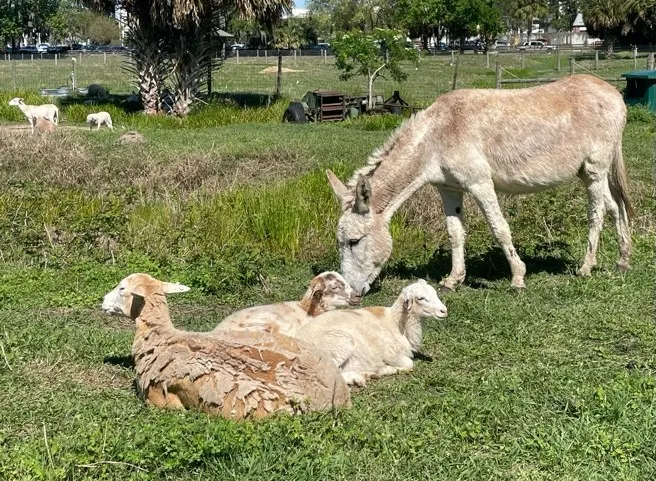
In the wild, donkeys form small herds where there are plentiful resources. These herds will often create territories around water resources and defend the resources from other animal species. This naturally defensive behavior makes them a good choice for guard animals. By selecting a donkey displaying naturally aggressive behavior towards predator species and allowing it to bond with the livestock, you can help defend your sheep flock, goat herd, or cattle herd from predation and loss of young stock. Donkeys are well suited to protect livestock from canine predators such as wolves and coyotes.
Credit: Isabel Cheng
Pack Animals
Because of their sure-footedness and their ability to endure long distances and carry heavy loads, donkeys have a long history of being used as pack animals. Historically, this job varied from carrying heavy loads around the farm or town, to the long-distance transport of goods and people along various trade routes (The Donkey Sanctuary 2021). Donkeys have been credited with carrying the advancement of early civilization on their backs.
Dairy Production
The evolutionary pressure to meet a foal’s nutritional requirement in a harsh environment has resulted in milk richer in nutrients and higher-quality protein. Donkey milk is similar to human milk in terms of protein profile, vitamins, and lactose content. It is a good nutritional alternative for infants who have cow milk allergies. Donkey milk production is found predominantly in Italy and parts of China. These regions have traditionally produced donkey milk because of its antimicrobial and antioxidant properties, which make it a desirable natural ingredient for cosmetic products and nutritional supplements (Cimmino et al. 2022).
Recreational Use
Donkeys have become more popular in recreational settings for their versatility, intelligence, and sociability. These activities include show driving, companionship, and inclusion of donkeys in equine-assisted therapies. Cart showing showcases the donkey’s ability to pull lightweight carts in a variety of classes; success in this activity is highlighted by presentation, movement, responsiveness, and the handler’s skill in training and guiding the donkey. As companion animals, donkeys’ social nature allows them to foster a connection with their owners, which is a rewarding experience that improves well-being and activity for their humans. Additionally, this connection is used in donkey-assisted therapy programs. The donkeys’ calming presence facilitates therapeutic interactions for individuals with physical, emotional, or developmental challenges.
Take-Home Message
Understanding the unique characteristics and needs of donkeys is essential for their proper care and management. Their selective feeding habits, resilience in harsh climates, and specific health risks necessitate informed practices from owners to ensure their well-being. Their historical roles as pack animals, dairy producers, livestock guardians, and companions highlight the important relationship between humans and these remarkable animals. By increasing our knowledge and appreciation of donkeys, we can enhance their health and well-being for years to come.
References
Burden, F., and A. Thiemann. 2015. “Donkeys are different.” Journal of Equine Veterinary Science 35: 376–382. https://doi.org/10.1016/j.jevs.2015.03.005
Cimmino, F., A. Catapano, I. Villano, G. Di Maio, L. Petrella, G. Traina, A. Pizzella, R. Tudisco, and G. Cavaliere. 2022. “Invited Review: Human, Cow, and Donkey Milk Comparison: Focus on Metabolic Effects.” Journal of Dairy Science 106: 3072–3085. https://doi.org/10.3168/jds.2022-22465
The Donkey Sanctuary. 2021. “Donkey Facts.” https://www.thedonkeysanctuary.org.uk/articles/donkey-facts
The Donkey Sanctuary. 2020. “Hyperlipaemia in Donkeys.” https://www.thedonkeysanctuary.org.uk/for-owners/owners-resources/hyperlipaemia-in-donkeys
Osthaus, B., L. Proops, S. Long, N. Bell, K. Hayday, and F. Burden. 2017. “Hair Coat Properties of Donkeys, Mules and Horses in a Temperate Climate.” Equine Veterinary Journal 50: 339–342. https://doi.org/10.1111/evj.12775
Wickens, C. L., and N. Liburt. 2021. “Caring for Long-eared Equid: Feeding and Nutritional Management of Donkeys.” UF/IFAS Extension. https://nwdistrict.ifas.ufl.edu/phag/2021/08/27/caring-for-long-eared-equine-feeding-and-nutritional-management-of-donkeys/