
Postbloom fruit drop (PFD) must be controlled on processing and fresh-market fruit. PFD, caused by the fungal species complex Colletotrichum acutatum, affects all species and cultivars of citrus, but severity on a given cultivar varies according to the time of bloom in relation to rainfall. Navel and Valencia oranges have experienced the most severe damage in Florida because they tend to have extended or multiple blooms.
Most spores of this fungus are produced directly on the surface of infected petals. Spores are splash-dispersed by rain to healthy flowers, where they infect within 24 hours and produce symptoms in 2–3 days. The fungus survives between bloom periods as resistant resting structures on the surface of leaves, persistent calyxes (buttons), and twigs. Flowers are susceptible from the button stage (with white tissue present) until they are open.
Groves with persistent calyxes (buttons) from the previous year should be closely examined once the bloom begins. If infected flowers are present on scattered early bloom, fungicide application recommendations should be followed once sufficient bloom is present for the fungicide application to be economical. Groves with a history of PFD should be scouted twice weekly during the bloom period. Ground and aerial applications are effective for control of PFD when properly timed. Low-volume application equipment can be used if good coverage of the flowers is provided and minimum volume levels are followed according to the label. Ideally, to reduce disease severity, remove declining trees, such as those with HLB, blight, or phytophthora, where off-season blooms may provide a site for fungal spore buildup, but this may not be practical in groves with many trees affected by HLB.
The Citrus Advisory System (CAS; Figure 1) was developed recently to further facilitate grower's decisions on the need for fungicide applications. The system uses real-time weather data from Florida Automated Weather Network (FAWN) stations throughout the state to determine whether risk for PFD is low (green), moderate (yellow), or high (red) based on leaf wetness duration and temperature during the wetting period. At least 15 hours of continuous wetness is usually required to trigger a moderate or high risk condition. Low areas in the grove that accumulate fog in the mornings should be monitored more closely since they would stay wet longer than the open areas where the weather stations are located. In these areas, if the risk level is just below the moderate threshold based on the FAWN data, the extended wetting period may raise the risk to above the moderate threshold and an application may be warranted. Specific fungicide spray recommendations are given according to the disease risk conditions and crop phenology, that is, the stage and intensity of the bloom. CAS is available at http://agroclimate.org/tools/cas. If desired, notifications can be sent via SMS or email for an alert to check the system because an infection event has occurred.
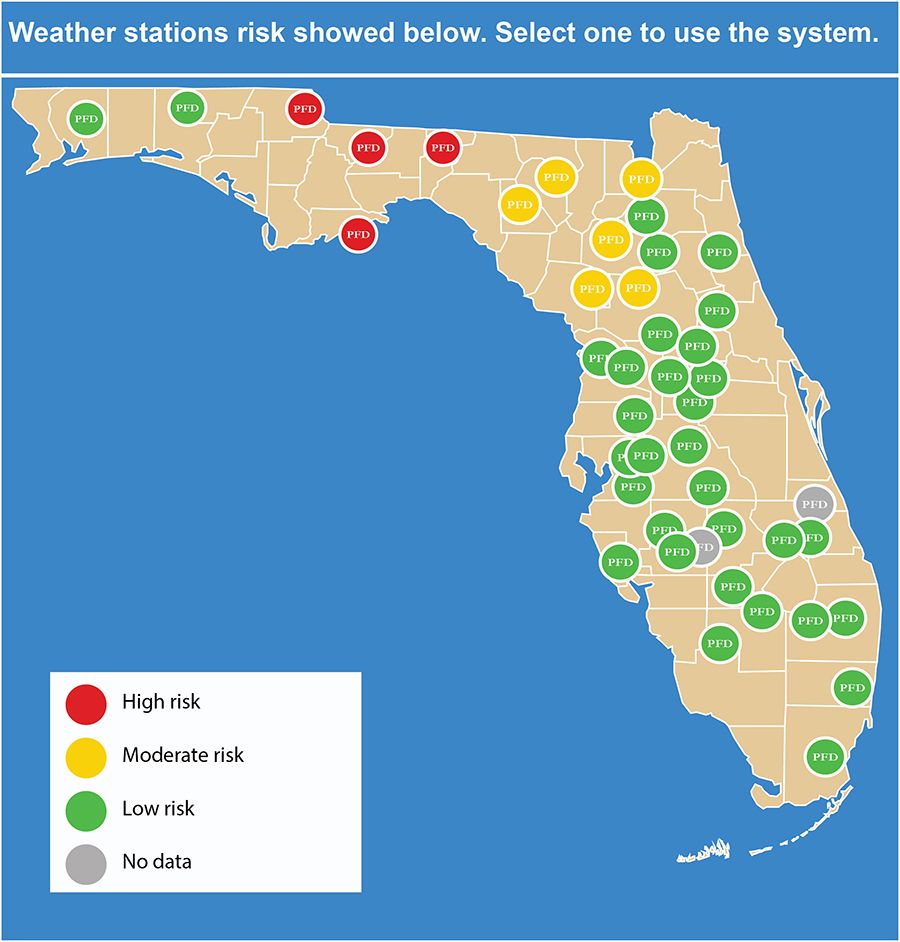
Because the number of fungicides available as well as the number of applications for each fungicide are limited, preventive fungicide programs are difficult to implement, especially in groves with large numbers of declining trees, which might bloom for an extended period. As a reminder, groves with a history of PFD should be checked semiweekly during bloom. If symptomatic flowers are found on scattered bloom, CAS recommendations should be followed once sufficient bloom is present to justify a fungicide application.
Of the products recommended for control of PFD, the strobilurin-containing fungicides (FRAC MOA 11) Amistar Top, Gem, Headline, Priaxor, Pristine, and Quadris are effective but do not have a long residual effect since new flowers are always emerging. Ferbam (FRAC MOA 03) is less effective and should not be used alone, but it can be combined with low rates of other products to maximize protection and reduce the risk of resistance development. No fungicide resistance has been detected to date. The strobilurin-containing fungicides should not be used alone more than once per season, but they can be used more than once if combined with Ferbam.
Recommended Chemical Controls
READ THE LABEL.
Rates for pesticides are given as the maximum amount required to treat mature citrus trees unless otherwise noted. To treat smaller trees with commercial application equipment—including handguns—mix the per-acre rate for mature trees in 125 gal of water. Calibrate and arrange nozzles to deliver thorough distribution, and treat as many acres as this volume of spray allows.