Introduction
Cost-share programs provide financial incentives to growers, making it more affordable to adopt and implement advanced technologies such as soil moisture sensors (SMS) for irrigation management. This publication is a resource for growers, Extension agents, and technical personnel. It summarizes key cost-share opportunities available for SMS across Florida. It provides an overview of the SMS-related cost-share programs available in Florida, summarizing eligibility, timelines, application steps, and relative benefits to help growers navigate available financial support efficiently.
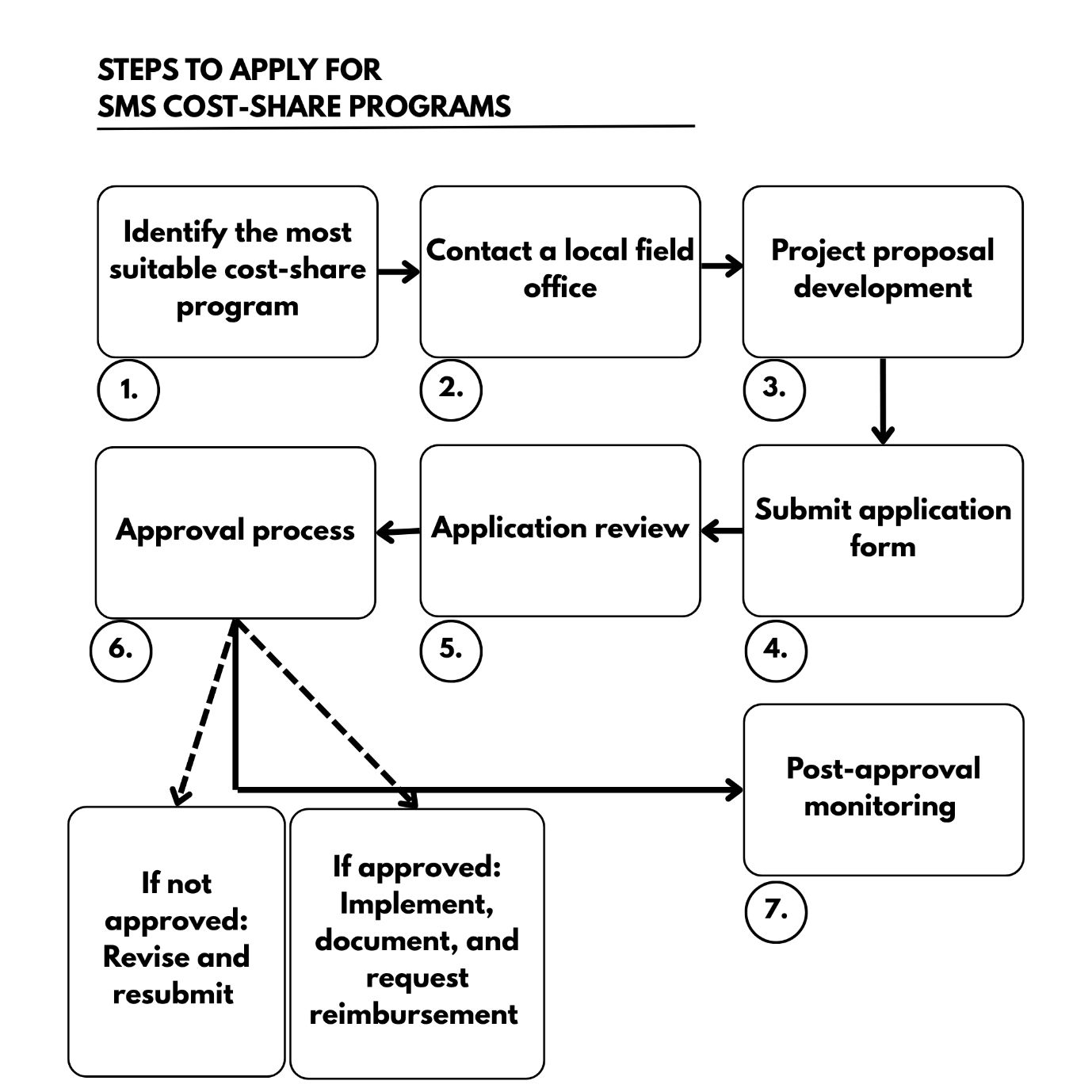
Florida growers can access a range of cost-share programs offered by federal and state agencies and water management districts. These programs typically cover a portion of the total project cost, with SMS being one of the eligible components. The information about these opportunities is often scattered across different websites, varies by region, and can be difficult to compare. This publication provides a centralized source for growers, Extension agents, and technical service providers to identify the irrigation cost-share program that best fits a specific farm's needs and timeline, focusing on SMS implementation. It offers a side-by-side comparison (Table 1) of the programs available as a decision support source to identify the most appropriate program and provides the steps to apply for SMS and irrigation projects cost-share (Figure 1). Additionally, it serves as an information source for Extension personnel, providing a comparative resource to allow direct assistance to growers for the application process.
Note: The information provided in this publication, including contact information and program requirements, was updated in Spring 2025 and provides a general overview of each program and a guide for program selection. For more detailed information, readers should refer to the agency's website. The cost-share information provided (e.g., caps, percentages) in the following sections applies to overall irrigation projects that may include SMS as one of their components.
Agencies Providing Cost-Share Programs in Florida
- Florida Department of Agriculture and Consumer Services (FDACS)
The Florida Department of Agriculture and Consumer Services (FDACS) is a critical player in promoting and adopting soil moisture sensors (SMS) as part of its best management practices (BMP) cost-share program. FDACS prioritizes funding projects based on the project's benefits to water resources conservation and sustainable nutrient management.
- Application process: To begin the application process, growers fill out the FDACS cost-share application form, which can be obtained from the FDACS website (https://www.fdacs.gov/Water/Agricultural-Water-Field-Services/BMP-Cost-Share-Program), or reach out to an FDACS Office of Agricultural Water Policy (OAWP) representative at (863) 467-3250 or AgBmpHelp@FDACS.gov. The supporting documentation, including proof of BMP program enrollment and a detailed project proposal, should be submitted along with the application form.
- Eligibility criteria: The farm should be in production for at least one year before application and have a Notice of Intent to Implement Agricultural BMPs (NOI).
- Cost share percentage: The funding is provided for 75% of the SMS equipment cost, and the reimbursement cap is $50,000 per project submitted. Soil moisture sensors are part of the irrigation projects category.
- Submission timeline: The applications are accepted throughout the year and can be made by contacting the local FDACS field office.
- Post-approval requirements: A contract is made between FDACS and the grower upon application approval. The reimbursement is provided after the SMS is purchased and installed, and proof of expenses should be submitted. The FDACS personnel may visit the field to verify the SMS equipment installation and continued compliance with the contract terms and to provide any additional support if required.
- Additional agency notes: FDACS collaborates with the USDA Natural Resources Conservation Service (NRCS) and water management districts and provides financial aid to the growers to obtain SMS.
2. USDA Natural Resources Conservation Service (NRCS)
The USDA NRCS is contributing to SMS adoption through the Environmental Quality Incentives Program (EQIP).
- Application process: To begin the application process, the farmer should contact the nearest USDA NRCS office (https://offices.sc.egov.usda.gov/locator/app?state=FL) to receive assistance with the application. An NRCS officer visits the farm, develops the action plan, and provides the farmer with the cost estimate. The farmer chooses the SMS, and the funding depends on the type of SMS chosen. The applications are reviewed based on the environmental benefits, such as water conservation and water quality.
- Eligibility criteria: Growers who own, lease, or have control of the land and use it for agricultural purposes are eligible for funding.
- Cost share percentage: As of May 2025, the funding covers up to 75% of the project cost, which can be 90% for beginner growers, growers with limited resources, and socially disadvantaged growers. EQIP funding is limited to $450,000 per grower during the contract period. The flat rate for one SMS with remote data access and an annual subscription could be around $2,000.
- Submission timeline: The applications are accepted throughout the year and can be made by contacting the local NRCS field office. However, for consideration, the application should be submitted before the fall deadline.
- Post-approval requirements: After the application is approved, a contract between USDA NRCS and the farmer is signed. If the application is not approved, the farmer is contacted and asked to make modifications or to resubmit.
- Additional agency notes: The Conservation Stewardship Program (CSP) provides annual payments for new conservation activities or maintenance of existing ones. The applicants should have five years of control of the land to be eligible for this program (NRCS CSP). The Regional Conservation Partnership Program (RCPP) promotes innovative conservation solutions by establishing partnerships among local, state, and federal agencies, private organizations, and growers. The eligibility is based on the specific projects and usually involves growers and ranchers (NRCS RCPP).
3. Water Management Districts
a. Southwest Florida Water Management District (SWFWMD)
The SWFWMD offers cost shares on SMS by Facilitating Agricultural Resource Management Systems (FARMS) and mini-FARMS programs, mainly aimed at enhancing water conservation and quality.
- Application process: Contact a FARMS staff member to begin the application process. Program goals, eligibility, guidelines, and contacts are available at the SWFWMD FARMS website (https://www.swfwmd.state.fl.us/business/agriculture/facilitating-agricultural-resource-management-systems-farms). You can also contact a FARMS representative at Carole.Estes@WaterMatters.org or at (941) 404-1452. For mini-FARMS: email Matt.Vinzant@WaterMatters.org, or call (863) 220-7250. The review process focuses on the environmental benefits, feasibility, and cost-effectiveness of the project.
- Eligibility criteria: Growers from Citrus, Hernando, Manatee, Pasco, Pinellas, Sumter, DeSoto, Hardee, Hillsborough, Sarasota, and parts of Charlotte, Highlands, Marion, Levy, Lake, and Polk counties are eligible. The mini-FARMS program is designed to aid the smaller agricultural operations of 100 irrigated acres or fewer.
- Cost share percentage: The FARMS program provides funding for up to 75% of the total project costs. The mini-FARMS funding is capped at $8,000 per project (i.e., 75% of the project). For example, a project with eligible expenses totaling approximately $10,600 would receive the full $8,000 allowed under the mini-FARMS program.
- Submission timeline: Applications are accepted throughout the year.
- Post-approval requirements: The grower and the district have a contract together for 5 to 10 years, and the growers are responsible for obtaining all permits related to the project. Permits might be required for some SMS installations if they modify irrigation infrastructure. Consult the district representative for guidance. The grower should obtain prior authorization from the district to receive reimbursements. The farmer should maintain records while executing the project, and proof of expenses should be submitted for reimbursement.
- Additional agency notes: The SWFWMD does not have an upper limit on the funding allocation for this program; however, the funding is determined based on the expected benefits achieved from the project.
b. St. Johns River Water Management District (SJRWMD)
The SJRWMD offers an agricultural cost-share program on SMS to improve its adoption. The program aims to improve water conservation and reduce nutrient runoff.
- Application process: To begin the application process, growers fill out the application for the cost-share program on the SJRWMD website (https://www.sjrwmd.com/localgovernments/funding/agricultural-cost-share/) or by contacting an SJRWMD representative at sarcher@sjrwmd.com or at (407) 215-1450. Supporting documentation, such as expected environmental benefits and justification for the SMS implementation, including water and nutrient savings anticipated to be achieved through the project, should be attached to the application.
- Eligibility criteria: Eligible projects include those that focus on both water conservation and nutrient reduction. Growers in Brevard, Clay, Duval, Flagler, Indian River, Putnam, Nassau, Seminole, and parts of Alachua, Baker, Osceola, Orange, Okeechobee, Marion, Lake, and Bradford counties are eligible.
- Cost share percentage: The SJRWMD agricultural cost-share program provides project funding for up to 75% of the expenses and not more than $250,000 yearly.
- Submission timeline: The specific deadlines will be posted on their website, but usually, they are around January or February.
- Post-approval requirements: Post-approval involves signing a contract with the SJRWMD, completing the project, and providing proof of expenses for reimbursement.
- Additional agency notes: The SJRWMD extends consumptive water use permits to growers who have demonstrated water conservation on their farms, regardless of their funding source.
c. Suwannee River Water Management District (SRWMD)
The SRWMD prioritizes water conservation and quality projects. The funding is available for projects based on water conservation, irrigation scheduling, and improved irrigation efficiency technologies.
- Application process: To begin the application process, growers fill out the cost-share application form (https://www.mysuwanneeriver.com/366/Agricultural-Cost-Share-Program) or reach out to an SRWMD representative at (386) 362-1001 or AgProjects@srwmd.org.
- Eligibility criteria: The cost shares are available for Alachua, Baker, Bradford, Columbia, Dixie, Hamilton, Gilchrist, Jefferson, Lafayette, Levy, Madison, Suwannee, Taylor, and Union counties. The grower should own or have control over the property and must have an active water use permit as well as an FDACS Notice of Intent to Implement Agricultural BMPs. The grower should not have obtained more than $300,000 from the SRWMD in the past five years.
- Cost share percentage: The cost shares are up to 75% of the irrigation project cost. Farms within the Basin Management Action Plan (BMAP) areas can qualify for a higher cost-share percentage up to 90%.
- Submission timeline: Applications are accepted throughout the year.
- Post-approval requirements: To receive the reimbursement, the farmer must provide documentation of invoices, vendor payment receipts, the installation location, proof to show data, and probe pictures.
- Additional agency notes: Farms within a BMAP area can qualify for a cost-share percentage up to 90%, with SMS full price capped at $2,000 per unit. The district also looks for novel ideas and projects to improve water conservation and decrease nutrient loading to aquifers. If the grower has an idea addressing the above goals, they can contact AgProjects@srwmd.org for funding opportunities.
d. South Florida Water Management District (SFWMD)
The SFWMD offers cost shares on SMS through their Water Conservation funding program, which aims to conserve water using technology-based solutions. Projects based on water conservation efficiency and environmental impact will be prioritized.
- Application process: To begin the application process, growers should visit the SFWMD website (https://www.sfwmd.gov/doing-business-with-us/coop-funding), email spayseno@sfwmd.gov, or call (561) 682-2577. The SFWMD provides information on the current application process during open application periods.
- Eligibility criteria: Growers in Broward, Charlotte, Collier, Glades, Hendry, Highlands, Martin, Lee, Monroe, Miami-Dade, Okeechobee, Osceola, Orange, Palm Beach, Polk, and St. Lucie counties are eligible.
- Cost share percentage: The program provides funds for up to 50% of the total project cost, capped at $50,000 per project. The reimbursement can vary for Rural Economic Development Initiative (REDI) communities.
- Submission timeline: The applications are received during specific periods. Check the website for deadlines.
- Post-approval requirements: Awardees should submit detailed documentation of expenses and outcomes. The staff from SFWMD may conduct site visits to ensure installation and compliance with the program terms.
- Additional agency notes: The SFWMD can collaborate with USDA NRCS and FDACS to ensure comprehensive support to the growers and make it easier for them to adopt other irrigation management technologies.
e. Northwest Florida Water Management District (NWFWMD)
The NWFWMD offers cost shares on SMS for agricultural producers through their BMP initiative. They focus primarily on enhancing water use efficiency and quality through this program. The project should focus on conserving water and improving the efficiency of agricultural practices.
- Application process: To begin the application process, growers should check the NWFWMD website (https://nwfwater.com/Water-Resources/Agriculture/Jackson-Blue-Spring-Grant-Funding-Programs/) or reach out to an NWFWMD representative at Case.Pilcher@nwfwater.com or (850) 510-9358.
- Eligibility criteria: Funding is available to growers from Jackson Blue Spring and Chipola Groundwater Contribution Area (CGWCA), who should be enrolled in the FDACS BMP program.
- Cost share percentage: The funding is provided for up to 75% of the project cost. Requirements may be waived for financially disadvantaged communities.
- Submission timeline: Applications are accepted throughout the year.
- Post-approval requirements: A cooperative agreement between the grower and the district will be made. The farmer is expected to provide a monthly or quarterly report and, at the end, inform the district regarding the progress made.
- Additional agency notes: Although the program does not offer cost shares on weather stations, growers can obtain additional funding through FDACS.
Table 1. A general overview of cost-share programs across the state of Florida for the implementation of SMS.
Applying for SMS Cost-Share Programs
- Identify and opt for the most suitable cost-share program. Before applying, carefully evaluate available programs based on:
- Farm location and applicable water management district boundaries.
- Eligibility requirements, including BMP enrollment status.
- Application deadlines and funding cycles.
- Reimbursement rates and coverage limitations.
- Program-specific priorities that align with your farm needs.
2. Contact a local field office. Reach out to the agency or local office for details on the application process, required documentation, and guidelines.
3. Develop your project proposal. Develop a proposal based on clear objectives, expected outcomes, and benefits, such as water and nutrient savings.
- Include SMS specifications from vendors.
- Attach supporting documentation such as BMP program enrollment, cost estimates, and vendor quotes.
4. Submit the application form.
- Check the agency application deadline.
- Submit the form along with the supporting documents required.
5. Go through application review. Projects are generally evaluated based on:
- Environmental benefits, water conservation, and runoff reduction.
- Feasibility.
- Cost-effectiveness.
6. Go through the approval process.
- If the project is approved, a contract detailing terms, funding amount, and reporting requirements is drafted between the agency and the grower.
- If not approved, revisions can be made and resubmitted with assistance from agency personnel.
a. Project implementation and documentation:
- After the contract is signed, purchase and install the SMS equipment.
- Keep detailed records of expenses, installation procedures, and operational data.
- Choose SMS brands that meet specific needs and are compatible with the farm's irrigation system, crop, and soil type. Sensors with remote data access would be preferable.
- Seek installation assistance from SMS vendors or local UF/IFAS Extension offices (https://sfyl.ifas.ufl.edu/find-your-local-office/).
- For more information on SMS installation, consult https://edis.ifas.ufl.edu/publication/AE551.
b. Project reimbursement:
- Submit proof of expenses, installation, operational data (including irrigation), invoices, and receipts for reimbursement.
- Agency personnel may inspect the farm to ensure compliance with the project proposal and contract terms.
- Reimbursement timelines vary but typically range from 2 to 6 months after project completion and documentation submission. If SMS is selected as the irrigation project, annual price per unit might range between $1,500 and $3,000 per unit.
7. Take appropriate steps for post-approval monitoring.
- Submit regular progress reports (e.g., monthly, quarterly, annual) to the agency.
- Provide a final report at the project's end to demonstrate achieved benefits and outcomes.
Credit: Sandra M. Guzmán, UF/IFAS
Summary
Cost-share programs in Florida provide valuable financial support for growers seeking to adopt SMS as part of improved irrigation practices. This publication outlines the key agencies, eligibility requirements, funding details, and application steps. By understanding the unique features of each program and following the outlined procedures from application to reimbursement and reporting, growers can make informed decisions and successfully access available resources. These efforts ultimately support efficient water use, improved crop management, and long-term sustainability in Florida agriculture.
Useful Links and Resources
- FDACS BMP https://www.fdacs.gov/Water/Agricultural-Water-Field-Services/Agricultural-Best-Management-Practices
- FDACS Cost Shares https://www.fdacs.gov/Water/Agricultural-Water-Field-Services/Agricultural-Best-Management-Practices/BMP-Cost-Share-Program
- USDA NRCS Office https://offices.sc.egov.usda.gov/locator/app
- NRCS Environmental Quality Incentives Program (EQIP) https://www.nrcs.usda.gov/sites/default/files/2022-06/EQIP-Factsheet%20%282%29.pdf
- NRCS Conservation Stewardship Program (CSP) https://www.nrcs.usda.gov/sites/default/files/2023-11/is-csp-right-for-me-11062023.pdf
- NRCS Regional Conservation Partnership Program (RCPP) https://www.nrcs.usda.gov/programs-initiatives/rcpp-regional-conservation-partnership-program
- SFWMD https://www.sfwmd.gov/doing-business-with-us/coop-funding
- SWFWMD Facilitating Agricultural Resource Management Systems (FARMS) https://www.swfwmd.state.fl.us/about/newsroom/facilitating-agricultural-resource-management-systems-farms-your-questions-answered
- SWFWMD Mini-FARMS https://www.swfwmd.state.fl.us/business/agriculture/mini-farms
- SJRWMD https://www.sjrwmd.com/localgovernments/funding/agricultural-cost-share/
- SRWMD https://www.mysuwanneeriver.com/366/Agricultural-Cost-Share-Program
- NWFWMD https://nwfwater.com/Water-Resources/Agriculture/Jackson-Blue-Spring-Grant-Funding-Programs/
- Understanding Agricultural Best Management Practices in Florida https://blogs.ifas.ufl.edu/mrec/2023/09/22/understanding-agricultural-best-management-practices-in-florida/
- Technical and Financial Assistance Available for Producers to Implement Agriculture Best Management Practices (BMPs) in Central Florida https://blogs.ifas.ufl.edu/mrec/2021/06/24/technical-and-financial-assistance-available-for-producers-to-implement-agriculture-best-management-practices-bmps-in-central-florida/
- Common Questions When Using Soil Moisture Sensors for Citrus and Other Fruit Trees https://edis.ifas.ufl.edu/publication/AE551
- Interpretation of Soil Moisture Content to Determine Soil Field Capacity and Avoid Over-Irrigating Sandy Soils Using Soil Moisture Sensors https://edis.ifas.ufl.edu/publication/AE460
- Smart Irrigation Controllers: How Do Soil Moisture Sensor (SMS) Irrigation Controllers Work? https://edis.ifas.ufl.edu/publication/AE437