
Introduction
Uncrewed aerial vehicles (UAVs), or drones, are experiencing rapid growth across the United States, particularly in agriculture. Equipped with sensors and cameras, UAVs enhance precision farming and resource management by assessing plant health and growth, detecting pests for early intervention, estimating yields, and applying fertilizers and pesticides with high accuracy or with targeted applications. They also play a growing role in livestock management, enabling efficient tracking and behavior monitoring. Small UAVs are favored for their cost-effectiveness, portability, and ease of operation, offering unmatched flexibility.
Due to rising data security concerns, state and federal government regulations exist regarding the procurement and use of drones from foreign countries of concern, currently including China. The Chinese company Da Jiang Innovations (DJI) is the largest global drone manufacturer, holding approximately 80% of the U.S. drone market (Tang 2024); thus, this ban and regulations significantly disrupt operations that depend on these drones. Florida state law, Chapter 2021-165 (Florida Department of Management Services 2023; Florida Senate 2021), enacted on July 1, 2021, requires the Department of Management Services (DMS) to set minimum security standards for drones used by state, county, local, and municipal agencies, including state universities and colleges. This legislation aims to protect sensitive data from security threats, particularly from foreign entities. Thus, Florida governmental agencies must utilize drones only from approved manufacturers meeting the appropriate risk assessment requirements.
Note that the ban primarily affects Florida governmental agencies and organizations. Private individuals, businesses, and out-of-state operators are not directly prohibited from using these banned drones unless they receive state funding.
These ban regulations could lead to shifts in the UAV market and technologies used in agricultural operations and research. Entities that rely on these drones for their affordability and advanced imaging capabilities may need to explore alternative options, potentially facing higher costs and adjustments in their workflows. Adapting to new platforms will likely introduce inefficiencies, additional training, and funding adjustments. While these challenges may disrupt operations in the short term, the ban could also encourage investment in U.S. drone manufacturing, fostering innovation in the sector. Understanding these changes is essential for those navigating Florida’s evolving UAS (unmanned aircraft systems) regulations.
This report provides a brief review of Florida’s UAS regulations and presents compliant drone equipment, focusing on imaging and mapping applications. It aims to assist agricultural professionals in selecting a UAV that best meets their operational needs.
Impact on Key Industries and Applications
Rule 60GG-2.0075 establishes the minimum security standards for drone use by governmental agencies in Florida, focusing on drones and their related equipment and accessories produced by entities identified as potential security risks.
- Governmental agencies: The rule primarily affects governmental agencies, including those involved in law enforcement, public safety, infrastructure monitoring, and data collection. These agencies must adhere to strict security standards to protect the confidentiality, integrity, and availability of drone-collected data. Due to the sensitive nature of public safety and law enforcement operations, the rule highlights the risks of data exploitation by foreign entities, particularly when using drones manufactured by companies with security concerns.
- Research and educational institutions: Florida College System institutions and State Universities engaged in research are significantly impacted by the new regulations. While state regulations offer limited exemptions for research activities involving drones, allowing their use under strict oversight, educational institutions face substantial challenges. They are prohibited from purchasing specific drones, particularly those linked to high-risk manufacturers, and must discontinue the use of previously owned drones now deemed security risks. New drone purchases and accessories must undergo stricter approval processes and potentially longer inspection time. Additionally, costs have increased considerably because compliant drone models that meet the security standards are often much more expensive. This places an additional financial burden on these institutions.
- Commercial and other uses: Although not directly stated, the implications extend to other sectors such as agriculture, environmental monitoring, and commercial businesses that might collaborate with governmental agencies or use drones in regulated contexts. The focus is on mitigating cybersecurity risks by ensuring that drones and their associated components are not sourced from manufacturers in countries of concern.
Evolution of Florida Drone Restrictions

Credit: Liyike Ji, UF/IFAS
- Before 2022: Although there was no formal ban, concerns raised by federal agencies led Florida’s DMS to halt approvals for state and local agencies to purchase DJI-branded UAVs and related equipment. However, this restriction only applied to public agency purchases and did not prohibit private use or privately funded research. Existing DJI equipment could continue to be operated.
- January to December 2022: Florida Statute 934.50 required state agencies to purchase drones only from a DMS-approved list, which included specific models from five companies. Agencies were required to submit phase-out plans for noncompliant drones by July 1, 2022.
- January to March 2023: New discussions led to Rule 60GG-2.0075, which restricted unapproved drones to limited uses, such as collaborations with external partners or FAA-certified self-built UAVs.
- After April 5, 2023: The University of Florida and other public universities implemented new compliance and risk assessment requirements, referencing the Defense Innovation Unit’s (DIU) “Blue Uncrewed Aerial Systems (UAS) Cleared List” (Defense Innovation Unit n.d.-a; Defense Innovation Unit n.d.-b).
- After December 7, 2024: Section 1709 of the National Defense Authorization Act (NDAA) introduced evaluation requirements that could lead to broader federal bans on drones from manufacturers such as DJI and Autel Robotics (U.S. House of Representatives 2024).
- Ongoing: The Blue UAS Cleared List and the Green UAS certification program continue to evolve, broadening the pool of approved, security-vetted drones for both government and commercial users (AUVSI n.d.; Defense Innovation Unit n.d.-a).
UAV Options Adapting Florida’s Drone Regulations in Agricultural Imaging and Mapping Applications
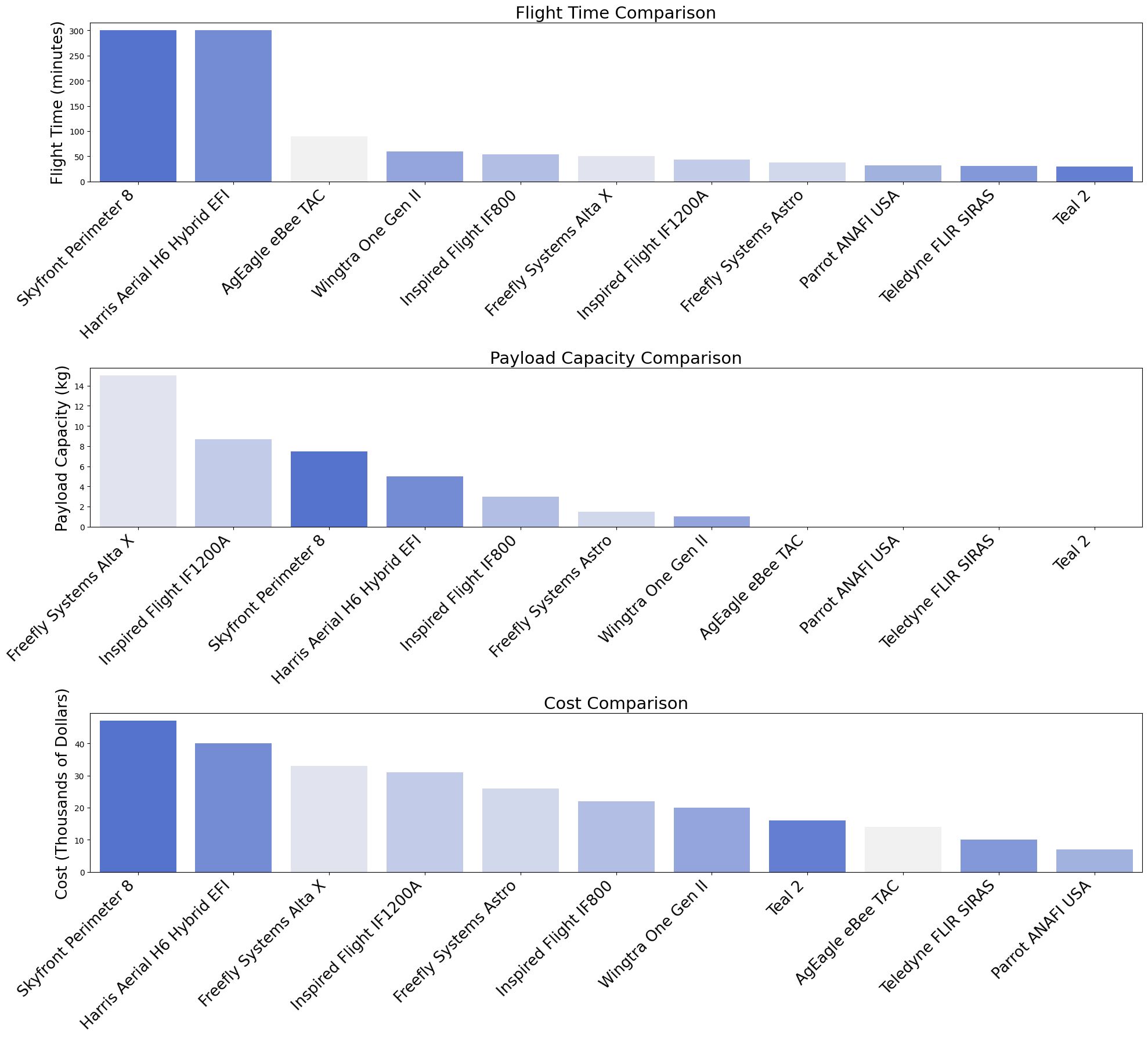
While drones on the DIU Blue UAS Cleared List meet rigorous security, reliability, and NDAA compliance standards, some users have noted that available models may be more limited in features or cost-effectiveness for specific applications such as agriculture. While some drones are not on the Blue List, they may still comply with regulations and are more suitable and well-adapted for agricultural use. Therefore, we evaluated 11 UAV models for agricultural applications, providing specifications (Table 1) for comparison and discussing their advancements and limitations. Finally, we identified the top recommendations in different categories to assist users in selecting the most suitable option based on specific needs (Figure 2).
For Long Flight Duration
Flight duration is a critical factor in agricultural applications because it directly impacts operational efficiency, such as the field area that can be surveyed within an optimal time frame. Among all the UAVs we surveyed, each model claims flight time exceeding 30 minutes without a payload, according to the specifications. However, adding a payload reduces flight duration depending on its weight. If the sensor draws power from the UAV, the flight time decreases even further. Aging batteries can also shorten the effective flight period. These factors must be considered beyond the flight duration stated in the specifications. We list only three models that claim the longest flight durations. However, the Inspired Flight UAVs (i.e., IF1200A and IF800), while not included in the top three list, also offer relatively long flight times and high payload capacity, primarily due to their dual high-capacity battery configurations. Therefore, balancing payload and flight duration is a key consideration when selecting a UAV (Figure 2).
- Harris Aerial H6 Hybrid EFI and Skyfront Perimeter 8: Utilizing hybrid gas-electric propulsion systems to power their rotors, both UAVs offer the longest flight endurance in their class. This makes them particularly well-suited for large-scale field mapping and extended precision agriculture missions. While their reliance on gasoline results in higher operational costs, their exceptional endurance sets them apart in this category. Operating these UAVs does not require any certification beyond the Remote Pilot Certificate under the FAA’s Small UAS Rule (Part 107). However, specialized missions, such as spraying, require additional certification such as Part 137 and the appropriate aerial pesticide applicator licensing.
- AgEagle eBee TAC: As a fixed-wing drone, the AgEagle eBee TAC offers a longer-than-average flight duration but with a limited payload capacity. Its fixed-wing design allows for high-speed flight; however, to ensure the generation of high-quality field maps, a flight plan following a grid pattern is essential. Additionally, because fixed-wing drones struggle to maintain altitude during turns, allowing extra space for turns is recommended for optimal coverage. The eBee TAC can be launched by hand, but a clear, unobstructed landing area is required for a safe touchdown.
- WingtraOne Gen II: The WingtraOne Gen II also provides extended flight duration, making it well-suited for large-scale mapping projects. It is a fixed-wing drone with a unique vertical take-off and landing (VTOL) design, which provides enhanced flexibility.
For High Payload Capacity
With the increasing use of high-end sensors, such as hyperspectral cameras, LiDAR sensors, and multi-sensor arrays, for precision remote sensing, as well as spraying modules for flexible and precise farm management, UAVs must have high payload capacities. We list only three models that claim the highest payload capacity. However, the balance between payload capacity and flight duration must be carefully evaluated. Additionally, installing heavy payload modules requires careful planning because they can disrupt airflow, shift the UAS center of gravity, alter aerodynamics, and pose potential safety risks. Therefore, users should evaluate the potential consequences of flight failure, such as drone crashes and sensor loss, before deployment.
- Freefly Alta X: The Freefly Alta X stands out in this category for its ability to carry large and multiple sensors in a single flight, offering exceptional versatility. Its ActiveBlade technology minimizes flight vibrations, ensuring high-quality data capture for LiDAR and hyperspectral imaging. However, as payload increases, flight duration decreases significantly, making it less ideal for large-scale monitoring or precision agriculture applications.
- Inspired Flight IF1200A: The Inspired Flight IF1200A is a strong contender in the heavy-lift hexacopter category, boasting one of the highest maximum flight speeds among similar drones. Its NDAA compliance makes it particularly attractive for government-funded and regulatory-sensitive projects. However, its base cost is nearly as high as that of the Freefly Alta X, despite offering only half the maximum payload capacity.
- Skyfront Perimeter 8: Although its maximum payload is lower than those of the previous two models, the Skyfront Perimeter 8 offers a significant advantage in flight duration, making it ideal for tasks that require heavy payloads and multiple sensors in a single flight. This extended endurance is achieved through its hybrid power system. However, its fuel and maintenance costs and operational complexity may pose challenges.
For Cost-Effectiveness
High-payload UAVs are generally much more expensive than their lower-payload counterparts. Additionally, the sensors or other payloads used on these UAVs can add significant costs. We highlight three models that may be suitable for beginners or budget-constrained projects. For projects with a limited number of data collection or operational tasks that require high payload capacity or advanced equipment, commercial drone services may offer a more cost-effective solution.
- Parrot ANAFI USA: The Parrot ANAFI USA stands out as a budget-friendly option, offering high-resolution RGB and thermal imaging at a lower cost than high-end UAVs. However, its shorter flight time and lack of additional payload options make it better suited for small-scale field monitoring rather than large-scale applications.
- Teledyne FLIR SIRAS: The Teledyne FLIR SIRAS is also competitively priced. Similar to the Parrot ANAFI USA, it features both RGB and thermal imaging; however, its thermal sensor offers superior performance, enabling more precise temperature variance monitoring and better object tracking (e.g., animals) from higher altitudes. However, it has a short flight time and does not support additional payload options.
- WingtraOne Gen II and Inspired Flight IF800: The WingtraOne Gen II and the Inspired Flight IF800 fall within a similar price range. The WingtraOne offers a longer flight duration due to its fixed-wing design with two motors, while the IF800 supports a higher payload capacity thanks to its four-motor configuration. Both drones accommodate multiple onboard camera options, but only the IF800 allows for gimbal installation.
Credit: Liyike Ji, UF/IFAS
For Deployment and Operability
Ranking the UAVs we surveyed based on ease of deployment and operability is challenging, as that ease largely depends on the complexity of the system. However, three key factors significantly impact deployment and operability.
- Sensor and payload integration: The ease of integrating sensors and payloads is a major factor in UAV deployment. Some drones, such as the Parrot ANAFI USA and Teledyne FLIR SIRAS, do not support external sensors, eliminating the need for integration. AgEagle offers seamless sensor integration with its eBee drones, reducing setup effort for users. Inspired Flight provides plug-and-play sensor and gimbal combinations, but at a higher cost. The Freefly Alta X supports various gimbal sizes, allowing greater flexibility for customization.
- Mission planning and flight control: Mission planning software and flight control hardware vary by brand, but many UAVs utilize ArduPilot as their flight control module. Free mission planning software may lack some advanced features found in paid versions. Additionally, NDAA-compliant flight controllers tend to be more expensive than noncompliant ones. For extended field operations, controllers with larger, anti-glare screens are preferred for better visibility and usability.
- Setup and maintenance: UAV setup plays a crucial role in operability. Foldable arms with propellers enhance safety and space efficiency during transport. Hot-swappable batteries minimize downtime by avoiding the need for a full restart. UAVs equipped with obstacle avoidance systems provide added safety and convenience, reducing the need for constant manual monitoring of potential hazards during flight.
Conclusion
In this article, we discussed Florida’s UAS regulations and their potential impact. We outlined the evolution of these rules and ways they affect UAV applications. While the DIU Blue UAS Cleared List offers several drone options, few are well-suited for agricultural applications, prompting this survey. Additionally, the introduction of the Green UAS certification program has expanded security-vetted drone choices, particularly for commercial and non-Department of Defense (DoD) users, offering a potential alternative for those who do not require immediate DoD approval.
Our findings indicate that compliance with these regulations requires a much higher budget for UAVs and their payloads, along with increased specialization in operational proficiency and sensor integration. Given the variety of operational needs and budgetary constraints, customizing a drone system tailored to specific tasks is often the most effective approach, particularly for specialized agricultural and research applications.
To assist with drone selection under Florida’s evolving rules, we identified top UAS options across key priorities:
- Best for long flight duration: Harris Aerial H6 Hybrid EFI, Skyfront Perimeter 8, AgEagle eBee TAC, and WingtraOne Gen II.
- Best for high payload capacity: Freefly Alta X, Inspired Flight IF1200A, and Skyfront Perimeter 8.
- Best for cost-effectiveness: Parrot ANAFI USA, Teledyne FLIR SIRAS, WingtraOne Gen II, and Inspired Flight IF800.
Evaluating available UAVs, considering both Blue and Green UAS-compliant alternatives, and accounting for all associated costs are crucial steps for meeting Florida’s regulations while optimizing performance. With Florida’s evolving drone laws, preparing for potential expenses and operational adjustments will ensure compliance, maintain efficiency, and provide the flexibility needed for advancing agricultural applications. By carefully selecting the right UAVs and adapting to the changing regulatory landscape, agricultural professionals can continue to benefit from the advancements UAV technology offers.
Table 1. Comparison of UAVs for agricultural applications with prices as of March 2025.
Glossary of Terms and Acronyms Used in This Study
- ActiveBlade: A rotor stabilization technology that allows slight articulation of the blade to reduce vibrations during flight.
- FAA: Federal Aviation Administration. U.S. government agency responsible for regulating civil aviation, including drone (UAV) operations.
- FAA Part 107: U.S. Federal Aviation Administration regulation that governs commercial drone operations (Federal Aviation Administration n.d.-a).
- FAA Part 137: U.S. Federal Aviation Administration regulation that governs the use of aircraft, including drones, to dispense or spray substances (including disinfectants) (Federal Aviation Administration n.d.-b).
- LiDAR: Light Detection and Ranging. A remote sensing method using laser light to measure distances and generate precise 3D models.
- NDAA: National Defense Authorization Act. U.S. legislation that regulates drone procurement based on national security considerations.
- VTOL: A type of aircraft or drone that can take off and land vertically without relying on a runway.
Disclaimer
The information provided in this publication, including the specifications table, is for educational purposes only. The mention of specific brands and models does not constitute an endorsement or recommendation by the authors or their affiliated institutions. This publication is not intended for marketing purposes. For the most current pricing and availability, contact the manufacturers directly.
References
AUVSI. n.d. "Cleared List." AUVSI. Accessed March 19, 2025. https://www.auvsi.org/cleared-list
Defense Innovation Unit. n.d.-a. "Blue UAS Cleared List." Defense Innovation Unit. Accessed March 19, 2025. https://www.diu.mil/blue-uas-cleared-list
Defense Innovation Unit. n.d.-b. "Blue UAS 2.0 Cleared List: Access to a Broader Variety of Capable Unmanned Systems." Defense Innovation Unit. Accessed March 19, 2025. https://www.diu.mil/latest/blue-uas-2-0-cleared-list-access-to-broader-variety-of-capable-unmanned
Federal Aviation Administration. n.d.-a. "Commercial Operators." Federal Aviation Administration. Accessed March 19, 2025. https://www.faa.gov/uas/commercial_operators
Federal Aviation Administration. n.d.-b. "Dispensing Chemicals and Agricultural Products." Federal Aviation Administration. Accessed March 19, 2025. https://www.faa.gov/uas/advanced_operations/dispensing_chemicals
Federal Aviation Administration. n.d.-c. "Drones by the Numbers." Federal Aviation Administration. Accessed March 19, 2025. https://www.faa.gov/node/54496
Florida Department of Management Services. 2023. "Rule: 60GG-2.0075 — Drone Operations." Florida Administrative Code & Florida Administrative Register. Accessed March 19, 2025. https://www.flrules.org/gateway/ruleno.asp?id=60GG-2.0075
Florida Senate. 2021. "Section 934.50 — Search and Seizure Using a Drone." Florida Statutes. Accessed March 19, 2025. https://www.flsenate.gov/laws/statutes/2021/934.50
Tang, D. 2024. "Many Americans Have Come to Rely on Chinese-Made Drones. Now Lawmakers Want to Ban Them." The Associated Press. Accessed March 19, 2025. https://www.ap.org/news-highlights/spotlights/2024/many-americans-have-come-to-rely-on-chinese-made-drones-now-lawmakers-want-to-ban-them/
U.S. House of Representatives. 2024. “Rules Committee Print 118–52: Text of the House Amendment to the Senate Amendment to H.R. 5009; Sec. 1709 of the National Defense Authorization Act (NDAA).” Accessed March 19, 2025. https://www.congress.gov/committee-print/118th-congress/house-committee-print/57838