
Introduction
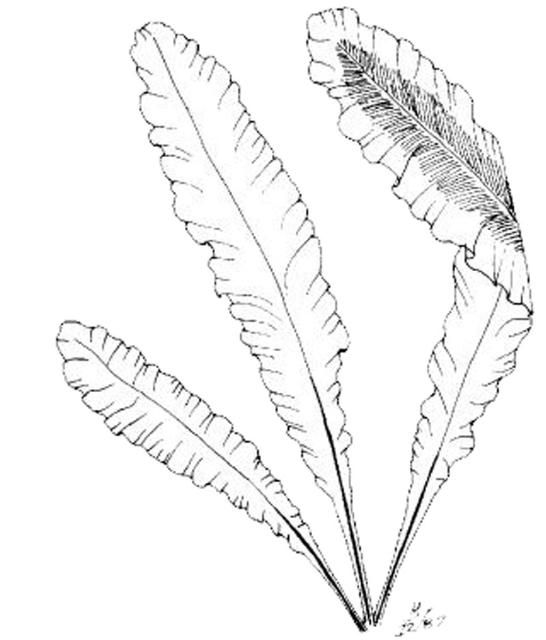
Eventually reaching about four feet tall and wide, bird's nest fern is a striking plant to use as a specimen planting, at entranceways, or in containers where it will always attract attention (Fig. 1). The large, stemless, apple-green leaves have a black, prominent midrib and unfurl from a tight center, giving a bird nest effect. The spores are borne in prominent brown sporophores on the underside of leaves.
General Information
Scientific name: Asplenium nidus
Pronunciation: ass-PLEE-nee-um NYE-dus
Common name(s): bird's nest frern
Family: Polypodiaceae
Plant type: herbaceous; perennial
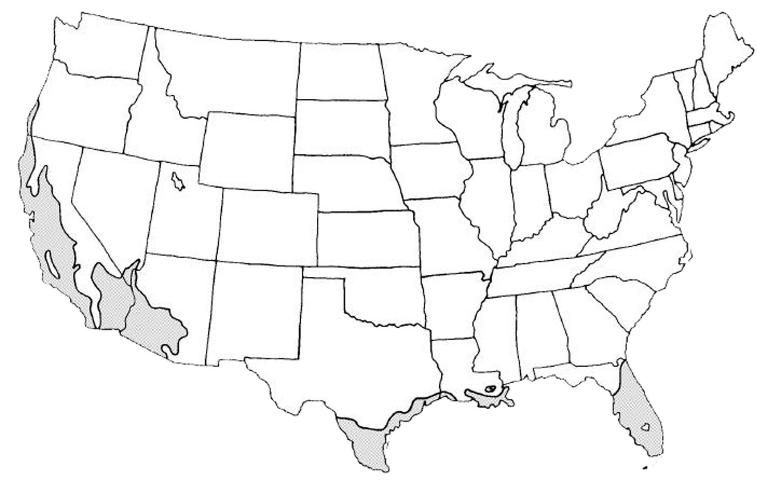
USDA hardiness zones: 9 through 11 (Fig. 2)
Planting month for zone 9: year round
Planting month for zone 10 and 11: year round
Origin: not native to North America
Uses: mass planting; foundation; border; ground cover; edging; suitable for growing indoors
Availability: somewhat available, may have to go out of the region to find the plant
Description
Height: 2 to 4 feet
Spread: 2 to 4 feet
Plant habit: upright; round
Plant density: open
Growth rate: slow
Texture: coarse
Foliage
Leaf arrangement: most emerge from the soil, usually without a stem
Leaf type: simple
Leaf margin: lobed; undulate
Leaf shape: linear
Leaf venation: pinnate
Leaf type and persistence: evergreen
Leaf blade length: more than 36 inches
Leaf color: green
Fall color: no fall color change
Fall characteristic: not showy
Flower
Flower color: no flowers
Flower characteristic: no flowers
Fruit
Fruit shape: no fruit
Fruit length: no fruit
Fruit cover: no fruit
Fruit color: no fruit
Fruit characteristic: no fruit
Trunk and Branches
Trunk/bark/branches: not applicable
Current year stem/twig color: not applicable
Current year stem/twig thickness: not applicable
Culture
Light requirement: plant grows in the shade
Soil tolerances: occasionally wet; clay; sand; acidic; loam
Soil salt tolerances: poor
Plant spacing: 36 to 60 inches
Other
Roots: not applicable
Winter interest: no special winter interest
Outstanding plant: not particularly outstanding
Invasive potential: not known to be invasive
Pest resistance: long-term health usually not affected by pests
Use and Management
Growing in rich, moist soil, bird's nest fern prefers shady locations. Leaves turn yellow and the plant stops growing in the sun. Like many ferns, drought tolerance is minimal. It can also be copper-wired to tree trunks to grow on a fibrous slab. Plant on two to three-foot centers to create a mass planting.
There is a dwarf cultivar which grows to about two feet tall and wide. It is reportedly cold hardy into the lower part of USDA hardiness zone 8b.
Propagation is by spores or from tissue culture.
Pest and Diseases
Problems include foliar nematodes, scale, slugs, and snails.
No diseases are of major concern.